Chola Dynasty: Capital, Founder, Kings, Time Period and History
Chola Dynasty: Capital, Founder, Kings, Time Period and History

Get in Touch with RASonly!

Explore the Chola Dynasty, including its capital, founder, famous kings, time period, and history. Learn about major rulers like Rajaraja Chola I and Rajendra Chola I, their conquests, administration, temple architecture, naval power, and lasting contributions to South Indian history.

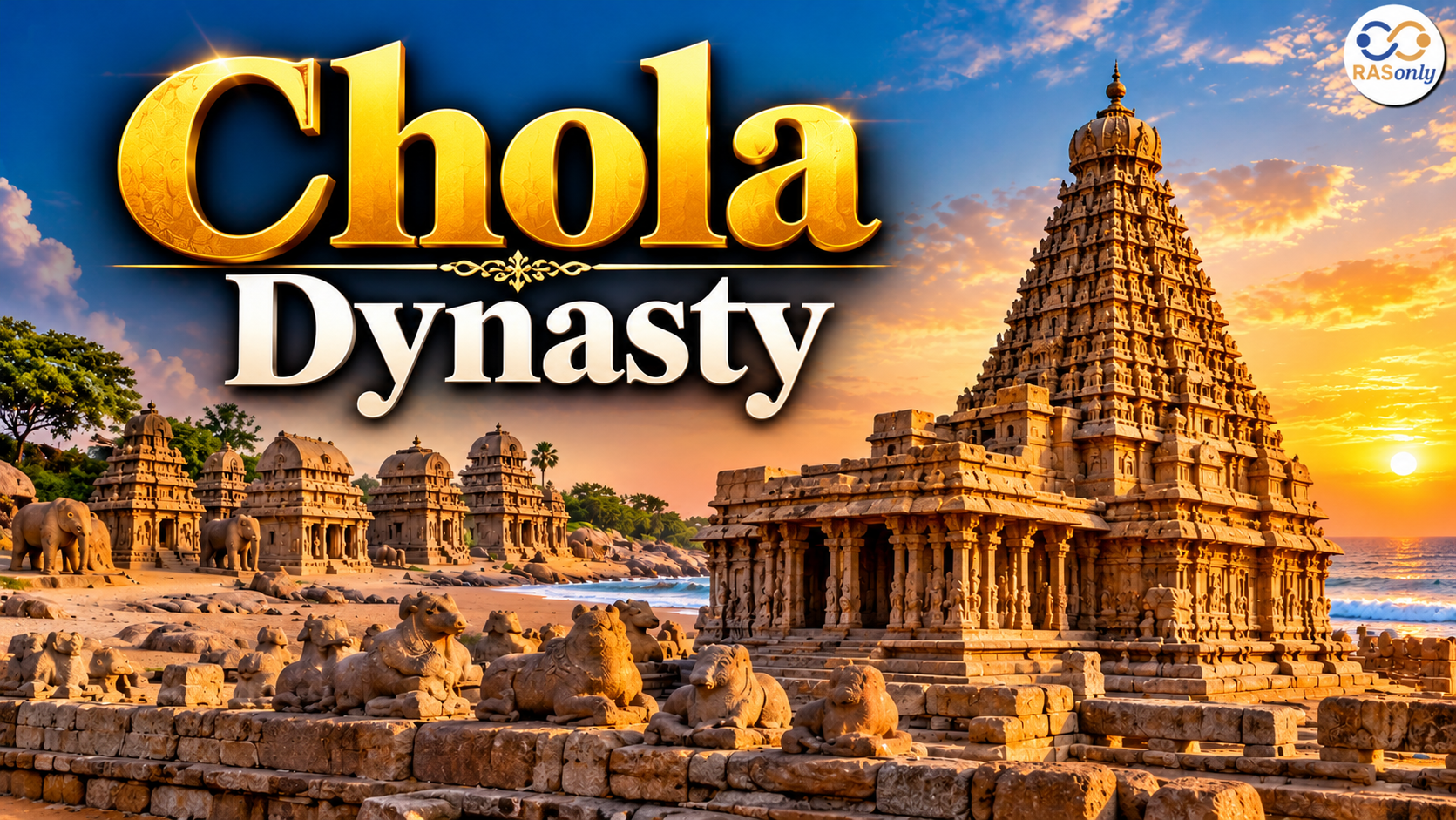
One of the most influential dynasties in the history of South India is the Chola dynasty. It controlled an integral part of present-day Tamil Nadu along with the adjoining areas and is noted to be an important political and maritime power during the medieval era. The Cholas were noted for their sound administration, agricultural improvements, trade in the form of a merchant marine and their exquisite temples. The empire reached throughout South India under rulers like Rajaraja Chola I and Rajendra Chola I, expanding into Sri Lanka and Southeast Asia. During the Chola period, significant advances were made in Tamil literature, the art of bronze sculpture, and in the construction of temples.
Chola Dynasty: Overview
The Cholas were one of the Three Crowned Kings of the Tamilakam states—with the Cheras and Pandyas. They already inhabited the fertile valley of the Kaveri, crucial for agriculture and the economic development of the kingdom, their traditional heartland.
The Cholas had been known in ancient times in both inscriptions and literary sources, which include Tamil literature. But the most well-documented period of their imperial history was in the 9th century A.D., when the Independent Chola king Vijayalaya Chola laid the foundation of the Imperial Chola kingdom.
Rajaraja Chola I and Rajendra Chola I were the period of maximum influence of the Chola Empire. The dynasty came to be a significant part of Indian and Southeast Asian history through military victories, trading at sea, and constructing temples.
Chola Dynasty: Important Facts
|
|
|
|
|
|
|
|
|
|
|
|
|
|
|
|
|
|
|
|
|
|
|
|
|
|
|
|
|
|
|
|
|
|
|
|
|
|
|
|
|
|
|
|
|
|
|
|
Chola Dynasty Origin
The early history of the Chola dynasty can be traced back to the ancient Tamil history. The Southern kingdom of the Cholas is referred in the inscriptions of Ashoka (3rd century BCE) as a kingdom extended beyond the direct governance of the Mauryan Empire. References to Chola rulers are seen in the ancient Tamil literature as well.
The dynasty was linked with the fertile Kaveri belt, where agriculture brought about an increase in population and settlement. The early Chola mythology includes rulers like Karikala Chola and Kocengannan.
The Chola power again came into play in the 9th century CE under Vijayalaya Chola, after a period of decreased importance in politics. A conquest he made was of the city of Thanjavur, which formed the core of the mighty Imperial Chola kingdom.
History of the Chola Dynasty
The prehistory of the Chola Dynasty can be broken down in three phases – the Early Chola period, a period of diminished political influence, the Imperial Cholas and the Later Chola period.
Early Cholas: Sangam Period
The Early Cholas, as a whole, are known only from Sangam literature, inscriptions and later traditions. They reigned over the Kaveri valley and the Tamil regio
The most popular early ruler is Karikala Chola. He is commonly known as the God of the Kallanai or Grand Anicut—a massive ancient irrigation channel of the river Kaveri.
The early Chola centres were Uraiyur and Kaveripattinam, also known as Puhar. Kaveripattinam is a port harbouring maritime trade.
Archaeological evidence shows that there are a number of references to Chola kings, battles, trade and royal patronage in ancient Tamil literature. The records help in the understanding of the earliest history of the dynasty, but some aspects of this history remain hard to substantiate independently.
Chola Interregnum (c. 300–848 CE)
The Chola rulers became much less prominent after the early period. Political upheavals in parts of Tamilakam can often be linked to the Kalabhra period.
The Cholas were not the prevailing ones in the region during this time. In the south, there were some families and chiefs who ruled respective territories.
Details are scant for this period compared to the later period of the Imperial Cholas. The main resurgence of this dynasty started in the 9th century AD with Vijayalaya Chola.
Imperial Cholas (c. 850–1070 CE)
The Imperial Chola kingdom was founded by Vijayalaya Chola, who conquered Thanjavur and built a new political headquarters there.
The descendants of this king increased his kingdom. Aditya I expanded the Chalukyan territory over the Pallavas, while Parantaka I consolidated the Chalukyas in the Tamil region.
Rajaraja Chola I and Rajanendra CholaI increased the power of the Chola empire. Rajendra expanded and initiated a great naval tour in the Southeast Asian region against Srivijaya.
Thanjavur became an imperial town, and Rajendra later founded a new capital at Gangaikonda Cholapuram.
Later Cholas (1070–1279 CE)
Kulottunga Chola was the first Later Chola King. The dynasty retained its traditions of temple promotion, administration and trade in significant sections of South India and continued to dominate these areas.
But the empire slowly came into decline due to wars in different parts of the world and the emergence of stronger rival empires. In southern Tamilnadu the Pandyas grew more and more influential, and the Hoysalas also made their impact on the power balance of the region.
The empire reached its decline in the 13th century C.E.The 13th century C.E. marks a significant decline in Chola power. The most significant of the Imperial Cholas ceased after c. 1279 CE.
Administration of the Chola Dynasty
The Chola Empire was organised through an administrative structure based upon the combination of imperial control, regional administration and local government. Information regarding taxes, land ownership, village assembly organisation, and temple management is available through inscriptions.
Central Administration
The emperor had the absolute authority within the empire. He led the campaign of war, appointed officials and controlled major administrative and religious functions.
In addition to helping the king manage revenue, maintain order and oversee his royal lands, the officials also used written records (and other forms of writing) to record information such as land grants, tax collection, and official actions.
Provincial Administration
The Chola Empire was divided into several territorial units to make administration easier.
|
|
|
|
|
|
|
|
|
|
|
|
|
|
|
|
|
|
|
|
|
Village Self-Government
The village assemblies were the most essential element of the Chola's government system. These assemblies were responsible for the management of all local activities including, but not limited to, irrigation, land management, gardening, and finances.
The Uttaramerur inscriptions provide details regarding how committee members were selected and what type of functions occurred within a village institution.
The Kudavolai system of selecting eligible candidates for some of the village committees is described in the inscriptions. These inscriptions also illustrate who can participate in these committees and show that participation is regulated rather than being open to all residents.
These documents provide important evidence regarding local governance during the Middle Ages in southern India.
Economy of the Chola Dynasty
The Chola economy relied on the production of agricultural products, tax revenue from land ownership, development of various crafts, and trade with other countries. The Kaveri Delta area of southern India was especially important due to the availability of natural resources such as water for farming and the establishment of an extensive network of irrigation systems.
Agriculture and Irrigation
In many parts of the Chola Empire, agriculture was the primary form of employment. Farmers relied heavily on irrigation to help them consistently grow crops like paddy.
The Cholas maintained and developed tanks, canals, and water channels for irrigation. Irrigation was particularly crucial in regions that relied upon the distribution of river water to produce crops.
A significant historical example of how people in the area managed their water resources over a period of many years can be seen at the Kallanai dam, which has been historically linked to King Karikala Chola.
Land Revenue and Taxation
The Chola State relied on land revenue as a primary source of funding. Records of land assessment, taxes owed, gifts given and tax exemptions are found in inscriptions.
Some historical terms associated with revenue and land measurement include:
- Irai: A term associated with taxation, particularly land revenue.
- Eriayam: A levy associated with the maintenance of irrigation tanks in some accounts.
- Kuli, Ma and Veli: Units used in land measurement.
- Puravuvarithinaikkalam: A term associated with the revenue administration.
Trade and Commerce
The Cholas had trade links with Sri Lanka, Southeast Asia, and China. Coastal ports and interior trading centres assisted in the transportation of goods from production areas to foreign markets.
The Cholas were involved in a large amount of maritime commerce, particularly around Kaveripattinam and Nagapattinam. There were numerous merchant organisations that were involved in long-distance trade. Some examples of these organisations include the Ayyavole 500 and Nanadesis.
The trade that occurred within regions and across oceans included textiles, spices, metals, and many other items. Archaeological finds and historical documents show how South India was connected to other parts of the world through trade.
Role of Temples in the Economy
Temples had an active part in the economic system of Chola society. The temples were given land grants and contributions, hired employees and artisans, and planned celebrations and other forms of worship.
Historians use temple inscriptions (which record donations, land deals, resource use) to gain insight into how people lived their lives in terms of religion, farming, jobs, and local economies.
Read About Pallava Dynasty
Chola Dynasty Military
The Chola army assisted in the expansion of the Chola empire, the protection of their territory, and the defense of their political and economic interests. Their army consisted of both land-based troops and a naval force.
Structure of the Army
The Chola military force was comprised of foot soldiers, horse soldiers, and combat elephants. In addition to these forces, inscriptions mention the existence of military units and bodyguards for high-ranking officials.
Important military terms include:
- Kaikkolaperumpadai: A term associated with the royal army.
- Velaikkarar: Soldiers who serve and protect the king.
- Kadagam: A term used by some historians to describe military installations and/or cantonments.
Chola rulers were able to wage wars in both Southern India and other areas due to their military organization. The size of the armies and the types of soldiers used varied during each ruler's reign.
Military Campaigns
Rajaraja Chola I expanded his empire to include some areas of South India and Sri Lanka. His successor Rajendra Chola I continued with the military campaigns and also increased Chola control throughout the Bay of Bengal region.
The Cholas also engaged in warfare against other powerful states within both the Deccan and Tamil areas. This warfare enabled them to grow the size of their empire; however, it required a significant amount of resources, which ultimately made it difficult for future rulers to maintain control over the expanded area.
Chola Dynasty Navy
The Chola Navy played a significant role within the military framework of the Chola Empire, as well as its overall maritime capabilities. The Navy had a variety of functions including supporting overseas military operations, defending coastal areas of interest to the Chola Dynasty, and working collaboratively with the Dynasty's business and trade network.

Naval Expansion under Rajaraja Chola I
Rajaraja Chola I increased the Chola's presence on the coast of Southern India and also extended their reach to some areas of Sri Lanka and the Maldives. Through their use of maritime power, the empire was able to maintain control over key shipping lanes.
Rajendra Chola I's Naval Expedition
In 1025 AD, Rajendra Chola I conducted an extensive naval operation against the maritime network of Srivijaya located in Southeast Asia.
The campaign had as targets many ports and centres that were tied to Srivijaya. Some of these included areas in the history of the region such as Palembang, Kedah and Tambralinga.
The expedition proved that the Cholas had a very large area where they could send their armies to fight, which included the entire Bay of Bengal. But although the Cholas were able to conquer parts of Southeast Asia during this time, they never established control over the entire region for any significant amount of time.
Importance of the Chola Navy
The Cholas' Navy enhanced the dynasty's overseas trade & Political Influence. The Cholas' Navy allowed for Expeditions Away From Their Heartland, as well as increasing the Bonds Between The Coromandel Coast & Southeast Asian Ports.
During the time that the Cholas expanded their influence, the Bay of Bengal served as an area where trade and government could interact.
Art and Culture of the Chola Dynasty
The Cholas were known primarily for their architecture (temples), sculpture (bronze statues), and their contribution to Tamil religion and literature. The royalty and the temple organisations provided financial support for the works of architects, sculptors, metalworkers and writers.
Chola Temple Architecture
The Chola Dynasty commissioned great stone temples that were both centres of worship and expressions of imperial power.
The Brihadisvara Temple, located in Thanjavur, was built by Rajaraja Chola I between approximately 1000 AD and 1010 AD. The temple is dedicated to Shiva. This temple is famous for being one of the largest temples ever constructed using stone. It is also famous for having a large tower, for having inscriptions on it, and for being highly detailed with sculptures.
Gangaikondacholisvaram Temple: Built under orders of Rajendra Chola I, the temple continues the Chola tradition of constructing large temples.
The Airavatesvara Temple in Darasuram was built by Rajaraja Chola II. It is well-known for the fine details of the stone carvings and the extensive architecture of the stone.
These three temples have been designated by UNESCO as a World Heritage Site called the "Great Living Chola Temples."
Bronze Sculptures
The most recognised achievement in South Indian art is Chola bronze sculpture. The artisans of this period were able to produce highly detailed sculptures through the use of the "lost-wax" casting process. These sculptures were created for the purpose of being used during religious ceremonies and other events.
The image of Shiva as Nataraja (the Lord of the Dance) is arguably one of the best-known images of Chola bronze sculpture. They are highly regarded for their well-proportioned forms, intricate detailing, and dynamic motion.
Tamil Literature
The Chola era was a time of growth for Tamil literature and devotion-based writings. One of the most significant works of the Shaiva literary tradition is the Periyapuranam, written by Sekkizhar in the twelfth century.
The preservation and development of the devotional hymns of the Nayanmar was another significant aspect of the period's religious and literary life.
Religion
The patronage of kings allowed for the development of Shaivite architecture with the building of many Shiva temples. Vaishnavism was still an active force during this time, and the Jains and Buddhists were part of the larger religious history of South India.
In this way, the Chola era reflects a vibrant religious and creative culture, regardless of whether certain kings and institutions supported specific religious beliefs and practices.
Chola Dynasty Foreign Relations
The Chola dynasty was able to establish both political and commercial relations with other parts of the world outside of South India. Their overseas influences were formed through diplomacy, maritime trade, and military campaigns.
Relations with Sri Lanka
The Chola Empire was led by two rulers who conducted military operations in Sri Lanka. These leaders were Rajaraja Chola I and Rajendra Chola I. While the Cholas had a level of control over much of Sri Lanka, there was also a great deal of opposition to their rule. The Chola Empire continued to exert control over parts of Sri Lanka, but this was always subject to change.
Sri Lanka was significant as a result of its geographical position on shipping lanes that connected the Indian Subcontinent with different trade areas.
Relations with Southeast Asia
The Cholas made their way to regions that were part of the Srivijayan maritime network in what is now modern-day Indonesia and the Malaysian Peninsula.
The 1025 CE expedition of Rajendra Chola I was particularly significant because it showed that the Chola Navy had the capability of hitting key overseas port cities.
Tamil merchants were active participants in trading throughout Southeast Asia, which helped to establish and maintain commercial and cultural relationships.
Relations with China
The Cholas established and maintained diplomatic and business relations with China, which included interactions with the Song Dynasty that are documented within historical records.
These interactions were a portion of the larger maritime trading network that linked the Coromandel Coast to East and Southeast Asia.

BEST SELLER
🏆 PRELIMS
RAS Pass
Prelims focused Hindi & English
₹399
✓
Prelims Topic-Wise Tests
✓
Subject-Wise Tests
✓
Full-Length Prelims Tests
✓
Daily Current Affairs Tests
✓
Prelims PYQs Tests
✓
Detailed Solutions & Analysis
✓
All Rajasthan Ranking
✓
Unlimited Reattempts
✓
Mains Tests
✓
Hindi & English Tests
✓
All Rajasthan Ranking
Trusted by 5,000+ Students
Post Category
- RAS Salary
- Result
- RAS Admit Card
- RAS Job
- RAS Cutoff
- Preparation Tips
- RAS Answer Key
- RAS Exam Analysis
- RAS Syllabus
- RAS Previous Year Papers
- RPSC RAS Exam Pattern
- RAS Interview
- RAS Exam Date
- RAS Vacancy
- RAS Test Series
- RAS Best Books
- RAS Preparation Resources
- RAS Coaching Centre
- History
- Polity
- Geography
- Economics
- Science
- Art and Culture
- RPSC RAS Application Form
- RPSC RAS Notification
- RAS Eligibility Criteria
- UPSC Exam
- RPSC RAS Mains
Visit Our RASonly Offline Center
Our Expert Faculty

Bhunesh Sir
Current Affairs · 13+ Yrs

Aamir Khan Sir
RAS-2017 · IIM Ahm.
Akash Sir
Polity · 8+ Yrs
Free Resources
Official Mobile App

RASOnly App
by OTSAdda · Free
Full Video Lectures
Mock Tests & PYQs
Daily Current Affairs
AI Mock Interview
Free Download · No subscription needed to install
RAS 2024 Toppers — RASonly
Rank 2
Virendra Charan
Rank 9
Bhoopinder Singh
Rank 26
Aanchal Nagpal
Rank 33
Lokendra Singh
Rank 45
Amar Rathore
Rank 46
Manasvini Verma

Join RASonly WhatsApp Community
Get daily current affairs, exam alerts, free study material and tips from expert faculty — right on WhatsApp.
Join for Free →RASonly Interview Guidance Program

Mr. Ashok Jain
Ex-Chief Secretary Govt of Rajasthan
- IAS officer of the 1981 batch, Rajasthan cadre.
- Passionate about mentoring the next generation of RAS officers with real-world insights.
- Got retired in Dec 2017 from the post of Chief Secretary of the state of Rajasthan.

Mr. Guru Charan Rai
Ex-ASP / SP in Jaisalmer
- Guru Charan Rai, IPS (Retd), retired as Inspector General of Police (Security), Rajasthan, Jaipur in 2017.
- Served as ASP and SP in Jaisalmer, Nagaur, Sri Ganganagar, Sawai Madhopur, Dausa, Sikar, and Karauli.
- He also held key positions as DIGP and IGP in the Law and Order division.

Mr. Rakesh Verma
Ex-IAS Officer, B.Tech, MBA, and M.A. (Economics)
- IAS officer of the 1981 batch and retired in Chief Secretary Rank.
- Civil servant of high repute and vast experience.
- Has been teaching UPSC CSE subjects for the last six years.
Related Post
Daily Current Affairs for RAS Exam Preparation 2026
Abhaneri Festival 2026
October 12, 2026
CAZRI Moth Bean Varieties Withstand 35-Day Dry Spell 2026
October 12, 2026
Public Pledge Against Drug Abuse
October 10, 2026