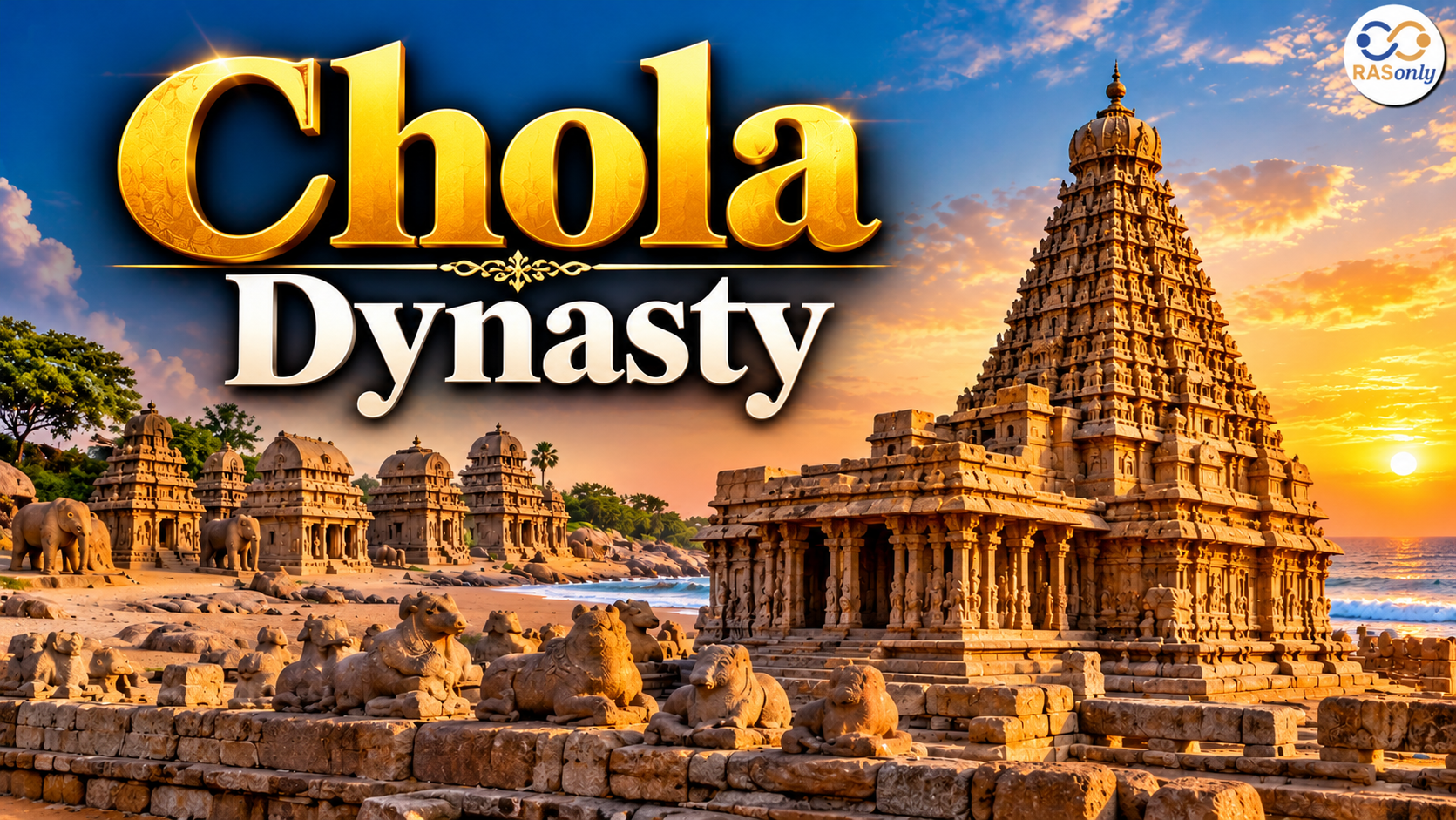
Chola Dynasty: Capital, Founder, Kings, Time Period and History
Buddhism, History, Key Texts, and Councils, Temple of Buddha in India

Get in Touch with RASonly!



Buddhism is one of the great ancient Indian religions and philosophies of India. It is based on the teachings of Gautama Buddha, who taught a practical method to understand suffering.
Buddha's teachings were created in the Indian subcontinent between the 6th–5th centuries BCE and then spread throughout Asia. Buddhist philosophy, literature, art, architecture and education were influenced by Buddhist concepts in India. Stupas, viharas and rock-cut caves became characteristic features of Buddhist architecture, and monasteries and learning centres suddenly became an important institution in the Buddhist world.
Buddhism, as well as its history, is intricately linked to the followers of Gautama Buddha, the Four Noble Truths, the Noble Eightfold Path, Buddhist Councils, Tripitaka and the evolution of Theravada, Mahayana and Vajrayana.
Gautama Buddha
- Buddha is also known as Sakyamuni and Tathagata.
- He was originally called Siddhartha Gautama.
- He was of the Shakya tribe.
- His father was Suddhodana, a traditional leader/chief of the Shakya clan/republic.
- His mother was Maya (Mahamaya).
- Buddha was born at Lumbini, near Kapilavastu, in present-day Nepal.
- It is believed that he was born on Vaishakha Purnima.
- Naturally, Buddha's birth, enlightenment and Mahaparinirvana are all traditionally celebrated on the Vaishakha Purnima, though there is a variety of historical dating of his life.
Early Life of Siddhartha
- Siddhartha's childhood spent was in the Shakya region.
- He was brought up in a life of comfort and luxury.
- Siddhartha married Yashodhara.
- They had a son, Rahula.
- Siddhartha, although living a privileged life, was troubled by the big issues that confronted human existence.
- He was led on a pilgrimage to see the Four Sights; they were:
- Old man
- Sick person
- Dead person
- Ascetic
- These experiences convinced Siddhartha that there were issues of old age, sickness, death and suffering.
Great Renunciation
- At about age 29, Siddhartha abandoned his palace and family life to seek truth and liberation.
- This occasion is called the Great Renunciation (Mahabhinishkramana).
- Siddhartha went to find teachers and learned various methods of spiritual practice.
- He practised extreme asceticism in his life at first.
- Later, he realised that extreme physical hardship was no way to free oneself.
- He consequently embraced the theory of the Middle Way.
Enlightenment of Buddha
- Siddhartha sat under the Bodhi Tree at Bodh Gaya
- At about age 35, he attained enlightenment.
- After enlightenment, Siddhartha was called “the Enlightened One” or Buddha.
- The place is now connected to the Mahabodhi Temple Complex at Bodh Gaya.
- One of the most significant events in the life of Buddha is his enlightenment.
First Sermon of Buddha
- When Buddha became enlightened, he visited Sarnath, near the city of Varanasi today.
- He preached the first sermon at the Deer Park at Sarnath.
- Such an event is called Dharmachakra Pravartana or the Turning of the Dharma Chakra.
- The Four Noble Truths and the Middle Way were the first teachings given by the Buddha.
- The first disciples were the initial monks in the Buddhist Sangha.
Mahaparinirvana
- After realising his full enlightenment, the Buddha roamed and taught his Dhamma for the remaining period of his life.
- He wanted to travel to various regions in the Gangetic plain.
- He won over the support of people from every class.
- The time of Buddha's Mahaparinirvana took place at what is called Kushinagar, at the age of about 80 years.
- Therefore, Kushinagar is one of the significant places of pilgrimage for Buddhists.
Four Major Events in Buddha's Life
| Event | Place |
|---|---|
| Birth | Lumbini |
| Enlightenment | Bodh Gaya |
| First Sermon | Sarnath |
| Mahaparinirvana | Kushinagar |
Four Noble Truths
The Four Noble Truths are the basis of Buddhist Philosophy.
1. Dukkha
- An unsatisfactoriness, dissatisfaction or suffering is ‘dukkha '.
- According to the Buddha, human life is a life of suffering, in which there are various depths of suffering.
- Suffering has been linked to things which happen at birth, ageing or sickness, death, separation and attachment.
2. Samudaya
- Samudaya is the source of suffering, the source of the cause of suffering.
- The desire of craving (Tanha) is recognised as one of the primary causes for suffering.
- Tied up by attachment and desire, the cycle of suffering continues.
3. Nirodha
- The meaning of nirodha is the end of suffering.
- When we are rid of craving, we are rid of suffering, Buddha said.
4. Magga
- The meaning of Magga is "the path to an end of suffering.
- The road that is this is the Noble Eightfold Path.
Noble Eightfold Path
The Noble Eightfold Path is the path that Buddha taught that is used to lift oneself out of suffering.
Wisdom (Prajna)
- Right View
- Right Intention
Ethical Conduct (Sila)
- Right Speech
- Right Action
- Right Livelihood
Mental Discipline (Samadhi)
- Right Effort
- Right Mindfulness
- Right Concentration
Important Buddhist Teachings
Karma
- Karma is the willful acts and the results thereof.
- In Buddhist philosophy, deeds have consequences and link people into the cycle of life.
Nirvana
- Nirvana is the state of relief from desire, delusion and suffering.
- It means the end of those things that fuel the cycle of suffering.
Anicca
- Anicca means impermanence.
- It says that all things under conditions are ever-changing.
Anatta
- Anatta means non-self.
- In Buddhism, there is no belief in a permanent and fixed sense of self.
Pratityasamutpada
- Dependent Origination is the path of all arising affairs that is Pratityasamutpada.
- Describes how phenomena occur when interconnected phenomena occur.
Ahimsa and Compassion
- Buddhist teachings are focused on Non-violence, care, and Kindness.
- In the Buddhist moral context, the term ‘compassion for sentient beings' is significant.
Buddhist Sangha
- The term Sangha refers to the monastic or Buddhist community.
- Buddha formed a well-organised group of nuns and monks.
- Sangha was very significant in maintaining and disseminating Buddhist doctrines.
- Traditionally, Buddhist monks abide by rules relating to:
- Conduct
- Discipline
- Food
- Clothing
- Monastic life
- Interaction with society
- Education and intellectual dialogue.
Buddhist Texts
The Buddhist texts have grown and evolved and vary by Buddhist tradition.
Tripitaka
The Three Baskets are also known as Tripitaka or Tipitaka.
This is the most important collection of the Theravada tradition.
It consists of:
- Vinaya Pitaka
- Sutta Pitaka
- Abhidhamma Pitaka
Vinaya Pitaka
- The main content of the Vinaya Pitaka is monastic discipline.
- Contains rules of living for monks and nuns.
- It gives details of the structure and operations of the Sangha.
Sutta Pitaka
- Sutta Pitaka is a collection of the Buddha's teachings and discourses and the teachings of his disciples.
- It is a significant manuscript in relation to early Buddhist teachings.
- The Dhammapada is part of the Khuddaka Nikaya of the Pali Canon's Sutta Pitaka.
Abhidhamma Pitaka
- The Abhidhamma is a Pitaka of systematic and analytical analysis of Buddhist teachings.
- It covers all topics concerning the mind, mental activities, phenomena and Buddhist philosophy.
Other Important Buddhist Literature
Dhammapada
- Dhammapada, a popular Buddhist saying.
- It is a part of the Khuddaka Nikaya of the Pali Canon.
- It has instructions about moral behaviour, sagacity and intelligence.
Jataka Tales
- The Jataka Stories cover the stories in previous lives of Buddha.
- They have morals and ethics in them.
- The Jataka tales also give clues on certain elements of Indian society and culture of the ancient age.
Mahayana Buddhist Texts
Some of Mahayana Buddhism's ancillary works grew up.
Important examples include:
- Lotus Sutra
- Heart Sutra
- Diamond Sutra
- Prajnaparamita literature
Buddhist Councils
| Buddhist Council | Time | Place | Chairman / Presiding Monk | Ruler / Patron | Significance |
|---|---|---|---|---|---|
| 1st Buddhist Council | c. 483 BCE | Rajagriha (Rajgir), Bihar – Saptaparni Cave | Mahakassapa | Ajatashatru | Buddha's teachings were preserved through oral recitation. Ananda recited Sutta Pitaka and Upali recited Vinaya Pitaka. |
| 2nd Buddhist Council | c. 383 BCE | Vaishali, Bihar | Sabbakami | Kalashoka | Dispute over Vinaya rules. It eventually led to the first major split between Sthaviras and Mahasanghikas. |
| 3rd Buddhist Council | c. 250 BCE | Pataliputra, Bihar | Moggaliputta Tissa | Emperor Ashoka | Sangha was purified; Abhidhamma Pitaka is traditionally associated with this council. Buddhist missionaries were sent to different regions. |
| 4th Buddhist Council | 1st–2nd century CE | Kundalavana, Kashmir | Vasumitra | Kanishka I | Buddhist teachings were systematised and commentaries were prepared. It is traditionally associated with the development of Mahayana and Sarvastivada traditions. |
Major Schools of Buddhism
Buddhism gradually split into a number of major traditions.
Theravada
Theravada is the teaching of the Elders.
Maintains an elaborate collection of the Pali.
The Pali Canon has been central to the tradition.
Theravada is particularly predominant in:
- Sri Lanka
- Myanmar
- Thailand
- Cambodia
- Laos
Mahayana
“Great Vehicle” is the meaning of Mahayana.
Bodhisattva is an integral aspect of Mahayana Buddhism.
A Bodhisattva strives to attain Enlightenment while doing what is best for the benefit of others and for their liberation.
It became influential in:
- China
- Korea
- Japan
- Vietnam
Vajrayana
Vajrayana evolved special tantric and esoteric practices.
It came in especially strongly in:
- Tibet
- Bhutan
- Mongolia
- Himalayan regions
It is very much linked with Tibetan Buddhist traditions.
Buddhist Art and Architecture
Buddhism made a major contribution to Indian art and architecture.
The following architectural features are significant in the world of the buddhists:
- Stupa
- Chaitya
- Vihara
- Rock-cut caves
- Monasteries
- Buddha images
- Bodhisattva sculptures
- Buddhist paintings
Stupa
Buddhist memorial monument called a stupa.
Buddhist relics or remembrance were connected to stupas.
The Sanchi Stupa is one of the most famous Buddhist stupas in India.
Elements of important architecture may be found in the design of the Buddhist stupa, including:
- Anda
- Harmika
- Chhatra
- Vedika
- Torana
Vihara
A Vihara, a Buddhist monastery or the monastic residence, was an institution.
Viharas were important centres for:
- Education
- Meditation
- Religious practice
- Intellectual discussion
Chaitya
- Chaitya was a place of Buddhist prayer or worship.
- In the Chaitya halls, a stupa had been built in most of the cases.
- The Western Ghats and the Deccan region are the important spots where the rock-cut architecture of Buddhism can be seen.
Buddhist Art Schools
Gandhara School
- This can be explained by the fact that it is mostly developed in the north west of Indian Sub Continent.
- It was inspired by the Hellenistic and Central Asian styles.
- In Buddha images, human features and drapery are oftentimes depicted realistically.
- Grey schist was commonly used.
Mathura School
- The city of Mathura in Northern India is the origin of these.
- It was predominantly made of red sandstone.
- It acquired its unique style of images of Buddhas and Bodhisattvas of India.
- Gandhara and Mathura were both significant at the process of anthropomorphic representation of Buddha.
Important Buddhist Symbols
Dharmachakra
- Dharmachakra, also called the Wheel of Dharma, is the number one symbol of the Buddha's teachings.
- It is particularly associated with Buddha's first sermon at Sarnath.
Bodhi Tree
- The Bodhi Tree symbolises Buddha's Enlightenment.
- Meditating under a Bodhi Tree, Buddha achieved enlightenment at the place of Bodh Gaya.
Lotus
- In Buddhist art, the Lotus is used extensively.
- It is associated with purity and spiritual development.
Stupa
- The Stupa embodies Buddhist sacred memory, primarily, or it is related to relics.
- The list of the most recognised Buddhist Temples and sites in India.
Famous Buddhist Temples and Sites in India
Mahabodhi Temple, Bodh Gaya
- Located in Bihar.
- The place to which it is associated is where Buddha attained enlightenment.
- The Mahabodhi Temple Complex is one of the World Heritage Sites.
- It is one of the most important Buddhist pilgrimage centres in the world.
Sarnath
- Near Varanasi in Uttar Pradesh.
- It is here that Buddha gave his first hand down sermon.
- Significant monuments: Dhamek Stupa.
- Sarnath is a holy place for Buddhists.
Kushinagar
- The city is in the Uttar Pradesh region.
- It is generally believed to be the site where Buddha was able to achieve Mahaparinirvana.
- Mahaparinirvana Temple: It is an important Buddhist pilgrimage place.
Sanchi
- It is situated in Madhya Pradesh.
- Famous for its Buddhist stupas, monasteries and gateways.
- These Buddhist monuments of Sanchi are on the UNESCO World Heritage List.
Ajanta Caves
- Located in Maharashtra.
- Valuable Buddhist paintings, sculptures and rock-cut architecture are found in the caves.
- Ajanta is part of the UNESCO World Heritage list.
- The paintings are of great value as evidence of ancient Indian Buddhist Art.
Nalanda
- Located in Bihar.
- Nalanda grew into a great Buddhist monastery and education centre.
- It became a place which was attractive to scholars and students from all over Asia.
- The archaeological site of Nalanda Mahavihara is one of the UNESCO World Heritage Sites.
Tawang Monastery
- Located in Arunachal Pradesh.
- It is one of the prominent monasteries of Buddhism in India.
- It's part of the Tibetan Buddhist tradition.
Rumtek Monastery
- Located in Sikkim.
- It is an important centre of Tibetan Buddhism.
- It is related to the transmission of the Karma-Kyungtajapa lineage.
Buddhism in Rajasthan
- There are also significant archaeological finds in Rajasthan related to Buddhism.
- Viratnagar (Bairat) in Rajasthan is of great importance for the Mauryan period in India.
- Bairat is related to the edict of Ashoka of Bhabru.
- The Bhabru Edict is significant in understanding Ashoka's tie-up with Buddhist teachings.
- Polished ruins at Bairat have remained as proof of the existence of the Buddha in the area after the ancient period.
FAQs on Buddhism
-
Gautama Buddha, originally known as Siddhartha Gautama, was the founder and principal teacher of Buddhism.
-
He taught the path to overcome suffering through wisdom, ethical conduct and mental discipline.
-
Gautama Buddha was born at Lumbini, near Kapilavastu, in present-day Nepal.
-
Lumbini is recognised as one of the major Buddhist pilgrimage sites.
-
Buddha attained enlightenment at Bodh Gaya in Bihar.
-
He meditated under the Bodhi Tree before attaining enlightenment.
-
Buddha delivered his first sermon at Sarnath, near Varanasi in Uttar Pradesh.
-
His first sermon is known as Dharmachakra Pravartana, or the Turning of the Wheel of Dharma.
-
Buddha attained Mahaparinirvana at Kushinagar in Uttar Pradesh.
-
Kushinagar is one of the most important Buddhist pilgrimage centres.

BEST SELLER
🏆 PRELIMS
RAS Pass
Prelims focused Hindi & English
₹399
✓
Prelims Topic-Wise Tests
✓
Subject-Wise Tests
✓
Full-Length Prelims Tests
✓
Daily Current Affairs Tests
✓
Prelims PYQs Tests
✓
Detailed Solutions & Analysis
✓
All Rajasthan Ranking
✓
Unlimited Reattempts
✓
Mains Tests
✓
Hindi & English Tests
✓
All Rajasthan Ranking
Trusted by 5,000+ Students
Post Category
- RAS Salary
- Result
- RAS Admit Card
- RAS Job
- RAS Cutoff
- Preparation Tips
- RAS Answer Key
- RAS Exam Analysis
- RAS Syllabus
- RAS Previous Year Papers
- RPSC RAS Exam Pattern
- RAS Interview
- RAS Exam Date
- RAS Vacancy
- RAS Test Series
- RAS Best Books
- RAS Preparation Resources
- RAS Coaching Centre
- History
- Polity
- Geography
- Economics
- Science
- Art and Culture
- RPSC RAS Application Form
- RPSC RAS Notification
- RAS Eligibility Criteria
- UPSC Exam
- RPSC RAS Mains
Visit Our RASonly Offline Center
Our Expert Faculty

Bhunesh Sir
Current Affairs · 13+ Yrs

Aamir Khan Sir
RAS-2017 · IIM Ahm.
Akash Sir
Polity · 8+ Yrs
Free Resources
Official Mobile App

RASOnly App
by OTSAdda · Free
Full Video Lectures
Mock Tests & PYQs
Daily Current Affairs
AI Mock Interview
Free Download · No subscription needed to install
RAS 2024 Toppers — RASonly
Rank 2
Virendra Charan
Rank 9
Bhoopinder Singh
Rank 26
Aanchal Nagpal
Rank 33
Lokendra Singh
Rank 45
Amar Rathore
Rank 46
Manasvini Verma

Join RASonly WhatsApp Community
Get daily current affairs, exam alerts, free study material and tips from expert faculty — right on WhatsApp.
Join for Free →RASonly Interview Guidance Program

Mr. Ashok Jain
Ex-Chief Secretary Govt of Rajasthan
- IAS officer of the 1981 batch, Rajasthan cadre.
- Passionate about mentoring the next generation of RAS officers with real-world insights.
- Got retired in Dec 2017 from the post of Chief Secretary of the state of Rajasthan.

Mr. Guru Charan Rai
Ex-ASP / SP in Jaisalmer
- Guru Charan Rai, IPS (Retd), retired as Inspector General of Police (Security), Rajasthan, Jaipur in 2017.
- Served as ASP and SP in Jaisalmer, Nagaur, Sri Ganganagar, Sawai Madhopur, Dausa, Sikar, and Karauli.
- He also held key positions as DIGP and IGP in the Law and Order division.

Mr. Rakesh Verma
Ex-IAS Officer, B.Tech, MBA, and M.A. (Economics)
- IAS officer of the 1981 batch and retired in Chief Secretary Rank.
- Civil servant of high repute and vast experience.
- Has been teaching UPSC CSE subjects for the last six years.
Related Post
Daily Current Affairs for RAS Exam Preparation 2026

Kundan Art Display in Hong Kong
October 23, 2026
Rajasthan International Folk Festival 2026
October 23, 2026
Inauguration of 100 New Kalika Patrolling Units in Rajasthan
October 21, 2026