Chola Dynasty: Capital, Founder, Kings, Time Period and History
Indian Polity Topic-wise Questions for RAS 2026 (Prelims & Mains) | MCQs & Complete Preparation

Get in Touch with RASonly!

Practice Indian Polity topic-wise questions for RAS 2026 with important MCQs and concept-based coverage. This helps you build clarity, improve accuracy, and understand frequently asked topics. Stay consistent with revision and practice to perform better in the RAS exam.

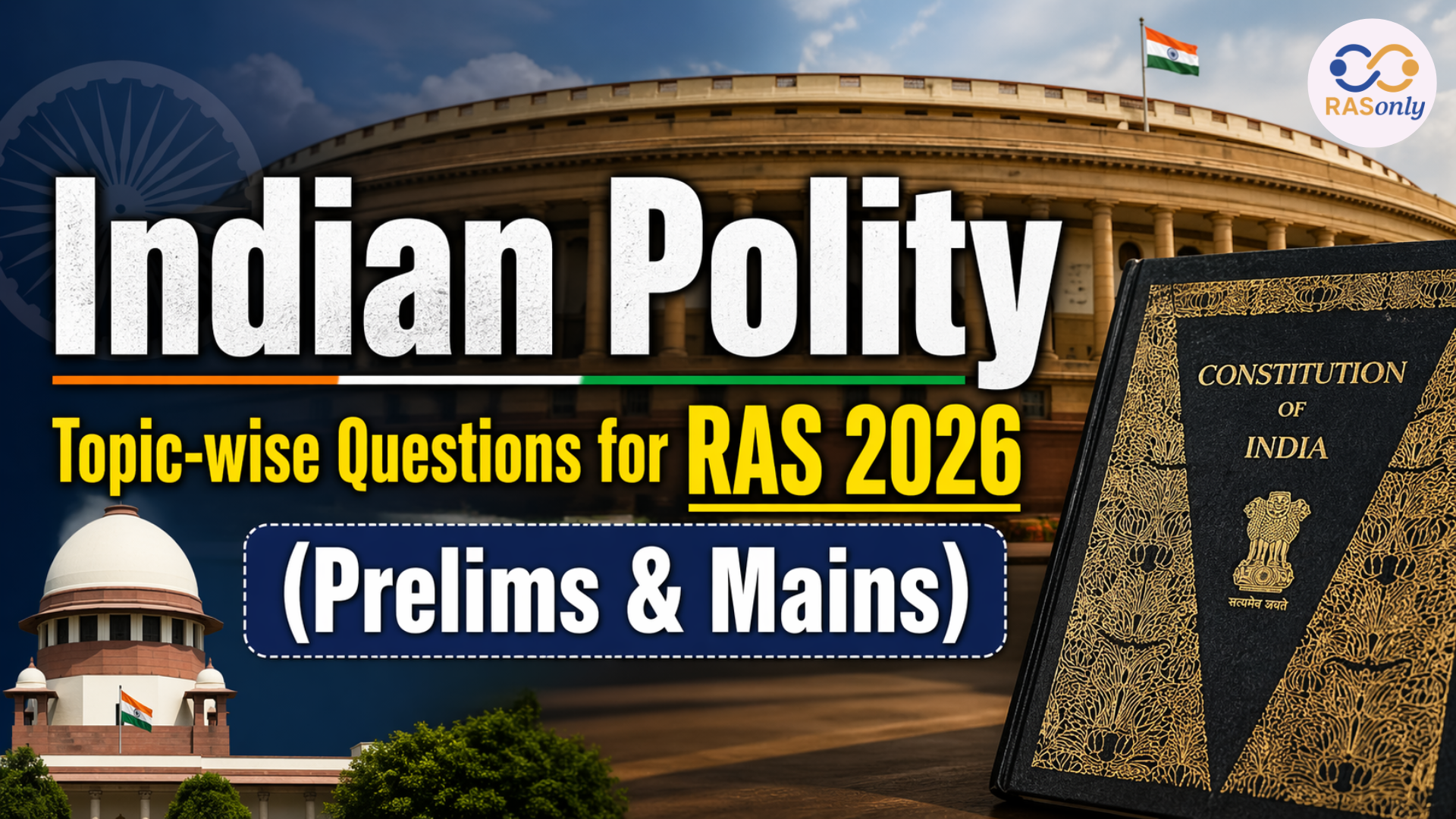
Indian Polity is among the most important topics for RAS 2026 and contributes significantly to Prelims and Mains. It describes the functioning of the Constitution, the process of lawmaking, and the operation of the government on various levels. This subject is very important as subjects such as Fundamental Rights, Parliament, President, and Judiciary are frequently examined in the exam. The topic-wise questions on
Indian Polity and the RAS Polity MCQs are topics that you can practice and in the process, develop good concept clarity and prevent confusion on similar topics.
Studying Indian Polity in a systematic manner makes it easier to comprehend and remember. By solving RAS Polity MCQs and PYQs, you can identify the question patterns, increase your speed and accuracy, and gain confidence. This is beneficial for both the Prelims and the RAS Mains answer writing.
Why Indian Polity is Important for RAS 2026
Indian Polity is one of those subjects in which you can score well if you understand the concepts. Rather than being a subject that needs to be memorised, Polity is more of a conceptual subject.
If your basics are strong, you can solve most questions quickly and accurately. It is also one of the few subjects that directly helps in both objective and descriptive exams.
Key Reasons to Focus on Polity
- High weightage in both Prelims and Mains
- Concept-based and predictable questions
- Helps in answer writing
- Static subject (doesn’t change much)
Important Areas Frequently Asked
- Constitution of India
- Fundamental Rights & Duties
- Directive Principles (DPSP)
- Parliament and law-making
- President, Prime Minister
- Judiciary
Indian Polity Syllabus for RAS 2026 (Detailed Breakdown)
Knowing the syllabus will help you avoid distractions. Indian Polity deals with the constitutional, political and administrative structure of the country.
Core Topics Covered
| Topic | Key Areas |
|---|---|
| Constitution | Features, sources |
| Fundamental Rights | Articles 12–35 |
| DPSP | Articles 36–51 |
| Executive | President, PM |
| Parliament | Lok Sabha, Rajya Sabha |
| Judiciary | Supreme Court, High Court |
| Federal System | Centre-State relations |
| Amendments | Important amendments |
Important Articles for RAS 2026 (Must Revise)
The Indian Constitution's Important Articles are an important component of Indian Polity and are often asked in RAS exams. A lot of questions are direct and based on the article number, so knowing these articles will help you answer the questions fast and correctly. Knowing these important articles also boosts your confidence in solving RAS Polity MCQs.
Instead of trying to memorize everything at once, focus on understanding the basic idea behind each article and revise them repeatedly. This approach makes it easier to retain information and avoid confusion in the exam.
Important Articles List
| Article | Topic |
|---|---|
| 12–35 | Fundamental Rights |
| 36–51 | DPSP |
| 52 | President |
| 74 | Council of Ministers |
| 79 | Parliament |
| 124 | Supreme Court |
| 368 | Constitutional Amendment |
Detailed Topic-wise Coverage
Preparing Indian Polity topic-wise helps you understand concepts clearly and avoid confusion between similar topics. This approach makes revision easier and improves your performance in both RAS Polity MCQs and descriptive answers in Mains.
Key Topics & Focus Areas
| Topic | What to Focus On |
|---|---|
| Constitution of India | Features, sources, structure, important provisions |
| Fundamental Rights | Articles, types of rights, key features |
| DPSP | Principles, importance, differences from Fundamental Rights |
| Union Executive | President, PM, powers and functions |
| Parliament | Structure, law-making process, Lok Sabha & Rajya Sabha |
| Judiciary | Supreme Court, judicial review, independence |
| Federal System | Centre-State relations, distribution of powers |
Constitution of India
The Constitution is the foundation of Indian governance and one of the most important topics for RAS 2026. Questions are usually asked about its features, sources, and overall structure, so having a clear basic understanding is essential.
Fundamental Rights
Fundamental Rights ensure equality and freedom to citizens and are frequently asked in exams. Focus on articles, types of rights, and their practical application.
Directive Principles of State Policy (DPSP)
DPSPs guide the government in policy-making and are important for conceptual clarity. Questions often compare DPSPs with Fundamental Rights.
Union Executive
Union Executive includes the President, Prime Minister, and Council of Ministers. Focus on their roles, powers, and how the executive functions in practice.
Parliament of India
Parliament is responsible for law-making, making it a high-weightage topic. Understanding the structure and functioning of both houses is important.
Judiciary
The Judiciary protects the Constitution and ensures justice. Topics like judicial review and independence of the judiciary are frequently asked.
Federal System
This explains how power is divided between the Centre and States. Questions are often conceptual, so clarity is important here.
Most Important Topics for RAS 2026 (High Priority)
If you're running out of time or need to quickly revise, it's crucial to know the most frequent topics in the RAS exam. In the Indian Polity section, some topics are asked year after year, and it's important to understand these well to score maximum marks. By revising and practising multiple-choice questions (MCQs), you can cover a significant part of the syllabus and get more marks in the exam.
Focus on These Important Areas:
- Fundamental Rights (concepts + important articles)
- Key Constitutional Articles
- Parliament and Executive (structure and functions)
- Judiciary (structure and powers)
- Constitutional Amendments
Indian Polity MCQs for RAS 2026
Solving Indian Polity MCQs is an excellent way to boost your preparation for RAS 2026. Polity questions are both conceptual and factual, so topic-wise MCQs help you get an idea of how the questions are asked and what you need to focus on.
When you practice RAS Polity MCQs along with PYQs, you not only improve your accuracy but also build speed and confidence. This approach makes revision more effective and helps you perform better in the actual exam.
Indian Polity Quiz
Q1. The Constitution of India came into force on:
Q2. Fundamental Rights are mentioned in:
Q3. DPSP is included in:
Q4.Who is the constitutional head of India?
Q5.Article 52 deals with:
Q6. Lok Sabha is:
Q7. Rajya Sabha is:
Q8. Article 368 is related to:
Q9. Supreme Court is established under:
Q10.Council of Ministers is responsible to:
Q11. Directive Principles are:
Q12. Minimum age for Lok Sabha member:
Q13. Who appoints the Prime Minister?
Q14. Judicial Review is related to:
Q15. Parliament consists of:
Q16. President holds office for:/h3>
Q17. Fundamental Duties are in:
Q18. High Court is established under:
Q19. Governor is appointed by:
Q20. Indian Constitution is:
Common Mistakes to Avoid
Indian Polity might be easy to study, but many students miss marks due to minor errors. It is not due to lack of effort, but lack of understanding. By avoiding these mistakes, you can improve your score and accuracy in RAS Polity MCQs.
Avoid these mistakes:
- Memorising articles without understanding the concept
- Confusing Fundamental Rights with DPSP
- Ignoring PYQs during preparation
- Reading theory without practising MCQs
How to Prepare Indian Polity for RAS 2026
Indian Polity becomes much easier when you focus on understanding how the system works instead of just memorising facts. A clear concept-based approach helps you solve questions quickly and accurately in the exam.
Follow this approach:
- Build strong clarity of basic concepts
- Revise important articles regularly
- Practice MCQs consistently
- Analyze PYQs to understand question patterns
Final Strategy for RAS 2026
Indian Polity can become one of your strongest subjects if you stay consistent with your preparation. Focus on concept clarity, regular revision, and enough practice to build confidence and accuracy for both Prelims and Mains.
Conclusion
Indian Polity is a very scoring and consistent subject for RAS 2026 if you study it properly. By studying the important topics such as Fundamental Rights, important articles, Parliament and Judiciary and solving Indian Polity MCQs, you can develop good conceptual clarity and accuracy.
With a systematic plan of revision, PYQ analysis and topic-wise practice, you will be able to maintain confidence and score well in both Prelims and Mains. Indian Polity can be a scoring subject in the RAS exam with the right approach.
FAQs - Indian Polity for RAS 2026
Yes, it is one of the most important subjects with high weightage in both Prelims and Mains.
Focus on concept clarity, revise important articles, and practice MCQs regularly along with PYQs.
Both types are asked, but most questions can be solved easily if your concepts are clear.
You should practice at least 20–30 MCQs daily to improve accuracy and speed.
Fundamental Rights, important articles, Parliament, Executive, and Judiciary are the most important topics.
BEST SELLER
🏆 PRELIMS
RAS Pass
Prelims focused Hindi & English
₹399
✓
Prelims Topic-Wise Tests
✓
Subject-Wise Tests
✓
Full-Length Prelims Tests
✓
Daily Current Affairs Tests
✓
Prelims PYQs Tests
✓
Detailed Solutions & Analysis
✓
All Rajasthan Ranking
✓
Unlimited Reattempts
✓
Mains Tests
✓
Hindi & English Tests
✓
All Rajasthan Ranking
Trusted by 5,000+ Students
Post Category
- RAS Salary
- Result
- RAS Admit Card
- RAS Job
- RAS Cutoff
- Preparation Tips
- RAS Answer Key
- RAS Exam Analysis
- RAS Syllabus
- RAS Previous Year Papers
- RPSC RAS Exam Pattern
- RAS Interview
- RAS Exam Date
- RAS Vacancy
- RAS Test Series
- RAS Best Books
- RAS Preparation Resources
- RAS Coaching Centre
- History
- Polity
- Geography
- Economics
- Science
- Art and Culture
- RPSC RAS Application Form
- RPSC RAS Notification
- RAS Eligibility Criteria
- UPSC Exam
- RPSC RAS Mains
Visit Our RASonly Offline Center
Our Expert Faculty

Bhunesh Sir
Current Affairs · 13+ Yrs

Aamir Khan Sir
RAS-2017 · IIM Ahm.

Akash Sir
Polity · 8+ Yrs
Free Resources
Official Mobile App

RASOnly App
by OTSAdda · Free
Full Video Lectures
Mock Tests & PYQs
Daily Current Affairs
AI Mock Interview
Free Download · No subscription needed to install
RAS 2024 Toppers — RASonly
Rank 2
Virendra Charan
Rank 9
Bhoopinder Singh
Rank 26
Aanchal Nagpal
Rank 33
Lokendra Singh
Rank 45
Amar Rathore
Rank 46
Manasvini Verma

Join RASonly WhatsApp Community
Get daily current affairs, exam alerts, free study material and tips from expert faculty — right on WhatsApp.
Join for Free →RASonly Interview Guidance Program

Mr. Ashok Jain
Ex-Chief Secretary Govt of Rajasthan
- IAS officer of the 1981 batch, Rajasthan cadre.
- Passionate about mentoring the next generation of RAS officers with real-world insights.
- Got retired in Dec 2017 from the post of Chief Secretary of the state of Rajasthan.

Mr. Guru Charan Rai
Ex-ASP / SP in Jaisalmer
- Guru Charan Rai, IPS (Retd), retired as Inspector General of Police (Security), Rajasthan, Jaipur in 2017.
- Served as ASP and SP in Jaisalmer, Nagaur, Sri Ganganagar, Sawai Madhopur, Dausa, Sikar, and Karauli.
- He also held key positions as DIGP and IGP in the Law and Order division.

Mr. Rakesh Verma
Ex-IAS Officer, B.Tech, MBA, and M.A. (Economics)
- IAS officer of the 1981 batch and retired in Chief Secretary Rank.
- Civil servant of high repute and vast experience.
- Has been teaching UPSC CSE subjects for the last six years.
Related Post
Daily Current Affairs for RAS Exam Preparation 2026

Kundan Art Display in Hong Kong
October 23, 2026
Rajasthan International Folk Festival 2026
October 23, 2026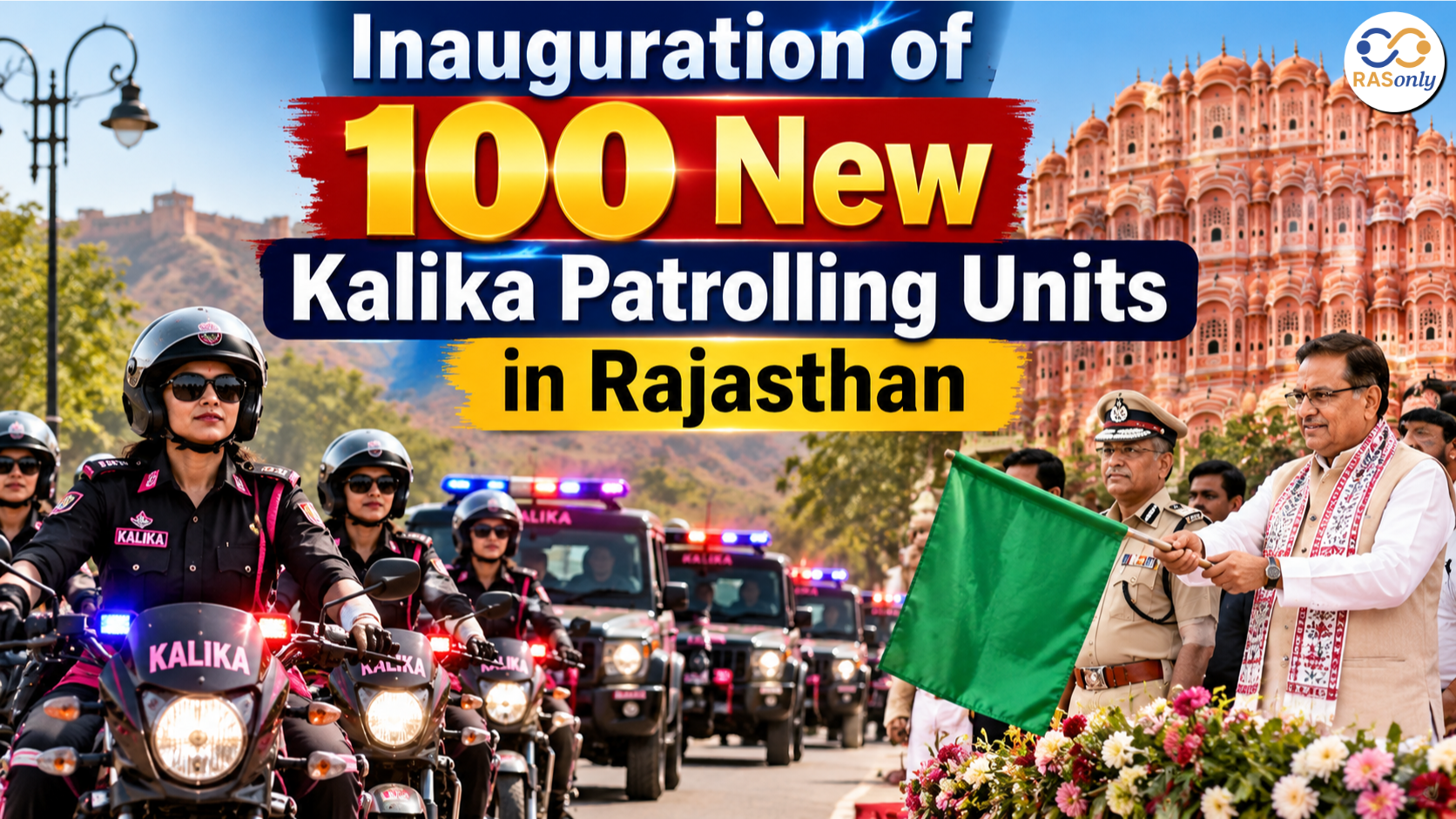
Inauguration of 100 New Kalika Patrolling Units in Rajasthan
October 21, 2026