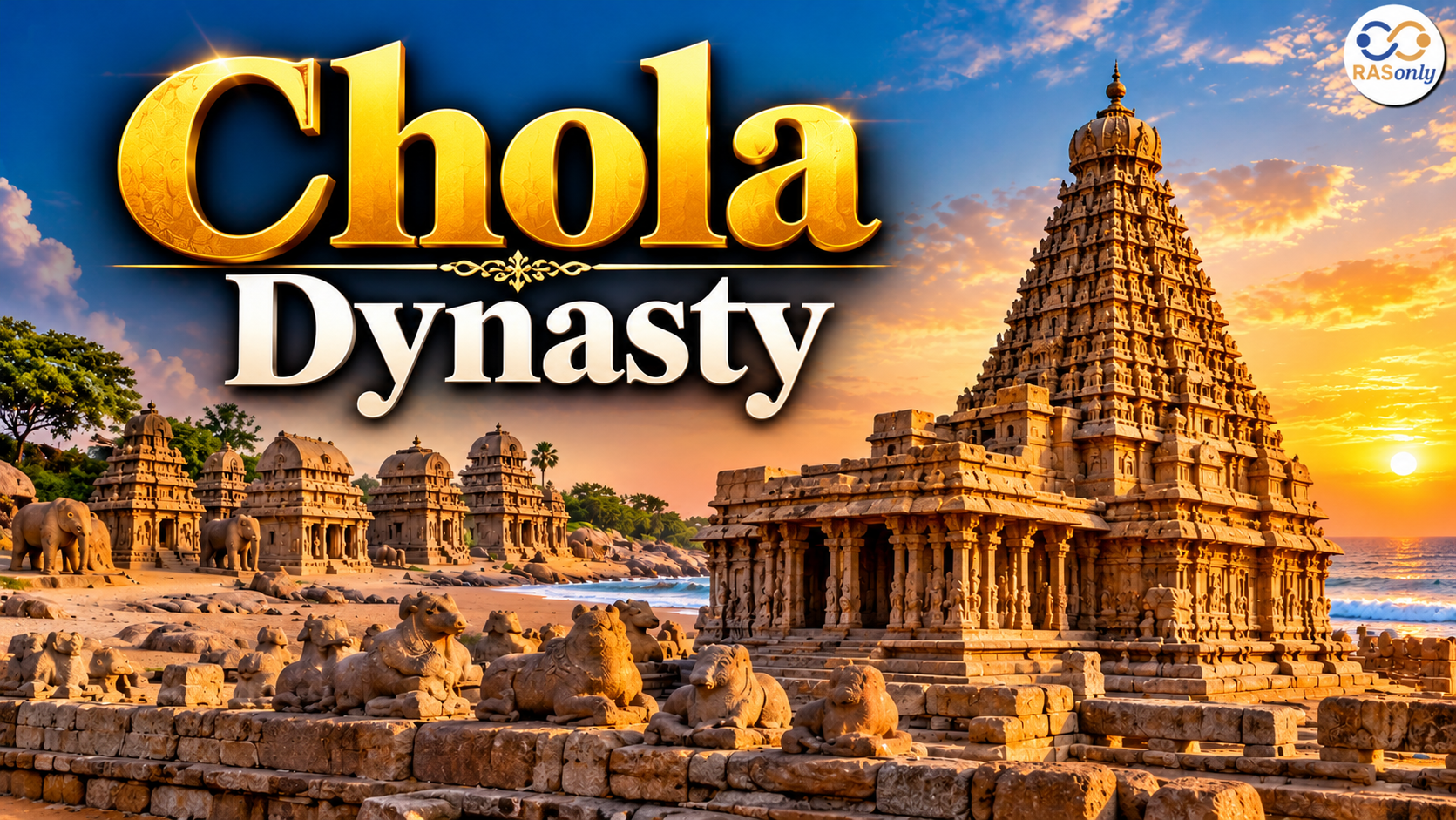
Chola Dynasty: Capital, Founder, Kings, Time Period and History
Comptroller and Auditor General of India (CAG)

Get in Touch with RASonly!

The Comptroller and Auditor General of India (CAG) is an independent constitutional authority responsible for auditing the accounts and expenditures of the Central and State Governments. Established under Articles 148–151 of the Constitution, the CAG acts as the guardian of public finances, ensuring transparency, accountability, and financial discipline. Appointed by the President, the CAG audits government funds, public sector organizations, and grants, and submits reports to Parliament and State Legislatures. As a key pillar of democratic governance, the CAG strengthens oversight, upholds constitutional values, and safeguards public resources.


The Comptroller and Auditor General of India (CAG), a constitutional body, stands as a bulwark of financial oversight and accountability. By serving as the guardian of the public purse, it safeguards the interests of the citizens and upholds the principles of good governance. This article of NEXT IAS aims to study in detail the Comptroller and Auditor General of India (CAG), including its constitutional mandate, composition, powers, functions, challenges faced by it, and other related aspects.
List of Comptroller & Auditor General of India
| List of Comptroller & Auditor General of India | Term |
|---|---|
| V. Narahari Rao | 1948 - 1954 |
| A.K Chanda | 1954 - 1960 |
| A.K Roy | 1960 - 1966 |
| S. Ranganathan | 1966 - 1972 |
| A. Bakshi | 1972 - 1978 |
| Gian Prakash | 1978 - 1984 |
| T.N Chaturvedi | 1984 - 1990 |
| C.G Somiah | 1990 - 1996 |
| V.K Shunglu | 1996 – 2002 |
| V. N. Kaul | 2002 – 2008 |
| Vinod Rai | 2008 – 2013 |
| Shashi Kant Sharma | 2013 – 2017 |
| Rajiv Mehrishi | 2017 – Aug 2020 |
| Girish Chandra Murmu | Present |
About the Comptroller and Auditor General of India (CAG)
- The Comptroller and Auditor General (CAG) is an independent service that is created by the Constitution of India to audit the reimbursements and expenditures of the Central Government, State Governments, and other organizations that are funded by the Government.
- Being established directly under the Constitution provisions, it is a Constitutional Body.
- The CAG is an All-India body in that it regulates the whole financial system of the country at the Central and the State level.
- The CAG is the president of the Indian Audit and Accounts department; he is the custodian of the public purse.
Constitutional Provisions related to the Comptroller and Auditor General of India (CAG)
Article 148 to Article 151 of the Constitution of India deal with the provisions related to the Comptroller and Auditor General of India (CAG).
| Article No. | Subject Matter |
|---|---|
| Article 148 | Comptroller and Auditor-General of India |
| Article 149 | Duties and powers of the Comptroller and Auditor-General (CAG) |
| Article 150 | Form of accounts of the Union and the States |
| Article 151 | Audit Reports |
Appointment of the Comptroller and Auditor General of India (CAG)
The Comptroller and Auditor General of India (CAG) is appointed by the President of India. The appointment is made through a warrant under the President’s hand and seal, which signifies the constitutional importance and independence of the office.
The Constitution does not specify qualifications, allowing the executive full discretion in selecting the CAG.
Oath and Affirmations of the Comptroller and Auditor General of India (CAG)
Prior to taking over his/her officer, the Comptroller and Auditor General of India (CAG) makes and subscribes to an oath or affirmation before the President of India:
- to bear true faith and allegiance to the Constitution of India,
- to uphold the sovereignty and integrity of India,
- to duly and faithfully and to the best of his ability, knowledge, and judgment perform the duties of his office without fear or favor, affection or ill-will,
- to uphold the Constitution and the laws.
Term of Comptroller and Auditor General of India (CAG)
As per the Comptroller and Auditor General of India (Duties, Powers, and Conditions of Service) Act of 1971, the CAG holds office for 6 years or up to the age of 65 years, whichever is earlier.
Resignation of Comptroller and Auditor General of India (CAG)
The Comptroller and Auditor General of India (CAG) can resign at any time from his office by addressing the resignation letter to the President of India.
Removal of CAG
The Comptroller and Auditor General of India (CAG) can be removed by the President of India on the same grounds and in the same manner as a judge of the Supreme Court. Thus, he/she can be removed by the President based on a resolution passed to that effect by both Houses of Parliament with a special majority, either on the grounds of proved misbehavior or incapacity.
Roles and Duties of CAG
- To uphold the Constitution of India and the laws of Parliament in the field of financial administration.
- This is the reason, that B.R. Ambedkar has called the CAG as one of the most important officers under the Constitution of India.
- The CAG has been envisaged as one of the four bulwarks of the democratic system of Government.
- To secure the accountability of the Executive to the Parliament in the sphere of financial administration through its audit reports.
- It acts as an agent of Parliament and conducts audits of expenditures on behalf of the Parliament.
- Therefore, he/she is responsible only to the Parliament.
Functions of Comptroller and Auditor General of India (CAG)
Constitutional Provisions
The Constitution of India has prescribed the following functions for the CAG:
| Article No. | Description |
|---|---|
| Article 150 | He advises the President with regard to the prescription of the form in which the accounts of the Centre and the States shall be kept. |
| Article 151 | He submits audit reports relating to the accounts of the Centre to the President, who shall place them before both Houses of Parliament. |
| Article 151 | He submits audit reports relating to the accounts of a State to the Governor, who shall place them before the State Legislature. |
| Article 279 | He ascertains and certifies the net proceeds of any tax or duty. CAG’s certificate in this regard is final. |
Legal Provisions
The Constitution of India in Article 149 grants the Parliament the power to declare the responsibilities and the authority of the Comptroller and Auditor General of India (CAG). The Parliament, therefore, passed the Comptroller and Auditor General of India (Duties, powers and conditions of service) act of 1971.
The roles of the Comptroller and Auditor General of India (CAG) as it is stipulated in the act are as follows:
- He/she audits accounts pertaining to all expenditures of the Consolidated Fund of India, Consolidated Fund of each State and Consolidated Fund of each UT with Legislative Assembly.
- He/she verifies all the transactions involving the Contingency Fund of India and Public Account of India and also Contingency Fund of each State and Public Account of each State.
- He/she audits all the trading, manufacturing, profit and loss accounts, balance sheets and all other subsidiary accounts maintained by any department of the Central Government and the State Governments.
- He/she controls the receipts and expenses of every body and authority, which are largely funded on the Central or State revenues.
- He/she controls the records of all entities and organizations that obtain grants and loans provided by the Central and State Governments to execute certain projects.
- He/she reviews all the Centre and States receipts, and makes sure that the rules and procedures in that matter are structured to provide an efficient control on the assessment, collection, and appropriate distribution of revenue.
- He/she audits the records of all stores and stock maintained in all the offices and departments of Central and State Governments.
- He/she reviews the account of all Government Companies according to the Companies Act.
- He/she audits the accounts of all the Corporations whose statutes have a provision of audit by him.
- He/she reviews the accounts of any other body/ authority when requested by the President or Governor.
- As an example, he/she can be requested to perform an audit of local bodies.
- He/she is a mentor, companion and philosopher of the Public Accounts Committee of the Parliament.
- He/she prepares and keeps the records of the State Governments.
- The CAG also used to prepare and maintain the accounts of Central Government before 1976. But in 1976, he/she was no longer charged with this responsibility as a result of separation of accounts and audit.
Conclusion
CAG is one of the pillars of the Indian system of both democratic and financial governance. CAG, being an independent constitutional body, promotes transparency, accountability, and legal utilisation of the public funds by auditing the Union, States, and government-funded organisations. Through its reports, the Parliament and State Legislatures are able to check on the executive and bring about financial discipline at all government levels. The CAG is vital in strengthening the confidence of the populace in the government institutions and ensuring good governance in India by protecting the Indian populace through efficient administration.
BEST SELLER
🏆 PRELIMS
RAS Pass
Prelims focused Hindi & English
₹399
✓
Prelims Topic-Wise Tests
✓
Subject-Wise Tests
✓
Full-Length Prelims Tests
✓
Daily Current Affairs Tests
✓
Prelims PYQs Tests
✓
Detailed Solutions & Analysis
✓
All Rajasthan Ranking
✓
Unlimited Reattempts
✓
Mains Tests
✓
Hindi & English Tests
✓
All Rajasthan Ranking
Trusted by 5,000+ Students
Post Category
- RAS Salary
- Result
- RAS Admit Card
- RAS Job
- RAS Cutoff
- Preparation Tips
- RAS Answer Key
- RAS Exam Analysis
- RAS Syllabus
- RAS Previous Year Papers
- RPSC RAS Exam Pattern
- RAS Interview
- RAS Exam Date
- RAS Vacancy
- RAS Test Series
- RAS Best Books
- RAS Preparation Resources
- RAS Coaching Centre
- History
- Polity
- Geography
- Economics
- Science
- Art and Culture
- RPSC RAS Application Form
- RPSC RAS Notification
- RAS Eligibility Criteria
- UPSC Exam
- RPSC RAS Mains
Visit Our RASonly Offline Center
Our Expert Faculty

Bhunesh Sir
Current Affairs · 13+ Yrs

Aamir Khan Sir
RAS-2017 · IIM Ahm.

Akash Sir
Polity · 8+ Yrs
Free Resources
Official Mobile App

RASOnly App
by OTSAdda · Free
Full Video Lectures
Mock Tests & PYQs
Daily Current Affairs
AI Mock Interview
Free Download · No subscription needed to install
RAS 2024 Toppers — RASonly
Rank 2
Virendra Charan
Rank 9
Bhoopinder Singh
Rank 26
Aanchal Nagpal
Rank 33
Lokendra Singh
Rank 45
Amar Rathore
Rank 46
Manasvini Verma

Join RASonly WhatsApp Community
Get daily current affairs, exam alerts, free study material and tips from expert faculty — right on WhatsApp.
Join for Free →RASonly Interview Guidance Program

Mr. Ashok Jain
Ex-Chief Secretary Govt of Rajasthan
- IAS officer of the 1981 batch, Rajasthan cadre.
- Passionate about mentoring the next generation of RAS officers with real-world insights.
- Got retired in Dec 2017 from the post of Chief Secretary of the state of Rajasthan.

Mr. Guru Charan Rai
Ex-ASP / SP in Jaisalmer
- Guru Charan Rai, IPS (Retd), retired as Inspector General of Police (Security), Rajasthan, Jaipur in 2017.
- Served as ASP and SP in Jaisalmer, Nagaur, Sri Ganganagar, Sawai Madhopur, Dausa, Sikar, and Karauli.
- He also held key positions as DIGP and IGP in the Law and Order division.

Mr. Rakesh Verma
Ex-IAS Officer, B.Tech, MBA, and M.A. (Economics)
- IAS officer of the 1981 batch and retired in Chief Secretary Rank.
- Civil servant of high repute and vast experience.
- Has been teaching UPSC CSE subjects for the last six years.
Related Post


Daily Current Affairs for RAS Exam Preparation 2026

9th Rashtriya Poshan Maah 2026
October 16, 2026
Seva Sankalp, Khadi Mahotsav 2026
October 16, 2026
Conclusion of Multinational Exercise Tarang Shakti 2.0
October 15, 2026