Chola Dynasty: Capital, Founder, Kings, Time Period and History
RAS Preparation After 12th: Complete Roadmap 2026

Get in Touch with RASonly!

Start your RAS preparation after 12th with a clear roadmap covering eligibility, subjects, NCERTs, current affairs, answer writing, and a four-year graduation plan. Build strong fundamentals, prepare consistently, and manage college studies alongside your RAS preparation effectively.

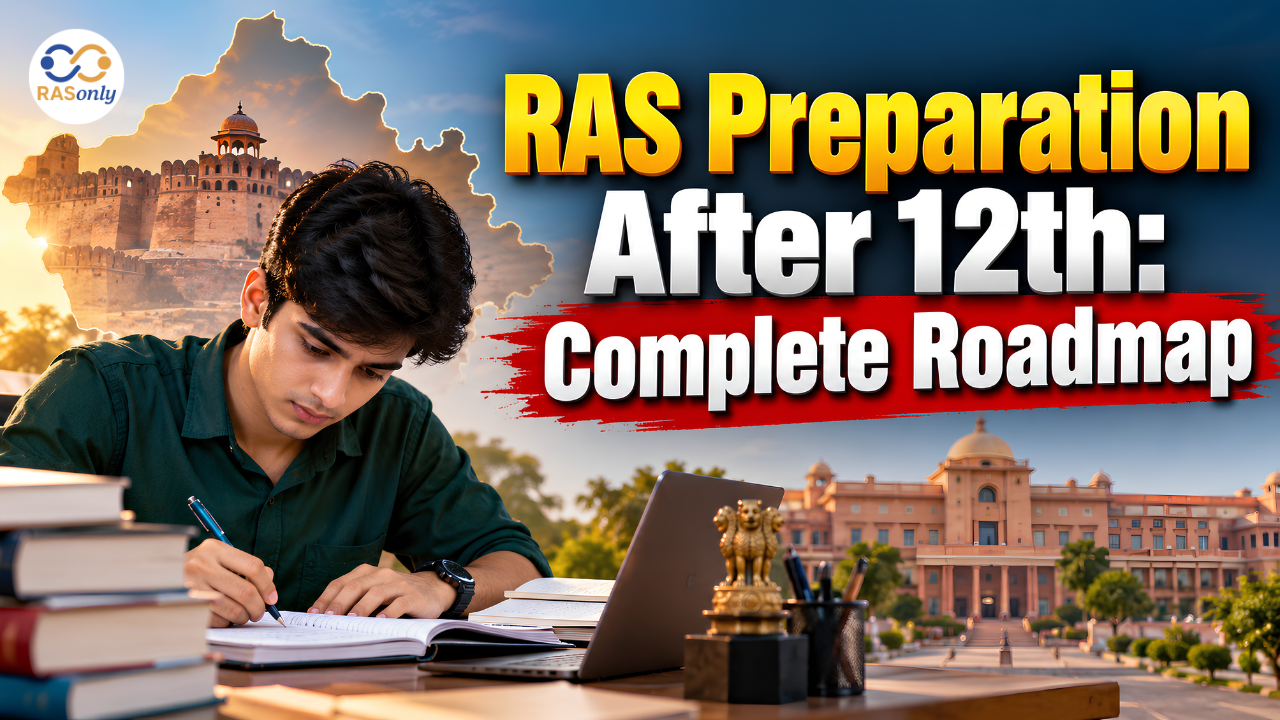
RAS preparation after 12th is one of the smartest decisions a student can make if they dream of joining the Rajasthan Administrative Service. The Rajasthan Public Service Commission (RPSC) conducts the exam, which opens the door to key administrative roles in the state government. Although a graduation degree is mandatory to apply, nothing stops you from understanding the syllabus and building your basics earlier.
Students who begin early get three to four years to cover the syllabus in stages instead of rushing at the end. This guide explains the eligibility rules, the exam pattern, the subjects to focus on, and a practical year-wise plan. It also covers answer writing, current affairs, and the mistakes that most beginners make, so you can plan your graduation years with clarity.
What Is the RAS Exam?
The Rajasthan Administrative Service (RAS) exam is a state-level civil service examination held by RPSC. It selects officers for administrative and executive positions in the Government of Rajasthan. Selected candidates work in policy implementation, public service delivery, and district administration.
- Conducting body: Rajasthan Public Service Commission (RPSC)
- Level: State civil services examination
- Eligibility: Graduate-level
- Selection stages: Prelims, Mains, and Interview
Can You Start RAS Preparation After 12th?
Yes, you can. There is no rule against preparing right after Class 12th, even though you can only appear for the exam after completing graduation. Early preparation lets you become familiar with the syllabus and study at a comfortable pace. It also keeps your final years free for revision and mock tests.
Understand the syllabus thoroughly.
- Build strong conceptual knowledge
- Develop a daily current affairs habit
- Improve answer writing step by step
- Reduce last-minute pressure
RAS Eligibility Criteria 2026
Before planning your studies, you should know the basic conditions to appear for the exam. Educational qualification, age, and nationality are the main criteria. As there are chances of changes to rules and dates, it is advised to always check the latest official RPSC notification regarding this.
| Criteria | Requirement |
|---|---|
| Educational Qualification | Bachelor's degree from a recognised university (any stream) |
| Age Limit | Generally 21 to 40 years for the general category, with relaxation for eligible categories as per government rules |
| Nationality | Indian citizen |
Why Start RAS Preparation After 12th?
Time is the biggest advantage in a competitive exam, and the early start is the best! If the syllabus has to be taught over several years, then it can be taught with a proper understanding of each subject. This is much more effective than "cramming" it at the last minute. It also helps you to maintain composure and consistency during the whole graduation process.
Strong Foundation and Better Time Management
History, Geography, Polity, Economy, and General Science are such subjects that require regular reading. A multi-year plan enables you to spread them out and not do them too quickly. There is ample opportunity to edit each topic multiple times.
Better Current Affairs and Answer Writing
Following news daily becomes a natural habit when started early. Frequent writing practice also enhances the clarity and speed in the Mains exam. Both skills build up over time – practice early, and you will have a head start!
Choosing the Right Graduation Course
There is no specific stream requirement for admission into RAS; students from any recognised bachelor's programme can apply. The best course is the one that matches your interests and career goals, since you must also score well in your degree. Enjoying a course simplifies balancing college and RAS preparation after 12th.
- BA (Bachelor of Arts)
- BSc (Bachelor of Science)
- BCom (Bachelor of Commerce)
- BBA, BCA, or BTech
- Any other recognised bachelor's degree
Understanding the RAS Exam Pattern
The RAS selection process consists of three parts, and each part will assess a different skill. Information regarding the structure also helps you to know what to practise and when. The figures below follow the pattern generally followed by RPSC, but check the latest notification for any updates.
| Stage | Details |
|---|---|
| Preliminary Exam | One objective paper of 200 marks with negative marking; it is qualifying in nature |
| Mains Exam | Four descriptive papers of 200 marks each, totalling 800 marks |
| Interview | 100 marks; tests personality, communication, and administrative outlook |
Why the Pattern Matters
The answers for Prelims must be accurate and cover the topics well, while the answers required for Mains are to be based on good writing and depth. The interview assesses your thinking and presentation skills. Save time later by preparing for all three stages at once.
Important Subjects for RAS Preparation
The topics of the RAS syllabus are national topics along with a significant Rajasthan-specific topic. Both should be treated equally. Rajasthan-based subjects often become the deciding factor between candidates with similar scores.
| Subject | What to Study |
|---|---|
| Indian Polity | Constitution, Fundamental Rights, Parliament, Judiciary, Governance |
| Indian History | Ancient, Medieval, and Modern History with major movements |
| Indian Geography | Physical, social, and economic geography |
| Rajasthan History | Dynasties, freedom movements, important personalities |
| Rajasthan Geography | Climate, rivers, soil, resources, agriculture |
| Rajasthan Art & Culture | Folk dances, fairs, festivals, architecture, handicrafts |
| Economy | Basic concepts, Indian economy, government schemes |
| Science & Technology | General science and recent developments |
| Current Affairs | National, international, and Rajasthan events |
Importance of NCERT Books in RAS Preparation
NCERT books are the most suitable books for beginners, as they make concepts easy to understand and present in a structured manner. In RAS, they prepare a base for you before you go to advanced books for RAS. Read them carefully rather than just skimming through.
Which NCERT Books Should You Read?
Begin with classes 6 to 12 in History, Geography, Political Science, Economics, and Science. Prelims and Mains fundamentals are strengthened in these books. It is important to note that NCERTs are insufficient, as they do not contain sufficient information about Rajasthan and current affairs.
Current Affairs Strategy for RAS 2026
Current affairs are helpful in Prelims, Mains, and an Interview. Questions are frequently related to current events, so it is better to read daily than to read regularly in long sessions on the weekends. Focus on understanding issues rather than memorising isolated facts.
- National and state news
- Rajasthan-specific developments
- Government schemes and policies
- Economy and budget updates
- Environment, science, and technology
- International relations
Tips to Stay Consistent
Take brief notes, update them each week, and look back on them monthly. Link each event with its context to remember it easily. This habit also helps you to get better examples for writing answers.
Four-Year Roadmap for RAS Preparation After 12th
A year-wise plan ensures that you don't burn out and stay organised. Each year has a clear goal, building on the previous one. Modify the plan to fit your college workload.
First Year of Graduation
Solve NCERTs, work on basic Rajasthan GK and daily reading of newspaper. Your goal is to understand the syllabus and start reading regularly. Keep the pace light so you can adjust to college life.
Second Year of Graduation
Study Polity, History, Geography, and Economy in detail. Begin to take brief notes for subsequent revision. Start reading in a serious manner on subjects related to Rajasthan.
Third Year of Graduation
Complete the remaining syllabus and begin solving MCQs. Start your first full revision cycle. Practise previous year papers to understand the question style.
Final Year of Graduation
Take regular mock tests and practise answer writing. Revise all subjects multiple times. Focus on weak areas and improve speed and accuracy.
Answer Writing for RAS Mains
Answer writing is an indication of the ability to communicate knowledge as well as a reflection of knowledge. It's something that is only improved with practice, and it should be done at graduation. A clear structure helps examiners follow your thoughts easily.
Effective Answer Structure
- Introduction: short and focused on the topic
- Main body: facts, examples, and analysis in logical order
- Conclusion: balanced summary with a practical view
Tips to Improve Answer Writing
Write answers regularly and compare them with model answers. Use relevant facts and examples, and keep time limits in mind. Review your answers often to find and fix repeated mistakes.
Common Mistakes to Avoid During RAS Preparation
Many beginners lose time because of poor planning rather than lack of effort. If you avoid these errors at the initial stage, then you will be able to prepare for RAS after 12th in a focused and efficient manner. Any change to their existing habit will have an impact on their outcomes as time goes on.
Delaying serious preparation until graduation ends
- Ignoring Rajasthan-specific topics
- Skipping regular revision
- Depending only on notes without understanding concepts
- Neglecting answer writing practice
Daily Study Schedule for College Students
With a definite pattern, it's easier to balance college and exam preparation. The schedule below is a flexible guide, so change the timings to suit your classes. It is more important to be consistent than to study for extremely long periods on a limited number of days.
| Activity | Suggested Time |
|---|---|
| Current Affairs | 30–45 minutes |
| College Studies | 3–5 hours |
| RAS Subject Preparation | 2–3 hours |
| Revision | 1 hour |
| Practice Questions | 30 minutes |
Also Read
| RAS Preparation Tips | RAS Syllabus |
| RAS Previous Year Papers | RAS Current Affairs |
| RAS Exam Pattern | RAS Revision Strategy |
Conclusion
You can prepare for RAS after 12th and still have sufficient time to build a strong foundation in preparation for RAS. Can understand syllabus without getting panicked, can build the habit of reading current affairs and can improve writing step-by-step. You can complete the syllabus without any last-minute hassles with regular revisions and a clear plan. Some of the topics are unique to the state of Rajasthan, which have weightage in the exam. Pick a degree you are interested in, stick with it, and monitor your progress annually. It can help you to make your whole RAS journey more confident and organised.
FAQ
Yes, you can begin right after Class 12th. However, you can appear for the exam only after completing your graduation. You will have a head start in these years by using them to develop the fundamentals.
Yes, a bachelor's degree from a recognised university is required to apply. The degree can be from any stream. This can be done ahead of time but cannot be done without it.
There is no compulsory stream, and so students with arts, science, commerce, and other degrees are accepted. Select the one that interests you and suits your talents. Arts subjects may overlap with the syllabus, but they are not required.
NCERT is a great starting point for concepts, but cannot be used alone. Rajasthan-specific study material, latest current affairs, and daily practice of question and answer writing are also required.
The two exams are not the same in terms of the material covered. UPSC has a wider national syllabus and a larger applicant pool, while RAS emphasises the Rajasthan syllabus and general studies as well. Difficulty depends on your preparation and strengths.
BEST SELLER
🏆 PRELIMS
RAS Pass
Prelims focused Hindi & English
₹399
✓
Prelims Topic-Wise Tests
✓
Subject-Wise Tests
✓
Full-Length Prelims Tests
✓
Daily Current Affairs Tests
✓
Prelims PYQs Tests
✓
Detailed Solutions & Analysis
✓
All Rajasthan Ranking
✓
Unlimited Reattempts
✓
Mains Tests
✓
Hindi & English Tests
✓
All Rajasthan Ranking
Trusted by 5,000+ Students
Post Category
- RAS Salary
- Result
- RAS Admit Card
- RAS Job
- RAS Cutoff
- Preparation Tips
- RAS Answer Key
- RAS Exam Analysis
- RAS Syllabus
- RAS Previous Year Papers
- RPSC RAS Exam Pattern
- RAS Interview
- RAS Exam Date
- RAS Vacancy
- RAS Test Series
- RAS Best Books
- RAS Preparation Resources
- RAS Coaching Centre
- History
- Polity
- Geography
- Economics
- Science
- Art and Culture
- RPSC RAS Application Form
- RPSC RAS Notification
- RAS Eligibility Criteria
- UPSC Exam
- RPSC RAS Mains
Visit Our RASonly Offline Center
Our Expert Faculty

Bhunesh Sir
Current Affairs · 13+ Yrs

Aamir Khan Sir
RAS-2017 · IIM Ahm.

Akash Sir
Polity · 8+ Yrs
Free Resources
Official Mobile App

RASOnly App
by OTSAdda · Free
Full Video Lectures
Mock Tests & PYQs
Daily Current Affairs
AI Mock Interview
Free Download · No subscription needed to install
RAS 2024 Toppers — RASonly
Rank 2
Virendra Charan
Rank 9
Bhoopinder Singh
Rank 26
Aanchal Nagpal
Rank 33
Lokendra Singh
Rank 45
Amar Rathore
Rank 46
Manasvini Verma

Join RASonly WhatsApp Community
Get daily current affairs, exam alerts, free study material and tips from expert faculty — right on WhatsApp.
Join for Free →RASonly Interview Guidance Program

Mr. Ashok Jain
Ex-Chief Secretary Govt of Rajasthan
- IAS officer of the 1981 batch, Rajasthan cadre.
- Passionate about mentoring the next generation of RAS officers with real-world insights.
- Got retired in Dec 2017 from the post of Chief Secretary of the state of Rajasthan.

Mr. Guru Charan Rai
Ex-ASP / SP in Jaisalmer
- Guru Charan Rai, IPS (Retd), retired as Inspector General of Police (Security), Rajasthan, Jaipur in 2017.
- Served as ASP and SP in Jaisalmer, Nagaur, Sri Ganganagar, Sawai Madhopur, Dausa, Sikar, and Karauli.
- He also held key positions as DIGP and IGP in the Law and Order division.

Mr. Rakesh Verma
Ex-IAS Officer, B.Tech, MBA, and M.A. (Economics)
- IAS officer of the 1981 batch and retired in Chief Secretary Rank.
- Civil servant of high repute and vast experience.
- Has been teaching UPSC CSE subjects for the last six years.
Related Post


Daily Current Affairs for RAS Exam Preparation 2026
9th Rashtriya Poshan Maah 2026
October 16, 2026
Seva Sankalp, Khadi Mahotsav 2026
October 16, 2026
Conclusion of Multinational Exercise Tarang Shakti 2.0
October 15, 2026