Gupta Empire, Founder, Time Period, Rulers, Map, Capital City
Important Environmental Conventions & Protocols Strategy for RAS Prelims 2026

Get in Touch with RASonly!

Important Environmental Conventions & Protocols are among the most important Environment and Climate Change topics for RAS 2026 preparation. Aspirants should focus on Paris Agreement, UNFCCC, Montreal Protocol, Ramsar Convention, CBD, Kyoto Protocol, and COP meetings through timelines, current affairs, comparison tables, and MCQ practice. Strong conceptual clarity in environmental governance can significantly improve scoring potential in Environment, Geography, International Relations, and Rajasthan GK sections.

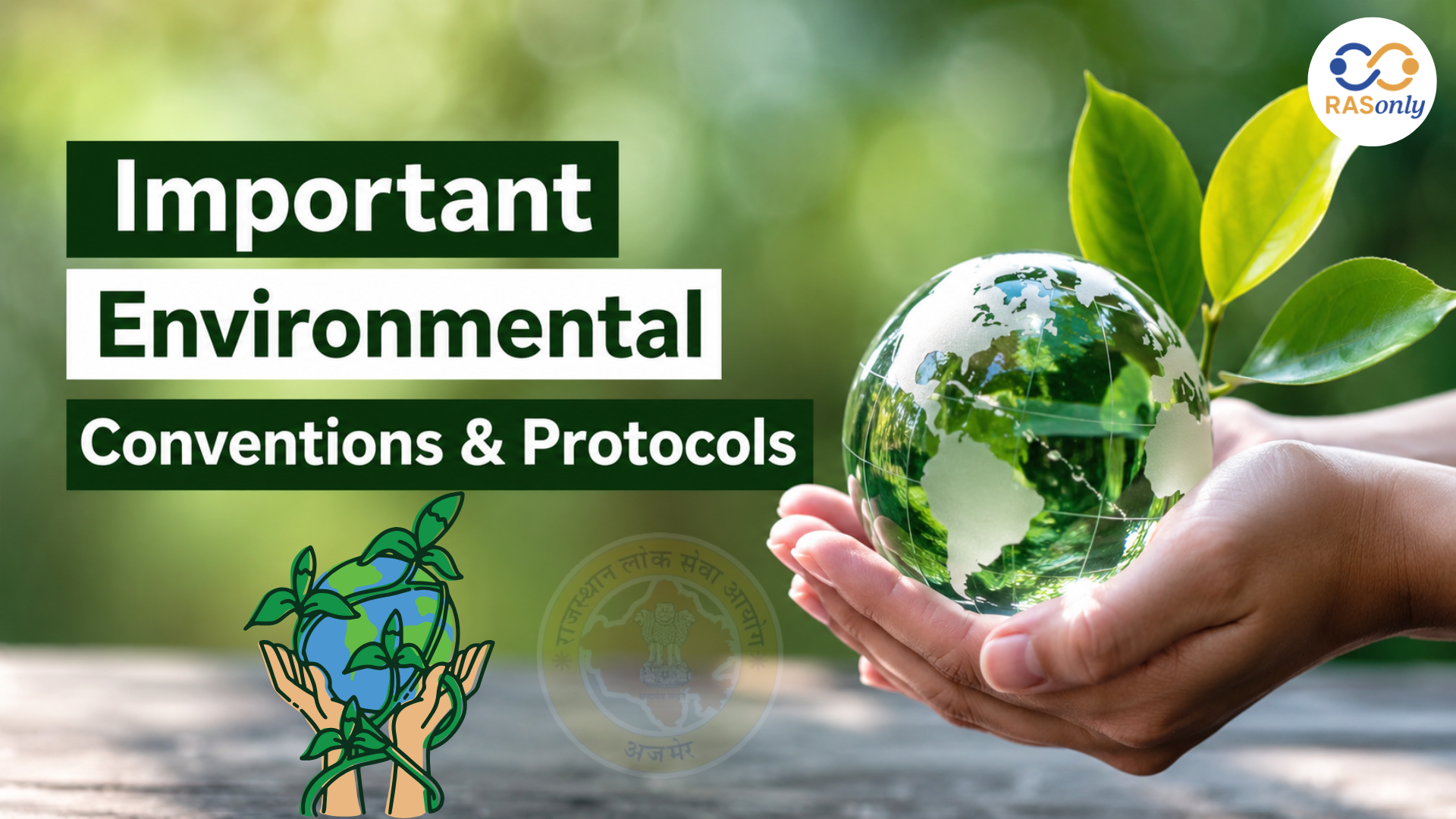
Important Environmental Conventions & Protocols have become one of the most important and high-scoring Environment topics for RAS Prelims 2026 because questions are regularly asked from Climate Change agreements, Biodiversity conventions, Ozone protection protocols, Sustainable Development frameworks, pollution-control treaties, and international environmental organizations. In recent years, RAS has significantly increased the weightage of Environment, Ecology, Climate Change, Biodiversity, International Relations, Sustainable Development, and current-affairs-linked global governance topics, making Environmental Conventions an extremely important preparation area for serious aspirants.
Many aspirants find Environmental Conventions confusing because multiple protocols, summits, climate agreements, COP meetings, biodiversity conventions, targets, and organizations are interconnected. However, with proper conceptual clarity, timeline-based preparation, convention-objective linkage, country commitments, comparison tables, and repeated MCQ revision, this section becomes one of the most scoring parts of the Environment preparation for RAS 2026. Aspirants should focus more on objectives, years, headquarters, themes, protocols, and India’s role instead of rote memorization only.
Why Environmental Conventions & Protocols are Important for RAS 2026
Environmental Conventions are directly linked with Climate Change, Biodiversity Conservation, Pollution Control, Sustainable Development, International Cooperation, Renewable Energy, and Environmental Governance. RAS frequently asks conceptual, factual, statement-based, and current-affairs-linked questions from global environmental agreements and international organizations.
Benefits of Strong Preparation
- Improves the Environment & Ecology preparation
- Helps with climate change topics
- Useful for International Relations linkage
- Important for current affairs integration
- Helpful in both Prelims and Mains
- Scoring with conceptual understanding and revision
What are Environmental Conventions & Protocols?
Environmental Conventions are international agreements signed by countries to address global environmental challenges such as climate change, biodiversity loss, desertification, pollution, ozone depletion, and sustainable development. Protocols are legally binding agreements developed under broader conventions to implement specific environmental goals and obligations.
Major Areas Covered
- Climate Change
- Biodiversity Conservation
- Ozone Layer Protection
- Wetland Conservation
- Desertification Control
- Hazardous Waste Management
- Marine Pollution
- Sustainable Development
Stockholm Conference 1972 Strategy for RAS 2026
The Stockholm Conference is one of the most important milestones in global environmental governance because it was the first major international conference focused on environmental protection.
The Stockholm Conference laid the foundation for modern environmental diplomacy and led to the establishment of UNEP (United Nations Environment Programme). Questions are frequently asked about its significance, objectives, and environmental governance impact.
Important Features
- Held in 1972
- Hosted in Stockholm, Sweden
- First global environmental conference
- Led to UNEP formation
Important Themes
- Human environment
- Pollution control
- Sustainable resource management
- International environmental cooperation
Smart Strategy
- Learn timeline carefully
- Link with UNEP
- Revise environmental governance concepts
- Practice statement-based MCQs
United Nations Environment Programme (UNEP) Strategy
UNEP is one of the most important international environmental organizations for RAS preparation. UNEP plays a major role in climate action, biodiversity conservation, pollution control, environmental monitoring, and sustainable development initiatives globally. Questions are frequently asked by headquarters, functions, and international environmental governance.
Important Features
- Established in 1972
- Headquarters: Nairobi, Kenya
- UN environmental agency
- Coordinates global environmental activities
Smart Strategy
- Revise headquarters carefully
- Link UNEP with conventions
- Practice organization-based MCQs
- Focus on global environmental governance
Vienna Convention & Montreal Protocol Strategy
The Vienna Convention and Montreal Protocol are among the most successful environmental agreements globally because they focus on ozone layer protection. The Montreal Protocol is especially important because it successfully reduced ozone-depleting substances like CFCs and is frequently asked in Environment and Climate Change sections.
Vienna Convention (1985)
- Framework for ozone layer protection
- International scientific cooperation
Montreal Protocol (1987)
- Control of ozone-depleting substances
- Reduction of CFCs & halons
- Legally binding agreement
Important Concepts
- Ozone depletion
- CFCs
- Ozone hole
- Kigali Amendment
Smart Strategy
- Compare convention vs protocol
- Learn ozone concepts carefully
- Focus on successful implementation
- Practice current-affairs-based MCQs
The Montreal Protocol is considered one of the most successful international environmental treaties.
Earth Summit 1992 (Rio Summit) Strategy
The Rio Earth Summit is one of the most important global environmental events because it connected Environment and Sustainable Development together. The summit introduced important concepts like Sustainable Development, Agenda 21, and global climate cooperation.
Important Outcomes
- Agenda 21
- UNFCCC
- Convention on Biological Diversity (CBD)
- Forest principles
Smart Strategy
- Learn the summit outcomes carefully
- Compare major conventions
- Revise sustainable development concepts
- Practice timeline-based MCQs
UNFCCC Strategy for RAS 2026
UNFCCC is one of the most important Climate Change conventions because it forms the foundation of global climate negotiations. The convention focuses on reducing greenhouse gas emissions and stabilizing global climate systems through international cooperation.
Important Features
- Adopted in 1992
- Climate change framework convention
- Annual COP meetings
- Global climate negotiations
Important Concepts
- Greenhouse gases
- Climate mitigation
- Adaptation
- Common But Differentiated Responsibilities (CBDR)
Smart Strategy
- Focus on climate concepts
- Learn the COP linkage carefully
- Revise climate governance repeatedly
- Practice statement-based MCQs
Kyoto Protocol Strategy for RAS 2026
Kyoto Protocol is highly important because it imposed legally binding emission reduction targets on developed countries. Questions are frequently linked with greenhouse gas reduction, Annex countries, and climate commitments.
Important Features
- Adopted in 1997
- Legally binding targets
- Developed-country responsibility
- Carbon emission reduction
Important Concepts
- Carbon credits
- Clean Development Mechanism (CDM)
- Emission trading
Smart Strategy
- Compare Kyoto vs Paris Agreement
- Learn emission concepts carefully
- Focus on climate commitments
- Practice current-affairs-based MCQs
Paris Agreement Strategy for RAS 2026
Paris Agreement is one of the highest-weightage Climate Change topics for competitive exams. The Paris Agreement focuses on limiting global temperature rise and promoting climate adaptation, renewable energy transition, and sustainable development through global cooperation.
Important Features
- Adopted in 2015
- Global climate agreement
- Temperature target below 2°C
- Nationally Determined Contributions (NDCs)
Important Concepts
- Net Zero
- Climate finance
- Renewable energy transition
- Carbon neutrality
Convention on Biological Diversity (CBD) Strategy
CBD is highly important because Biodiversity and Conservation topics are increasingly important in RAS. The convention focuses on biodiversity conservation, sustainable use of biological resources, and fair sharing of benefits from genetic resources.
Important Objectives
- Biodiversity conservation
- Sustainable resource use
- Benefit-sharing mechanisms
Important Protocols
- Cartagena Protocol
- Nagoya Protocol
Ramsar Convention Strategy for RAS 2026
Ramsar Convention is one of the most important wetland conservation agreements. Questions are frequently asked about Ramsar Sites, wetland conservation, biodiversity, and ecological sustainability.
Important Features
- Signed in 1971
- Wetland conservation treaty
- Ramsar Sites designation
Important Rajasthan Linkage
- Keoladeo National Park
- Sambhar Lake
Smart Strategy
- Revise Ramsar Sites through maps
- Focus on wetland ecology
- Practice Rajasthan linkage
- Practice statement-based MCQs
UNCCD Strategy for RAS 2026
UNCCD is highly important because desertification and drought are major issues in Rajasthan. The convention focuses on combating desertification, land degradation, drought management, and sustainable land use.
Important Features
- Adopted in 1994
- Focus on dryland ecosystems
- Sustainable land management
Important Rajasthan Linkage
- Desertification
- Drought-prone regions
- Land degradation
Smart Strategy
- Link with Rajasthan Geography
- Focus on desertification concepts
- Revise sustainability linkage
- Practice environment-based MCQs
COP Meetings & Climate Governance Strategy
COP meetings are increasingly important because current-affairs-based Environment questions are frequently asked in RAS. COP meetings involve global negotiations on climate action, renewable energy, adaptation, and sustainability under UNFCCC.
Important COP Concepts
- Climate finance
- Loss & damage
- Net Zero
- Adaptation goals
- Renewable energy targets
Smart Strategy
- Revise recent COP updates
- Focus on climate governance
- Link with Paris Agreement
- Practice current-affairs MCQs
Environmental Conventions Timeline Strategy
Timeline-based preparation helps aspirants avoid confusion between conventions and protocols.
| Convention / Protocol | Year |
|---|---|
| Ramsar Convention | 1971 |
| Stockholm Conference | 1972 |
| Vienna Convention | 1985 |
| Montreal Protocol | 1987 |
| Rio Earth Summit | 1992 |
| UNFCCC | 1992 |
| CBD | 1992 |
| UNCCD | 1994 |
| Kyoto Protocol | 1997 |
| Paris Agreement | 2015 |
Smart Strategy
- Revise timeline repeatedly
- Prepare one-line notes
- Use comparison tables
- Practice chronological MCQs
Important Organizations & Institutions
Various international organizations are involved in climate governance, biodiversity protection, sustainable development, and environmental policy implementation.
| Organization | Main Role |
|---|---|
| UNEP | Environmental governance |
| IPCC | Climate science |
| UNFCCC | Climate negotiations |
| CBD Secretariat | Biodiversity governance |
| Ramsar Secretariat | Wetland conservation |
Understanding organizational roles improves conceptual clarity in Environment-related MCQs.
Map Practice Strategy for Environmental Conventions
Map practice is important because questions are frequently linked with Ramsar Sites, biodiversity regions, climate conferences, and environmental hotspots.
Important Areas to Practice
- Ramsar Sites
- Biodiversity hotspots
- Desertification-prone regions
- Climate conference locations
- Wetland regions
Smart Map Practice Tips
- Practice India maps regularly
- Mark Ramsar Sites visually
- Link biodiversity with conventions
- Revise environmental hotspots repeatedly
Environmental Conventions MCQ Practice Strategy
MCQ practice is extremely important because Environment questions are mostly conceptual, statement-based, and current-affairs-linked.
Important Focus Areas
- Climate agreements
- Biodiversity conventions
- Ramsar Sites
- Ozone layer protection
- COP meetings
- Hazardous waste conventions
Smart MCQ Strategy
- Solve topic-wise MCQs daily
- Practice PYQs regularly
- Analyze wrong answers carefully
- Revise timeline-based concepts repeatedly
Most Important Environmental Convention Topics for RAS 2026
Some Environmental Conventions are repeatedly asked in RAS because they form the foundation of Climate Change, Biodiversity, Pollution Control, and Sustainable Development preparation.
High-Weightage Topics
- Paris Agreement
- Montreal Protocol
- Ramsar Convention
- CBD
- UNFCCC
- Kyoto Protocol
- UNCCD
| Topic | Importance Level |
|---|---|
| Paris Agreement | Very High |
| UNFCCC | Very High |
| Ramsar Convention | High |
| Montreal Protocol | High |
| CBD | High |
Revision Strategy for Environmental Conventions
Revision is extremely important because conventional names, years, objectives, protocols, and organizations are easy to confuse during the exam. Repeated revision through timelines, comparison tables, current affairs, and MCQs improves long-term retention significantly.
Smart Revision Tips
- Revise convention timelines weekly
- Use comparison tables regularly
- Practice current-affairs MCQs
- Revise organizations repeatedly
- Focus on protocol-convention linkage
| Revision Stage | Focus Area |
|---|---|
| First Revision | Conventions & objectives |
| Second Revision | Timelines & organizations |
| Final Revision | MCQs & quick notes |
Conclusion
Important Environmental Conventions & Protocols are among the most important and high-scoring Environment topics for RAS 2026 because they connect Climate Change, Biodiversity, Pollution Control, Sustainable Development, Wetland Conservation, and International Environmental Governance together. Agreements such as the Paris Agreement, UNFCCC, Montreal Protocol, Ramsar Convention, CBD, Kyoto Protocol, and UNCCD are repeatedly asked in Environment and current-affairs-based questions.
Aspirants should prepare this topic through timeline-based revision, convention-objective linkage, protocol comparison, organization mapping, current affairs integration, and repeated MCQ practice instead of rote memorization. Strong conceptual clarity in environmental conventions can significantly improve scoring potential in Environment, Geography, International Relations, and Rajasthan GK sections.
FAQ
Environmental Conventions are important because RAS frequently asks questions about climate agreements, biodiversity conservation, pollution control, sustainable development, and international environmental organizations.
Paris Agreement, UNFCCC, Montreal Protocol, Ramsar Convention, CBD, Kyoto Protocol, and UNCCD are among the most important conventions for RAS preparation.
A convention is a broad international agreement framework, while a protocol is a legally binding agreement developed under a convention for specific implementation goals.
The Montreal Protocol is important because it successfully reduced ozone-depleting substances like CFCs and is considered one of the most successful environmental treaties globally.
Aspirants should focus on timelines, objectives, headquarters, protocol linkage, current affairs, comparison tables, and repeated MCQ revision for effective preparation.

BEST SELLER
🏆 PRELIMS
RAS Pass
Prelims focused Hindi & English
₹399
✓
Prelims Topic-Wise Tests
✓
Subject-Wise Tests
✓
Full-Length Prelims Tests
✓
Daily Current Affairs Tests
✓
Prelims PYQs Tests
✓
Detailed Solutions & Analysis
✓
All Rajasthan Ranking
✓
Unlimited Reattempts
✓
Mains Tests
✓
Hindi & English Tests
✓
All Rajasthan Ranking
Trusted by 5,000+ Students
Post Category
- RAS Salary
- Result
- RAS Admit Card
- RAS Job
- RAS Cutoff
- Preparation Tips
- RAS Answer Key
- RAS Exam Analysis
- RAS Syllabus
- RAS Previous Year Papers
- RPSC RAS Exam Pattern
- RAS Interview
- RAS Exam Date
- RAS Vacancy
- RAS Test Series
- RAS Best Books
- RAS Preparation Resources
- RAS Coaching Centre
- History
- Polity
- Geography
- Economics
- Science
- Art and Culture
- RPSC RAS Application Form
- RPSC RAS Notification
- RAS Eligibility Criteria
- UPSC Exam
- RPSC RAS Mains
Visit Our RASonly Offline Center
Our Expert Faculty

Bhunesh Sir
Current Affairs · 13+ Yrs

Aamir Khan Sir
RAS-2017 · IIM Ahm.

Akash Sir
Polity · 8+ Yrs
Free Resources
Official Mobile App

RASOnly App
by OTSAdda · Free
Full Video Lectures
Mock Tests & PYQs
Daily Current Affairs
AI Mock Interview
Free Download · No subscription needed to install
RAS 2024 Toppers — RASonly
Rank 2
Virendra Charan
Rank 9
Bhoopinder Singh
Rank 26
Aanchal Nagpal
Rank 33
Lokendra Singh
Rank 45
Amar Rathore
Rank 46
Manasvini Verma

Join RASonly WhatsApp Community
Get daily current affairs, exam alerts, free study material and tips from expert faculty — right on WhatsApp.
Join for Free →RASonly Interview Guidance Program

Mr. Ashok Jain
Ex-Chief Secretary Govt of Rajasthan
- IAS officer of the 1981 batch, Rajasthan cadre.
- Passionate about mentoring the next generation of RAS officers with real-world insights.
- Got retired in Dec 2017 from the post of Chief Secretary of the state of Rajasthan.

Mr. Guru Charan Rai
Ex-ASP / SP in Jaisalmer
- Guru Charan Rai, IPS (Retd), retired as Inspector General of Police (Security), Rajasthan, Jaipur in 2017.
- Served as ASP and SP in Jaisalmer, Nagaur, Sri Ganganagar, Sawai Madhopur, Dausa, Sikar, and Karauli.
- He also held key positions as DIGP and IGP in the Law and Order division.

Mr. Rakesh Verma
Ex-IAS Officer, B.Tech, MBA, and M.A. (Economics)
- IAS officer of the 1981 batch and retired in Chief Secretary Rank.
- Civil servant of high repute and vast experience.
- Has been teaching UPSC CSE subjects for the last six years.
Related Post


Daily Current Affairs for RAS Exam Preparation 2026

CM Bhajan Lal Sharma Launches Rajasthan Portals
October 08, 2026
Rajasthani Film ‘Omlo’ Selected for Cannes Film Market
October 08, 2026
Rajasthan Initiative to Build India’s First UNESCO Global Geopark
October 07, 2026