Chola Dynasty: Capital, Founder, Kings, Time Period and History
Election Commission of India for RAS Notes

Get in Touch with RASonly!

The Election Commission of India is a constitutional body responsible for conducting free and fair elections across India. This guide covers Article 324, constitutional provisions, composition, appointment, tenure, removal, important Supreme Court cases, functions, latest updates, and the complete list of Chief Election Commissioners.

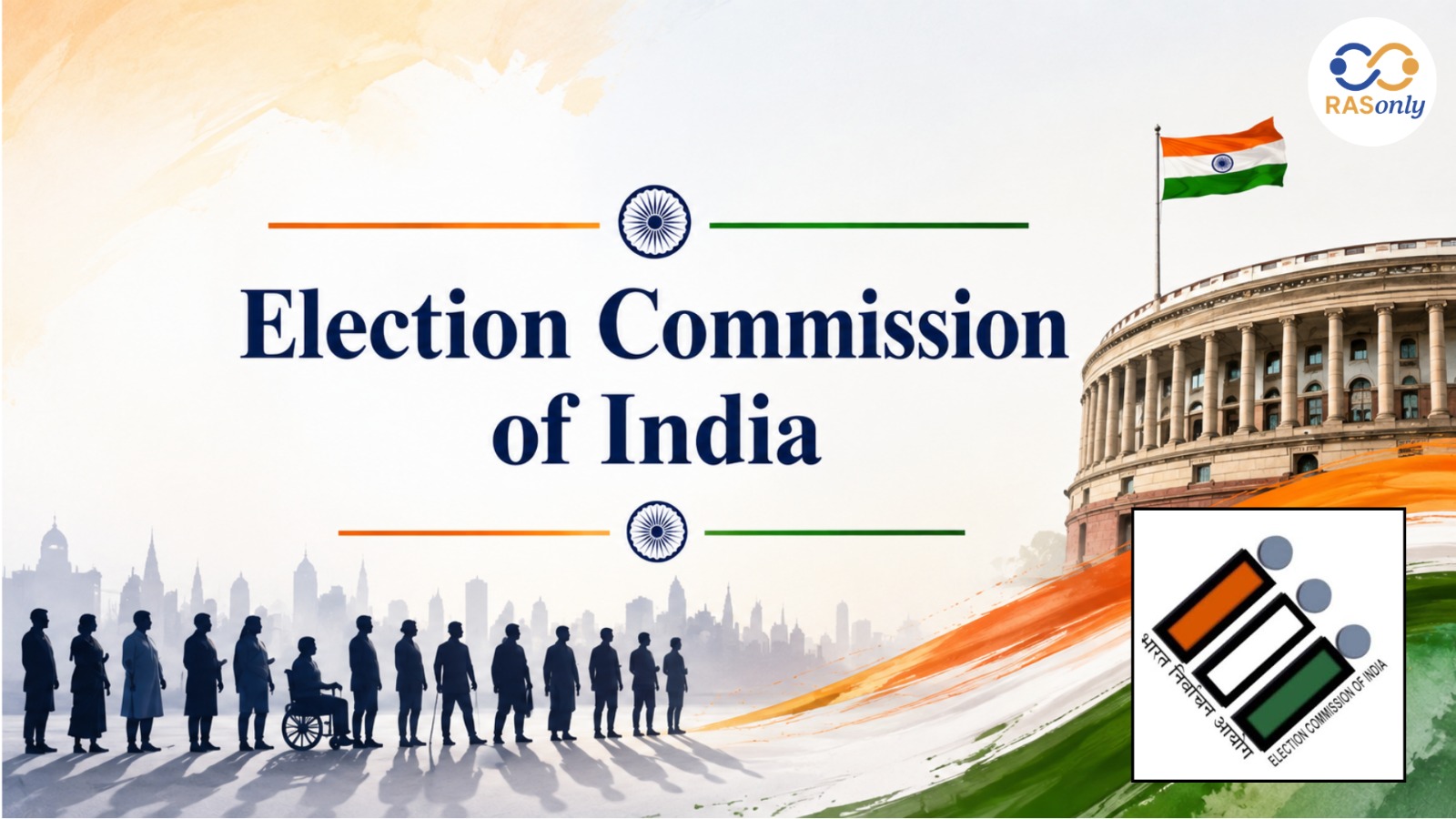
The Election Commission of India (ECI) is a constitutional body responsible for conducting elections in India. It has a pivotal role in ensuring that elections are held free, fair, transparent and orderly.
The Commission conducts elections for the Parliament, State Legislatures and the President and Vice-President. It does more than poll and count. It maintains electoral rolls, governs political parties, allocates election symbols, expenses and ensures a level playing field in elections.
Article 324 of the Constitution forms the basis of the Election Commission; Articles 325 to 329 and a few Parliamentary laws lay out the overall framework of the electoral process.
Election Commission of India
The Election Commission of India came into existence on 25th January, 1950. Based in Nirvachan Sadan, New Delhi, it is a non-citizenship-based constitutional body.
The Commission consists of two Election Commissioners and a Chief Election Commissioner. It acts as a multi-member body; decisions are made in accordance with the rules applicable to it, and with majority voting if required.
The ECI conducts elections to the Lok Sabha, Rajya Sabha, State Legislative Assemblies, State Legislative Councils (wherever applicable) and the positions of President and Vice-President.
Does not hold any elections for Panchayats and Municipalities. The responsibility for administering these elections is with the relevant State Election Commissions.
Constitutional Basis of the Election Commission of India
The constitutional provisions relating to elections are contained basically in Part XV of the Constitution (Articles 324 to Article 329). Among these provisions, Article 324 is perhaps the most important as it establishes the Election Commission and outlines its basic constitutional powers.
Article 324: Foundation of the Election Commission
- Article 324: Election Commission to be in each State under the rule of superintendence, direction and control of elections to Parliament, State Legislatures, and the President.
- It is also the Commission's duty to prepare electoral rolls and conduct elections within its constitutional jurisdiction.
- The phrases "superintendence, direction and control" confer wide administrative and supervisory powers on the Commission. But these powers can lead the ECI to flout parliamentary legislation or act against the Constitution.
- Reiterating, the Supreme Court has drawn attention to the wide vesting of powers in the Commission under Article 324; such powers would remain subject to ordinary constitutional and statutory limitations.
Article 325: Common Electoral Roll
- Article 325 provides for a general electoral roll for territorial constituencies.
- It bars exclusion from an electoral roll solely on the ground of religion, race, caste or sex.
- It is in line with the constitutional mandate of equal opportunity in contesting elections.
Article 326: Adult Suffrage
- Elections are to be based on adult suffrage in Article 326.
- Persons aged over eighteen years are entitled to register as voters, according to the qualifications and disqualifications laid down by law.
- One of the most prominent features of India's democracy is adult suffrage, which enables citizens from various economic and social strata to pick their leaders.
Composition of the Election Commission
Art 324 of the Constitution provides for an Election Commission consisting of the Chief Election Commissioner and such number of other Election Commissioners as the President may determine.
The Commission originally consisted of a single-member body headed by the Chief Election Commissioner.
In 1993, it was changed to a multi-member body. Currently, the body consists of a Chief Election Commissioner and two Election Commissioners.
Role of the Chief Election Commissioner
- The Chief Election Commissioner is the chairperson of the Commission.
- However, the CEC does not function as an institutionally superior authority who can independently overrule the other Election Commissioners. The Commission operates collectively, and decisions are taken within the prescribed decision-making framework.
- This multi-member structure is an important feature of the institutional design.
Appointment of Chief Election Commissioner and Election Commissioners
Even the appointment mechanism for the Election Commission has changed over time.
Currently, the Chief Election Commissioner and Other Election Commissioners Act, 2023 provides the statutory framework for appointment, tenure and service conditions.
At present, the Chief Election Commissioner and Election Commissioners are appointed by the President on the advice of a Selection Committee.
Selection Committee
The Selection Committee consists of:
- Prime Minister as the Chairperson
- Leader of Opposition in Lok Sabha
- Prime Minister nominates a Union Cabinet Minister
Tenure and Service Conditions
- The Chief Election Commissioner and Election Commissioners serve a term of 6 years or until the age of 65years, whichever is earlier.
- They are not eligible for reappointment.
- The terms of service and the other function-related rules for these posts are also prescribed in law.
- Tenure provisions are significant as electoral independence partly relies on protections against arbitrary removal from office.
Removal of the Election Commissioners
However, the Constitution provides protections for the Chief Election Commissioner and other Election Commissioners.
Removal of the Chief Election Commissioner
- There is a particular safeguard enshrined in the Constitution for the Chief Election Commissioner.
- Just like a Supreme Court judge can be impeached, so can a CEC, but through a law.
- The purpose of this higher bar is to safeguard the office from an arbitrary executive.
Removal of Other Election Commissioners
- Other Election Commissioners can be removed by the President on the recommendation of the Chief Election Commissioner.
- This separation of powers is a key aspect of the constitutional design, setting the CEC apart from other Election Commissioners.
Election Commission of India: Important Case Laws
- Mohinder Singh Gill v. Chief Election Commissioner (1978): The Supreme Court ruled that the broad powers of the Election Commission under Article 324 were necessary to ensure a fair election; election law is silent on a specific issue.
- A.C. Jose v. Sivan Pillai (1984): The Court clarified that the ECI cannot use Article 324 to override or contradict laws enacted by Parliament. Its powers must operate within the existing legal framework.
- T.N. Seshan v Union of India (1995): The Supreme Court upheld the multi-member Election Commission and ruled that the Chief Election Commissioner is not primary, or has greater powers than other Election Commissioners.
- Union of India v. Association for Democratic Reforms (2002): To promote transparency in elections, the Court recognised voters' right to know material information about the candidates.
- PUCL v. Union of India (2003): The result was to buttress the voter's right to free selection & expression, a step towards introducing NOTA.
- Anoop Baranwal v. Union of India (2023): The Supreme Court examined the appointment of Election Commissioners and prescribed an ad hoc selection mechanism until Parliament enacted a 2023 law governing appointments.
Chief Election Commissioners of India
| S.No. | Name | Tenure | Significance |
|---|---|---|---|
| 1 | Sukumar Sen | 1950–1958 | First Chief Election Commissioner of India; conducted the first General Elections of 1951–52. |
| 2 | K. V. K. Sundaram | 1958–1967 | Second CEC; one of the longest-serving Chief Election Commissioners. |
| 3 | S. P. Sen Verma | 1967–1972 | Third CEC; served during the 1967 and 1971–72 electoral period. |
| 4 | Dr. Nagendra Singh | 1972–1973 | Served as CEC for a short tenure; later became President of the International Court of Justice. |
| 5 | T. Swaminathan | 1973–1977 | Served as CEC during the period of major political and electoral changes in the 1970s. |
| 6 | S. L. Shakdhar | 1977–1982 | Served during the post-Emergency electoral period and subsequent general elections. |
| 7 | R. K. Trivedi | 1982–1985 | Served as CEC during the 1980s and oversaw important electoral processes. |
| 8 | R. V. S. Peri Sastri | 1986–1990 | Served as CEC during a period of significant electoral and administrative developments. |
| 9 | V. S. Ramadevi | 1990 | First and only woman to serve as Chief Election Commissioner of India. |
| 10 | T. N. Seshan | 1990–1996 | Known for strengthening the authority of the ECI, enforcing the Model Code of Conduct and promoting electoral reforms. |
| 11 | M. S. Gill | 1996–2001 | Oversaw elections during a period of major technological and administrative changes in election management. |
| 12 | J. M. Lyngdoh | 2001–2004 | Known for his role in strengthening electoral administration and enforcing election-related rules. |
| 13 | T. S. Krishnamurthy | 2004–2005 | Served as CEC during the 2004 General Election period. |
| 14 | B. B. Tandon | 2005–2006 | Served as CEC during the implementation of several electoral and administrative measures. |
| 15 | N. Gopalaswami | 2006–2009 | Served during the period of increasing use of technology and electoral reforms. |
| 16 | Navin B. Chawla | 2009–2010 | Served as CEC during the 2009 General Election period. |
| 17 | S. Y. Quraishi | 2010–2012 | Focused on voter participation, electoral awareness and strengthening the election process. |
| 18 | V. S. Sampath | 2012–2015 | Served during the 2014 General Elections and the expansion of technology in elections. |
| 19 | H. S. Brahma | 2015 | Served as CEC for a short tenure in 2015. |
| 20 | Nasim Zaidi | 2015–2017 | Served during the 2017 Assembly election cycle and continued technological modernisation of elections. |
| 21 | Achal Kumar Jyoti | 2017–2018 | Served as CEC during the 2017–18 Assembly election period. |
| 22 | Om Prakash Rawat | 2018 | Served as CEC during the 2018 election cycle. |
| 23 | Sunil Arora | 2018–2021 | Oversaw the 2019 General Election and several Assembly elections. |
| 24 | Sushil Chandra | 2021–2022 | Served during the 2022 Assembly elections and continued electoral technology initiatives. |
| 25 | Rajiv Kumar | 2022–2025 | Oversaw the 2024 General Election and several major electoral reforms and initiatives. |
| 26 | Gyanesh Kumar | 2025–Present | 26th Chief Election Commissioner of India; assumed office on 19 February 2025. |
Also Read
| Parliament of India | The President of India (Articles 52-62) |
| Supreme Court & Judicial Review | Comptroller and Auditor General of India (CAG) |
| Union Executive | Preamble of the Indian Constitution |
Election Commission of India: Latest updates
- Special Intensive Revision 2026: The Special Intensive Revision of electoral rolls was extended by the Election Commission to 16 States and 3 Union Territories 36.73 crore electors so far.
- Verification on Large Scale: Over 3.94 lakh Booth Level Officers are involved in the verification process, which is one of the biggest exercises for electoral roll revision in India.
- Political Party Participation: Political parties were engaged through Booth Level Agents, enabling them to participate in ground-level verification and revision.
- Digital verification facilities: Voters may verify their electoral roll details online, explore past roll records, and find services on the SIR process.
- The revision focuses on the electoral roll, finding out the eligible voters, deleting ineligible voters or those whose names are repeated, along with an opportunity to file claims & objections.
- Phased Implementation: Instead of a single all-India deadline, the exercise is being held in phases, so that verification and finalisation of rolls can be carried out as per varying administrative conditions of different States and Union Territories.
Election Commission of India FAQs
The Election Commission of India (ECI) is an independent constitutional authority responsible for supervising, directing and controlling elections to Parliament, State Legislatures, and the offices of the President and Vice-President of India.
Article 324 provides for the Election Commission of India and gives it the superintendence, direction and control of electoral rolls and the conduct of elections.
The President of India appoints the Chief Election Commissioner and other Election Commissioners according to the procedure prescribed under the current law governing their appointment.
The term is six years or until attaining the age of 65 years, whichever is earlier. They are not eligible for reappointment under the current statutory framework.
The ECI prepares and supervises electoral rolls, conducts elections, allots election symbols, registers political parties, monitors election expenditure and enforces the Model Code of Conduct.
BEST SELLER
🏆 PRELIMS
RAS Pass
Prelims focused Hindi & English
₹399
✓
Prelims Topic-Wise Tests
✓
Subject-Wise Tests
✓
Full-Length Prelims Tests
✓
Daily Current Affairs Tests
✓
Prelims PYQs Tests
✓
Detailed Solutions & Analysis
✓
All Rajasthan Ranking
✓
Unlimited Reattempts
✓
Mains Tests
✓
Hindi & English Tests
✓
All Rajasthan Ranking
Trusted by 5,000+ Students
Post Category
- RAS Salary
- Result
- RAS Admit Card
- RAS Job
- RAS Cutoff
- Preparation Tips
- RAS Answer Key
- RAS Exam Analysis
- RAS Syllabus
- RAS Previous Year Papers
- RPSC RAS Exam Pattern
- RAS Interview
- RAS Exam Date
- RAS Vacancy
- RAS Test Series
- RAS Best Books
- RAS Preparation Resources
- RAS Coaching Centre
- History
- Polity
- Geography
- Economics
- Science
- Art and Culture
- RPSC RAS Application Form
- RPSC RAS Notification
- RAS Eligibility Criteria
- UPSC Exam
- RPSC RAS Mains
Visit Our RASonly Offline Center
Our Expert Faculty

Bhunesh Sir
Current Affairs · 13+ Yrs

Aamir Khan Sir
RAS-2017 · IIM Ahm.
Akash Sir
Polity · 8+ Yrs
Free Resources
Official Mobile App

RASOnly App
by OTSAdda · Free
Full Video Lectures
Mock Tests & PYQs
Daily Current Affairs
AI Mock Interview
Free Download · No subscription needed to install
RAS 2024 Toppers — RASonly
Rank 2
Virendra Charan
Rank 9
Bhoopinder Singh
Rank 26
Aanchal Nagpal
Rank 33
Lokendra Singh
Rank 45
Amar Rathore
Rank 46
Manasvini Verma

Join RASonly WhatsApp Community
Get daily current affairs, exam alerts, free study material and tips from expert faculty — right on WhatsApp.
Join for Free →RASonly Interview Guidance Program

Mr. Ashok Jain
Ex-Chief Secretary Govt of Rajasthan
- IAS officer of the 1981 batch, Rajasthan cadre.
- Passionate about mentoring the next generation of RAS officers with real-world insights.
- Got retired in Dec 2017 from the post of Chief Secretary of the state of Rajasthan.

Mr. Guru Charan Rai
Ex-ASP / SP in Jaisalmer
- Guru Charan Rai, IPS (Retd), retired as Inspector General of Police (Security), Rajasthan, Jaipur in 2017.
- Served as ASP and SP in Jaisalmer, Nagaur, Sri Ganganagar, Sawai Madhopur, Dausa, Sikar, and Karauli.
- He also held key positions as DIGP and IGP in the Law and Order division.

Mr. Rakesh Verma
Ex-IAS Officer, B.Tech, MBA, and M.A. (Economics)
- IAS officer of the 1981 batch and retired in Chief Secretary Rank.
- Civil servant of high repute and vast experience.
- Has been teaching UPSC CSE subjects for the last six years.
Related Post
Daily Current Affairs for RAS Exam Preparation 2026

9th Rashtriya Poshan Maah 2026
October 16, 2026
Seva Sankalp, Khadi Mahotsav 2026
October 16, 2026
Conclusion of Multinational Exercise Tarang Shakti 2.0
October 15, 2026