Pallava Dynasty: Major Rulers, Temple Architecture and Contributions to South India
Urbanisation and Urban Development in Rajasthan - RAS Notes, Trends & Government Schemes

Get in Touch with RASonly!

Urbanisation and urban development in Rajasthan has reshaped the state faster than most people realise. Once seen as purely agrarian, Rajasthan's cities - Jaipur, Jodhpur, Kota, and Udaipur - are now economic hubs pulling in migrants every year. This growth brings jobs and infrastructure, but also water shortages, slums, and traffic. Here's a complete RAS-focused breakdown of the causes, data, schemes, and challenges shaping Rajasthan's urban future.

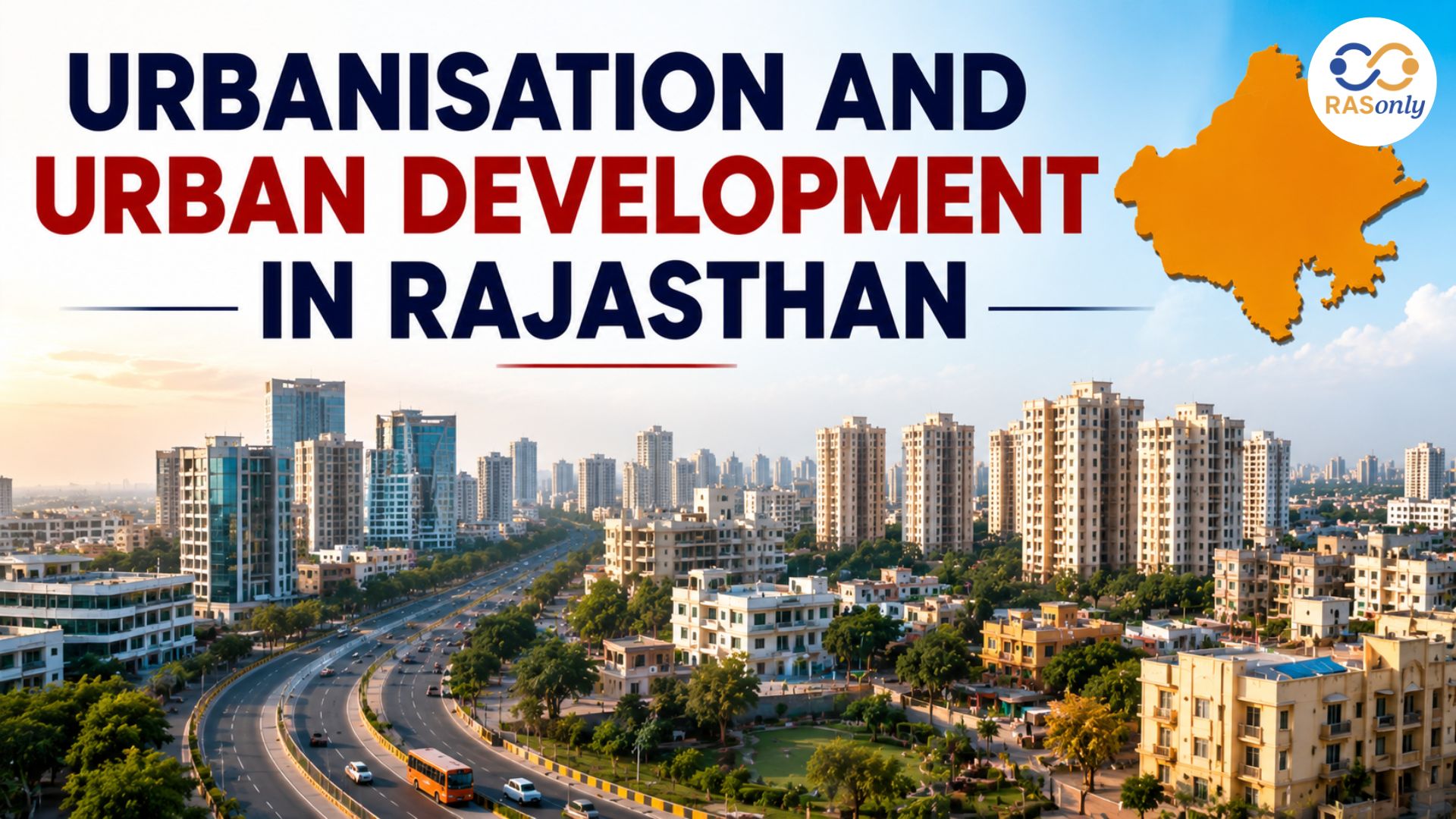
Rajasthan, India's largest state by area, has traditionally been known as an agrarian and rural economy. But over the last three decades, the picture has been changing fast. Urbanisation and urban development in Rajasthan has become one of the most talked-about themes in state planning circles, and it's also a recurring topic in the RAS (Rajasthan Administrative Services) General Studies syllabus.
Cities like Jaipur, Jodhpur, Kota, and Udaipur are no longer just tourist destinations - they're turning into economic engines that pull migrants from villages every year. This shift brings opportunities (jobs, infrastructure, better services) but also real problems (slums, water shortage, traffic, pollution). If you're preparing for RAS or simply want to understand where Rajasthan's cities are headed, this article breaks down everything you need - from the numbers to the schemes to the exam-relevant angles.
What Do We Mean by Urbanisation?
Urbanisation refers to the process by which an increasing proportion of a population comes to live in towns and cities rather than rural areas. It's usually measured by comparing the share of a state's population that lives in "urban areas" (as defined by the Census of India) over time.
In Rajasthan, urbanisation has historically been slower than the national average - largely due to the state's desert geography, water scarcity, and dependence on agriculture and animal husbandry. But that gap is narrowing.
Key Definitions (Exam-relevant)
| Term | Meaning |
|---|---|
| Statutory Town | Area with a municipality, corporation, cantonment board, or notified town area committee |
| Census Town | Area satisfying: population > 5,000; density > 400 persons/sq km; 75%+ male workers in non-agricultural activities |
| Urban Agglomeration (UA) | A continuous urban spread formed by a city/town and its adjoining urban outgrowths |
| Million Plus City | City/UA with population exceeding 1 million |
Rajasthan's Urban Population - The Data Story
According to Census 2011, Rajasthan's urban population stood at roughly 24.87% of the total population - well below the national urban average of around 31%. This makes Rajasthan one of the less urbanised large states in India, though the trend line is clearly upward.
| Census Year | Urban Population (%) | Approx. Urban Population (in crore) |
|---|---|---|
| 1991 | ~22.9% | 1.02 |
| 2001 | ~23.4% | 1.32 |
| 2011 | ~24.87% | 1.70 |
| 2023-24 (estimated) | ~27-28% | ~2.1 (estimated) |
Note: 2023-24 figures are projections since Census 2021 was delayed; always cross-check with the latest official government release before quoting in exams.
Fastest Growing Urban Centres
Jaipur remains the largest and fastest-growing urban agglomeration in the state, followed by Jodhpur, Kota, Bikaner, Ajmer, and Udaipur. Jaipur alone accounts for a significant chunk of the state's total urban population - a pattern known as primacy, where one city dominates the urban hierarchy disproportionately.
Causes of Urbanisation in Rajasthan
Understanding why people move to cities is a favourite RAS Mains angle. Here are the major drivers:
- Push factors from rural areas - Frequent droughts, low agricultural productivity, fragmented landholdings, and limited non-farm employment push rural populations toward cities.
- Pull factors of cities - Better job opportunities in industry, services, tourism, and government sectors attract migrants.
- Industrial growth - Development of industrial areas (RIICO estates) around Jaipur, Bhiwadi, Neemrana, and Pali has created factory-based employment hubs.
- Tourism-led urbanisation - Cities like Udaipur, Jaisalmer, and Pushkar have urbanised partly due to the hospitality and tourism economy.
- Educational institutions - Kota's transformation into India's "coaching capital" is a textbook example of institution-driven urban growth.
- Improved connectivity - Expansion of highways (Delhi-Mumbai Expressway passing through Rajasthan), rail networks, and the upcoming RRTS-like connectivity have made peri-urban areas more attractive for settlement.
- Administrative and service-sector expansion - Government offices, healthcare, and higher education concentrated in district headquarters drive local urbanisation.
Government Schemes and Policies for Urban Development in Rajasthan
This is one of the highest-weightage sub-topics in RAS exams because examiners love asking about scheme names, objectives, and implementing bodies.
| Scheme/Policy | Focus Area | Key Feature |
|---|---|---|
| AMRUT (Atal Mission for Rejuvenation and Urban Transformation) | Basic infrastructure — water supply, sewerage, green spaces | Covers major towns in Rajasthan; AMRUT 2.0 focuses on universal water coverage |
| Smart City Mission | Technology-driven urban governance | Jaipur, Udaipur, Kota, and Ajmer selected as Smart Cities under this mission |
| PMAY-Urban (Pradhan Mantri Awas Yojana) | Affordable housing for urban poor | "Housing for All" target, implemented via Rajasthan Housing Board |
| Rajasthan Urban Infrastructure Development Project (RUIDP) | Water supply, sewerage, roads in secondary towns | World Bank/ADB-funded, covers non-major cities |
| Swachh Bharat Mission (Urban) | Sanitation and waste management | Focus on ODF (Open Defecation Free) status and solid waste management |
| Jaipur Development Authority (JDA) Master Plan | Land use and city expansion planning | Governs Jaipur's spatial growth till 2025 and beyond |
| Rajasthan Municipal Act | Legal/governance framework for Urban Local Bodies | Defines powers of municipal corporations, councils, and boards |
| 74th Constitutional Amendment Act, 1992 | Decentralisation of urban governance | Created Urban Local Bodies (ULBs), Wards Committees, and Metropolitan Planning Committees |
Urban Local Governance Structure in Rajasthan
Rajasthan's urban governance follows the framework set by the 74th Constitutional Amendment. The hierarchy generally looks like this:
- Municipal Corporations - for larger cities (e.g., Jaipur has multiple zones under Greater and Heritage corporations, Jodhpur, Kota, Bikaner, Ajmer, Udaipur)
- Municipal Councils (Nagar Parishad) - for medium-sized towns
- Municipal Boards (Nagar Palika) - for smaller towns
Each ULB is responsible for water supply, sanitation, street lighting, local roads, building permissions, and property tax collection. The Directorate of Local Bodies (DLB), under the Urban Development & Housing Department, supervises these bodies at the state level.
Challenges of Urbanisation in Rajasthan
This section is exam gold - RAS Mains often frames questions around "problems" or "challenges," so structure your answer around these heads:
1. Water Scarcity
Rajasthan is India's driest state. Rapid urban growth in a water-stressed region creates serious strain on groundwater and surface water sources, especially in Jaipur, Jodhpur, and Bikaner.
2. Unplanned Growth and Urban Sprawl
Many towns have grown faster than their master plans anticipated, leading to unauthorised colonies, encroachments, and haphazard land use.
3. Slum Proliferation
Migration without matching housing supply has led to slum clusters in most large cities, straining civic amenities.
4. Infrastructure Deficit
Roads, sewerage, and public transport systems in many Tier-2 towns have not kept pace with population growth.
5. Traffic Congestion and Pollution
Jaipur and Kota, in particular, face rising vehicular congestion and air quality concerns.
6. Employment Pressure
Not all urban migrants find formal jobs, leading to a growing informal sector and underemployment.
7. Heritage vs. Development Conflict
Cities like Jaipur (a UNESCO World Heritage City) and Udaipur face the tricky balance of modern infrastructure development without damaging historic character.
Impact of Urbanisation on Rajasthan's Economy and Society
- Positive impacts: Growth of the services sector, rise in per capita income in urban districts, better access to healthcare and education, expansion of the real estate and construction sector, and growth of MSMEs in industrial towns.
- Negative impacts: Rural-urban divide widening, pressure on urban land prices, loss of agricultural land to urban expansion, and social challenges around migrant integration.
Smart City Projects in Rajasthan - A Closer Look
Under the Smart Cities Mission, Jaipur, Udaipur, Kota, and Ajmer were selected in different rounds. Broad focus areas across these cities include:
- Integrated Command and Control Centres (ICCC) for real-time city monitoring
- Smart water and waste management systems
- Heritage conservation and area-based development (especially in Jaipur's Walled City and Udaipur)
- E-governance and citizen service portals
- Smart mobility - dedicated bus lanes, non-motorised transport corridors
RAS Exam Perspective - What to Focus On
If you're preparing this topic for RAS Prelims or Mains, prioritise these areas:
- Prelims: Census data (urban % figures), definitions (statutory town, census town, UA), names and years of key schemes, list of Smart Cities in Rajasthan.
- Mains (GS Paper on Rajasthan Economy/Society): Causes and consequences of urbanisation, government policy response, governance structure of ULBs, case studies (Kota's coaching-led urbanisation, Jaipur's heritage-development balance).
- Answer writing tip: Structure your answer with Introduction → Causes → Government Response (Schemes) → Challenges → Way Forward. Examiners reward structured, point-wise answers over long paragraphs.
Sample Previous-Year-Style Questions
- "Discuss the pattern and causes of urbanisation in Rajasthan." (GS Mains style)
- "What is the difference between a Census Town and a Statutory Town?" (Prelims style)
- "Examine the role of AMRUT and Smart City Mission in Rajasthan's urban transformation." (Mains style)
Way Forward - Building Sustainable Cities in Rajasthan
- Strengthening water conservation and rainwater harvesting in urban master plans
- Promoting Tier-2 and Tier-3 town development to reduce migration pressure on Jaipur
- Encouraging public transport and non-motorised transport to cut congestion
- Integrating heritage conservation guidelines into all urban development projects
- Capacity-building of ULBs for better fiscal and administrative autonomy
Important Links
Conclusion
Urbanisation and urban development in Rajasthan is a story of transition - from a largely rural, agrarian state to one where cities are increasingly becoming the center of economic and social life. For RAS aspirants, this topic isn't just about memorizing scheme names; it's about understanding the why and how behind Rajasthan's changing urban landscape and being able to connect data, policy, and real challenges in a well-structured answer.
FAQs
As per Census 2011, Rajasthan's urban population was around 24.87%, and it has likely grown to approximately 27-28% by 2024, though official confirmation awaits the next Census.
Jaipur, Udaipur, Kota, and Ajmer have been selected under the Smart Cities Mission.
Key causes include rural distress (droughts, low farm income), industrial growth, tourism, educational hubs like Kota, and improved road/rail connectivity.
Municipal Corporations govern larger cities with bigger populations and budgets, while Municipal Councils (Nagar Parishad) and Municipal Boards (Nagar Palika) govern medium and smaller towns respectively.
It connects multiple GS areas - geography, economy, governance, and current affairs - making it a high-yield, frequently tested topic in both Prelims and Mains.

BEST SELLER
🏆 PRELIMS
RAS Pass
Prelims focused Hindi & English
₹399
✓
Prelims Topic-Wise Tests
✓
Subject-Wise Tests
✓
Full-Length Prelims Tests
✓
Daily Current Affairs Tests
✓
Prelims PYQs Tests
✓
Detailed Solutions & Analysis
✓
All Rajasthan Ranking
✓
Unlimited Reattempts
✓
Mains Tests
✓
Hindi & English Tests
✓
All Rajasthan Ranking
Trusted by 5,000+ Students
Post Category
- RAS Salary
- Result
- RAS Admit Card
- RAS Job
- RAS Cutoff
- Preparation Tips
- RAS Answer Key
- RAS Exam Analysis
- RAS Syllabus
- RAS Previous Year Papers
- RPSC RAS Exam Pattern
- RAS Interview
- RAS Exam Date
- RAS Vacancy
- RAS Test Series
- RAS Best Books
- RAS Preparation Resources
- RAS Coaching Centre
- History
- Polity
- Geography
- Economics
- Science
- Art and Culture
- RPSC RAS Application Form
- RPSC RAS Notification
- RAS Eligibility Criteria
- UPSC Exam
- RPSC RAS Mains
Visit Our RASonly Offline Center
Our Expert Faculty

Bhunesh Sir
Current Affairs · 13+ Yrs

Aamir Khan Sir
RAS-2017 · IIM Ahm.
Akash Sir
Polity · 8+ Yrs
Free Resources
Official Mobile App

RASOnly App
by OTSAdda · Free
Full Video Lectures
Mock Tests & PYQs
Daily Current Affairs
AI Mock Interview
Free Download · No subscription needed to install
RAS 2024 Toppers — RASonly
Rank 2
Virendra Charan
Rank 9
Bhoopinder Singh
Rank 26
Aanchal Nagpal
Rank 33
Lokendra Singh
Rank 45
Amar Rathore
Rank 46
Manasvini Verma

Join RASonly WhatsApp Community
Get daily current affairs, exam alerts, free study material and tips from expert faculty — right on WhatsApp.
Join for Free →RASonly Interview Guidance Program

Mr. Ashok Jain
Ex-Chief Secretary Govt of Rajasthan
- IAS officer of the 1981 batch, Rajasthan cadre.
- Passionate about mentoring the next generation of RAS officers with real-world insights.
- Got retired in Dec 2017 from the post of Chief Secretary of the state of Rajasthan.

Mr. Guru Charan Rai
Ex-ASP / SP in Jaisalmer
- Guru Charan Rai, IPS (Retd), retired as Inspector General of Police (Security), Rajasthan, Jaipur in 2017.
- Served as ASP and SP in Jaisalmer, Nagaur, Sri Ganganagar, Sawai Madhopur, Dausa, Sikar, and Karauli.
- He also held key positions as DIGP and IGP in the Law and Order division.

Mr. Rakesh Verma
Ex-IAS Officer, B.Tech, MBA, and M.A. (Economics)
- IAS officer of the 1981 batch and retired in Chief Secretary Rank.
- Civil servant of high repute and vast experience.
- Has been teaching UPSC CSE subjects for the last six years.
Related Post

Daily Current Affairs for RAS Exam Preparation 2026

Public Pledge Against Drug Abuse
October 10, 2026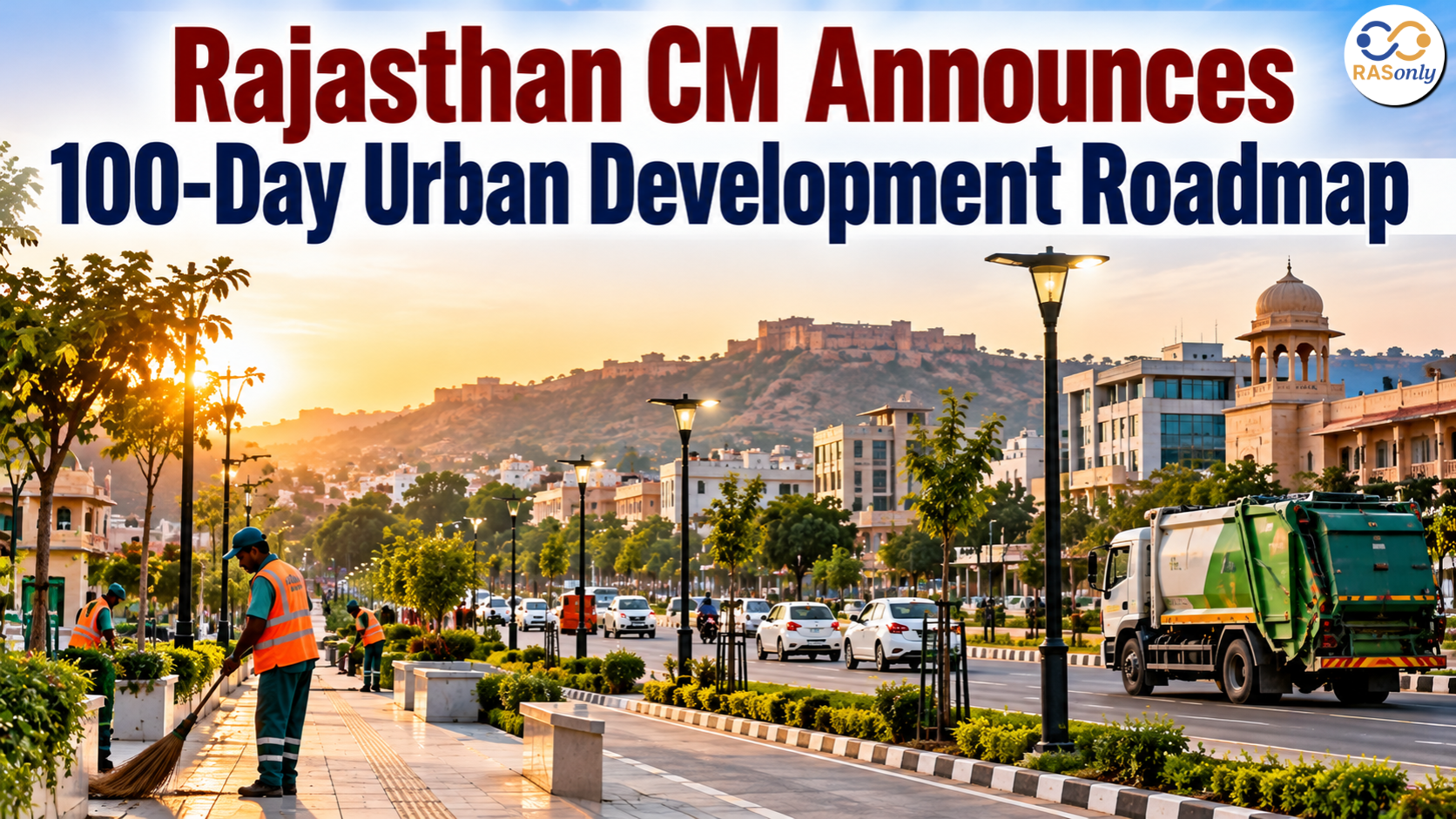
Rajasthan CM Announces 100-Day Urban Development Roadmap
October 10, 2026
Khelo Rajasthan Campaign
October 09, 2026