Chola Dynasty: Capital, Founder, Kings, Time Period and History
Major Crops of Rajasthan

Get in Touch with RASonly!

Major Crops of Rajasthan reveal how a rain-scarce state became India's top producer of bajra, guar, and mustard. From drought-hardy fields in Jodhpur and Barmer to canal-fed farms in Ganganagar, water availability shapes almost every cropping decision here. This guide covers Kharif and Rabi crops, state rankings, agro-climatic zones, and how the 2026-27 state budget is shaping farm policy - everything a serious RAS aspirant needs in one place.

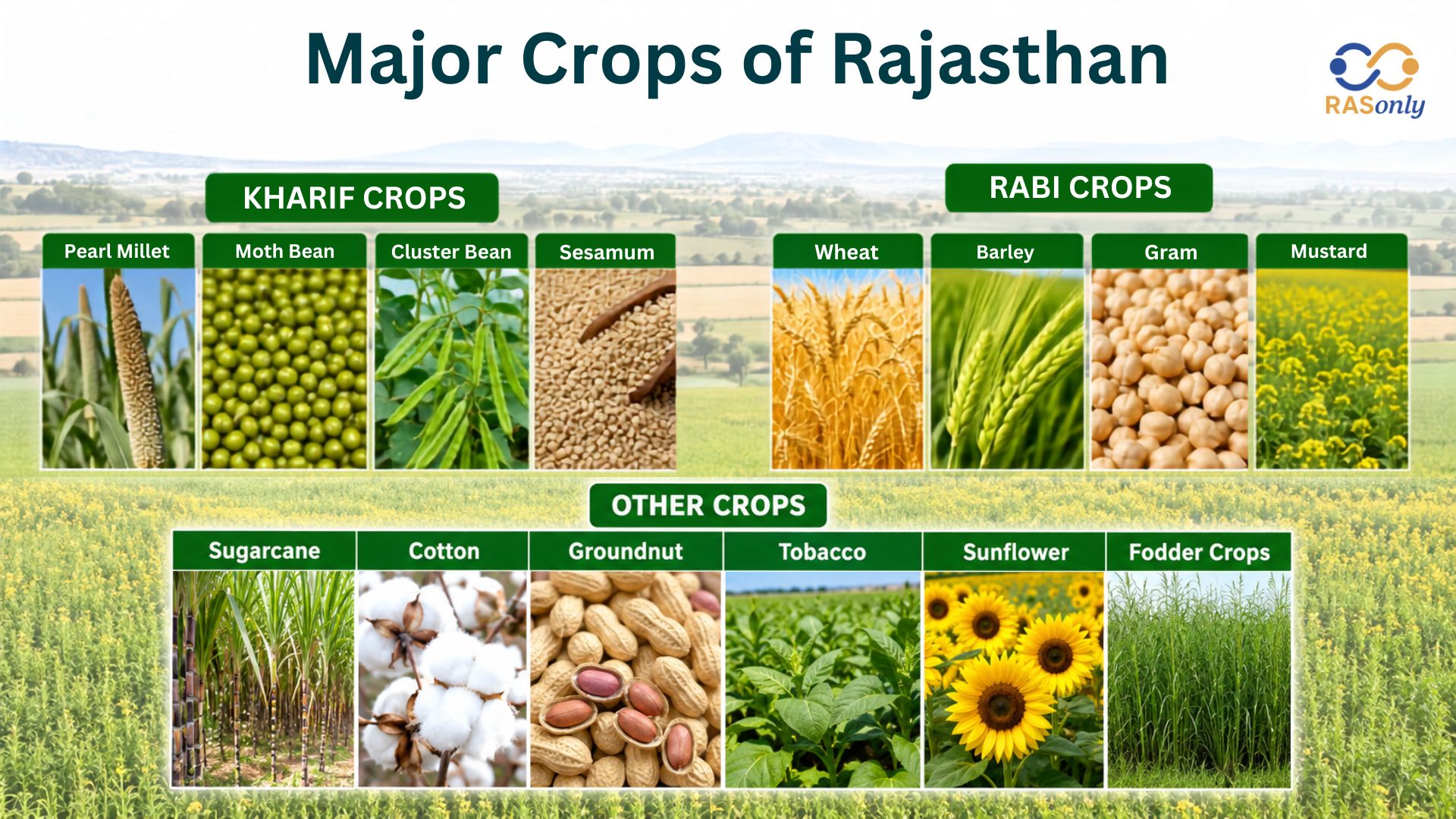
Agriculture is the backbone of Rajasthan's economy, employing more than 60% of the workforce despite the state's arid and semi-arid climate. Rajasthan is the largest in area among Indian states but receives highly uneven and scanty rainfall, so cropping patterns are shaped by water availability, soil type, and irrigation infrastructure (especially the Indira Gandhi Nahar Pariyojna / IGNP).
- Contribution to GSVA: Agriculture sector's value has grown from ₹1.19 lakh crore (2011-12) to ₹2.18 lakh crore (2024-25), a CAGR of about 4.76% at constant prices.
- State ranking snapshot: Rajasthan is the No.1 producer in India of Bajra, Mustard, Guar, Total Oilseeds, and Nutri-cereals; and the largest producer of Barley, Coriander, Fenugreek and Moth beans among various sources.
2. Cropping Seasons of Rajasthan
| Season | Local Name | Sowing | Harvesting | Major Crops |
|---|---|---|---|---|
| Kharif | Salu | June–July | September–October | Bajra, Jowar, Maize, Cotton, Groundnut, Guar, Til, Moong, Moth |
| Rabi | Unalu | October–November | March–April | Wheat, Barley, Gram, Mustard, Coriander, Cumin, Fenugreek, Taramira |
| Zaid | — | March–June | Before Monsoon | Muskmelon, Cucumber, Watermelon, Fodder Crops, Vegetables |
3. Kharif Crops - Detailed
Bajra (Pearl Millet) - Pennisetum glaucum
- Rajasthan's most important Kharif crop by area; called the "King of arid crops."
- Rajasthan is India's no. 1 bajra producer, contributing roughly 44–45% of national bajra production (Rajasthan Economic Review 2025-26).
- Growing belt: Western arid zones - Jodhpur, Barmer, Pali, Nagaur, Sikar, Jhunjhunu.
- Needs only 200–400 mm rainfall; tolerates temperatures above 40°C; suited to sandy soils.
- Nutritionally significant - about 2.5× more protein than rice; key food-security crop for arid households.
- Improved varieties (HHB-67, HHB-197) developed by CAZRI, Jodhpur (est. 1959).
- Yield remains low (~11 quintals/hectare) due to rainfed, marginal-land cultivation - government is pushing hybrid seed adoption.
Guar (Cluster Bean) - Cyamopsis tetragonoloba
- Rajasthan's most globally significant crop - produces roughly 80–90% of India's guar and around 80% of world guar output.
- Districts: Barmer, Jodhpur, Nagaur, Sikar, Bikaner, Hanumangarh, Sri Ganganagar.
- Industrial importance: guar gum (from the seed endosperm) is used in oil & gas hydraulic fracturing, food processing (thickener E412), pharmaceuticals, cosmetics, paper, and textiles.
- India dominates world guar-gum exports, and Rajasthan drives that dominance - a recurring Mains linkage point (agriculture ↔ industry ↔ export economy).
Other Key Kharif Crops
- Maize: Concentrated in Bhilwara, Udaipur, Chittorgarh - better rainfall/soil belt (Mewar region).
- Jowar (Sorghum): Grown across semi-arid eastern and southern tracts; both food and fodder use.
- Cotton: Cash crop of the irrigated Ganganagar–Hanumangarh belt (IGNP command area); black-soil pockets also support it.
- Groundnut: Major oilseed; concentrated in Bikaner, Churu, Nagaur.
- Til (Sesame) & Moong/Moth: Pulses/oilseeds suited to dryland farming across western districts.
4. Rabi Crops - Detailed
Mustard (Sarson/Raida) - Brassica juncea
- Most important Rabi oilseed and cash crop of Rajasthan; state ranks no. 1 in India for mustard production.
- Leading districts: Bharatpur, Alwar, Sri Ganganagar, Hanumangarh, Kota, Sawai Madhopur belt.
- High-yielding varieties promoted via Cluster Frontline Demonstrations (CFLDs) under National Food Security Mission: RH-749, RH-725, and DRMR 2017-15 (Radhika) are notable varieties recently promoted in the state.
- Directly linked to India's edible-oil import dependence - a favourite Mains angle (self-sufficiency in oilseeds).
Wheat & Barley
- Wheat: Second most important Rabi food crop; concentrated in canal-irrigated tracts - Ganganagar, Hanumangarh, Kota, Bundi, Chittorgarh.
- Barley: Rajasthan is the largest barley-producing state in India; grown mainly in less-irrigated Rabi tracts; used for food, fodder, and malting/brewing industry.
- Gram (Chana)
- Major Rabi pulse; concentrated in south-eastern districts (Kota, Bundi, Baran) with moderate rainfall and black/loamy soils.
Spices - Rajasthan's Rabi Specialisation
- Rajasthan is the 4th largest spice-producing state in India; key spices: Coriander, Cumin, Mustard, Garlic, Fenugreek.
- Coriander (Dhaniya): Ramganj Mandi (Kota district) is Asia's largest coriander mandi/market.
- Cumin (Jeera) & Fenugreek (Methi): Concentrated in Nagaur, Jodhpur, Barmer - a semi-arid spice belt.
- Isabgol & Taramira: Niche Rabi crops - Isabgol (psyllium husk) mainly in Jalore/Barmer with pharma-export relevance; Taramira grown on poorer soils needing minimal inputs.
5. State Rankings - Quick Reference Table
| Crop | India Rank | Approx. Share of National Output | Leading Districts |
|---|---|---|---|
| Bajra | 1st | ~44–45% | Jodhpur, Barmer, Nagaur, Sikar |
| Guar | 1st | ~80–90% | Barmer, Nagaur, Bikaner, Sri Ganganagar |
| Mustard | 1st | Largest Producer | Bharatpur, Alwar, Sri Ganganagar |
| Barley | 1st | Largest Producer | Kota, Bundi, Chittorgarh Belt |
| Coriander | 1st | Largest Producer | Kota (Ramganj Mandi), Baran |
| Fenugreek | 1st | Largest Producer | Nagaur, Jodhpur |
| Moth Bean | 1st | Largest Producer | Western Arid Districts |
| Total Oilseeds | 1st | — | Statewide (Mustard-driven) |
6. Agro-Climatic Zones & Cropping Pattern
Rajasthan is divided into 10 agro-climatic zones by ICAR/state agriculture department, which largely determine crop suitability:
| Zone | Key Districts | Cropping Pattern |
|---|---|---|
| Arid Western Zone | Jodhpur, Barmer, Bikaner, Jaisalmer | Bajra, Guar, and Moth dominate (drought-tolerant Kharif crops); minimal Rabi cropping without irrigation. |
| IGNP Command Area | Sri Ganganagar, Hanumangarh | Canal-irrigated agriculture with wheat, cotton, mustard, and horticultural crops such as Kinnow. |
| Semi-Arid Transitional Zone | Nagaur, Sikar, Jhunjhunu | Mixed Bajra–Mustard–Gram cropping pattern supported by groundwater irrigation through tube wells. |
| Sub-Humid Southern/South-Eastern Zone | Kota, Bundi, Baran, Chittorgarh | Highest rainfall zone supporting wheat, soybean, coriander, gram, and paddy in selected areas; known as Rajasthan's "Grain Bowl". |
| Humid Southern Zone | Udaipur, Banswara, Dungarpur | Maize-dominated tribal agriculture with rice cultivation in limited irrigated pockets. |
7. Irrigation & Cropping Intensity
- Rajasthan has the lowest rainfall dependency-resilience among major states; over half of net sown area is still unirrigated/rainfed.
- IGNP (Indira Gandhi Nahar Pariyojna) is the single largest irrigation intervention, transforming the Ganganagar–Hanumangarh–Bikaner belt from arid scrub into a wheat-cotton-mustard granary.
- Tube wells and groundwater extraction dominate irrigation in central districts (Nagaur, Sikar) - raising sustainability concerns due to falling water tables.
- Cropping intensity (Gross Cropped Area / Net Sown Area × 100) in Rajasthan is moderate compared to Punjab/Haryana, reflecting single-cropping dominance in arid tracts versus double-cropping in canal-irrigated zones.
8. Related Government Schemes & Policies
- National Food Security Mission (NFSM) – Oilseeds: Drives Cluster Frontline Demonstrations for mustard yield improvement in Rajasthan.
- Rajasthan Krishi Vikas Yojana/input subsidy schemes: Subsidized seeds and fertilizers for bajra, guar, and pulses in arid districts.
- MSP procurement: Wheat, mustard, gram, and (recently) bajra were procured at MSP with state-run centers, aimed at price stabilization for farmers.
- Rajasthan Agriculture Policy: Emphasises crop diversification, micro-irrigation (drip/sprinkler) push in water-stressed districts, and value addition for guar gum export.
9. Mains-Oriented Analytical Points
Possible essay/answer themes
- Link between Rajasthan's guar dominance and its role in the global shale-gas/fracking supply chain - an example of an arid-zone crop acquiring strategic global-industrial importance.
- Water stress vs. cropping choice: why bajra/guar (low water need) dominate the west while wheat/mustard (higher water need) dominate the IGNP-irrigated north and Kota-Bundi rainfall belt.
- Challenges: yield stagnation in rainfed crops, groundwater depletion from tube-well irrigation, price volatility in guar gum exports, climate variability affecting Rabi sowing windows.
- Way forward: promotion of hybrid/drought-resistant seed varieties (CAZRI role), expansion of micro-irrigation, strengthening MSP procurement infrastructure, value-addition clusters (spice processing at Ramganj Mandi model).
10. Rajasthan Budget 2026-27 - What It Means for Agriculture and Major Crops
Finance Minister (and Deputy CM) Diya Kumari presented the Rajasthan Budget for 2026-27 with a total outlay of around ₹21.52 lakh crore, and once again agriculture featured as one of its central pillars, framed within the government's larger "Viksit Rajasthan @2047" vision.
The allocation numbers - and why they differ
The agriculture and allied sector saw its funding rise by more than 7.59% over the previous year, with ₹11,300 crore earmarked directly for agriculture and allied activities. Separately, Chief Minister Bhajan Lal Sharma spoke of a much larger figure - about ₹1.19 lakh crore for agriculture - while linking it to a longer-term "Developed Rajasthan 2047" roadmap that carries crop-wise production targets, and describing this as a 34% jump. For exam purposes, it's worth noting these two numbers are not contradictory; they simply describe different scopes. The narrower ₹11,300 crore figure covers core agriculture-department schemes, while the ₹1.19 lakh crore figure folds in irrigation, dairy, and other allied heads together.
Independent budget analysis by PRS Legislative Research adds useful context here: agriculture still receives a comparatively modest 4.5% share of the state's total expenditure in 2026-27 - actually below the 5.7% average that other Indian states spent on agriculture in 2025-26. Irrigation shows a similar pattern, with Rajasthan's 2.8% share trailing the interstate average of 3.4%. This gap between headline budget announcements and the underlying expenditure share is a good analytical point to raise in a Mains answer on Rajasthan's farm-sector financing.
Credit and farmer relief
On the credit side, the budget promises ₹25,000 crore in institutional farm loans, expected to reach roughly 3.5 million farming households. A separate relief measure offers a 100% waiver on outstanding interest for farmers in colonisation areas - largely the canal-colony tracts of Ganganagar and Hanumangarh - provided they clear their principal dues between April and September 2026.
Irrigation and water security
Water gets attention through Mukhya Jal Swavlamban Abhiyan 2.0 (MJSA), the state's flagship water-conservation programme, together with subsidies for solar-powered irrigation pumps under PM-KUSUM (targeting 50,000 new installations) and support for crop dryers and other farm equipment. Given how tightly Rajasthan's cropping pattern tracks water availability (see Section 6), these irrigation-linked announcements matter as much for crop output as any direct farm subsidy.
Crop-specific and technology initiatives
For crop production itself, the budget mentions Centres of Excellence for key crops in selected districts, a push toward precision farming, and integration with the Agri Stack digital-records framework. It also references "Raj GIFT" agro-products, part of an effort to build district-level branding and market linkages for the state's specialty produce - the kind of value-addition push that fits naturally with existing strengths like the coriander trade around Ramganj Mandi. Alongside this, the government plans to expand agricultural mandis and organic-produce markets, and it has retained crop and livestock insurance cover as a safety net against weather-related losses.
Allied sectors that feed back into the crop economy
Dairy and allied activities, closely tied to Rajasthan's mixed farming systems, also received a boost - a ₹5-per-litre milk subsidy backed by ₹700 crore and a doubling of the Rajasthan Cooperative Dairy Infrastructure Development fund to ₹2,000 crore. On the environmental side, Mission Hariyalo Rajasthan aims to add ten crore more trees on top of the nineteen crore already planted, largely through agroforestry, which has a direct bearing on soil and water conservation across the state's cropping belts. A further ₹130 crore has been set aside for protecting the Aravalli range, an important watershed for agriculture across eastern and southern Rajasthan.
The policy message behind the numbers
Beyond the figures, Chief Minister Sharma used the budget season to flag a genuine concern about the state's heavy reliance on chemical fertilisers, urging farmers to follow their soil health cards and to combine crop farming with animal husbandry so that natural manure can bring down input costs. This isn't a funded budget line as such, but examiners tend to reward candidates who notice this kind of policy signalling running alongside the hard numbers - it shows where the government wants the sector to head next, even before money is formally attached to it.
Quick-reference table: Budget 2026-27 crop/agriculture allocations
| Head | Amount / Target | Relevance |
|---|---|---|
| Direct Agriculture & Allied Allocation | ₹11,300 Crore | Core farm schemes, seed & equipment subsidy |
| Broader Agriculture + Allied (CM's Figure) | ~₹1.19 Lakh Crore | Full agri-ecosystem including irrigation, dairy, and allied sectors |
| Institutional Farm Loans | ₹25,000 Crore | Credit support for approximately 3.5 million farmers |
| Dairy Subsidy | ₹700 Crore (₹5/Litre) | Supports mixed crop-livestock farming |
| PM-KUSUM Solar Pumps | 50,000-Pump Target | Reduces irrigation energy costs |
| Cooperative Dairy Infrastructure Fund | ₹2,000 Crore (Doubled) | Strengthens the allied dairy sector |
| Aravalli Conservation | ₹130 Crore | Protects watersheds supporting agricultural regions |
| Mission Hariyalo Rajasthan | 10 Crore Additional Trees | Promotes agroforestry, soil conservation, and water conservation |
11. One-Line Quick Revision (Prelims)
Rajasthan is no. 1 in India: Bajra, Guar, Mustard, Barley, Coriander, Fenugreek, Moth bean, Total oilseeds, Nutri-cereals.
- CAZRI (Jodhpur, est. 1959) = premier arid-zone crop research institute.
- Ramganj Mandi (Kota) = Asia's largest coriander market.
- Guar gum = key input for oil & gas fracking fluid; food thickener E412.
- IGNP = transformed Ganganagar-Hanumangarh into a wheat-cotton-mustard belt.
- Bajra needs only 200-400 mm rainfall; grows at 40°C+; sandy soils.
Important Link
| Irrigation Infrastructure | Climatic Characteristics of Rajasthan |
| Water Resources Rajasthan | Physiographic Divisions of Rajasthan |
| Rainfall Distribution in Rajasthan | Eastern Plain Region of Rajasthan |
Conclusion
Rajasthan's farm story is really a water story - and the crops that have learned to work with, or around, its scarcity. Bajra and guar thrive where irrigation barely reaches, while wheat, cotton, and mustard flourish wherever canals or budget-backed schemes bring water in. For RAS aspirants, the real skill isn't memorising rankings; it's connecting rainfall, soil, irrigation, and policy into one coherent answer. Keep this guide handy for both quick Prelims revision and structured Mains answer-writing.
FAQs
Rajasthan ranks first in India for bajra, guar, mustard, barley, coriander, fenugreek, and moth bean production, with bajra and guar being its most globally significant crops.
The main Kharif crops are bajra, guar, maize, jowar, cotton, groundnut, til, and moong/moth, mostly grown across the state's western arid and semi-arid districts.
Wheat, barley, gram, mustard, coriander, cumin, and fenugreek are the leading Rabi crops, concentrated largely in canal-irrigated and higher-rainfall southeastern districts.
Guar gum, extracted from the guar seed, is a critical input for oil and gas hydraulic fracturing worldwide, and Rajasthan alone supplies roughly 80-90% of India's guar output, making it a major export commodity.
The budget raised agriculture and allied-sector funding by over 7.59%, with ₹11,300 crore allocated directly to agriculture, ₹25,000 crore in farm loans, and schemes like MJSA 2.0 and PM-KUSUM solar pump subsidies.

BEST SELLER
🏆 PRELIMS
RAS Pass
Prelims focused Hindi & English
₹399
✓
Prelims Topic-Wise Tests
✓
Subject-Wise Tests
✓
Full-Length Prelims Tests
✓
Daily Current Affairs Tests
✓
Prelims PYQs Tests
✓
Detailed Solutions & Analysis
✓
All Rajasthan Ranking
✓
Unlimited Reattempts
✓
Mains Tests
✓
Hindi & English Tests
✓
All Rajasthan Ranking
Trusted by 5,000+ Students

Post Category
- RAS Salary
- Result
- RAS Admit Card
- RAS Job
- RAS Cutoff
- Preparation Tips
- RAS Answer Key
- RAS Exam Analysis
- RAS Syllabus
- RAS Previous Year Papers
- RPSC RAS Exam Pattern
- RAS Interview
- RAS Exam Date
- RAS Vacancy
- RAS Test Series
- RAS Best Books
- RAS Preparation Resources
- RAS Coaching Centre
- History
- Polity
- Geography
- Economics
- Science
- Art and Culture
- RPSC RAS Application Form
- RPSC RAS Notification
- RAS Eligibility Criteria
- UPSC Exam
- RPSC RAS Mains
Visit Our RASonly Offline Center
Our Expert Faculty

Bhunesh Sir
Current Affairs · 13+ Yrs

Aamir Khan Sir
RAS-2017 · IIM Ahm.

Akash Sir
Polity · 8+ Yrs
Free Resources
Official Mobile App

RASOnly App
by OTSAdda · Free
Full Video Lectures
Mock Tests & PYQs
Daily Current Affairs
AI Mock Interview
Free Download · No subscription needed to install
RAS 2024 Toppers — RASonly
Rank 2
Virendra Charan
Rank 9
Bhoopinder Singh
Rank 26
Aanchal Nagpal
Rank 33
Lokendra Singh
Rank 45
Amar Rathore
Rank 46
Manasvini Verma

Join RASonly WhatsApp Community
Get daily current affairs, exam alerts, free study material and tips from expert faculty — right on WhatsApp.
Join for Free →RASonly Interview Guidance Program

Mr. Ashok Jain
Ex-Chief Secretary Govt of Rajasthan
- IAS officer of the 1981 batch, Rajasthan cadre.
- Passionate about mentoring the next generation of RAS officers with real-world insights.
- Got retired in Dec 2017 from the post of Chief Secretary of the state of Rajasthan.

Mr. Guru Charan Rai
Ex-ASP / SP in Jaisalmer
- Guru Charan Rai, IPS (Retd), retired as Inspector General of Police (Security), Rajasthan, Jaipur in 2017.
- Served as ASP and SP in Jaisalmer, Nagaur, Sri Ganganagar, Sawai Madhopur, Dausa, Sikar, and Karauli.
- He also held key positions as DIGP and IGP in the Law and Order division.

Mr. Rakesh Verma
Ex-IAS Officer, B.Tech, MBA, and M.A. (Economics)
- IAS officer of the 1981 batch and retired in Chief Secretary Rank.
- Civil servant of high repute and vast experience.
- Has been teaching UPSC CSE subjects for the last six years.
Related Post



Daily Current Affairs for RAS Exam Preparation 2026
Continuous Biomass Torrefaction Reactor
October 17, 2026
Shri Jaswant Exhibition and Cattle Fair
October 17, 2026
9th Rashtriya Poshan Maah 2026
October 16, 2026