Chola Dynasty: Capital, Founder, Kings, Time Period and History
RAS vs Patwar 2026: Salary, Eligibility and Career Growth

Get in Touch with RASonly!

Compare RAS vs Patwar 2026 on salary, eligibility, exam pattern, work pressure, authority, promotions, and career growth to understand which Rajasthan government job suits your goals.

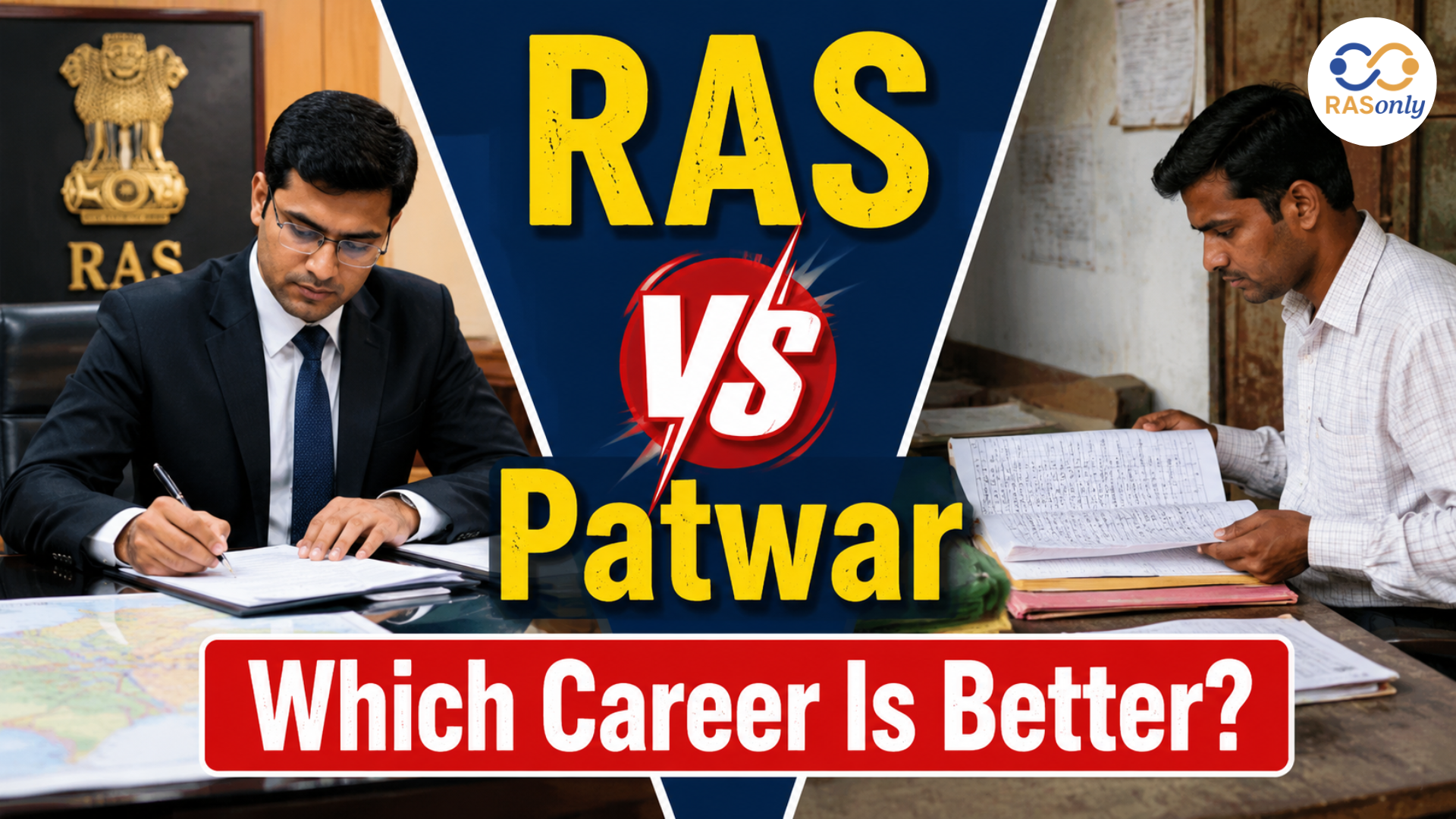
RAS vs Patwar is one of the most common comparisons among Rajasthan government job aspirants because both posts offer job security, a regular salary, and long-term benefits. The two roles are, however, at distinct levels of the administrative system. RAS (Rajasthan Administrative Service) is a gazetted, executive-level service, while Patwar is a village-level post in the revenue department.
This is an updated guide that compares both jobs on exam pattern, eligibility, salary, work pressure, authority, and promotion. It will give you the chance to select the course you are best able to take, the time you need to prepare, and your future objectives. Figures such as age limits and pay are based on the latest information available. Before applying, check them in the official notifications of RPSC and RSSB.
Understanding RAS: Role and Responsibilities
RAS is the best civil service of the state of Rajasthan, and recruitment is done by the Rajasthan Public Service Commission (RPSC). Selected candidates are appointed to key executive posts such as Sub-Divisional Magistrate (SDM) and other administrative roles across departments.
Key responsibilities:
- Implementing government policies at the sub-division and district level
- Maintaining law and order in the assigned jurisdiction
- Supervising revenue administration and development work
- Coordinating with departments during public programmes and emergencies
Understanding Patwar: Role and Responsibilities
A village-level revenue post whose job is to keep proper records of land. Recruitment is conducted by the Rajasthan Staff Selection Board (RSSB). The Patwari is the first point of contact between villagers and the revenue administration.
Key responsibilities:
- Maintaining land records such as Khasra and Khatauni
- Making entries of transfers and mutations
- Collecting village-level revenue and crop-related data
- Conducting field inspections and surveys
RAS vs Patwar Exam Pattern
The difference between the two posts is greatest in terms of the selection process. RAS has three stages, including a descriptive Mains and a personal interview. The recruitment for Patwars is simpler and focused on a written exam. The table below shows the difference.
| Particulars | RAS | Patwar |
|---|---|---|
| Conducting body | RPSC | RSSB |
| Selection stages | Prelims, Mains, Interview | Written Exam and Document Verification |
| Exam type | Objective (Prelims) + Descriptive (Mains) | Objective (MCQ-based) |
| Interview | Yes | No |
| Difficulty level | High | Moderate |
RAS vs Patwar Eligibility Criteria
The age limits and additional requirements are different for both posts, and both require a graduation course from a recognised university. Relaxation in age for reserved category as per government rules. Please refer to the latest notification for exact limits/cuttoffs.
| Particulars | RAS | Patwar |
|---|---|---|
| Educational qualification | Graduation | Graduation |
| Computer qualification | Not separately required | Basic computer qualification as prescribed in the notification |
| Minimum age | 21 years | 18 years |
| Maximum age | 40 years (relaxation applicable) | 40 years (relaxation applicable) |
| Nationality | Indian citizen | Indian citizen |
RAS vs Patwar Salary Comparison
The basic pay of an officer in the RAS starts from ₹56,100 and is as per the pay matrix of the state of Rajasthan, along with various allowances like DA and HRA. The post of Patwari falls in Pay Level 5, and the pay band is quite low for this post. In-hand pay varies based on DA changes, posting location, and any deductions (NPS).
| Aspect | RAS | Patwar |
|---|---|---|
| Entry basic pay | ₹56,100 | Pay Level 5 (lower pay band) |
| Approx. monthly in-hand | Roughly ₹70,000 and above after probation (estimates vary) | Roughly ₹24,000 to ₹26,000 (estimates vary) |
| Allowances | DA, HRA and other state allowances | DA, HRA and other state allowances |
These are only approximate estimates and not official figures available from public estimates. Please confirm them with the latest Pay Rules of the State of Rajasthan.
Work Pressure in RAS vs Patwar
There are a lot of differences between the two roles when it comes to the nature of the work and the pressure of the day. The work of RAS officers is heavy as they are responsible for implementation of policies, maintenance of law and order, and redress of public grievances. The work of patwars is primarily at the village level, in the context of records and field inspection, with the pressure of work being less and the work being more routine.
- RAS: Administrative and managerial tasks, high level of accountability, regular job changes.
- Patwar: Work in the field, related to revenue, and having little decision-making power.
Job Security and Benefits
The job of RAS and Patwar is permanent, and employment is secure; salary revision and retirement benefits are regular. Security is thus not the determining factor. The true distinction is in the authority, the range of the job, and how far you can go up the chain.
Career Growth in RAS vs Patwar
The range of development possibilities is much larger for RAS. The officers get promoted from SDM to senior administrative posts throughout the course of their career, and RAS officers may be considered for promotion to Indian Administrative Service (IAS) as per the rules. A Patwar may get promoted in the departments, typically the revenue department, and will be limited in number.
- RAS: Greater promotion prospects, senior leadership opportunities, and potential IAS promotion.
- Patwar: Promotion is based on seniority, vacancies, and departmental rules; thus, growth is slower.
Competition Level: Which Exam Is Tougher?
RAS is considered the tougher exam because of its three-stage selection, descriptive papers, and a very low selection ratio compared to the number of applicants. There are also several other tests that have considerable numbers of interested candidates, such as the Patwar, which has an objective-type paper and a simpler syllabus. Depending on how many vacancies there are in a particular recruitment cycle, the difficulty in both cases is the number of vacancies.
RAS vs Patwar Preparation Strategy
There is a difference in preparation because in RAS, emphasis would be on depth and writing skills, while in Patwar, emphasis would be on speed and accuracy in objective questions. Start by studying the syllabus and previous years' papers of the exam you are targeting.
| RAS preparation | Patwar preparation |
|---|---|
| In-depth study of Rajasthan GK, history, polity, and geography | Strong focus on Rajasthan GK |
| Current affairs analysis | Maths and reasoning practice |
| Regular answer writing practice for Mains | Computer basics |
| Optional or paper-wise revision | Daily MCQ practice and mock tests |
Advantages and Disadvantages
There are definite advantages and disadvantages to each career. The better you know them, the easier it is to have realistic expectations.
| Aspect | RAS | Patwar |
|---|---|---|
| Advantages | Higher salary, strong authority, better career growth, respected gazetted position | Simpler exam, shorter selection process, stable job |
| Disadvantages | Very tough exam, long preparation, intense competition, high work pressure | Lower salary, limited authority, slower promotion |
RAS or Patwar: Which Should You Choose?
When deciding on RAS vs Patwar, begin with your goals, the amount of time you have to prepare, and how comfortable you are with competition. They're both good government jobs, but they're for different priorities.
Choose RAS if you want:
- Higher salary and allowances
- The position of administrative control and leadership roles
- Wider promotion and career growth
Choose Patwar if you want:
- An easier recruitment process
- A quicker entry into government service
- Revenue work at the field level that is stable.
Also Read
| RAS Syllabus | RAS Exam Pattern |
| RAS Exam Date | RAS Preparation Tips |
| RAS Previous Year Papers | RAS Salary |
Conclusion
Overall, RAS vs Patwar comes down to ambition, preparation time, and the kind of work you want to do. RAS is an appropriate fit for candidates who are willing to undergo a lengthy and competitive selection and aspire to authority, leadership, and higher remuneration. In short, the patwar posts are presented for candidates who wish to get a stable government job through a shorter and objective selection process. Both have job security, but they have significantly different pay, scope of power, and promotion relative to each other. Always refer to the official notification before applying and select the suitable exam according to your ability and time.
FAQs
RAS is better for candidates who want a higher salary, more authority, and stronger career growth. Patwar is better for those who want a stable government job with a simpler selection process.
Yes. RAS has three stages (Prelims, Mains, and Interview) with descriptive papers and a very low selection ratio. Patwar is mainly an objective written exam, so it is generally considered easier.
RAS has better career growth, with senior administrative posts and a possible promotion route to IAS. Patwar promotions exist within the revenue department but are slower and limited.
Yes, a graduation degree from a recognised university is required for both posts. Patwar also requires a computer qualification as specified in the notification.
RAS officers hold far more authority, including executive and magisterial powers in roles like SDM. A Patwar works at the village level with limited decision-making power.

BEST SELLER
🏆 PRELIMS
RAS Pass
Prelims focused Hindi & English
₹399
✓
Prelims Topic-Wise Tests
✓
Subject-Wise Tests
✓
Full-Length Prelims Tests
✓
Daily Current Affairs Tests
✓
Prelims PYQs Tests
✓
Detailed Solutions & Analysis
✓
All Rajasthan Ranking
✓
Unlimited Reattempts
✓
Mains Tests
✓
Hindi & English Tests
✓
All Rajasthan Ranking
Trusted by 5,000+ Students
Post Category
- RAS Salary
- Result
- RAS Admit Card
- RAS Job
- RAS Cutoff
- Preparation Tips
- RAS Answer Key
- RAS Exam Analysis
- RAS Syllabus
- RAS Previous Year Papers
- RPSC RAS Exam Pattern
- RAS Interview
- RAS Exam Date
- RAS Vacancy
- RAS Test Series
- RAS Best Books
- RAS Preparation Resources
- RAS Coaching Centre
- History
- Polity
- Geography
- Economics
- Science
- Art and Culture
- RPSC RAS Application Form
- RPSC RAS Notification
- RAS Eligibility Criteria
- UPSC Exam
- RPSC RAS Mains
Visit Our RASonly Offline Center
Our Expert Faculty

Bhunesh Sir
Current Affairs · 13+ Yrs

Aamir Khan Sir
RAS-2017 · IIM Ahm.

Akash Sir
Polity · 8+ Yrs
Free Resources
Official Mobile App

RASOnly App
by OTSAdda · Free
Full Video Lectures
Mock Tests & PYQs
Daily Current Affairs
AI Mock Interview
Free Download · No subscription needed to install
RAS 2024 Toppers — RASonly
Rank 2
Virendra Charan
Rank 9
Bhoopinder Singh
Rank 26
Aanchal Nagpal
Rank 33
Lokendra Singh
Rank 45
Amar Rathore
Rank 46
Manasvini Verma

Join RASonly WhatsApp Community
Get daily current affairs, exam alerts, free study material and tips from expert faculty — right on WhatsApp.
Join for Free →RASonly Interview Guidance Program

Mr. Ashok Jain
Ex-Chief Secretary Govt of Rajasthan
- IAS officer of the 1981 batch, Rajasthan cadre.
- Passionate about mentoring the next generation of RAS officers with real-world insights.
- Got retired in Dec 2017 from the post of Chief Secretary of the state of Rajasthan.

Mr. Guru Charan Rai
Ex-ASP / SP in Jaisalmer
- Guru Charan Rai, IPS (Retd), retired as Inspector General of Police (Security), Rajasthan, Jaipur in 2017.
- Served as ASP and SP in Jaisalmer, Nagaur, Sri Ganganagar, Sawai Madhopur, Dausa, Sikar, and Karauli.
- He also held key positions as DIGP and IGP in the Law and Order division.

Mr. Rakesh Verma
Ex-IAS Officer, B.Tech, MBA, and M.A. (Economics)
- IAS officer of the 1981 batch and retired in Chief Secretary Rank.
- Civil servant of high repute and vast experience.
- Has been teaching UPSC CSE subjects for the last six years.
Related Post




Daily Current Affairs for RAS Exam Preparation 2026
9th Rashtriya Poshan Maah 2026
October 16, 2026
Seva Sankalp, Khadi Mahotsav 2026
October 16, 2026
Conclusion of Multinational Exercise Tarang Shakti 2.0
October 15, 2026