Public Policy in India: Meaning, Types, Process, Importance and Challenges
Minerals of Rajasthan: Metallic and Non-Metallic Resources (Complete RAS Notes 2026)

Get in Touch with RASonly!

Minerals of Rajasthan make the state one of India's richest mineral-bearing regions, often called the "Mineral Capital of India." From the ancient Aravalli range to the hydrocarbon-rich Western Desert Basin, Rajasthan produces nearly 22% of India's total mineral output and ranks 1st in non-metallic mineral production nationwide. With 81 identified mineral types across zinc, lead, copper, marble, and gypsum, this guide covers everything RAS aspirants need - metallic minerals, non-metallic resources, key locations, and recent policy updates.

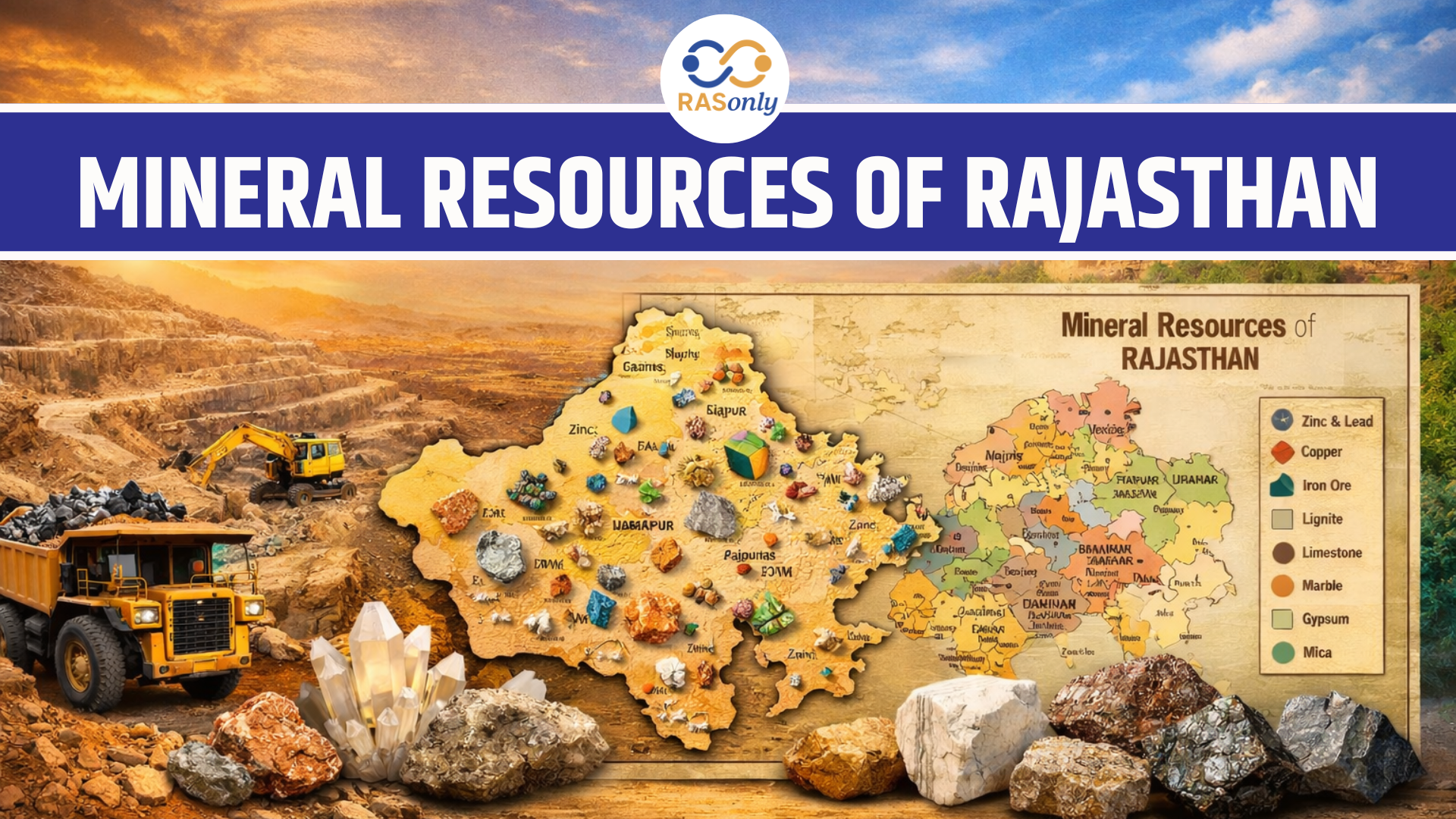
Rajasthan is one of India's richest mineral-bearing states and is often referred to as the "Mineral Capital of India." Spread across a geologically diverse landscape - from the ancient Aravalli mountain range to the sedimentary plains of the Vindhyan basin and the hydrocarbon-rich Western Desert Basin - the state produces nearly 22% of India's total mineral output. It ranks 1st in the country in non-metallic mineral production and 2nd overall in mineral reserves, just behind Jharkhand.
For a state that occupies only about 10.4% of India's land area, this concentration of mineral wealth is remarkable. Rajasthan is home to 81 identified mineral types, of which 58 are currently under active mining - 22 major minerals and 36 minor minerals. This mineral base is not just a geological curiosity; it is the backbone of major industries in the state, including cement, ceramics, glass, fertilizers, and dimensional stone exports, and it directly feeds employment across mining belts in Udaipur, Bhilwara, Nagaur, Jhunjhunu, and the western desert districts.
For RAS aspirants, this topic sits at the intersection of Rajasthan Geography, Economic Development, Industrial Location, and Environmental Governance - making it relevant for both Prelims (factual recall) and Mains (analytical, policy-based answers).
Why Is Rajasthan So Mineral-Rich? The Geological Foundation
Rajasthan's exceptional mineral diversity stems directly from its complex geological history, which spans some of the oldest rock formations on Earth. The state's mineral distribution can be understood through three broad geological zones, each hosting a distinct category of resources.
The Aravalli Metamorphic Belt, running diagonally across the state from the southwest to the northeast, is composed of some of the oldest rocks in India (Archaean and Proterozoic). This belt is where almost all of Rajasthan's metallic minerals are concentrated - copper, zinc, lead, silver, and iron - along with marble, which forms through the metamorphism of limestone under heat and pressure. The Vindhyan Sedimentary Basin, located in the southeastern part of the state, consists of layered sedimentary rocks and is the source of limestone, sandstone, and Kota stone - materials central to the construction and cement industries. Finally, the Western Desert Basin, covering Barmer, Jaisalmer, Bikaner, and Nagaur, is a much younger sedimentary basin that holds Rajasthan's energy minerals: petroleum, natural gas, lignite, and large gypsum deposits formed in ancient dried-up lake beds (paleochannels).
Understanding this three-way geological division is one of the highest-yield conceptual points for RAS Prelims, since most questions on "which district produces which mineral" can be reasoned out once you know which geological belt that district falls into.
Metallic Minerals of Rajasthan
Although Rajasthan does not lead India in the sheer volume of metallic mineral output, the quality of its metallic ores is exceptionally high, and in specific minerals - zinc and lead most notably - the state holds a virtual national monopoly. This section covers each major metallic mineral in detail.
Metallic Minerals at a Glance
| Mineral | Top Producing Area | Major Use | National Position |
|---|---|---|---|
| Zinc | Zawar, Rajpura-Dariba, Rampura Agucha (Bhilwara), Kayad, Sindesar Khurd | Galvanizing, alloys (brass), batteries | Largest/sole producer — near-monopoly |
| Lead | Zawar, Rajpura-Dariba (with Zinc) | Batteries, cable sheathing, ammunition | Largest/sole producer — near-monopoly |
| Copper | Khetri Belt (Jhunjhunu), Kho-Dariba (Alwar), Anjani-Umara & Debari (Udaipur) | Electrical wiring, alloys, industrial equipment | Major producer (Khetri = "Copper Capital of India") |
| Silver | Zawar, Rajpura-Dariba (by-product of Zn-Pb refining) | Jewellery, electronics, industrial catalysts | Top silver-producing state |
| Iron Ore | Jaipur, Sikar, Bhilwara, Udaipur | Steel manufacturing | High quality, but low volume (not a leading state) |
| Manganese | Banswara, Sawai Madhopur (new deposits: Jaipur, Alwar) | Steel-making, fertilizers, paint pigments | Minor/limited producer |
| Tungsten | Degana (Nagaur district) | Iron alloys, bulb filaments (historically) | India's sole producer |
1. Zinc and Lead
Rajasthan is India's largest - effectively sole - producer of zinc and lead ore, a fact that surprises many because these metals rarely come up in everyday conversation about "Indian minerals," yet the state supplies almost the entire domestic requirement. The primary mining belt stretches through Zawar, Rajpura-Dariba, Kayad, and Sindesar Khurd, all located in and around Udaipur and Bhilwara districts.
The dominant player here is Hindustan Zinc Limited (HZL), part of the Vedanta Group, which operates what is recognized as the world's largest zinc mine at Rampura Agucha in Bhilwara district, along with major operations at Zawar and Kayad. The Rajpura-Dariba deposit deserves special mention as one of India's richest polymetallic deposits - a single ore body yielding zinc, lead, copper, and silver together, which makes it disproportionately valuable relative to its size.
2. Copper
Copper mining in Rajasthan has one of the longest histories of any mineral in the state, with evidence of ancient workings dating back centuries. Today, the Khetri Copper Belt in Jhunjhunu district - operated by the public-sector Hindustan Copper Limited (HCL) - is so central to India's copper output that Khetri is popularly known as the "Copper Capital of India." Additional copper-producing areas include Kho-Dariba in Alwar and Anjani-Umara and Debari near Udaipur.
3. Silver
Silver in Rajasthan is largely a by-product of zinc-lead ore refining, extracted during the smelting process at Zawar and Rajpura-Dariba. Despite being a by-product, the volumes are significant enough that Rajasthan ranks among India's top silver-producing states.
4. Iron Ore
This is a frequent point of confusion for exam candidates: Rajasthan is not a major iron ore state by volume - that distinction belongs to Odisha, Chhattisgarh, and Jharkhand — but the iron ore that is found here, mainly in Jaipur, Sikar, Bhilwara, and Udaipur, is of notably high quality. Candidates should be careful not to overstate Rajasthan's role in India's iron ore economy in Mains answers.
5. Manganese
Manganese deposits in Rajasthan are limited and scattered, found mainly in Banswara and Sawai Madhopur, with newer surveyed deposits emerging in Jaipur and Alwar. Manganese is used chiefly in steel-making, fertilizers, and paint pigments.
6. Tungsten
Rajasthan holds a unique distinction as India's only producer of tungsten, sourced entirely from Degana in Nagaur district. Tungsten is used in making iron alloys and, historically, in incandescent bulb filaments.
Non-Metallic Minerals of Rajasthan
This is the category where Rajasthan truly dominates the national picture. The state enjoys a virtual monopoly in several non-metallic minerals and leads India in others, making this section the single most exam-critical part of the topic.
Non-Metallic Minerals at a Glance
| Mineral | Top Producing Area | Major Use | National Position |
|---|---|---|---|
| Gypsum | Bikaner, Nagaur, Jodhpur | Cement, Plaster of Paris, fertilizers | Largest producer (~90%+ national share) |
| Rock Phosphate | Jhamarkotra (Udaipur) | Fertilizer manufacturing | Leading producer |
| Marble | Makrana (Nagaur), Rajsamand, Udaipur | Construction, sculpture, flooring | Leading producer (~90% of India's marble) |
| Sandstone | Jodhpur, Kota, Dholpur | Construction, flooring | Leading producer |
| Feldspar | Ajmer, Udaipur, Sikar, Alwar | Ceramics, glass manufacturing | Leading producer |
| Mica | Bhilwara–Udaipur belt | Electrical insulation | Significant producer |
| Wollastonite, Selenite, Calcite | Various Aravalli locations | Ceramics, chemical industry | Near-monopoly / sole producer |
| Asbestos | Kherwara, Rikhabdeo (Udaipur) | Roofing sheets, pipes | Leading producer |
| Salt | Sambhar Lake | Edible and industrial salt | Major inland source |
Marble - Rajasthan's Signature Mineral
If one mineral defines Rajasthan in the popular imagination, it is marble, and specifically Makrana marble, quarried in Nagaur district. Makrana is among the oldest marble-producing regions in India, and its stone is prized for exceptional whiteness and durability - qualities that led to its use in the construction of the Taj Mahal and the Victoria Memorial. Beyond Makrana, significant marble deposits are also worked in Rajsamand and Udaipur, including "green marble" (serpentine), where Rajasthan again holds a near-monopoly position.
Rock Phosphate and the Jhamarkotra Deposit
The Jhamarkotra rock phosphate deposit in Udaipur district is not just important for Rajasthan - it is recognized as one of the largest phosphate deposits in the world, and it plays a direct role in India's fertilizer security, since phosphate is a core input for phosphatic fertilizers. This deposit is operated by Rajasthan State Mines and Minerals Limited (RSMML).
Gypsum
Gypsum, a soft hydrated calcium sulphate mineral, is found in paleochannels - the buried beds of ancient rivers - across Bikaner, Nagaur, and Jodhpur. Rajasthan alone accounts for the overwhelming majority of India's gypsum production, feeding cement plants, Plaster of Paris manufacturing, and the fertilizer industry.
Other Notable Non-Metallic Minerals
Sandstone and Kota Stone are dimensional/building stones central to Rajasthan's construction export economy - Kota stone in particular is valued for its durability and affordability in flooring applications. Feldspar, sourced from Ajmer, Udaipur, Sikar, and Alwar, feeds the ceramics and glass industries, where Rajasthan is the country's chief producer. Mica, concentrated along a northeast–southwest belt through Bhilwara and Udaipur, is used primarily for electrical insulation. Sambhar Lake, India's largest inland salt lake, is a major - and frequently overlooked - source of salt, and exam-setters often use it as a trap question since students tend to associate salt only with coastal states.
Energy Minerals of the Western Desert Basin
Beyond metallic and non-metallic minerals, Rajasthan's Western Desert Basin - covering Barmer, Jaisalmer, and Bikaner - has emerged as an important energy resource frontier over the last two decades. Petroleum reserves in the Barmer basin have transformed the region's economic profile, supporting both extraction and, more recently, refining infrastructure. Natural gas has been discovered in the Jaisalmer basin, at sites including Manohar Tibba, Tanot, and Shahgarh. Lignite, a low-grade coal, is mined in the Bikaner-Nagaur basin and is used for thermal power generation, giving the state a degree of energy self-sufficiency that is unusual for a largely arid region.
Institutional Framework Supporting the Mining Sector
Several institutions govern and operate Rajasthan's mineral economy. Rajasthan State Mines and Minerals Limited (RSMML) is the key state undertaking responsible for mining and marketing non-metallic minerals - rock phosphate, lignite, limestone, and gypsum - through dedicated Strategic Business Units. Hindustan Zinc Limited (HZL), under the Vedanta Group, is the dominant private player in zinc-lead mining and refining. Hindustan Copper Limited (HCL), a central public-sector enterprise, operates the Khetri copper belt. Overseeing all of this at the state level is the Department of Mines and Geology (DMG), Rajasthan, which regulates leases, licenses, and increasingly runs digital governance through its DMG-OMS portal for maintaining digital maps of mining leases and quarry licenses.
Recent Developments and Government Policy (Current Affairs Relevance)
This section is particularly valuable for Mains answers, since RAS examiners often look for candidates who can connect static geography with current policy.
Under the Rajasthan Investment Promotion Scheme, 2024, the state government has introduced a substantial incentive package for mining and mineral-based industries — including a 75% investment subsidy on state tax dues for ten years, 50% reimbursement of employer EPF/ESI contributions for seven years (for domiciled employees), 75% stamp duty exemption, and full electricity duty exemption for seven years. The state has also outlined an ambitious long-term roadmap: expanding the mineral concession area from 0.68% to 2.0% of state area by 2046-47, increasing the number of actively extracted minerals from 58 to 70, and auctioning 50 major mineral blocks with pre-embedded clearances by 2029-30. The mining sector's contribution to Rajasthan's GSDP is targeted to rise from 3.4% in 2023-24 to 8.0% by 2046-47, alongside employment targets of 50 lakh people by 2029-30, rising to over 1 crore (direct and indirect) by 2046-47.
Two specific projects worth remembering: the Kotputli Zinc City project, a new zinc-lead processing hub under development, and Rajasthan's first oil refinery at Barmer (BS-VI standard), which will also host an integrated petrochemical complex - marking the state's shift from raw extraction toward downstream, value-added industry.
Environmental Concerns Linked to Mining
Mining, particularly in the ecologically sensitive Aravalli region, has generated well-documented environmental concerns that frequently appear in Mains-style analytical questions. Aravalli denudation - the physical erosion and depletion of the hill range due to decades of quarrying - remains an ongoing concern despite conservation efforts. Near Makrana, marble slurry (the sludge byproduct of cutting and polishing marble) has accumulated into large "white hills," contaminating agricultural land and water bodies in surrounding areas. Elsewhere, acid mine drainage from metallic mineral operations has caused water contamination, while dust from stone-cutting and polishing contributes to localized air pollution. Mining activity in forested tracts of the Aravallis has also led to biodiversity loss and habitat displacement for local wildlife.
Quick Revision Points
- Rajasthan is the sole/near-sole producer of Lead, Zinc, Selenite, and Wollastonite.
- Rajasthan is the largest producer of Silver, Calcite, Gypsum, Rock Phosphate, Marble, Sandstone, and Feldspar.
- Rajasthan is not a major iron ore state by volume - don't confuse ore quality with national ranking.
- Marble is metamorphic (derived from limestone); Granite is igneous - they are mined in different zones and often confused in exams.
- Five location names cover most Prelims questions on this topic: Zawar, Rajpura-Dariba, Khetri, Makrana, Jhamarkotra, plus Degana for tungsten.
- Sambhar Lake (salt) is a commonly missed fact - remember Rajasthan's inland salt production.
Important Links
Conclusion
Rajasthan's mineral wealth is not just a geography footnote - it's a story that runs through the state's economy, industry, and even its most iconic monument. From the zinc mines of Zawar to the marble quarries of Makrana that gave the Taj Mahal its glow, the state's metallic and non-metallic resources have shaped both its identity and its GSDP. For RAS aspirants, mastering this topic means connecting three things: the geological belts that decide where each mineral is found, the specific districts and companies (HZL, HCL, RSMML) tied to each resource, and the current policy push - like the Rajasthan Investment Promotion Scheme, 2024 - driving the sector's future. Get these three layers right, and questions on Minerals of Rajasthan become one of the most scoring topics in both Prelims and Mains.
FAQs
Rajasthan produces the widest range of minerals of any Indian state and holds a monopoly or leading national position in zinc, lead, marble, gypsum, and several other non-metallic minerals.
Zinc, lead, wollastonite, and selenite - Rajasthan is virtually the sole domestic producer of these.
At Rampura Agucha in Bhilwara district, operated by Hindustan Zinc Limited.
Makrana in Nagaur district - the marble used in the Taj Mahal was sourced from here.
Degana in Nagaur district.
BEST SELLER
🏆 PRELIMS
RAS Pass
Prelims focused Hindi & English
₹399
✓
Prelims Topic-Wise Tests
✓
Subject-Wise Tests
✓
Full-Length Prelims Tests
✓
Daily Current Affairs Tests
✓
Prelims PYQs Tests
✓
Detailed Solutions & Analysis
✓
All Rajasthan Ranking
✓
Unlimited Reattempts
✓
Mains Tests
✓
Hindi & English Tests
✓
All Rajasthan Ranking
Trusted by 5,000+ Students
Post Category
- RAS Salary
- Result
- RAS Admit Card
- RAS Job
- RAS Cutoff
- Preparation Tips
- RAS Answer Key
- RAS Exam Analysis
- RAS Syllabus
- RAS Previous Year Papers
- RPSC RAS Exam Pattern
- RAS Interview
- RAS Exam Date
- RAS Vacancy
- RAS Test Series
- RAS Best Books
- RAS Preparation Resources
- RAS Coaching Centre
- History
- Polity
- Geography
- Economics
- Science
- Art and Culture
- RPSC RAS Application Form
- RPSC RAS Notification
- RAS Eligibility Criteria
- UPSC Exam
- RPSC RAS Mains
Visit Our RASonly Offline Center
Our Expert Faculty

Bhunesh Sir
Current Affairs · 13+ Yrs

Aamir Khan Sir
RAS-2017 · IIM Ahm.
Akash Sir
Polity · 8+ Yrs
Free Resources
Official Mobile App

RASOnly App
by OTSAdda · Free
Full Video Lectures
Mock Tests & PYQs
Daily Current Affairs
AI Mock Interview
Free Download · No subscription needed to install
RAS 2024 Toppers — RASonly
Rank 2
Virendra Charan
Rank 9
Bhoopinder Singh
Rank 26
Aanchal Nagpal
Rank 33
Lokendra Singh
Rank 45
Amar Rathore
Rank 46
Manasvini Verma

Join RASonly WhatsApp Community
Get daily current affairs, exam alerts, free study material and tips from expert faculty — right on WhatsApp.
Join for Free →RASonly Interview Guidance Program

Mr. Ashok Jain
Ex-Chief Secretary Govt of Rajasthan
- IAS officer of the 1981 batch, Rajasthan cadre.
- Passionate about mentoring the next generation of RAS officers with real-world insights.
- Got retired in Dec 2017 from the post of Chief Secretary of the state of Rajasthan.

Mr. Guru Charan Rai
Ex-ASP / SP in Jaisalmer
- Guru Charan Rai, IPS (Retd), retired as Inspector General of Police (Security), Rajasthan, Jaipur in 2017.
- Served as ASP and SP in Jaisalmer, Nagaur, Sri Ganganagar, Sawai Madhopur, Dausa, Sikar, and Karauli.
- He also held key positions as DIGP and IGP in the Law and Order division.

Mr. Rakesh Verma
Ex-IAS Officer, B.Tech, MBA, and M.A. (Economics)
- IAS officer of the 1981 batch and retired in Chief Secretary Rank.
- Civil servant of high repute and vast experience.
- Has been teaching UPSC CSE subjects for the last six years.
Related Post

Daily Current Affairs for RAS Exam Preparation 2026
Justice Agrawal Becomes 44th CJ of Rajasthan HC
September 08, 2026
Udaipur Air Pollution August 2026
September 08, 2026
Justice Sanjay Agrawal New Rajasthan HC Chief Justice
September 07, 2026