Kushan Empire: History, Rulers, Administration, Economy, Art, Decline
Rajasthan Tribes & Scheduled Areas – Constitutional Framework, Governance & Tribal Development for RAS 2026

Get in Touch with RASonly!

Rajasthan Tribes & Scheduled Areas form a crucial part of Rajasthan Polity, Social Justice, and Tribal Governance for RAS 2026. Understanding Fifth Schedule provisions, PESA Act, FRA 2006, and Tribal Sub-Plan is essential for high-scoring Prelims and Mains answers.

Rajasthan Tribes & Scheduled Areas form a core component of Rajasthan Polity, Social Justice, Tribal Administration, Governance, and Inclusive Development topics for RPSC RAS Prelims, Mains, and Interview 2026. Rajasthan has a large concentration of Scheduled Tribes (ST), with most of them being located in the southern and southeastern districts, which fall under the Fifth Schedule of the Indian Constitution. The tribal demography, constitutional protections, administration of Scheduled Areas, implementation of the PESA Act, the concept of Tribal Sub-Plan (TSP), the Forest Rights Act (FRA), and the challenges in tribal development are the main factors that should be understood in preparation specific to Rajasthan.
There are three major tribes in India, but among the states that are significant in respect to tribalism, Rajasthan has the largest population,n numbering about 13.48% of the total population, according to Census 2011. The tribal belt will run through the southern districts of Gujarat and Madhya Pradesh. This is also known as the Tribal Sub-Plan (TSP) Area in Rajasthan. For RAS 2026, this topic is highly relevant.
- Rajasthan Polity & Governance
- Social Justice & Welfare Administration
- Decentralization & Panchayati Raj
- Inclusive Growth & Tribal Development
- Constitutional Provisions (Fifth Schedule)
1. Tribal Demography of Rajasthan
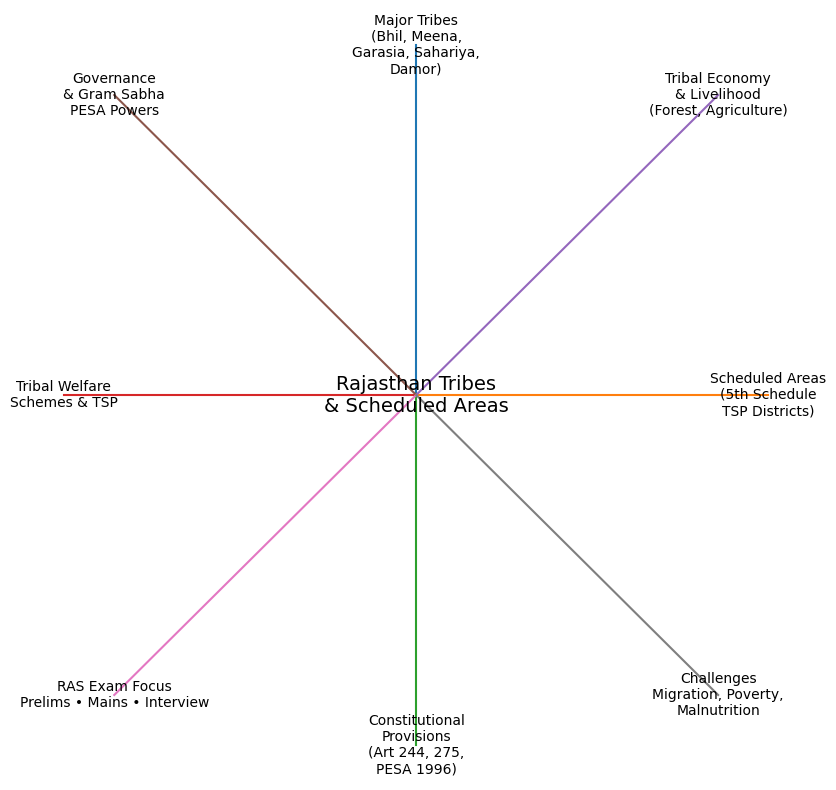
The Scheduled Tribe population of Rajasthan is very high, with most of the population being found in the southern and southeastern parts of the state. These tribal societies constitute a significant element of the social system, cultural heritage, and the rural economy of Rajasthan. Knowledge of tribal distribution, demographic trends, and socio-economic features is necessary regarding Rajasthan-specific polity, governance, and social justice issues in competition tests.
Major Scheduled Tribes in Rajasthan
Scheduled Tribes in Rajasthan are notified under Article 342 of the Constitution of India. The following are the major tribal communities along with their regional concentration and defining features:
| Tribe | Region of Concentration | Key Characteristics |
|---|---|---|
| Bhil | Udaipur, Dungarpur, Banswara, Pratapgarh | Largest tribe; forest-based and rain-fed agriculture livelihood |
| Meena | Eastern Rajasthan (Jaipur, Dausa, Sawai Madhopur, Karauli) | Agrarian base; significant socio-political presence |
| Garasia | Sirohi, Udaipur | Pastoral-agricultural economy; distinct customary practices |
| Sahariya | Baran district (Kishanganj & Shahbad) | Classified as a Particularly Vulnerable Tribal Group (PVTG) |
| Damor | Southern Rajasthan | Marginal farming and seasonal wage labour |
Key Examination-Oriented Facts
- The Bhil tribe is the largest Scheduled Tribe in Rajasthan and dominates the southern tribal belt.
- The Sahariya tribe is officially recognized as a Particularly Vulnerable Tribal Group (PVTG) due to socio-economic backwardness and high vulnerability.
- Tribal concentration is highest in districts falling under the Fifth Schedule Areas of Rajasthan.
Important Concepts for Preparation
- Scheduled Tribes under Article 342
- Tribal population distribution in Rajasthan
- PVTG classification and vulnerability indicators
- Tribal Sub-Plan (TSP) areas
- Socio-economic profile of the southern tribal belt
2. Scheduled Areas in Rajasthan (Fifth Schedule Framework)
Scheduled Areas in Rajasthan are constitutionally protected tribal regions identified for special administrative safeguards and development interventions. They are announced in the Fifth Schedule of the Constitution of India and are intended to secure land rights of the tribes, their culture, traditional ways, and socio-economic interests. Learning Scheduled Areas is a must when discussing such things as tribal governance, provisions that are made by the constitution, decentralization, and social justice.
Constitutional Basis of Scheduled Areas
Scheduled Areas are declared under:
- Article 244(1) – Administration of Scheduled Areas and Tribal Areas
- Fifth Schedule – Special governance provisions for Scheduled Areas
These provisions enable the Governor and the Union Government to protect the legislation, stop the alienation of the land, and enhance the welfare of the tribes.
Scheduled Areas of Rajasthan
As per Presidential Orders (including subsequent amendments), the following regions are classified as Scheduled Areas in Rajasthan:
Entire Districts:
- Banswara
- Dungarpur
- Pratapgarh
- Udaipur
Specific Areas:
- Abu Road Tehsil (Sirohi district)
- Kishanganj and Shahbad Tehsils (Baran district)
Such areas are included in the Tribal Sub-Plan (TSP) system, and thus special attention is given tothe allocation of funds and development programs to Scheduled Tribes.
Constitutional Framework for Scheduled Areas
| Provision | Purpose |
|---|---|
| Article 244(1) | Administration of Scheduled Areas |
| Fifth Schedule | Special governance and regulatory framework |
| Article 275(1) | Grants-in-aid from the Union to the States for tribal welfare |
| Article 339 | Union oversight of tribal administration |
| Article 342 | Specification of Scheduled Tribes |
Governance Significance
- The governor has special powers to modify or suspend state laws in Scheduled Areas.
- Tribal Advisory Council (TAC) is constituted to advise on tribal welfare matters.
- Focus on preventing land alienation and exploitation of tribal communities.
- Development planning aligned with Tribal Sub-Plan priorities.
3. Governance Structure in Scheduled Areas
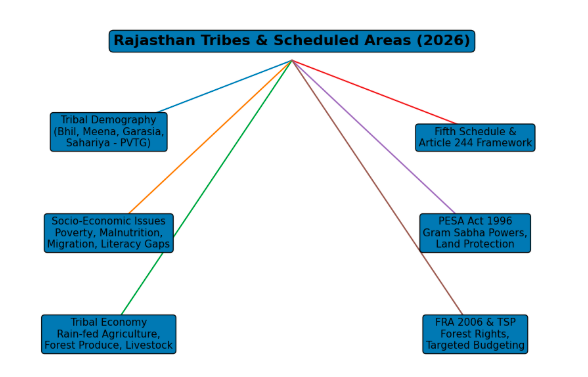
The politics of the Scheduled Areas of Rajasthan is made based on the Fifth Schedule of the Constitution to provide protection of tribal land, culture, and socio-economic rights. It offers special administration safeguards using discretionary powers of the Governor and the tribal Advisory Council (TAC) to retain the tribal-based development policies as constitutional and safe.
Role of the Governor (Fifth Schedule Powers)
Under the Fifth Schedule, the Governor holds special authority in Scheduled Areas:
- Can modify or restrict the application of state laws in Scheduled Areas.
- Can issue regulations for peace and good governance.
- Can prohibit or regulate the transfer of tribal land to non-tribals.
- Can regulate money-lending activities to prevent tribal exploitation.
- Submits annual reports to the President regarding the administration of the Scheduled Areas.
These powers ensure land protection, prevention of exploitation, and preservation of tribal autonomy.
Tribal Advisory Council (TAC)
The Tribal Advisory Council is a constitutional body established in states having Scheduled Areas.
Key Features:
- Advises the Governor on matters related to the welfare and advancement of Scheduled Tribes.
- The majority of members must be Scheduled Tribe MLAs from the State Legislative Assembly.
- Focuses on development planning, tribal rights protection, and policy implementation.
The TAC acts as a consultative bridge between tribal communities and state governance mechanisms.
4. PESA Act, 1996 in Rajasthan
The Panchayats ( Extension to Scheduled Areas) Act, 1996 (PESA) is a historic law that produces self-government in the tribal environments situated under the Fifth Schedule. The Scheduled Areas of Rajasthan under PESA enhance the power of Gram Sabha, safeguard the traditional tribal culture, and participatory democracy. Of high importance are questions of decentralization, tribal autonomy, and grassroots governance.
Key Features of PESA
- Gram Sabha is the central authority in decision-making
- Mandatory consultation before land acquisition and rehabilitation
- Ownership rights over minor forest produce (MFP)
- Protection of customary laws and traditional dispute resolution systems
- Prevention of land alienation in tribal areas
- Control over local resources and village-level planning
Mains Perspective
- Grassroots democracy model
- Decentralization of power
- Participatory governance
- Tribal self-rule framework
PESA reflects the constitutional vision of empowering tribal communities through democratic decentralization.
5. Tribal Sub-Plan (TSP) in Rajasthan
The Tribal Sub-Plan (TSP) is a special development plan that makes sure budgetary allocation of Scheduled Tribes is proportionate to their population. TSP is functional in Scheduled Areas, primarily in Rajasthan, where it is aimed at narrowing down regional and socio-economic disparities.
Focus Areas Under TSP
| Sector | Intervention |
|---|---|
| Education | Ashram schools, hostels, and scholarships |
| Health | Tribal health centers, maternal care |
| Livelihood | Skill development, self-employment schemes |
| Infrastructure | Roads, irrigation, and electrification |
| Social Security | Pensions, financial inclusion |
Analytical Dimensions
- Area-based development approach
- Targeted welfare allocation
- Inclusive budgeting model
- Reducing the tribal development gap
TSP is frequently linked with inclusive growth, welfare state principles, and social justice in Mains answers.
6. Forest Rights Act (FRA), 2006
The Recognition of Forest Rights ( Schedule Tribes and Other Traditional Forest Dwellers ) Act, 2006, in recognition of historical injustices towards the forest-living communities. The tribal belt of Rajasthan is acutely in need of the FRA to get their right to tenure of land, livelihood security, and community resources.
Rights Recognized Under FRA
- Individual forest land rights
- Community forest resource rights
- Grazing and traditional usage rights
- Minor forest produce ownership
- Habitat rights for vulnerable groups
Analytical Importance
- Forest governance reform
- Land rights protection
- Environmental justice
- Tribal livelihood security
FRA has linked the sustainability of the environment with social equity, making it a highly interesting subject to RAS Mains.
7. Socio-Economic Issues in Tribal Areas
Tribal regions in Rajasthan still have developmental problems despite the constitutional protection and special schemes. These problems need to be addressed by balancing welfare issues and sustainable development strategies.
Major Issues
- High poverty levels
- Malnutrition (notably among the Sahariya tribe)
- Land alienation and displacement
- Seasonal migration
- Low literacy rates
- Limited irrigation access
- Healthcare infrastructure gaps
Tribal Economy in Rajasthan
Tribal livelihoods largely depend on:
- Rain-fed agriculture
- Animal husbandry
- Collection of forest produce
- Wage labour
- Seasonal migration
Climate Vulnerability
The southern tribal belt faces:
- Rainfall variability
- Soil erosion
- Drought risks
- Reduced agricultural productivity
These factors increase livelihood insecurity and migration pressure.
8. Development vs Tribal Rights Debate
This is an analysis topic that has a high score in RAS Mains. The problem here is whether economic development and constitutional protection of tribal rights can be balanced.
Key Policy Tensions
| Issue | Core Debate |
|---|---|
| Mining Projects | Economic growth vs tribal displacement |
| Forest Conservation | Ecological protection vs livelihood access |
| Infrastructure Projects | Development vs land alienation |
Mains Answer Approach
- Provide a balanced analysis
- Mention Fthe ifth Schedule safeguards
- Refer to PESA & FRA provisions
- Emphasize suthe stainable development model
- Highlight inclusive governance
An organized response that involves the constitutional protection and economic development views is a good score.
RAS Exam Strategy – How to Prepare Rajasthan Tribes & Scheduled Areas
Rajasthan Tribes & Scheduled Areas is a high-weightage topic in RPSC RAS because it connects the Constitution (Fifth Schedule, Article 244, Article 342), governance reforms (PESA, FRA), social justice, and inclusive development. The questions may be in the form of factual MCQ in Prelims, 15-20 marker questions in Mains, and opinion-based discussion in the Interview. Preparation is to be stage-specific, concept-specific, and Rajasthan-specific.
For Prelims
Focus on:
- Scheduled Area districts of Rajasthan
- Fifth Schedule provisions
- PESA Act features
- Sahariya as PVTG
- Tribal Advisory Council structure
For Mains
Prepare analytical themes such as:
- Tribal self-governance model
- Role of Gram Sabha under PESA
- Implementation challenges of the FRA
- Evaluation of Tribal Sub-Plan
- Inclusive growth and social justice
For Interview
Be ready to discuss:
- Current tribal development issues in Rajasthan
- Malnutrition concerns among vulnerable tribes
- Decentralization and empowerment
- Climate vulnerability in tribal belt
- Development vs rights debate
Analytical Themes for High-Scoring Answers
This subject scores high on RAS Mains when you are past description and are writing answers based on the analytical framework. You do not need to merely enumerate the provisions of the constitution or just schemes; base your answer on principles of governance, social justice theory, decentralization, and sustainable development models. Explaining the answer in transparent conceptual frameworks makes the answer mature, balanced, and policy-oriented.
Key Frameworks to Use:
Constitutional Morality & Tribal Rights
- Link the Fifth Schedule, PESA Act, and FRA with the protection of land, culture, and autonomy.
Welfare State & Social Justice
- Use Tribal Sub-Plan, education, health, and livelihood schemes to show inclusive growth.
Decentralization & Grassroots Democracy
- Highlight the role of Gram Sabha and tribal self-governance under PESA.
Sustainable Development Model
- Balance development projects with environmental protection and tribal rights.
Conclusion
Rajasthan Tribes & Scheduled Areas represent a critical intersection of constitutional governance, social justice, decentralization, and inclusive development. The Fifth Schedule framework, PESA Act, Tribal Sub-Plan, and Forest Rights Act are all meant to defend the identity of the tribes, their land, and self-governance, and enhance social-economic development.
In the case of RAS 2026 aspirants, this subject topic makes preparation in the field of Rajasthan Polity, Governance, Social Justice, and Rural Development stronger. Analytical knowledge, as opposed to memorization, is the key to scoring a high mark in Prelims and Mains.
FAQ
Scheduled Areas in Rajasthan are tribal-dominated regions notified under Article 244(1) and the Fifth Schedule of the Constitution, including Banswara, Dungarpur, Pratapgarh, Udaipur, Abu Road (Sirohi), and parts of Baran district.
The Sahariya tribe in Rajasthan is classified as a Particularly Vulnerable Tribal Group (PVTG) due to high poverty, malnutrition, and socio-economic backwardness.
The PESA Act 1996 empowers the Gram Sabha in Scheduled Areas, protects customary tribal laws, ensures consultation before land acquisition, and strengthens tribal self-governance.
The Tribal Sub-Plan Rajasthan ensures proportionate budget allocation for Scheduled Tribes, focusing on education, health, livelihood, infrastructure, and social security in tribal regions.
This topic is important for RAS Prelims (Fifth Schedule, PVTG, districts), Mains (tribal governance, FRA, PESA, inclusive growth), and Interview (tribal development issues and policy debate).
BEST SELLER
🏆 PRELIMS
RAS Pass
Prelims focused Hindi & English
₹399
✓
Prelims Topic-Wise Tests
✓
Subject-Wise Tests
✓
Full-Length Prelims Tests
✓
Daily Current Affairs Tests
✓
Prelims PYQs Tests
✓
Detailed Solutions & Analysis
✓
All Rajasthan Ranking
✓
Unlimited Reattempts
✓
Mains Tests
✓
Hindi & English Tests
✓
All Rajasthan Ranking
Trusted by 5,000+ Students
Post Category
- RAS Salary
- Result
- RAS Admit Card
- RAS Job
- RAS Cutoff
- Preparation Tips
- RAS Answer Key
- RAS Exam Analysis
- RAS Syllabus
- RAS Previous Year Papers
- RPSC RAS Exam Pattern
- RAS Interview
- RAS Exam Date
- RAS Vacancy
- RAS Test Series
- RAS Best Books
- RAS Preparation Resources
- RAS Coaching Centre
- History
- Polity
- Geography
- Economics
- Science
- Art and Culture
- RPSC RAS Application Form
- RPSC RAS Notification
- RAS Eligibility Criteria
- UPSC Exam
- RPSC RAS Mains
Visit Our RASonly Offline Center
Our Expert Faculty

Bhunesh Sir
Current Affairs · 13+ Yrs

Aamir Khan Sir
RAS-2017 · IIM Ahm.

Akash Sir
Polity · 8+ Yrs
Free Resources
Official Mobile App

RASOnly App
by OTSAdda · Free
Full Video Lectures
Mock Tests & PYQs
Daily Current Affairs
AI Mock Interview
Free Download · No subscription needed to install
RAS 2024 Toppers — RASonly
Rank 2
Virendra Charan
Rank 9
Bhoopinder Singh
Rank 26
Aanchal Nagpal
Rank 33
Lokendra Singh
Rank 45
Amar Rathore
Rank 46
Manasvini Verma

Join RASonly WhatsApp Community
Get daily current affairs, exam alerts, free study material and tips from expert faculty — right on WhatsApp.
Join for Free →RASonly Interview Guidance Program

Mr. Ashok Jain
Ex-Chief Secretary Govt of Rajasthan
- IAS officer of the 1981 batch, Rajasthan cadre.
- Passionate about mentoring the next generation of RAS officers with real-world insights.
- Got retired in Dec 2017 from the post of Chief Secretary of the state of Rajasthan.

Mr. Guru Charan Rai
Ex-ASP / SP in Jaisalmer
- Guru Charan Rai, IPS (Retd), retired as Inspector General of Police (Security), Rajasthan, Jaipur in 2017.
- Served as ASP and SP in Jaisalmer, Nagaur, Sri Ganganagar, Sawai Madhopur, Dausa, Sikar, and Karauli.
- He also held key positions as DIGP and IGP in the Law and Order division.

Mr. Rakesh Verma
Ex-IAS Officer, B.Tech, MBA, and M.A. (Economics)
- IAS officer of the 1981 batch and retired in Chief Secretary Rank.
- Civil servant of high repute and vast experience.
- Has been teaching UPSC CSE subjects for the last six years.



Daily Current Affairs for RAS Exam Preparation 2026

Chandra Shekhar Sain Receives Lalit Kala Akademi National Award
October 01, 2026
Jodhpur to Get India’s Third Dedicated Tropical Medicine Institute
October 01, 2026
Establishment of the Aesthetic Office
September 30, 2026