Chola Dynasty: Capital, Founder, Kings, Time Period and History
Mughal Empire: History, Rulers, Administration, Battles and Architecture

Get in Touch with RASonly!

The Mughal Empire, founded by Babur in 1526 after the First Battle of Panipat, shaped Indian history for over three centuries. From Akbar’s administrative reforms to Shah Jahan’s architecture and Aurangzeb’s expansion, it ended with Bahadur Shah Zafar after the Revolt of 1857.


The Mughal Empire was an influential Empire in Indian History. It was established in 1526 by Babur; it changed the political dynamic in northern India, and it eventually spread Babur's control over much of the subcontinent. The developments over the course of Mughal rule include its military campaigns, its administrative reforms, its land revenue system, its court culture, literature, and its unique architecture.
The Mughal era covers the rise of Babur to power, the short-lived downfall and resurgence of Mughal rule under Humayun, the cultural era of Akbar through Jahangir, and the expansionist policies of Aurangzeb. By the time of Aurangzeb's death in 1707, the empire was plagued by increasing difficulties on the regional scene and political unrest. Some Mughal emperors remained in power, but their power slowly waned till the end of the rule of the Mughals during the Revolt of 1857.
Origin and Foundation of the Mughal Empire
- The origins of the Mughals are in Central Asia. Babur's family line through his father was from the Timurid family; through his mother, he was related by descent to Genghis Khan. He lost his ancestral lands in Central Asia and settled in Kabul in 1504, then shifted his focus to India in the north.
- At that time, Ibrahim Lodi of the Lodi dynasty was the Ruler of the Delhi Sultanate. However, the result was an opportunity presented by political disputes between the Afghan nobles and the desire for power by the regional Governors.
- Babur fought Ibrahim Lodi in the First Battle of Panipat in 21st April, 1526. He was able to overwhelm the bigger Lodi force with effective use of field artillery, discipline, and tactics on the battlefield. This proved to be the conventional beginning of the Mughal rule in India.
- But, as with all empires, establishing them was just the first step. “Babur's claim to success was not secured when he halted his path, but yet needed to outsmart the strong competition against him in the region.
Important Mughal Emperors and Their Achievements
Successive rulers' achievements, military conflicts, and administrative decisions give the reader the best insight into the history of the Mughal Empire.
1. Babur (1526–1530)
- Babur was the first of the Mughals to rule India. Prior to this, he had been having difficulty holding on to his kingdom of Fergana, and subsequently he gained control of Kabul in India.
- The Panipat victory made him the owner of the city of Delhi and Agra, but he was in a difficult situation due to opposition by the Rajput and Afghan forces.
Major battles fought by Babur
- First Battle of Panipat (1526): Babur defeated Ibrahim Lodi and laid the foundation of Mughal rule in India.
- Battle of Khanwa (1527): He defeated the Rajput confederacy led by Rana Sanga of Mewar. This victory strengthened his position in northern India.
- Battle of Chanderi (1528): Babur defeated Medini Rai, an important Rajput chief associated with Malwa.
- Battle of Ghaghra (1529): He defeated Afghan opponents in a campaign that helped consolidate Mughal authority in eastern India.
- Babur also loved gardening, writing memoirs, and poetry. The Baburnama (autobiography) offers insight into his life, campaigns, observations, and places visited.
- He died in 1530, and his son Humayun took up the rule of the newly established empire.
2. Humayun (1530–1540 and 1555–1556)
- On his accession, Humayun inherited a fledgling empire. During his reign, conflicts occurred with his brothers and challenges from Afghan leaders, especially Sher Shah Suri.
- Humayun lost the Battle of Chausa in 1539 to Sher Shah Suri. In 1540, he faced another setback at the Battle of Kannauj, where he had to retreat from northern India. The Sur dynasty then ruled a large amount of land that was previously ruled by the Mughals.
- Humayun was exiled for several years, and he was supported by the Safavid Iranian ruler. He took a military stand and over time regained his rank with help from his allies.
- Humayun once more conquered the city of Delhi in 1555 and re-established the Mughals. But his second reign was short-lived. After falling down the stairs of the library, he died in 1556.
- Although Humayun had political failures, he restored the Mughal dynasty, and Akbar's rule thereafter was an important contribution. His tomb in Delhi, which was later developed, became a landmark in the evolution of that type of garden-tomb architecture, known as Mughal.
3. Akbar (1556–1605)
- Akbar was one of the most influential Mughal emperors. In 1556, he reigned at the age of about thirteen, whilst at first his regent was Bairam Khan.
- One of the important events in his early tenure was the Second Battle of Panipat (1556). With the help of the Mughals, Hemu's army was defeated, which helped Akbar to take control of Delhi and Agra.
- Akbar then conquered other lands, shrewdly formed alliances and peace treaties with the rulers of the region. He had a special association with the Rajputs. There were some Rajput rulers with whom they formed political and matrimonial bonds with the Mughals, and Mewar even challenged them during a significant time of his reign to get out of Mughal control.
Akbar's Administrative Reforms
Akbar introduced a better method of imperial governance. His chief initiatives were:
- Mansabdari system: Authority holding posts based upon rank, how much they had to spend on salary payments, and their military duties.
- Land reform: Raja Todar Mal introduced more systematic land assessment in his time based on land measurement, yield of crops, and prevailing prices.
- Provincial administration: The Empire was divided into provinces known as subahs, which had governors in charge of the province's three affairs: governance, revenue and army.
- Religious policy: Akbar created unity among the religions and recruited members from many religions into the royal service.
- The pilgrimage tax was abolished by Akbar in 1563 and the jizya tax in 1564. His wider political strategy of sulh-i-kul (universal peace) was one of universal political accommodation. He did introduce a miniature moral order, Din-i Ilahi, in 1582, which was without connection with any mass religious movement, but the existence of which is not substantiated in other sources.
- Akbar also founded the imperial city of Fatehpur Sikri, and sponsored painting and literature, court scholarship and architecture. His reign provided the basis of the institution of the later Mughals.
4. Jahangir (1605–1627)
- As a result, Akbar's successor Jahangir was also called Salim, but personally he was known as Jahangir. Many of the administrative and cultural practices instituted by his father stayed in place during his reign.
- Jahangir had relationships with other local and foreign powers like European trading companies. It was during his tenure that the English East India Company was established in 1600 to gain privileges for its country in commerce. The English diplomatic representative visited his court in 1615-1619 to be known as Sir Thomas Roe.
- Jahangir's wife, Nur Jahan, emerged as a strong player in the court sphere of politics and patronage. Her function reflects the significance of the presence of the imperial household and the elite network in the politics of the Mughals.
- Jahangir was also noted for his talents in painting, natural history, and gardens. During this time, Mughal painting emerged with an image of detailed portraiture, naturalistic representation, and studies of animals.
- Major buildings built during his tenure and his family's are the Tomb of Akbar at Sikandra and the Tomb of Itimad-ud-Daulah in Agra, which is particularly remarkable for its decoration in marble and pietra dura.
5. Shah Jahan (1628–1658)
- The period of Shah Jahan's rule is known for being the peak of Mughal achievements in architecture. He commissioned grand buildings that were composed of the art of Persia, Central Asia, and India.
- The most famous monument of his reign is the Taj Mahal, which was constructed in the city of Agra as his mausoleum for Mumtaz Mahal. Delhi, with its iconic Red Fort and Jama Masjid, is another notable construction that holds significance.
- It is from Shah Jahan that the Imperial city of Shahjahanabad – which encompasses the historic city centre of Old Delhi today – took its name. The court had a rather rich ceremonial culture, and the imperial resources fueled monumental building.
- His sons fought for power at the end of his reign. In 1658, Aurangzeb consolidated his power and defeated his rivals to establish his rule. Shah Jahan was imprisoned in Agra Fort for the rest of his life and died in 1666.
6. Aurangzeb (1658–1707)
- Aurangzeb (also called Alamgir I) was the Emperor who ruled an empire for almost 50 years. Under his rule, the Mughal Empire was at its largest, as far as the Deccan was concerned.
- Because of his extensive career in southern India, however, his military activities had a profound impact on the imperial fiscal and material resources.
- Aurangzeb had fought the Marathas, had traveled to the Deccan sultanates, and continued the struggle against various regional powers. The challenges to Mughal power by the leaders of Shivaji and later by the Marathas were carried out by military means and the spread of Maratha influence.
- There were some differences in Aurangzeb's religious policy and that of Akbar, too. In 1679, he reintroduced the jizya tax and ordered some temples to be destroyed; others existed in different ways and under different circumstances. His reign should consequently be analysed within the context of his religious policy and the prevailing political landscape of imperial rule.
- He also commissioned the compilation of Fatawa-e-Alamgiri, which contained Islamic legal opinions prepared while under the imperial patronage.
- Aurangzeb died in 1707. However, the Mughal Empire did not end immediately after his death, but rather it was a turning point. As succession struggles and rebellions occurred within regions, and prolonged wars cost money, the imperial system had grown fractured.
Later Mughal Emperors and the Decline of the Empire
Immediately following Aurangzeb, the Mughal emperors faced challenges in establishing their authority over local rulers and empowered nobles, as well as over growing military entrants. The imperial court remained in place, but lost the ability to enforce decisions throughout the empire.
Bahadur Shah I (1707–1712)
After a battle for the throne, Bahadur Shah I ascended to the throne following Aurangzeb. He tried to settle with Rajputs, Sikhs, and Marathas, but failed to turn the wheel in his brief stint as a ruler to reduce the increasing political problems.
Jahandar Shah (1712–1713)
Jahandar Shah's rule in a short lasting less than one year. The accession and dismissal of his own tenure indicated his growing dominance of non-Chinese nobles and contending factions determining the imperial succession.
Farrukhsiyar (1713–1719)
The Sayyid Brothers were influential, and Farrukhsiyar succeeded after their support. He issued a farman to the English East India Company in 1717, which granted them important trading privileges in Bengal. The king's reign also highlighted the ability of court factions to play a strong role in politics.
Muhammad Shah (1719–1748)
Muhammad Shah's reign took place during a time when there was increasing regional autonomy. The worst incident of his rule was the invasion of India by Nadir Shah in 1739. Nadir Shah defeated the Mughals at the Battle of Karnal and looted the city, including the Peacock Throne.
This invasion exposed the military weakness of the empire and further hurt its reputation.
Ahmad Shah Bahadur (1748–1754) and Alamgir II (1754–1759)
Both the emperors ruled during a time of much rivalry within the palace, and when the influence of the Mughal Empire was in decline. The decisions of the emperor became more heavily influenced by powerful nobles, regional states, and external matters.
Shah Alam II (1759–1806)
Shah Alam II came out of one of the most progressive and influential benign empires in Northern India, the British East India Company. The Mughal emperor merged in the Battle of Buxar in 1764, in alliance with the Nawab of Awadh and the Nawab of Bengal, but they were beaten by the Company.
Shah Alam II in 1765 gave the Company the revenue rights for Bengal, Bihar and Orissa under the Treaty of Allahabad. The concession signified a significant growth of the Company's authority and a consequent loss of financial autonomy for the emperor.
Akbar II (1806–1837)
Akbar II ruled over the Mughals, who were left nearly under the guardianship of the British. The East India Company wielded effective political power over Delhi and the authority of his, that of the ruling Khwaja was mainly ceremonial.
Bahadur Shah II, also known as Bahadur Shah Zafar (1837-1857).
- Bahadur Shah Zafar was the last emperor of the Mughals. He was a poet and a significant part of Delhi's literary scene.
- In 1857, during the time of the Revolution, the rebel army and leaders proclaimed him their symbolic emperor. His rebellion was put down, and he was exiled (1857) to Rangoon and died in 1862.
- His dismissal brought an end to the rule of the Mughals.
Mughal Empire Timeline: Important Events
| Year | Event | Historical Significance |
|---|---|---|
| 1526 | First Battle of Panipat | Babur defeated Ibrahim Lodi and established Mughal rule. |
| 1527 | Battle of Khanwa | Babur defeated Rana Sanga. |
| 1539 | Battle of Chausa | Sher Shah Suri defeated Humayun. |
| 1540 | Battle of Kannauj | Humayun lost control of northern India. |
| 1555 | Humayun Recovered Delhi | Mughal rule was restored. |
| 1556 | Second Battle of Panipat | Akbar's forces defeated Hemu. |
| 1564 | Abolition of Jizya by Akbar | An important change in imperial taxation policy. |
| 1576 | Battle of Haldighati | Mughal forces under Man Singh fought Maharana Pratap. |
| 1605 | Accession of Jahangir | Akbar's son became emperor. |
| 1628 | Accession of Shah Jahan | A major phase of Mughal architecture followed. |
| 1658 | Aurangzeb Took Power | The succession conflict ended in his victory. |
| 1679 | Jizya Reimposed | A significant change in religious taxation. |
| 1707 | Death of Aurangzeb | Regional challenges and succession struggles intensified. |
| 1739 | Nadir Shah's Invasion | Delhi was plundered and Mughal prestige suffered. |
| 1764 | Battle of Buxar | The East India Company defeated the allied Indian forces. |
| 1765 | Treaty of Allahabad | The Company gained revenue-collection rights in Bengal, Bihar and Orissa. |
| 1857 | Revolt of 1857 | Bahadur Shah Zafar became the symbolic leader of the rebellion. |
| 1858 | End of Mughal Imperial Rule | The British formally ended the dynasty's rule. |
Mughal Administration and Revenue System
The Mughal institution had built up a system of central administration from which various officers with responsibilities at the provincial level, military command, noblemen, and revenue officers were appointed. Many key institutions of the system were developed during Akbar's rule, although some of Akbar's own were developed over time.
Mansabdari and Jagirdari Systems
- The system of ranking the officers of the imperial government was known as the mansabdari system, where the ranking is based on a number called mansab. These ranks indicated an official's status and responsibilities. Special terms were used to differentiate someone's rank from the duties of cavalry. The words zat and sawar were used.
- Often, a jagir was a purely revenue-based appointment to an officer in lieu of, or along with, salary. It usually did not involve unlimited control over the land. The jagirdars received specific revenues from the assigned territories in accordance with the imperial regulations.
- The system proved useful in providing the emperor with an effective way of handling military and civil officials but also required good supervision, coupled with a good supply of income.
Land Revenue Reforms
- The empire got the major portion of its income from agriculture. Large-scale attempts were made to assess land revenue more systematically in Akbar's regime under the auspices of the famous Raja Todar Mal.
- It introduced the zabt system of land measurement, which set revenue calculation standards in land-use areas where this system was applicable. Dahsala was determined from the average of crops and prices during a decade and used to assess the crops.
- These were approaches to the process of making revenue collection more regular. However, their implementation was regionalized, largely due to the non-uniformity of the agricultural conditions and hence the local power structures and administration.
Central and Provincial Administration
The emperor was the head of the structure. Important officials included:
- Diwan: a finance and revenue administration department.
- Mir Bakhshi: Organised military service and military appointments of Manasabdars, etc.
- Sadr-us-Sudur: Member of the grant office and some judicial and charitable duties.
- Subahdar: Supervised the administration of provinces or subahs, metaphorically governed them.
Collection of taxes, maintenance of order, and implementation of the imperial decisions were the responsibilities of the provincial and local officials. This system worked well as long as the central court was co-operative with the provincial authorities and the local intermediaries.
Mughal Relations with the Rajputs
The growth and consolidation of the Mughal Empire was greatly influenced by Mughal-Rajput relations. These were all relations of war, political negotiation, marriage bonds, and administration.
Akbar went in pursuit of friendship with various ruling families of the Rajputs. The Rajput nobles were also employed in the court of the Mughals, either as officers in the state administration or soldiers in the Mughal army, and others possessed jurisdiction over their tribes in accordance with water paper. Moreover, some of the Rajputs had power over their tribes as part of the administration during the Mughals.
With Mewar, it was a different story. The kingdom stood up against the Mughal expansion, and the war gained prominence during Akbar's and Maharana Pratap's reign.
Battle of Haldighati (1576)
First Battle of Haldighati - 1576 between Maharana Pratap and Man Singh I of Amber and the Mughals. The engagement was a part of the general scenario of the struggle for Mughal domination in Mewar.
Mugal army got the control of that battlefield, but Maharana Pratap continued fighting in that area. In due course, he succeeded in regaining several territories of Mewar, but Chittorgarh was never in his hands.
This clash is an example that Mughal expansion was occurring through means other than diplomacy. Where they felt their political rights were at stake, the rulers of the regions resisted imperial rule.
Mughal Art, Architecture and Literature
Mughal art and architecture developed through the interaction of Persian, Central Asian and Indian traditions. Imperial patronage supported monumental buildings, gardens, illustrated manuscripts, court paintings and literary works.
Important Mughal Monuments
| Monument | Location | Historical Association |
|---|---|---|
| Kabuli Bagh Mosque | Panipat | Babur |
| Humayun's Tomb | Delhi | Commissioned by Humayun's widow, Hamida Banu Begum |
| Agra Fort | Agra | Major rebuilding under Akbar |
| Fatehpur Sikri | Uttar Pradesh | Akbar |
| Buland Darwaza | Fatehpur Sikri | Akbar |
| Akbar's Tomb | Sikandra, Agra | Begun under Akbar and completed under Jahangir |
| Itimad-ud-Daulah's Tomb | Agra | Commissioned by Nur Jahan |
| Taj Mahal | Agra | Shah Jahan |
| Red Fort | Delhi | Shah Jahan |
| Jama Masjid | Delhi | Shah Jahan |
| Badshahi Mosque | Lahore | Aurangzeb's reign |
Mughal Painting
Under Akbar, Jahangir, and Shah Jahan, Mughal painting began to flourish. Akbar undertook large illustrated manuscript projects, and Jahangir commissioned detailed portraits of birds, animals, and plants, often done in a realistic style.
At the imperial court, artists learned Persian miniatures and Pakistani Indian styles and motifs. What we know from their painting is the court ceremonies, the clothes, feelings, military campaigns, and the visual culture of this time.
Literature and Historical Records
Persian was the main language of the court/imperial literature of the Mughals. During this time, important historical and autobiographical texts were produced.
- Babur Nama: Babur's memoirs recording his life, campaigns, and observations.
- Akbarnama: Abu'l-Fazl's document recording Akbar's reign and imperial endeavours.
- Ain-i-Akbari: Book of Abu'l-Fazl’s detailed Harvard notes on Akbar's court and Empire, revenue provisions and administration.
- Tuzuk-i-Jahangir: Through Jahangir's Book of Remembrance, this reveals his personal observations of his reign.
Considered valuable for political history, these must always be read with regard to their authors and the uses and court sympathies of their writers.
Major Causes of the Decline of the Mughal Empire
There was not a single event that led to the downfall of the Mughal Empire. Its downfall was due to a succession of political, military, administrative, and economic events that accumulated over a period of decades.
Succession Wars and Weak Central Authority
- In most instances, Mughal succession depended on individual royal princes and not, as the establishment claimed, on the law of primogeniture. These wars wasted resources and gave a lot of influence to strong lords in choosing and kicking out emperors.
- With Aurangzeb's death, numerous succession crises made it more difficult as the imperial court lost its firm grip on leadership.
Prolonged Deccan Campaigns
- Rather, at the end of his reign, Aurangzeb was engaged in military campaigns in the Deccan. These wars grew the empire, but they cost a fair bit of money and had the effect of putting imperial troops out of the way of the north-centred governments.
- The Mughals' inability to exercise control over distant lands and the Maratha resistance in India weakened their rule.
- The state of administrative and revenue pressures.State of administrative and revenue pressure.
- Much of the agricultural output could be employed to pay the officials and to provide for military needs. The difficulties in maintaining the mansabdari-jagirdari system are caused by conflicts and the failures to collect, and the difficulty of competition for profitable jagirs.
- As the empire grew weaker, the governors of the provinces and local powers came to control resources and decided how to spend them largely on their own accord.
Rise of Regional Powers
The central tax structure began to weaken, and power was transferred to the Marathas, Sikhs, Jats, and regional states. Bengal, Awadh and Hyderabad emerged with a strong sense of autonomy, and other powers conflicted with Mughal control over land and revenue.
Foreign Invasions and British Expansion
- In 1739, Nadir Shah attacked, and the Indian army failed, and Delhi was plundered. The military weakness of the empire was exposed by the attack of Nadir Shah in 1739 and the plundering of Delhi. Afterwards, Ahmad Shah Abdali's invasions put additional strain on northern India.
- Meanwhile, the English East India Company entered the political and military arena from a commercial enterprise. It claimed such successes in eastern India at Plassey in 1757 and Buxar in 1764. By the nineteenth century, the Mughal emperor's power had come to hinge on the British.
- Revolt of 1857 proved to be the last significant milestone. The rebellion was put down, and Bahadur Shah Zafar was convicted and exiled, effectively ending Mughal rule.
Frequently Asked Questions About the Mughal Empire
Babur founded the Mughal Empire in India after defeating Ibrahim Lodi in the First Battle of Panipat on 21 April 1526.
Akbar is widely recognised for consolidating the empire and developing its administrative system. Aurangzeb ruled over its greatest territorial extent, while Shah Jahan is especially associated with monumental architecture. The answer depends on the aspect of Mughal rule being considered.
Babur was the first Mughal emperor in India. He ruled from 1526 until his death in 1530.
Bahadur Shah II, popularly known as Bahadur Shah Zafar, was the last Mughal emperor. He was deposed after the Revolt of 1857 and died in exile in Rangoon in 1862.
The Mansabdari system was an administrative and military ranking system developed under Akbar. It assigned ranks to imperial officials and helped determine their status, remuneration, and military obligations.

BEST SELLER
🏆 PRELIMS
RAS Pass
Prelims focused Hindi & English
₹399
✓
Prelims Topic-Wise Tests
✓
Subject-Wise Tests
✓
Full-Length Prelims Tests
✓
Daily Current Affairs Tests
✓
Prelims PYQs Tests
✓
Detailed Solutions & Analysis
✓
All Rajasthan Ranking
✓
Unlimited Reattempts
✓
Mains Tests
✓
Hindi & English Tests
✓
All Rajasthan Ranking
Trusted by 5,000+ Students
Post Category
- RAS Salary
- Result
- RAS Admit Card
- RAS Job
- RAS Cutoff
- Preparation Tips
- RAS Answer Key
- RAS Exam Analysis
- RAS Syllabus
- RAS Previous Year Papers
- RPSC RAS Exam Pattern
- RAS Interview
- RAS Exam Date
- RAS Vacancy
- RAS Test Series
- RAS Best Books
- RAS Preparation Resources
- RAS Coaching Centre
- History
- Polity
- Geography
- Economics
- Science
- Art and Culture
- RPSC RAS Application Form
- RPSC RAS Notification
- RAS Eligibility Criteria
- UPSC Exam
- RPSC RAS Mains
Visit Our RASonly Offline Center
Our Expert Faculty

Bhunesh Sir
Current Affairs · 13+ Yrs

Aamir Khan Sir
RAS-2017 · IIM Ahm.
Akash Sir
Polity · 8+ Yrs
Free Resources
Official Mobile App

RASOnly App
by OTSAdda · Free
Full Video Lectures
Mock Tests & PYQs
Daily Current Affairs
AI Mock Interview
Free Download · No subscription needed to install
RAS 2024 Toppers — RASonly
Rank 2
Virendra Charan
Rank 9
Bhoopinder Singh
Rank 26
Aanchal Nagpal
Rank 33
Lokendra Singh
Rank 45
Amar Rathore
Rank 46
Manasvini Verma

Join RASonly WhatsApp Community
Get daily current affairs, exam alerts, free study material and tips from expert faculty — right on WhatsApp.
Join for Free →RASonly Interview Guidance Program

Mr. Ashok Jain
Ex-Chief Secretary Govt of Rajasthan
- IAS officer of the 1981 batch, Rajasthan cadre.
- Passionate about mentoring the next generation of RAS officers with real-world insights.
- Got retired in Dec 2017 from the post of Chief Secretary of the state of Rajasthan.

Mr. Guru Charan Rai
Ex-ASP / SP in Jaisalmer
- Guru Charan Rai, IPS (Retd), retired as Inspector General of Police (Security), Rajasthan, Jaipur in 2017.
- Served as ASP and SP in Jaisalmer, Nagaur, Sri Ganganagar, Sawai Madhopur, Dausa, Sikar, and Karauli.
- He also held key positions as DIGP and IGP in the Law and Order division.

Mr. Rakesh Verma
Ex-IAS Officer, B.Tech, MBA, and M.A. (Economics)
- IAS officer of the 1981 batch and retired in Chief Secretary Rank.
- Civil servant of high repute and vast experience.
- Has been teaching UPSC CSE subjects for the last six years.
Related Post
Daily Current Affairs for RAS Exam Preparation 2026
Ustad Bismillah Khan Yuva Puraskar
October 24, 2026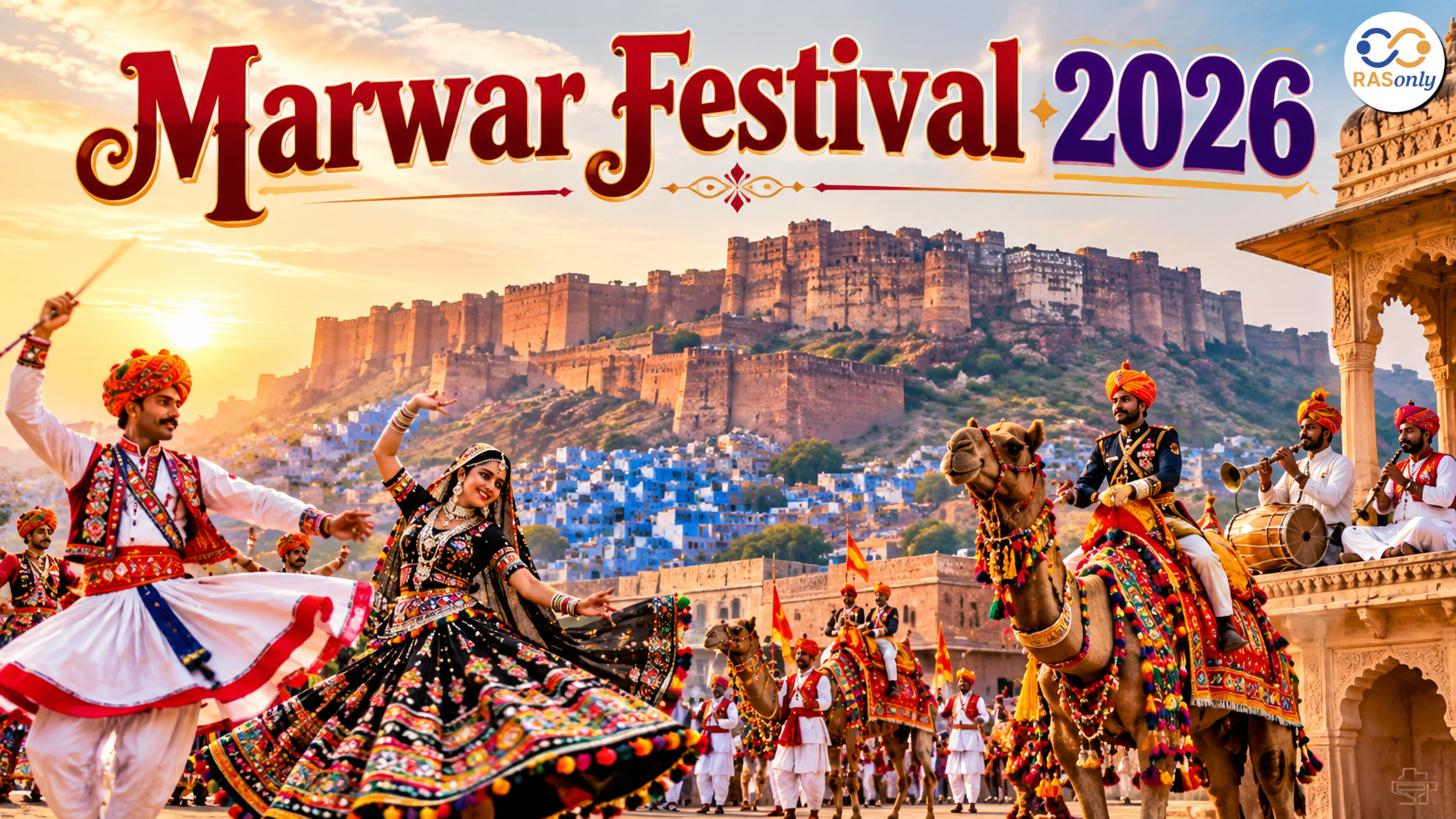
Marwar Festival 2026
October 24, 2026
Kundan Art Display in Hong Kong
October 23, 2026