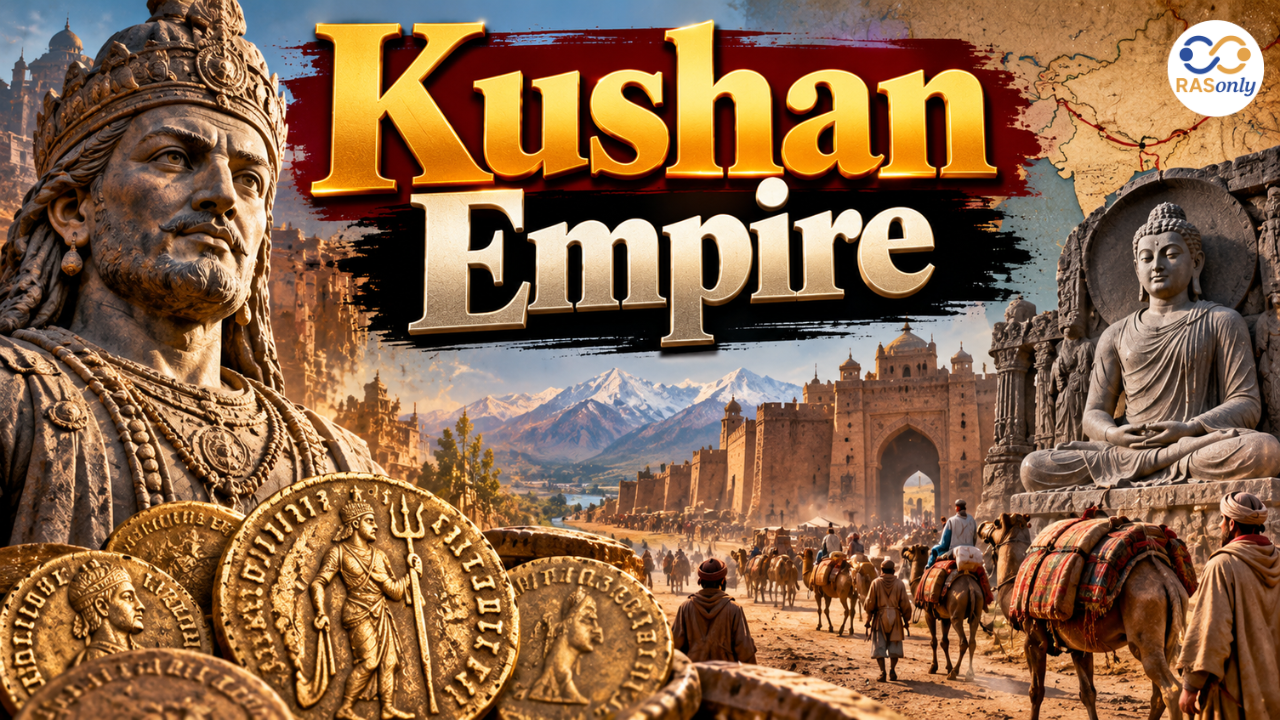
Kushan Empire: History, Rulers, Administration, Economy, Art, Decline
Top 10 Must-Read NCERT Books for RAS Preparation (Classes 6 to 12)

Get in Touch with RASonly!

NCERT books form the core of RAS preparation by building strong conceptual clarity across History, Geography, Polity, Economy, Science, and Environment. This guide lists the top 10 must-read NCERT books from Classes 6 to 12, along with smart study strategies for RAS Prelims and Mains success.

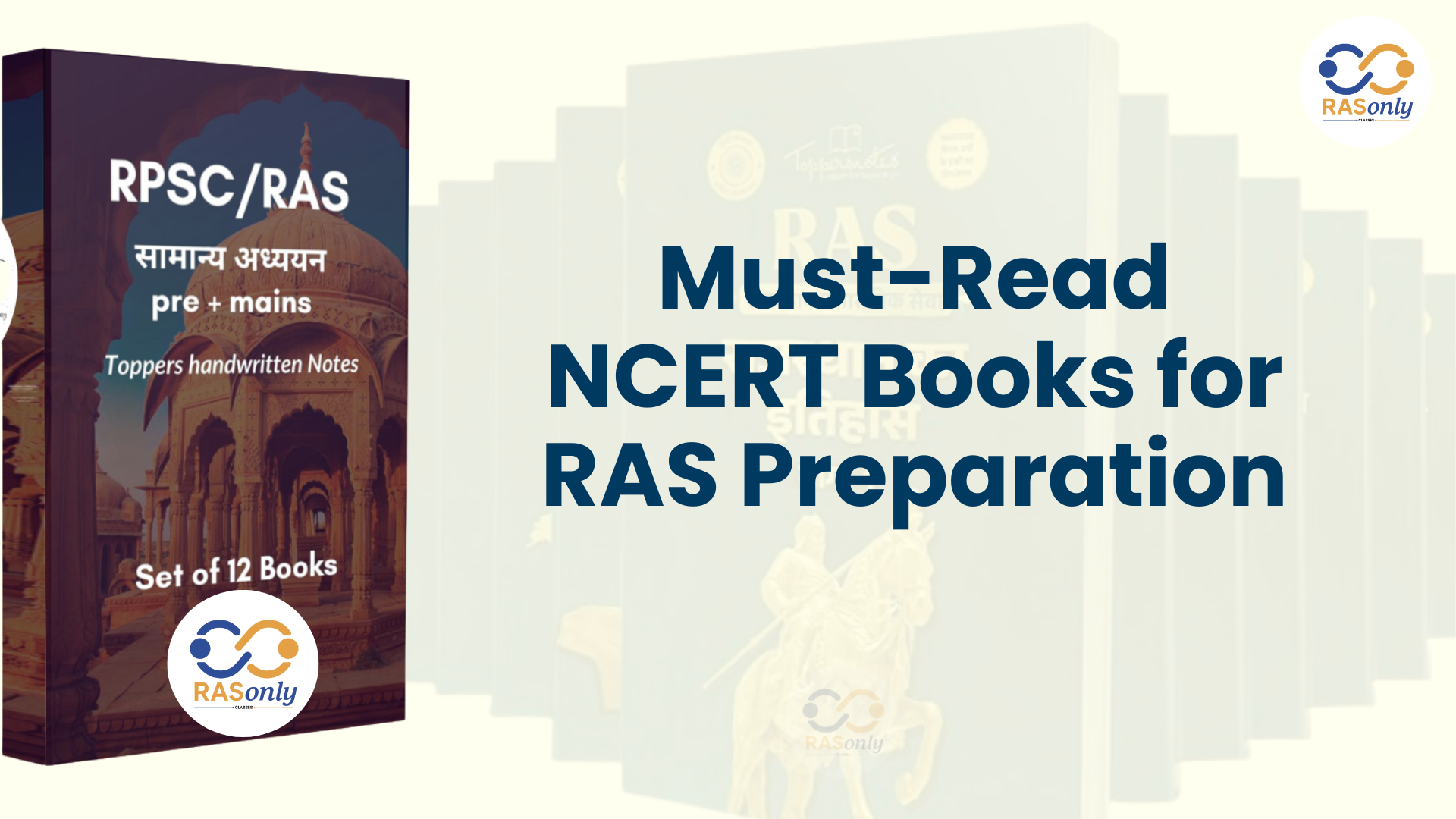
Preparing for the Rajasthan Administrative Services (RAS) exam requires a strong foundation in basic concepts. Every successful RAS topper agrees on one thing: NCERT books are non-negotiable. They build conceptual clarity, improve answer quality, and help you understand topics exactly the way examiners expect.
Many aspirants make the mistake of jumping straight to advanced reference books. Without NCERTs, that approach often leads to confusion, weak fundamentals, and low retention. NCERT books from Classes 6 to 12 provide the backbone for subjects like History, Geography, Polity, Economy, Science, and Environment.
In this article, you will find the top 10 must-read NCERT books for RAS preparation, how to study them effectively, and how they fit into the RAS syllabus.
Why are NCERTs Important for RAS Preparation?
NCERT books would also be a treasure trove in building up a good conceptual foundation in Rajasthan Administrative Services (RAS) Exam. They impart the fundamental topics such as History, Geography, Polity, Economy, and Science in a plain down to earth manner. When one reads the appropriate top 10 Must-Read NCERT Books for RAS Preparation the fundamentals are clear, reaches the syllabus, and there is improved retention. These books will be the best foundation to prepare your RAS in a more systematic and better way.
Benefits of NCERT for RAS Exam
- Basic Understanding of the Concepts -They make you grasp the fundamental concepts of History, Geography, Economics, Polity, Science etc.
- Easy Results -Explanations are in clear simple language and examples are provided to understand them better.
- Syllabus Coverage-A major section of the UPSC Prelims and Mains syllabus has the same content as NCERT.
- Holistic Perspective-Reflections on the past, culture and socio-economics of India
- RAS Terminology Familiarity - This topic is used to put forward terms and definitions commonly applied in UPSC questions.
- Cost Effective - Low cost and printed and available in PDF fashion
- Enhances High Order Learning-The comprehension of the standard NCERT RAS booklist such as Laxmikanth, Spectrum becomes simplified.
- In accordance with exam needs – workshop as per the objective and factual style that follows the UPSC pattern of questions.
- Toppers & Experts Recommended-The first step toward structured preparation is commonly cited.
- Real world applications- Assists in addressing scenario and analytical questions.
Top 10 Must-Read NCERT Books for RAS Preparation
1. NCERT History (Class 6 to 10)
History forms a major portion of the RAS syllabus, especially Ancient, Medieval, and Modern India.
Books to Read:
- Class VI – Our Past – I
- Class VII – Our Past – II
- Class IX – India and the Contemporary World – I
- Class XII – Themes in Indian History – I
Importance:
- These NCERT RAS booklist show a historical view of ancient and modern Indian history.
- Important issues such as the Harappan Civilization, the Vedic Period, the Mauryas, the Mughals, and the British are elucidated
- It is a compulsory reading to know Indian history well and its socio-economic, political, and cultural evolution.
RAS Utility:
- Ordinary questions are posed between Medieval and Modern History
- The history of Rajasthan is closely linked with Indian history in the times of the Mughal-Maratha
- The current history and the question of the Indian fight against freedom
- Descriptive, direct main supporting material
Preparation tips:
- Make a few notes for dates, battles, dynasties, and reforms.
- Focus on the Revolt of 1857, the Gandhian Period, the Partition and the Constitutional Evolution.
2. NCERT Geography (Class 6 to 12)
Geography is one of the most scoring subjects in RAS if studied properly.
Books to Read:
- Class VIII – Resource and Development
- Class XI – Fundamentals of Physical Geography
- Class XII – India: People and Economy
Importance:
- It states the basic facts of physical geography such as latitudes, longitudes, landforms, continents and atmosphere.
- Comprehensive account of India's physiography, climate, drainage system, natural vegetation, and wildlife.
RAS Utility:
- Geography materials on the study of Indian & world
- It can be applied to a question-type-based map.
- Incredibly important as Prelims geography
- RAS Mains paper can be supported with maps and diagram-based explanations
Preparation tip:
- It is an effective way to read using maps to realize a higher level of retention.
3. NCERT Political Science (Class 9 to 12)
Polity is a core subject in RAS Prelims and Mains.
Important Books
- Class 9 & 10: Democratic Politics
- Class 11: Indian Constitution at Work
- Class 12: Politics in India Since Independence
Why These Books Matter
- Clear explanation of Constitution, governance, and democracy
- Useful for understanding federalism, judiciary, and elections
- Language aligns closely with exam expectations
Study Tip
- Focus on constitutional articles, institutions, and real-life examples.
4. NCERT Economics (Class 9 to 12)
Economics often scares aspirants, but NCERTs make it manageable.
Important Books
- Class 9–10: Economics
- Class 11: Indian Economic Development
- Class 12: Macroeconomics
Why These Books Matter
- Explains economy in simple language
- Covers growth, inflation, budgeting, and planning
- Essential for both objective and descriptive answers
Study Tip
- Create flowcharts for economic processes and revise definitions.
5. NCERT Science (Class 6 to 10)
Science is important for general awareness and environment-related questions.
Important Books
- Class 6 to 10: Science
Why These Books Matter
- Covers physics, chemistry, biology basics
- Helps with environment, health, and technology questions
- Useful for eliminating options in Prelims
Study Tip
- Focus more on biology and environmental science chapters.
6. NCERT Environment (Class 12 Biology – Select Chapters)
Environment is a high-return subject in RAS.
Important Chapters
- Ecology
- Biodiversity
- Conservation
- Environmental issues
Why These Books Matter
- Concepts are directly asked in exams
- Builds base for current affairs linkage
- Helps in sustainable development topics
Study Tip
- Link chapters with Rajasthan-specific environmental issues.
7. NCERT Sociology (Class 11 & 12 – Selective)
Useful for social issues and answer enrichment.
Why These Books Matter
- Helps in understanding society, caste, tribes, and gender
- Improves quality of Mains answers
- Useful for ethics and social justice topics
8. NCERT Art and Culture (Class 11 – An Introduction to Indian Art)
Art and culture is often unpredictable but scoring.
Why This Book Matters
- Covers architecture, paintings, sculptures
- Useful for Rajasthan heritage topics
- Helps in prelims factual questions
9. NCERT Hindi (Optional but Useful)
Helpful for candidates writing Mains in Hindi.
Why This Matters
- Improves language clarity
- Helps in structured answer writing
- Builds confidence in expression
10. NCERT Class 12 History (Themes in Indian History I, II, III)
These books go deeper than earlier classes.
Why These Books Matter
- Source-based history
- Useful for analytical answers
- Enhances understanding of culture and society
How to Read NCERT for RAS Exam - Smart Strategy
NCERT books for RAS Exam Preparation are not read chapter by chapter; to clear RAS, reading must be purposeful. The most common mistake handled by many aspirants is either reading them or looking at them like a customary school text, or attempting to mug up all things. In order to break RAS, your strategic approach must be intelligent, selective, and exam-focused. Here’s how to use NCERT for RAS exam:
1. Begin from class 6 & above: Take a chronological direction, eventually developing your ideas.
2. Make concise notes: Write the outline points of each chapter in diagrams, flowcharts, and points.
3. Highlight keywords: Express dates, phrases, and major activities, years, definitions, and terminologies.
4. Revise regularly: Review your notes every week in order to remember them longer.
5. Solve questions: Once you have read, do the MCQs and description questions to sharpen your hold.
6. Learn the Main Points: Write down the main ideas instead of facts.
7. Examples of analysis: Take note of real life examples presented in the books.
8. Connect with Current Affairs: Relate NCERT concepts to other topics that are going on to make them more relevant.
9. Practice Questions: The exercises are to practice what you have learned.
10. Make diagrams, mind maps, etc: Make visuals to revise quickly and you can use them in answer writing as well to score better.
11. Do Not use Rote Learning: Do not memorize blindly, learn concepts.
Reading NCERTs is not all that is required but reading smartly to make the most out of the NCERTs.
Conclusion
NCERT books are the foundation of effective RAS preparation, offering clear concepts, syllabus-oriented content, and exam-relevant terminology. Studying NCERTs from Classes 6 to 12 ensures strong basics in History, Geography, Polity, Economy, Science, and Environment. When read strategically with regular revision, note-making, and linkage to current affairs, NCERTs significantly enhance conceptual clarity, answer quality, and overall performance in both RAS Prelims and Mains.
FAQ
NCERTs are essential for building fundamentals, but they should be supplemented with standard reference books, current affairs, and answer-writing practice for complete preparation.
NCERT books from Classes 6 to 12 are important, with Classes 9–12 being especially crucial for Polity, Economy, History, Geography, and Environment.
Ideally, NCERTs should be revised at least 2–3 times. Multiple revisions help in better retention and conceptual clarity.
Yes, NCERTs help in Prelims by strengthening factual knowledge and in Mains by improving conceptual understanding and answer quality.
Yes, making short notes, flowcharts, and diagrams while reading NCERTs helps in quick revision and effective answer writing during the exam.
BEST SELLER
🏆 PRELIMS
RAS Pass
Prelims focused Hindi & English
₹399
✓
Prelims Topic-Wise Tests
✓
Subject-Wise Tests
✓
Full-Length Prelims Tests
✓
Daily Current Affairs Tests
✓
Prelims PYQs Tests
✓
Detailed Solutions & Analysis
✓
All Rajasthan Ranking
✓
Unlimited Reattempts
✓
Mains Tests
✓
Hindi & English Tests
✓
All Rajasthan Ranking
Trusted by 5,000+ Students
Post Category
- RAS Salary
- Result
- RAS Admit Card
- RAS Job
- RAS Cutoff
- Preparation Tips
- RAS Answer Key
- RAS Exam Analysis
- RAS Syllabus
- RAS Previous Year Papers
- RPSC RAS Exam Pattern
- RAS Interview
- RAS Exam Date
- RAS Vacancy
- RAS Test Series
- RAS Best Books
- RAS Preparation Resources
- RAS Coaching Centre
- History
- Polity
- Geography
- Economics
- Science
- Art and Culture
- RPSC RAS Application Form
- RPSC RAS Notification
- RAS Eligibility Criteria
- UPSC Exam
- RPSC RAS Mains
Visit Our RASonly Offline Center
Our Expert Faculty

Bhunesh Sir
Current Affairs · 13+ Yrs

Aamir Khan Sir
RAS-2017 · IIM Ahm.

Akash Sir
Polity · 8+ Yrs
Free Resources
Official Mobile App

RASOnly App
by OTSAdda · Free
Full Video Lectures
Mock Tests & PYQs
Daily Current Affairs
AI Mock Interview
Free Download · No subscription needed to install
RAS 2024 Toppers — RASonly
Rank 2
Virendra Charan
Rank 9
Bhoopinder Singh
Rank 26
Aanchal Nagpal
Rank 33
Lokendra Singh
Rank 45
Amar Rathore
Rank 46
Manasvini Verma

Join RASonly WhatsApp Community
Get daily current affairs, exam alerts, free study material and tips from expert faculty — right on WhatsApp.
Join for Free →RASonly Interview Guidance Program

Mr. Ashok Jain
Ex-Chief Secretary Govt of Rajasthan
- IAS officer of the 1981 batch, Rajasthan cadre.
- Passionate about mentoring the next generation of RAS officers with real-world insights.
- Got retired in Dec 2017 from the post of Chief Secretary of the state of Rajasthan.

Mr. Guru Charan Rai
Ex-ASP / SP in Jaisalmer
- Guru Charan Rai, IPS (Retd), retired as Inspector General of Police (Security), Rajasthan, Jaipur in 2017.
- Served as ASP and SP in Jaisalmer, Nagaur, Sri Ganganagar, Sawai Madhopur, Dausa, Sikar, and Karauli.
- He also held key positions as DIGP and IGP in the Law and Order division.

Mr. Rakesh Verma
Ex-IAS Officer, B.Tech, MBA, and M.A. (Economics)
- IAS officer of the 1981 batch and retired in Chief Secretary Rank.
- Civil servant of high repute and vast experience.
- Has been teaching UPSC CSE subjects for the last six years.
Daily Current Affairs for RAS Exam Preparation 2026
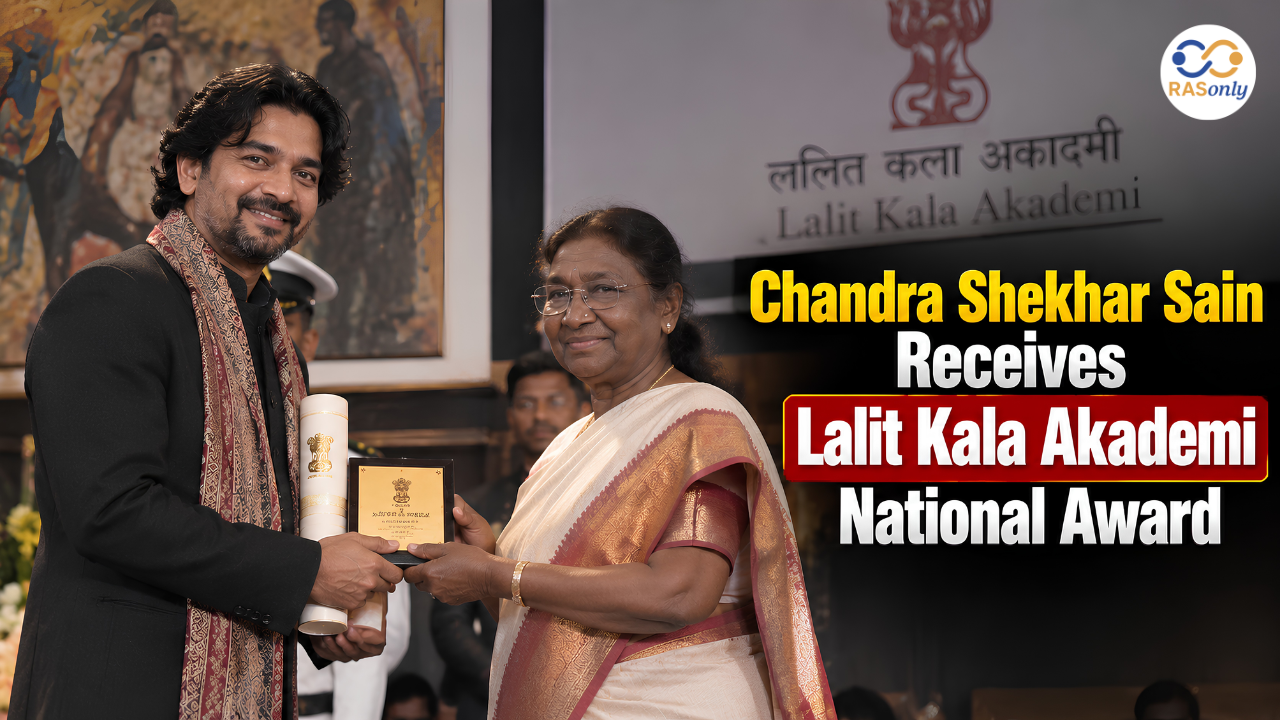
Chandra Shekhar Sain Receives Lalit Kala Akademi National Award
October 01, 2026
Jodhpur to Get India’s Third Dedicated Tropical Medicine Institute
October 01, 2026
Establishment of the Aesthetic Office
September 30, 2026