Kushan Empire: History, Rulers, Administration, Economy, Art, Decline
Rajasthan Formation: 7 Stages of Integration (1948–1956)

Get in Touch with RASonly!

Rajasthan Formation: 7 Stages of Integration (1948–1956) stands as one of the most fascinating chapters of post-independence India. Unlike states formed in a single step, Rajasthan took shape gradually - through patient diplomacy, careful planning, and the combined efforts of Sardar Patel and V.P. Menon. Starting with the Matsya Union in March 1948 and ending with the final reorganization in November 1956, this eight-year journey transformed 22 scattered princely states into India's largest and most diverse state.

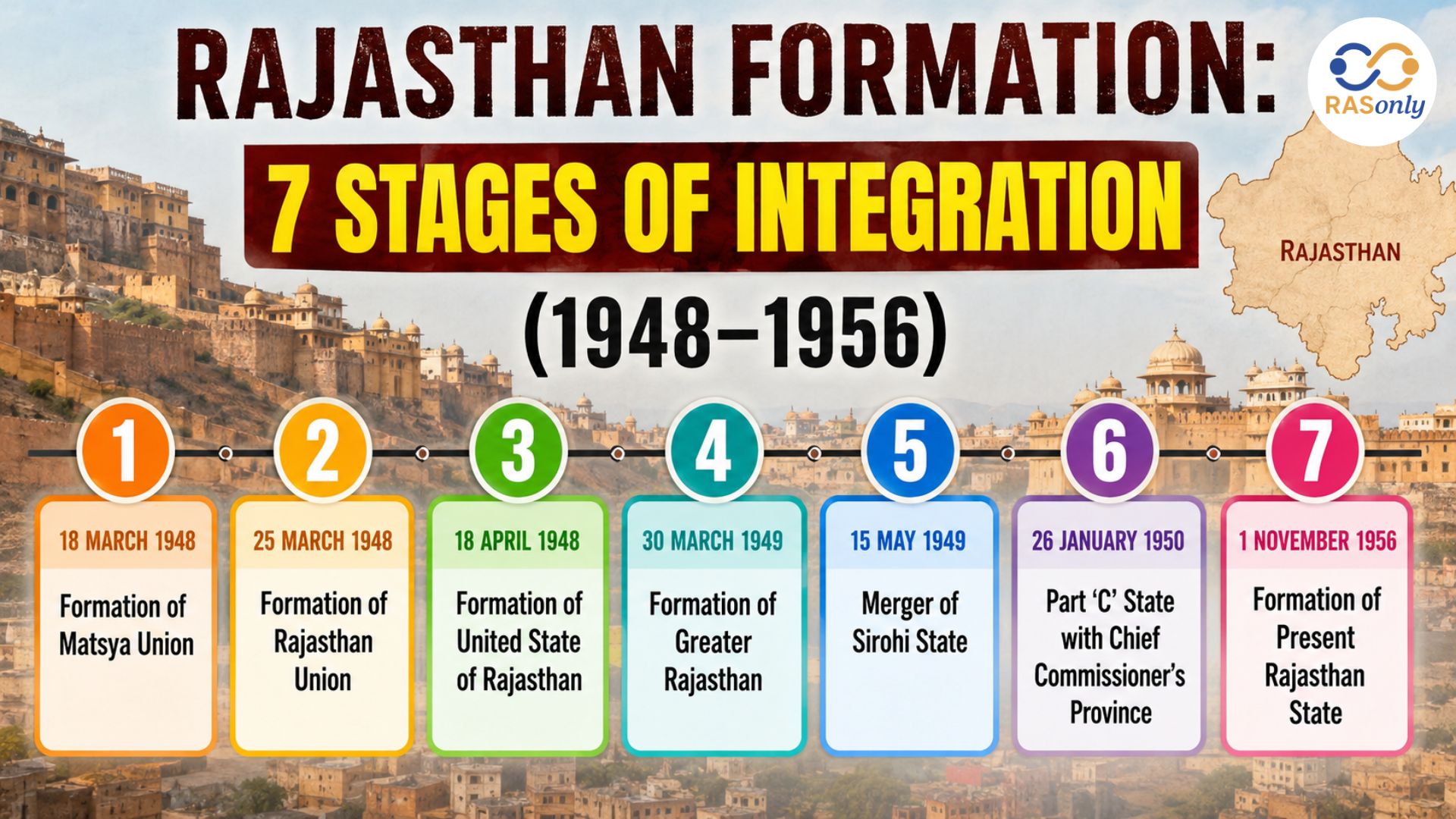
The formation of Rajasthan is one of the most significant chapters in post-independence Indian history. After India gained independence on 15 August 1947, the process of Rajasthan unification in 1948 began with the task of merging 19 princely states and 3 chiefships of the former Rajputana region into a single administrative unit. This entire process of integration of princely states in Rajasthan was completed in 7 carefully planned stages between 1948 and 1956.
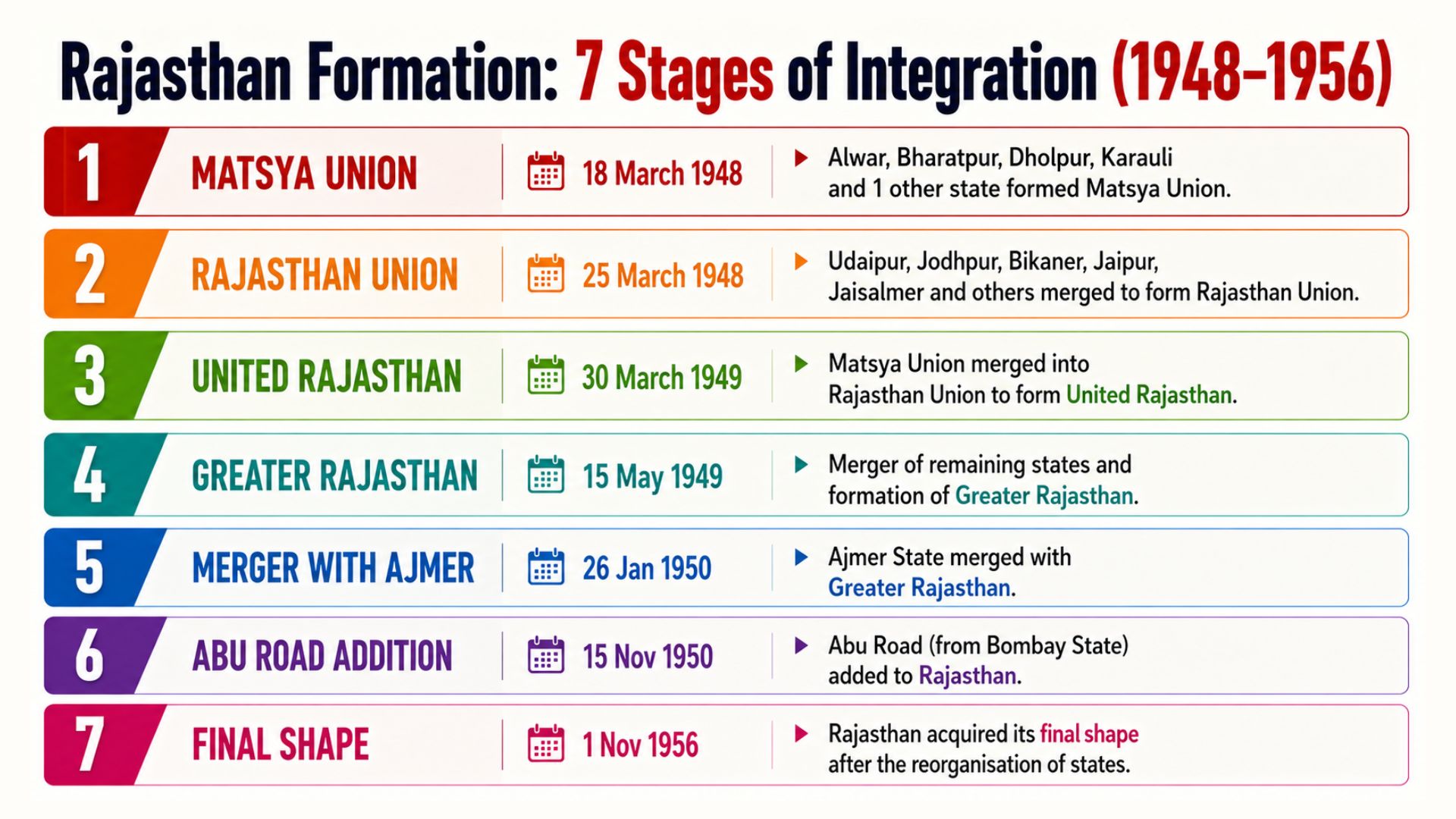
The Rajasthan State formation history is unique because, unlike most other Indian states, Rajasthan was not formed in one step. It took 8 years, 7 stages, and the strategic leadership of Sardar Vallabhbhai Patel (Iron Man of India) and his Secretary of States Ministry, V.P. Menon, to complete the Rajputana merger and give birth to the modern state of Rajasthan.
| KEY FACTS AT A GLANCE | |
|---|---|
| Total Stages: 7 | Period: 18 March 1948 – 1 November 1956 |
| States Merged: 19 princely states + 3 chiefships | Rajasthan Day: 30 March 1949 |
| Key Leader: Sardar Vallabhbhai Patel | Secretary: V.P. Menon |
_1782730676.jpg)
Historical Background: Why Was Integration Needed?
Before 1947, the region now known as Rajasthan was called Rajputana. It was a collection of 22 princely states and chiefships, each with its own ruler, army, and administration. These states were under the suzerainty of the British Crown through the doctrine of paramountcy. When British paramountcy lapsed on 15 August 1947, each princely state technically became independent.
The integration of princely states in Rajasthan was a massive challenge. The states varied hugely in size - from the large state of Jodhpur (93,424 sq km) to the tiny chiefship of Lawa (only 186 sq km). The stage-wise merger of Rajputana states 1948 to 1956 was designed to group similar and geographically adjacent states together to make administration efficient.
How Was Rajasthan Formed from Princely States?
The answer lies in a deliberate phased approach. Rather than forcing all states into one unit overnight, the Indian government - under the leadership of Sardar Patel and V.P. Menon - merged the states in 7 careful stages. Each stage brought more states together until the final consolidated Rajasthan was formed on 1 November 1956 under the State Reorganization Act 1956.
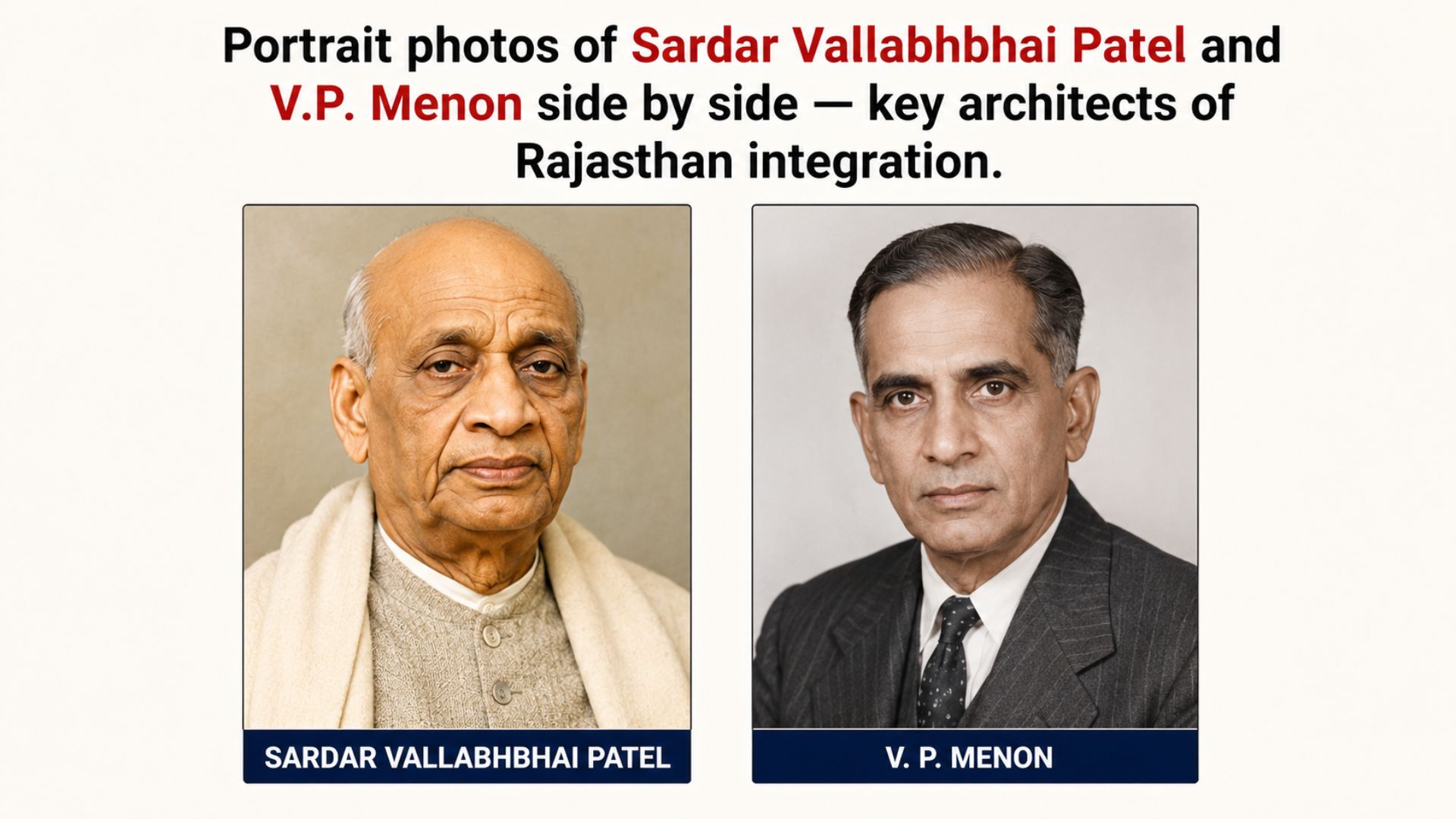
Stage-wise Merger of Rajputana States 1948 to 1956
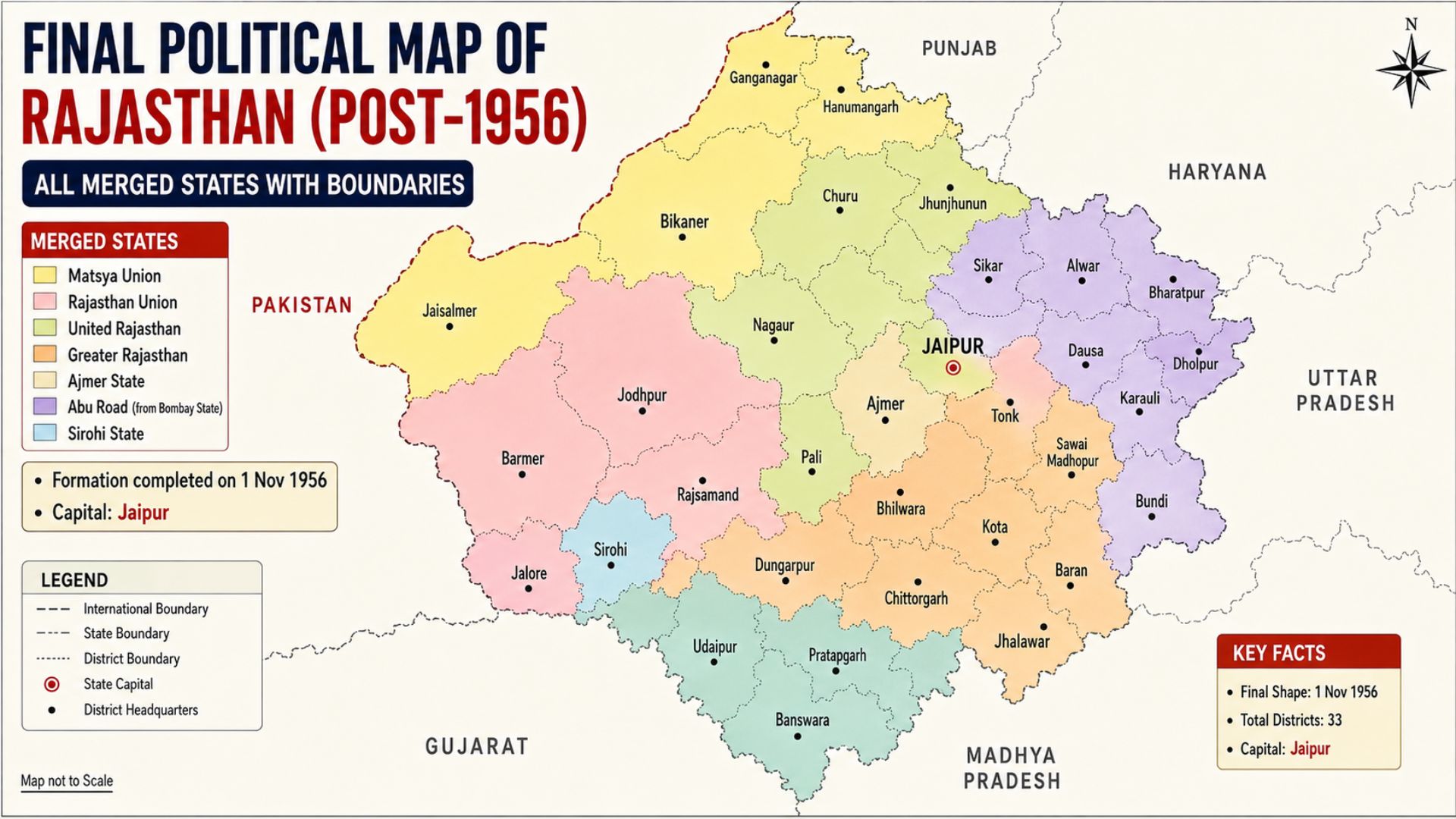
Here is the complete step-by-step account of the 7 stages of Rajasthan integration for RAS exam. Each stage had its own name, date, participating states, and significance.
STAGE 1 - Matsya Union (18 March 1948)
Official Name: Matsya Union (Matsya Sangh)
Date: 18 March 1948
Capital: Alwar
Rajpramukh: Maharaja Udai Bhan Singh of Dholpur
Chief Minister: Shobha Ram Kumawat
States Included:
- Alwar
- Bharatpur
- Dholpur
- Karauli
Rajasthan's formation actually traces back to 1948, when the Matsya Union became the very first building block of the state. It brought together four princely states - Alwar, Bharatpur, Dholpur, and Karauli - mainly because of how close they sat to Delhi and the cultural identity they shared. The name "Matsya" itself comes from an ancient Vedic kingdom that once existed in this same region. Together, these states covered around 30,247 sq km and were home to nearly 19 lakh people.
STAGE 2 - Rajasthan Union (25 March 1948)
Official Name: Rajasthan Union (Rajasthan Sangh)
Date: 25 March 1948
Capital: Kota
Rajpramukh: Maharao Bhim Singh of Kota
States Included:
- Banswara
- Bundi
- Dungarpur
- Jhalawar
- Kishangarh
- Kota
- Pratapgarh (Partabgarh)
- Shahpura
- Tonk
The Rajasthan Union of 1948 brought together 9 small and medium Rajputana states into one administrative body. This was a crucial step in Rajasthan State formation history, as it showed that the princely states merger with India policy could be executed peacefully. The Rajasthan Union had a combined population of nearly 26 lakh.
STAGE 3 - United State of Rajasthan (18 April 1948)
Official Name: United State of Rajasthan
Date: 18 April 1948
Capital: Udaipur
Rajpramukh: Maharana Bhupal Singh of Mewar
Prime Minister: Manikya Lal Verma
Inaugurated By: Pandit Jawaharlal Nehru (Prime Minister of India)
States Added:
- Mewar (Udaipur) - the largest and most prestigious Rajputana state
This stage is remembered for the Rajasthan integration Mewar event. The merger of Mewar (modern Udaipur) into the United State of Rajasthan was a historic moment in the Rajputana merger process. Mewar was the most respected and culturally significant state in Rajputana, so its inclusion gave the union both political legitimacy and deep historical weight. Maharana Bhupal Singh was made the Rajpramukh (Constitutional Head) of the United State of Rajasthan.
The merger ceremony was personally inaugurated by India's first Prime Minister, Pandit Jawaharlal Nehru, on 18 April 1948 in Udaipur - making this one of two stages (along with Stage 4) where a national-level leader presided over the inauguration.
STAGE 4 - United State of Greater Rajasthan (30 March 1949) Most Important
Official Name: United State of Greater Rajasthan
Date: 30 March 1949 - Celebrated as Rajasthan Day (Rajasthan Diwas)
Capital: Jaipur
Rajpramukh: Maharaja Sawai Man Singh II of Jaipur
Prime Minister: Hiralal Shastri
States Added:
- Jaipur (Jaipur state merger 1949)
- Jodhpur
- Bikaner
- Jaisalmer
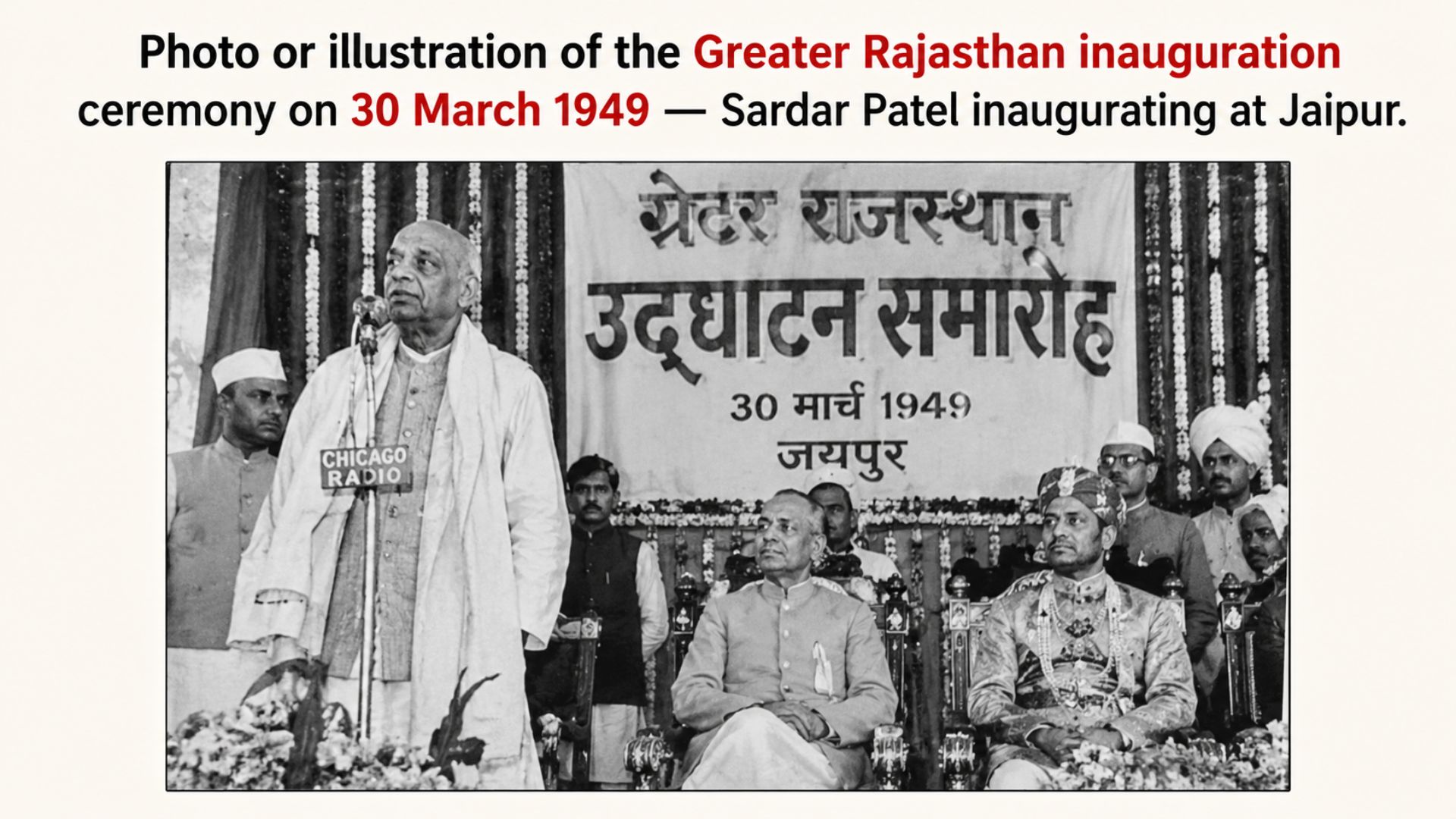
This is the most significant stage in Rajasthan's formation history. The Greater Rajasthan 1949 was formed on 30 March 1949 — a date now celebrated every year as Rajasthan Day 30 March. The Jaipur state merger in 1949 was particularly important as Jaipur became the new capital. The Sardar Patel Rajasthan merger strategy was fully visible here — by bringing together the four biggest Rajputana states, the backbone of modern Rajasthan was created. The inauguration ceremony was personally conducted by Sardar Vallabhbhai Patel himself.
STAGE 5 - United State of Greater Rajasthan + Matsya (15 May 1949)
Date: 15 May 1949
Capital: Jaipur (unchanged)
Event: Matsya Union (Alwar, Bharatpur, Dholpur, Karauli) merged into Greater Rajasthan
In this stage, the United State of Greater Rajasthan absorbed the earlier Matsya Union 1948 states. The Rajasthan integration stages were moving rapidly - within just 14 months of independence, most of the Rajputana region was now under one administrative umbrella. The Matsya Union states had been hesitant earlier due to their proximity to Delhi, but the momentum of Rajasthan unification was now unstoppable.
STAGE 6 - Rajasthan with Sirohi (26 January 1950)
Date: 26 January 1950 (Republic Day of India)
Capital: Jaipur (unchanged)
States Added: Sirohi (partial) - Abu Road Taluka given to Bombay State; rest of Sirohi merged into Rajasthan
This stage of Rajasthan integration stages saw the merger of Sirohi on Republic Day. Sirohi was a unique and politically sensitive case - the state was split between two units. The Abu and Delwara talukas went to Bombay (now Gujarat) due to the large Gujarati-speaking population there, while the rest of Sirohi merged into Rajasthan. This decision reflected the linguistic principles of reorganization that would formally appear later in the State Reorganization Act 1956.
STAGE 7 - Final Rajasthan (1 November 1956) Present Form
Date: 1 November 1956
Legislative Basis: States Reorganization Act 1956
Capital: Jaipur
First Governor: Gurumukh Nihal Singh
Chief Minister: Mohanlal Sukhadia
Areas Added:
- Ajmer-Merwara (previously a Chief Commissioner's Province under British rule)
- Abu Road Taluka (returned from Bombay State)
- Sunel Tappa (from Madhya Bharat)
Areas Transferred OUT: Abu and Delwara talukas of Sirohi went to Bombay State (now Gujarat)
The Rajasthan reorganization of 1956 under the States Reorganization Act of 1956 completed the formation of Rajasthan. With the addition of Ajmer, which had been directly administered under the British, Rajasthan became a linguistically and culturally cohesive state. This final stage gave India its largest state by area, and 1 November 1956 is the Rajasthan state formation date in its present complete form.
Rajasthan Formation Important Dates for RPSC - Complete Reference Table
This is a must-memorize table for the RAS exam. All Rajasthan formation important dates for RPSC are listed here in chronological order.
| Stage | Date | Name | States Merged | Capital |
|---|---|---|---|---|
| 1 | 18 Mar 1948 | Matsya Union | Alwar, Bharatpur, Dholpur, Karauli | Alwar |
| 2 | 25 Mar 1948 | Rajasthan Union | Banswara, Bundi, Dungarpur, Jhalawar, Kishangarh, Kota, Pratapgarh, Shahpura, Tonk | Kota |
| 3 | 18 Apr 1948 | United State of Rajasthan | Mewar (Udaipur) | Udaipur |
| 4 | 30 Mar 1949 | Greater Rajasthan | Jaipur, Jodhpur, Bikaner, Jaisalmer | Jaipur |
| 5 | 15 May 1949 | Greater Rajasthan + Matsya | Matsya Union merges in | Jaipur |
| 6 | 26 Jan 1950 | Rajasthan + Sirohi | Sirohi (partial) | Jaipur |
| 7 | 1 Nov 1956 | Final Rajasthan | Ajmer-Merwara, Abu Road Taluka, Sunel Tappa | Jaipur |
Most important dates for RAS MCQ. 30 March 1949 = Rajasthan Day. 1 November 1956 = Final formation date.
Which Princely States Merged to Form Rajasthan? - Complete List
One of the most frequently asked questions in RAS exams is: Which princely states merged to form Rajasthan? Here is the complete list:
| S.No | State Name | Stage | Area (sq km) | Ruler at Time of Merger |
|---|---|---|---|---|
| 1 | Alwar | Stage 1 - Matsya Union | 8,380 | Maharaja Tej Singh |
| 2 | Bharatpur | Stage 1 - Matsya Union | 5,124 | Maharaja Brijendra Singh |
| 3 | Dholpur | Stage 1 - Matsya Union | 3,034 | Maharaja Udai Bhan Singh |
| 4 | Karauli | Stage 1 - Matsya Union | 1,584 | Maharaja Ganesh Pal Dev |
| 5 | Banswara | Stage 2 - Rajasthan Union | 1,606 | Maharawal Chandraveer Singh |
| 6 | Bundi | Stage 2 - Rajasthan Union | 2,220 | Maharao Bahadur Singh |
| 7 | Dungarpur | Stage 2 - Rajasthan Union | 1,447 | Maharawal Lakshman Singh |
| 8 | Jhalawar | Stage 2 - Rajasthan Union | 2,184 | Harishchandra Singh |
| 9 | Kishangarh | Stage 2 - Rajasthan Union | 858 | Maharaja Sumar Singh |
| 10 | Kota | Stage 2 - Rajasthan Union | 5,684 | Maharao Bhim Singh II |
| 11 | Pratapgarh | Stage 2 - Rajasthan Union | 1,016 | Ambika Pratap Singh |
| 12 | Shahpura | Stage 2 - Rajasthan Union | 405 | Maharaja Sudarshan Dev |
| 13 | Tonk | Stage 2 - Rajasthan Union | 2,694 | Nawab Muhammad Ismail Ali Khan |
| 14 | Mewar (Udaipur) | Stage 3 | 13,800 | Maharana Bhupal Singh |
| 15 | Jaipur | Stage 4 - Greater Rajasthan | 40,302 | Maharaja Sawai Man Singh II |
| 16 | Jodhpur | Stage 4 - Greater Rajasthan | 22,850 | Maharaja Hanwant Singh |
| 17 | Bikaner | Stage 4 - Greater Rajasthan | 23,317 | Maharaja Sadul Singh |
| 18 | Jaisalmer | Stage 4 - Greater Rajasthan | 16,062 | Maharawal Girdhari Singh |
| 19 | Sirohi | Stage 6 | 5,136 | Maharao Raja Tej Singh |
| 20 | Ajmer-Merwara | Stage 7 - 1956 | 6,920 | Central Province (British) |
| 21 | Abu Road Taluka | Stage 7 - 1956 | — | From Bombay State |
| 22 | Sunel Tappa | Stage 7 - 1956 | — | From Madhya Bharat |
Role of Sardar Patel in Rajasthan Formation
Sardar Vallabhbhai Patel
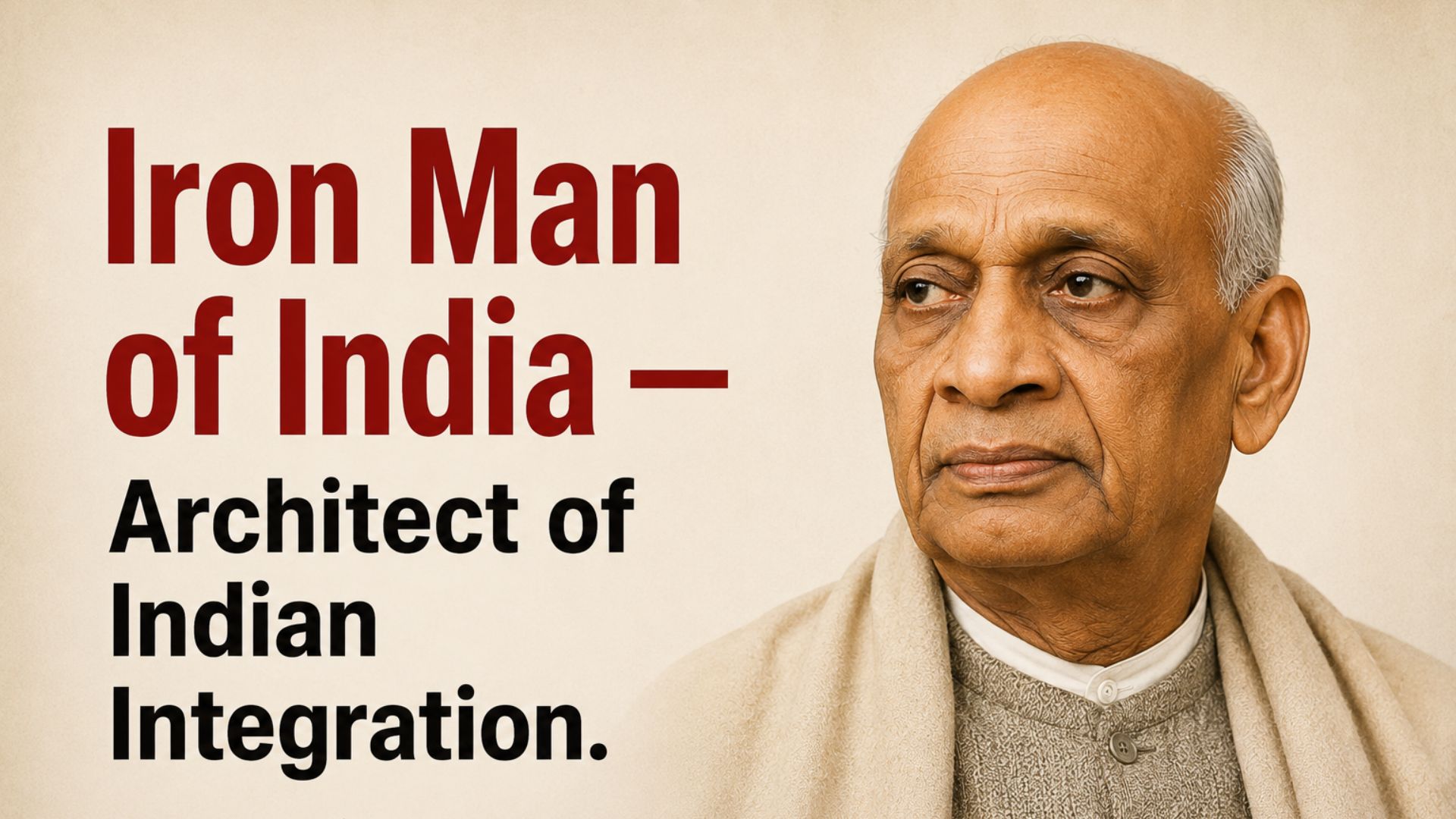
The role of Sardar Patel in the formation was absolutely central. As the first Home Minister of India and head of the Ministry of States, Sardar Patel was the master architect of the entire princely states merger India project. His key contributions in the Rajasthan unification 1948 process were:
- Political Persuasion: He personally negotiated with reluctant rulers like the Maharaja of Jodhpur and Jaipur to convince them to join the Indian Union.
- Legal Framework: He used the Instrument of Accession as the legal tool to bring princely states under Indian sovereignty.
- Privy Purses: He offered rulers financial compensation (Privy Purse) and privileges in exchange for merger.
- Staged Approach: His phased Rajasthan integration stages strategy allowed careful administrative planning.
V.P. Menon
The VP Menon Rajasthan integration role was equally critical. As Secretary of the Ministry of States, he was the operational genius behind the Rajputana merger. He personally travelled to each state, drafted the merger documents, and ensured smooth transitions. His book "The Story of the Integration of the Indian States" remains the authoritative account of this entire process.
Quick Revision - One-Liner Facts for RAS MCQ
| Question | Answer |
|---|---|
| First stage of Rajasthan formation | Matsya Union - 18 March 1948 |
| Rajasthan Day (Rajasthan Diwas) | 30 March 1949 - Greater Rajasthan |
| Final stage (Present Rajasthan) | 1 November 1956 - State Reorganization Act |
| First Chief Minister of Greater Rajasthan | Hiralal Shastri |
| First Rajpramukh of Greater Rajasthan | Maharaja Sawai Man Singh II (Jaipur) |
| Iron Man of India | Sardar Vallabhbhai Patel |
| Key bureaucrat in Rajasthan merger | V.P. Menon |
| Capital of Greater Rajasthan | Jaipur |
| The largest princely state by area merged | Jaipur (40,302 sq km) |
| The most prestigious state merged | Mewar (Udaipur) - Stage 3 |
| Stage 7 legislation | States Reorganization Act, 1956 |
| Who inaugurated Greater Rajasthan? | Sardar Vallabhbhai Patel himself |
Conclusion: Rajasthan Formation 7 Stages of Integration 1948–1956
The Rajasthan Formation 7 Stages of Integration 1948–1956 stands as a remarkable achievement in Indian administrative history. In just 8 years, 22 princely states and chiefships were brought together into one cohesive unit through a patient, diplomatic, and legally structured process. The formation of Rajasthan was made possible by the vision of Sardar Patel, the operational efficiency of V.P. Menon, and the cooperation of the various rulers of the Rajputana region.
Today, Rajasthan is India's largest state by area (342,239 sq km), and its Rajasthan State formation history is a subject of immense pride and academic importance. For RAS aspirants, understanding the 7 stages of Rajasthan integration, their dates, their participants, and their significance is absolutely essential for both the Preliminary and Main examinations.
FAQs
Rajasthan was formed in 7 stages. The first stage was on 18 March 1948 (Matsya Union). Rajasthan Day is celebrated on 30 March 1949 (when Greater Rajasthan was formed). The final Rajasthan state formation date in its present complete form is 1 November 1956 under the State Reorganization Act 1956.
There are 7 stages of Rajasthan integration starting from 18 March 1948 (Matsya Union) to 1 November 1956 (final Rajasthan reorganization 1956). This is the complete chronological order of Rajasthan unification stages.
The first Chief Minister of Greater Rajasthan (formed on 30 March 1949) was Hiralal Shastri. He was appointed when Greater Rajasthan was inaugurated by Sardar Patel.
Before 1947, Rajputana was a collection of 22 princely states under British paramountcy. The Rajputana states were individually governed by their respective rulers. After independence, the stage-wise merger of Rajputana states 1948 to 1956 converted this region into the modern state of Rajasthan.
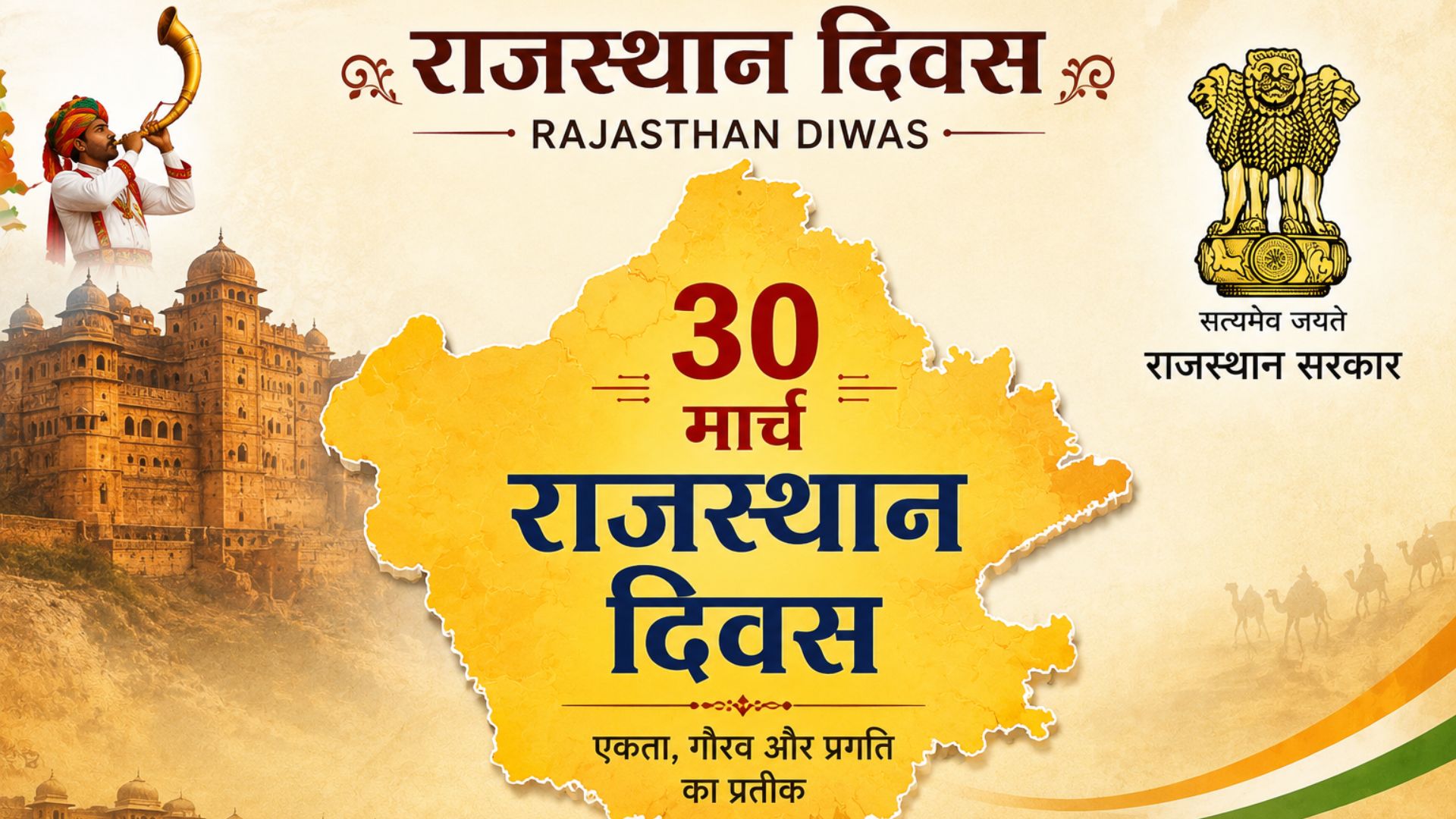
Rajasthan Day (Rajasthan Diwas) is celebrated every year on 30 March. This date marks the formation of Greater Rajasthan in 1949 when the four biggest states - Jaipur, Jodhpur, Bikaner, and Jaisalmer - were merged. The Rajasthan Day 30 March celebration commemorates this most significant milestone in the formation of Rajasthan.
BEST SELLER
🏆 PRELIMS
RAS Pass
Prelims focused Hindi & English
₹399
✓
Prelims Topic-Wise Tests
✓
Subject-Wise Tests
✓
Full-Length Prelims Tests
✓
Daily Current Affairs Tests
✓
Prelims PYQs Tests
✓
Detailed Solutions & Analysis
✓
All Rajasthan Ranking
✓
Unlimited Reattempts
✓
Mains Tests
✓
Hindi & English Tests
✓
All Rajasthan Ranking
Trusted by 5,000+ Students
Post Category
- RAS Salary
- Result
- RAS Admit Card
- RAS Job
- RAS Cutoff
- Preparation Tips
- RAS Answer Key
- RAS Exam Analysis
- RAS Syllabus
- RAS Previous Year Papers
- RPSC RAS Exam Pattern
- RAS Interview
- RAS Exam Date
- RAS Vacancy
- RAS Test Series
- RAS Best Books
- RAS Preparation Resources
- RAS Coaching Centre
- History
- Polity
- Geography
- Economics
- Science
- Art and Culture
- RPSC RAS Application Form
- RPSC RAS Notification
- RAS Eligibility Criteria
- UPSC Exam
- RPSC RAS Mains
Visit Our RASonly Offline Center
Our Expert Faculty

Bhunesh Sir
Current Affairs · 13+ Yrs

Aamir Khan Sir
RAS-2017 · IIM Ahm.
Akash Sir
Polity · 8+ Yrs
Free Resources
Official Mobile App

RASOnly App
by OTSAdda · Free
Full Video Lectures
Mock Tests & PYQs
Daily Current Affairs
AI Mock Interview
Free Download · No subscription needed to install
RAS 2024 Toppers — RASonly
Rank 2
Virendra Charan
Rank 9
Bhoopinder Singh
Rank 26
Aanchal Nagpal
Rank 33
Lokendra Singh
Rank 45
Amar Rathore
Rank 46
Manasvini Verma

Join RASonly WhatsApp Community
Get daily current affairs, exam alerts, free study material and tips from expert faculty — right on WhatsApp.
Join for Free →RASonly Interview Guidance Program

Mr. Ashok Jain
Ex-Chief Secretary Govt of Rajasthan
- IAS officer of the 1981 batch, Rajasthan cadre.
- Passionate about mentoring the next generation of RAS officers with real-world insights.
- Got retired in Dec 2017 from the post of Chief Secretary of the state of Rajasthan.

Mr. Guru Charan Rai
Ex-ASP / SP in Jaisalmer
- Guru Charan Rai, IPS (Retd), retired as Inspector General of Police (Security), Rajasthan, Jaipur in 2017.
- Served as ASP and SP in Jaisalmer, Nagaur, Sri Ganganagar, Sawai Madhopur, Dausa, Sikar, and Karauli.
- He also held key positions as DIGP and IGP in the Law and Order division.

Mr. Rakesh Verma
Ex-IAS Officer, B.Tech, MBA, and M.A. (Economics)
- IAS officer of the 1981 batch and retired in Chief Secretary Rank.
- Civil servant of high repute and vast experience.
- Has been teaching UPSC CSE subjects for the last six years.
Daily Current Affairs for RAS Exam Preparation 2026
India Wins Gold in 10m Air Pistol
September 26, 2026
India’s Rank in Travel And Tourism Development Index 2026
September 26, 2026
India Wins Bronze Medal in Men’s Double Sculls
September 25, 2026