Kushan Empire: History, Rulers, Administration, Economy, Art, Decline
Heritage of Rajasthan - Cultural, Architectural and Historical Legacy

Get in Touch with RASonly!

Heritage of Rajasthan spans forts, palaces, UNESCO sites, temples, and folk traditions across Rajputana dynasties. This RAS exam guide covers Mehrangarh, Chittorgarh, Hawa Mahal, Dilwara Temples, and conservation challenges, offering detailed tables, facts, and exam-focused insights for aspirants.

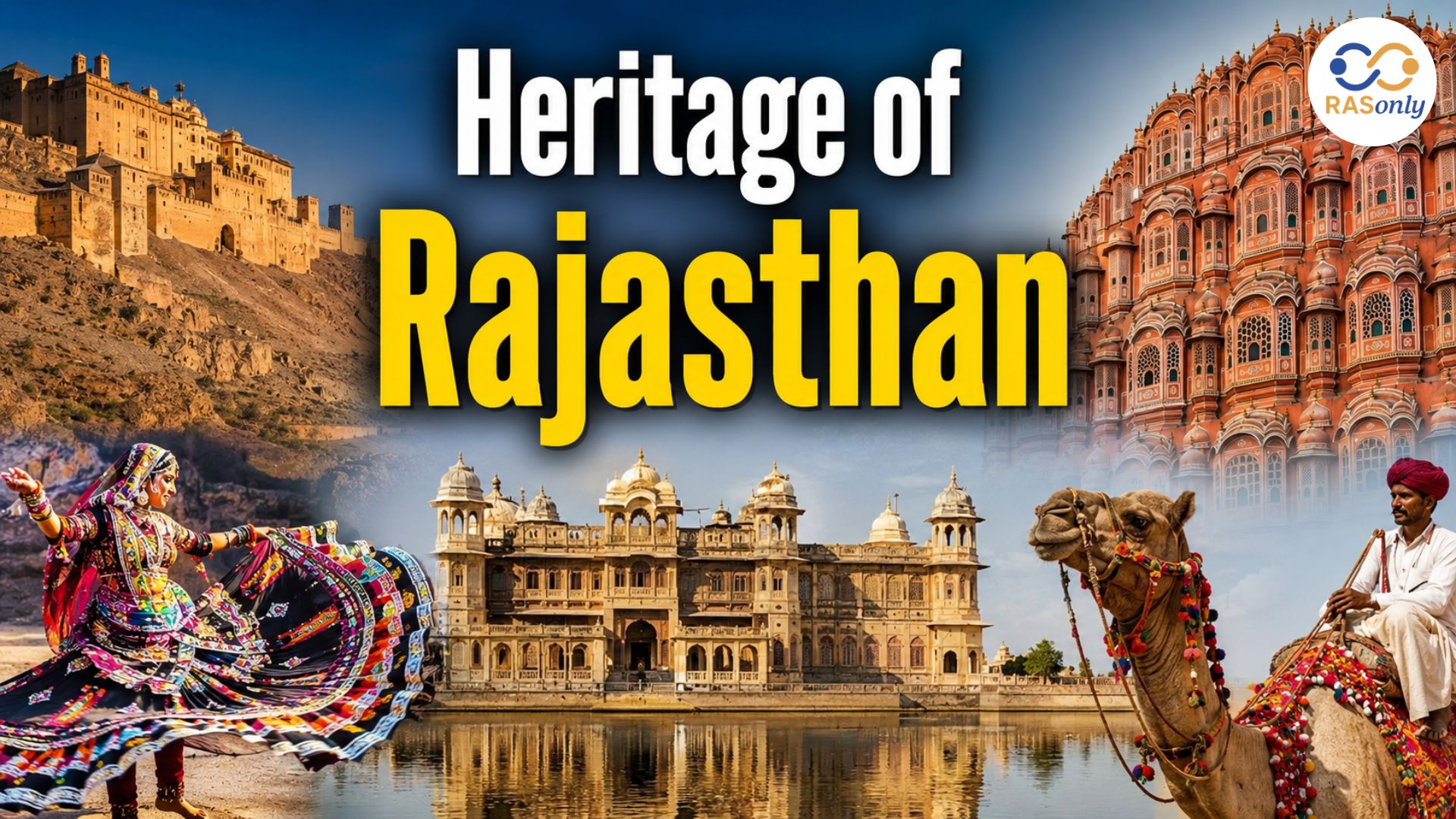
Rajasthan, often called the "Land of Kings," carries one of the richest cultural and architectural legacies in India. The Heritage of Rajasthan is not just about old buildings and monuments; it is a living tradition that reflects centuries of Rajputana valour, royal patronage, religious devotion, and artistic brilliance. From towering forts perched on rocky hills to intricately carved temples and vibrant folk traditions, this state offers a complete picture of India's historical journey.
For RAS exam aspirants, understanding the Cultural Heritage of Rajasthan is essential, as it forms a core part of the General Studies syllabus. This article covers everything in detail: forts, palaces, UNESCO sites, temples, folk culture, and conservation efforts, along with exam-oriented points.
Introduction to Rajasthan's Heritage
Rajasthan's heritage developed over centuries under the rule of various Rajput dynasties such as the Sisodias of Mewar, Rathores of Marwar, Kachwahas of Amber, and Bhattis of Jaisalmer. Each dynasty contributed its own architectural style, art form, and cultural practice, which together make up what we now recognize as the Rajputana Culture and Heritage. This was further enriched by geography, since the arid Thar Desert on one side and the fertile Aravalli belt on the other shaped very different lifestyles, building materials, and survival strategies, giving Rajasthan an unusually diverse cultural landscape within a single state.
Historically, Rajasthan was never a single unified kingdom but a cluster of princely states, each ruled independently until their merger into the Indian Union after independence. This political fragmentation, rather than weakening the region's identity, actually strengthened its cultural richness, as every princely state - Mewar, Marwar, Amber (Jaipur), Bikaner, Jaisalmer, Kota, Bundi, and others, developed its own distinct school of art, dialect, and architectural signature while still sharing a broader Rajputana identity.
The state's heritage can broadly be divided into these categories:
- Architectural heritage - forts, palaces, temples, havelis, step-wells (baoris), and cenotaphs (chhatris)
- Intangible heritage - folk music, dance, oral traditions, storytelling, and puppetry
- Handicrafts and visual arts - miniature paintings, pottery, textiles, jewellery, and metalwork
- Festivals and religious practices - fairs, pilgrimages, and seasonal celebrations tied to local deities
- Culinary heritage - traditional Rajasthani cuisine shaped by desert conditions and royal kitchens
This diversity is why Rajasthan is frequently referred to as an open museum of Indian history, and why the topic demands a layered understanding rather than rote memorization something RAS examiners specifically test for in mains-level answers.
Forts of Rajasthan
The Forts of Rajasthan are perhaps the most iconic symbols of the state's military and architectural history. Built primarily for defense, these forts also served as centers of administration, culture, and royal residence.
| Fort | Location | Built By | Notable Feature |
|---|---|---|---|
| Mehrangarh Fort | Jodhpur | Rao Jodha | One of the largest forts in India, built on a 400-ft hill |
| Chittorgarh Fort | Chittorgarh | Mauryan/Guhila rulers | Largest fort complex in India, associated with Rani Padmini |
| Jaisalmer Fort | Jaisalmer | Rawal Jaisal | Living fort with residents still inside |
| Kumbhalgarh Fort | Rajsamand | Rana Kumbha | Second-longest continuous wall in the world after the Great Wall of China |
| Amber Fort | Jaipur | Raja Man Singh I | Known for Sheesh Mahal (Mirror Palace) |
| Ranthambore Fort | Sawai Madhopur | Chauhan rulers | Located inside Ranthambore National Park |
These forts are not just tourist attractions but also hold immense strategic and historical significance, often being the site of major battles in Rajput history. Many of these structures reflect the blend of Rajasthan Architecture with defensive military engineering, making them unique compared to forts in other parts of India.
Each fort also carries its own historical narrative that goes beyond architecture. Chittorgarh Fort, for instance, is closely linked to the legendary tales of Rani Padmini and the practice of Jauhar, where women chose self-immolation over surrender during sieges by invading armies, most notably during Alauddin Khilji's attack in 1303. Similarly, Kumbhalgarh Fort is significant not just for its massive 36-kilometer-long wall but also because it was the birthplace of Maharana Pratap, one of the most celebrated warrior-kings in Indian history who resisted Mughal expansion for decades.
Jaisalmer Fort holds a unique distinction among Indian forts because it is one of the very few "living forts" in the world, meaning that a significant residential population still inhabits the fort complex today, running shops, homes, and temples within its walls a fact that also makes its conservation more complex, since modern civic needs must be balanced against heritage preservation.
From an RAS exam perspective, it is useful to remember forts not just by name but by their builder, dynasty, strategic location, and any associated historical event, since questions are frequently framed around these connecting details rather than isolated facts.
Palaces of Rajasthan
While forts represent strength, the Palaces of Rajasthan reflect the artistic and luxurious side of royal life. These structures showcase intricate craftsmanship, use of local sandstone and marble, and a fusion of Rajput and Mughal architectural styles.
- City Palace, Udaipur - A blend of Rajasthani and Mughal architecture overlooking Lake Pichola.
- Hawa Mahal, Jaipur - Famous for its honeycomb-shaped facade with 953 small windows, built for royal women to observe street life.
- Jal Mahal, Jaipur - A palace situated in the middle of Man Sagar Lake.
- Umaid Bhawan Palace, Jodhpur - One of the largest private residences in the world, built during a famine relief project.
- Lake Palace, Udaipur - Now a heritage hotel, floating on Lake Pichola.
These palaces are a testament to the aesthetic sensibilities of Rajput rulers and their ability to merge functionality with grandeur, a hallmark of Traditional Rajasthan Culture.
What makes these palaces particularly interesting from a historical standpoint is how they reflect changing political relationships over time. Many palaces built after the 16th century, especially those constructed by rulers who had matrimonial or diplomatic alliances with the Mughal Empire, show a clear fusion of Rajput and Mughal design elements, Persian-style gardens, chhatris (domed pavilions), jharokhas (overhanging balconies), and jali (lattice) work all appear together in structures like the City Palace complex in Jaipur and Udaipur.
Interestingly, Umaid Bhawan Palace tells a very different story compared to older palaces. It was commissioned by Maharaja Umaid Singh in the 1920s primarily as a famine relief employment project for local artisans and labourers during a period of severe drought, rather than purely as a royal residence. This makes it an important example of how heritage architecture in Rajasthan was sometimes shaped by socio-economic necessity rather than only royal vanity a nuanced point that adds depth to mains-level answers.
Many of these palaces today function as heritage hotels or museums, which has created an important revenue model for their upkeep while also raising questions about balancing commercial tourism with authentic historical preservation.
UNESCO World Heritage Sites in Rajasthan
Rajasthan holds a special place on the global heritage map due to its UNESCO World Heritage Sites. These sites are recognized for their outstanding universal value and are protected under international conventions.
| Site | Year Inscribed | Category |
|---|---|---|
| Keoladeo National Park | 1985 | Natural |
| Jantar Mantar, Jaipur | 2010 | Cultural |
| Hill Forts of Rajasthan (Chittorgarh, Kumbhalgarh, Ranthambore, Gagron, Amber, Jaisalmer) | 2013 | Cultural |
| Jaipur City (Parkota) | 2019 | Cultural |
The List of UNESCO World Heritage Sites in Rajasthan is a frequently asked topic in RAS mains examinations, especially under the General Studies paper covering Rajasthan's history and culture.
It is worth noting that the Hill Forts of Rajasthan were inscribed as a single serial site rather than six separate listings, meaning UNESCO recognized them collectively for representing the distinct Rajput style of hill architecture across different time periods, from the 8th to the 19th century. This collective inscription highlights how these forts, despite being built by different dynasties in different eras, share common defensive planning principles, water harvesting systems, and urban layouts within their walls.
Jantar Mantar, built by Maharaja Sawai Jai Singh II in the early 18th century, deserves special mention as it is one of five astronomical observatories built by the same ruler across India, but the Jaipur observatory is the largest and best preserved. It contains the world's largest stone sundial and represents a remarkable intersection of science, mathematics, and architecture, a point that makes it stand apart from the purely defensive or residential heritage structures discussed elsewhere in this article.
The 2019 inscription of Jaipur City itself (rather than just a single monument within it) as a UNESCO World Heritage Site is also significant, since it recognized the entire planned city designed on Vastu Shastra principles by Vidyadhar Bhattacharya under Sawai Jai Singh II - as a living example of urban heritage, making Jaipur one of the very few walled cities in the world to receive such recognition.
Temples and Religious Architecture
Religious architecture forms an important pillar of Rajasthan Temples and Monuments. These structures are known for their intricate carvings, symbolic designs, and spiritual significance.
- Dilwara Temples, Mount Abu - Jain temples renowned for exquisite marble carvings, built by Vimal Shah and Vastupal-Tejpal.
- Ranakpur Jain Temple - Famous for its 1,444 uniquely carved marble pillars, no two of which are identical.
- Eklingji Temple, Udaipur - Dedicated to Lord Shiva, historically significant to the Mewar dynasty.
- Karni Mata Temple, Bikaner - Known for its association with sacred rats.
- Brahma Temple, Pushkar - One of the very few temples in India dedicated to Lord Brahma.
These temples highlight not only religious devotion but also the technical mastery achieved by artisans of that era.
The Dilwara Temples deserve particular attention because their exterior is deliberately plain and unremarkable, while the interior ceilings, pillars, and doorways are covered in marble carvings so fine that they resemble lacework rather than stone a design choice believed to reflect Jain philosophy of inner spiritual richness over outward display. Similarly, the Ranakpur Jain Temple, dedicated to Tirthankara Adinatha, is architecturally significant because its 1,444 pillars were each carved individually by different artisans, and no two carvings are identical, showcasing an extraordinary degree of individual craftsmanship within a single unified structure.
Beyond these two major sites, Rajasthan is also home to numerous havelis (traditional merchant mansions) particularly in the Shekhawati region, which are sometimes called the "open art gallery of Rajasthan" due to their elaborately painted frescoes depicting mythological scenes, historical events, and even early depictions of European technology like trains and airplanes as imagined by local artists who had never seen them. This lesser-known aspect of Rajasthan's built heritage is increasingly gaining academic and tourism attention.
Folk Culture - Music, Dance, Art and Craft
The Folk Art and Craft of Rajasthan represents the intangible side of heritage that continues to thrive in villages and cities alike. Unlike monuments, this form of heritage is passed down orally and through practice from one generation to another.
Folk Dance and Music:
- Ghoomar - traditional dance performed by women, especially among Bhil and Rajput communities
- Kalbelia - dance form of the Kalbelia (snake charmer) community, recognized by UNESCO as Intangible Cultural Heritage
- Kathputli - traditional puppetry, often narrating folk tales and historical events
Art and Craft:
- Rajasthani miniature paintings, especially from Mewar, Marwar, and Kishangarh schools
- Bandhani - traditional tie-dye textile art
- Blue pottery of Jaipur, influenced by Persian and Chinese techniques
- Meenakari (enamel work) and Kundan jewelry craftsmanship
This living heritage plays a crucial role in tourism and continues to provide livelihood to thousands of artisans across the state, keeping the Rajasthan Folk Dance and Music Heritage alive.
Musical Instruments and Communities: Folk music in Rajasthan is inseparable from specific communities who have preserved these traditions across generations. The Manganiyar and Langa communities of western Rajasthan, particularly in the Jaisalmer and Barmer regions, are hereditary musicians who perform using instruments like the Kamaycha, Sarangi, and Khartal. Their music has gained international recognition, with several artists performing at global festivals, yet many of these communities continue to face economic hardship, making cultural preservation and livelihood support an important policy discussion.
Festivals as Living Heritage: Festivals in Rajasthan are not merely religious observances but also function as informal preservation mechanisms for folk arts, since most major fairs include competitions and performances of traditional music, dance, and crafts. Key festivals include
| Festival | Location | Significance |
|---|---|---|
| Pushkar Fair | Pushkar, Ajmer | Camel trading fair combined with religious pilgrimage to Brahma Temple |
| Desert Festival | Jaisalmer | Celebrates desert culture through folk music, camel races, and turban-tying competitions |
| Teej Festival | Statewide, especially Jaipur | Celebrates the onset of monsoon and marital bonds, associated with Goddess Parvati |
| Gangaur Festival | Statewide | Honours Goddess Gauri, celebrated mainly by women for marital happiness |
| Marwar Festival | Jodhpur | Celebrates the heroism of Rajput warriors through music and dance |
These festivals also serve an important economic function today, forming the backbone of Rajasthan's rural and heritage tourism industry, which in turn provides direct income to artisans, folk performers, and craftsmen who might otherwise struggle to sustain traditional livelihoods in a modernizing economy.
Museums and Cultural Institutions
Museums play a supporting but important role in preserving and presenting Rajasthan Heritage to both scholars and the general public. Some of the most significant institutions include:
- Albert Hall Museum, Jaipur - The oldest museum in Rajasthan, housing artifacts, paintings, and an Egyptian mummy, and itself an architectural landmark combining Indo-Saracenic style.
- City Palace Museum, Udaipur - Displays royal artifacts, weapons, and historical documents of the Mewar dynasty.
- Government Museum, Jodhpur - Located in Umaid Public Garden, showcasing sculptures, paintings, and natural history exhibits.
- Rajasthan State Archives, Bikaner - A crucial repository of historical documents used by researchers studying Rajputana political and administrative history.
These institutions are essential not only for tourism but also for academic research, and RAS aspirants should note that questions on heritage sometimes extend to the role of museums and archives in historical documentation.
Culinary Heritage of Rajasthan
Although often overlooked in discussions of formal heritage, Rajasthan's traditional cuisine is itself a product of historical and geographical circumstances and deserves mention as part of the state's cultural identity. The scarcity of water and fresh vegetables in the desert regions led to the development of unique preservation techniques and reliance on lentils, millets, and dried ingredients. Dishes like Dal-Baati-Churma, Gatte ki Sabzi, and Ker Sangri reflect this adaptation, while royal kitchens in cities like Jodhpur and Udaipur developed richer, more elaborate dishes influenced by Mughal cooking styles. This culinary tradition, passed down largely through oral and practical transmission within families, is increasingly being recognized as an important component of intangible cultural heritage.
Rajasthan Heritage Conservation Efforts
Preserving such a vast heritage requires continuous effort from government bodies, private organizations, and local communities. Key conservation initiatives include:
- Archaeological Survey of India (ASI) protecting monuments of national importance
- Rajasthan State Department of Archaeology and Museums managing state-protected sites
- Heritage hotel schemes converting old palaces into functional heritage properties, generating revenue for upkeep
- INTACH (Indian National Trust for Art and Cultural Heritage) involvement in restoration projects
- Public-private partnerships for maintaining forts and havelis
Despite these efforts, challenges such as urban encroachment, lack of funding, and environmental degradation continue to threaten many lesser-known heritage sites. This is a critical point for RAS mains answer writing, as questions often ask about both the significance and the challenges of heritage conservation.
Some of the specific challenges facing heritage conservation in Rajasthan include:
- Financial constraints - Many smaller forts, havelis, and step-wells located outside major tourist circuits receive little to no government funding, leading to gradual decay.
- Encroachment and urbanization - Rapid urban growth around historic city centres, particularly in Jaipur and Jodhpur, has led to unauthorized construction near protected monuments.
- Environmental factors - Sandstone and marble structures are vulnerable to weathering, water seepage, and pollution, requiring specialized and often expensive restoration techniques.
- Skilled labour shortage - Traditional stone carving and restoration skills are becoming rare as younger generations move away from these hereditary crafts toward other occupations.
- Balancing tourism and preservation - Excessive footfall at popular sites like Amber Fort and Hawa Mahal can accelerate structural wear, creating a tension between generating tourism revenue and protecting the monument itself.
On a positive note, several successful models have emerged, such as the adaptive reuse of palaces as heritage hotels under private management, which has provided sustainable funding for maintenance while keeping these structures functionally relevant rather than turning them into static, underfunded museums.
Important Links
| Role of the Thar Desert | Aravalli Range |
| Physiographic Divisions of Rajasthan | Districts of Rajasthan Sharing Border with Pakistan |
| RAS Syllabus | Art and Culture |
| Tourism of Rajasthan | Geography |
Conclusion
The Heritage of Rajasthan stands as a remarkable blend of architectural brilliance, cultural richness, and historical depth. From the mighty Forts of Rajasthan to the elegant Palaces of Rajasthan, and from sacred temples to vibrant folk traditions, every element tells a story of the state's glorious past. For RAS aspirants, a thorough understanding of this Cultural Heritage of Rajasthan is not only essential for scoring well in the exam but also for appreciating the state's contribution to India's civilizational identity. As conservation efforts continue, it becomes equally important to understand both the achievements and the challenges in preserving this Rajasthan Heritage for future generations.
FAQs
Rajasthan has four UNESCO World Heritage Sites: Keoladeo National Park, Jantar Mantar (Jaipur), the Hill Forts of Rajasthan, and Jaipur City.
Chittorgarh Fort is considered the largest fort complex in India and one of the most significant in Rajasthan's history.
It forms a core part of the General Studies syllabus covering Rajasthan's history, art, and culture, and is frequently asked in both prelims and mains examinations.
The Dilwara Temples in Mount Abu are known worldwide for their extraordinarily detailed marble carvings and are considered masterpieces of Jain architecture.
Government bodies like ASI and the State Department of Archaeology, along with organizations like INTACH, work on restoration, protection, and promotion of heritage sites through schemes such as heritage hotels and public-private partnerships.

BEST SELLER
🏆 PRELIMS
RAS Pass
Prelims focused Hindi & English
₹399
✓
Prelims Topic-Wise Tests
✓
Subject-Wise Tests
✓
Full-Length Prelims Tests
✓
Daily Current Affairs Tests
✓
Prelims PYQs Tests
✓
Detailed Solutions & Analysis
✓
All Rajasthan Ranking
✓
Unlimited Reattempts
✓
Mains Tests
✓
Hindi & English Tests
✓
All Rajasthan Ranking
Trusted by 5,000+ Students
Post Category
- RAS Salary
- Result
- RAS Admit Card
- RAS Job
- RAS Cutoff
- Preparation Tips
- RAS Answer Key
- RAS Exam Analysis
- RAS Syllabus
- RAS Previous Year Papers
- RPSC RAS Exam Pattern
- RAS Interview
- RAS Exam Date
- RAS Vacancy
- RAS Test Series
- RAS Best Books
- RAS Preparation Resources
- RAS Coaching Centre
- History
- Polity
- Geography
- Economics
- Science
- Art and Culture
- RPSC RAS Application Form
- RPSC RAS Notification
- RAS Eligibility Criteria
- UPSC Exam
- RPSC RAS Mains
Visit Our RASonly Offline Center
Our Expert Faculty

Bhunesh Sir
Current Affairs · 13+ Yrs

Aamir Khan Sir
RAS-2017 · IIM Ahm.
Akash Sir
Polity · 8+ Yrs
Free Resources
Official Mobile App

RASOnly App
by OTSAdda · Free
Full Video Lectures
Mock Tests & PYQs
Daily Current Affairs
AI Mock Interview
Free Download · No subscription needed to install
RAS 2024 Toppers — RASonly
Rank 2
Virendra Charan
Rank 9
Bhoopinder Singh
Rank 26
Aanchal Nagpal
Rank 33
Lokendra Singh
Rank 45
Amar Rathore
Rank 46
Manasvini Verma

Join RASonly WhatsApp Community
Get daily current affairs, exam alerts, free study material and tips from expert faculty — right on WhatsApp.
Join for Free →RASonly Interview Guidance Program

Mr. Ashok Jain
Ex-Chief Secretary Govt of Rajasthan
- IAS officer of the 1981 batch, Rajasthan cadre.
- Passionate about mentoring the next generation of RAS officers with real-world insights.
- Got retired in Dec 2017 from the post of Chief Secretary of the state of Rajasthan.

Mr. Guru Charan Rai
Ex-ASP / SP in Jaisalmer
- Guru Charan Rai, IPS (Retd), retired as Inspector General of Police (Security), Rajasthan, Jaipur in 2017.
- Served as ASP and SP in Jaisalmer, Nagaur, Sri Ganganagar, Sawai Madhopur, Dausa, Sikar, and Karauli.
- He also held key positions as DIGP and IGP in the Law and Order division.

Mr. Rakesh Verma
Ex-IAS Officer, B.Tech, MBA, and M.A. (Economics)
- IAS officer of the 1981 batch and retired in Chief Secretary Rank.
- Civil servant of high repute and vast experience.
- Has been teaching UPSC CSE subjects for the last six years.

Daily Current Affairs for RAS Exam Preparation 2026

India Wins Gold in 10m Air Pistol
September 26, 2026
India’s Rank in Travel And Tourism Development Index 2026
September 26, 2026
India Wins Bronze Medal in Men’s Double Sculls
September 25, 2026