Chalukya Dynasty: Origin, Rulers, Three Branches and Architecture
Rajasthan Water Conservation Projects Complete Preparation Strategy for RAS 2026

Get in Touch with RASonly!

Rajasthan Water Conservation Projects are among the most important Rajasthan Geography and Environment topics for RAS 2026 preparation. Aspirants should focus on ERCP, MJSA, Jal Jeevan Mission, irrigation systems, watershed development, and traditional water harvesting structures through maps, current affairs, and MCQ practice. Strong conceptual clarity in water conservation can significantly improve scoring potential in both Prelims and Mains.

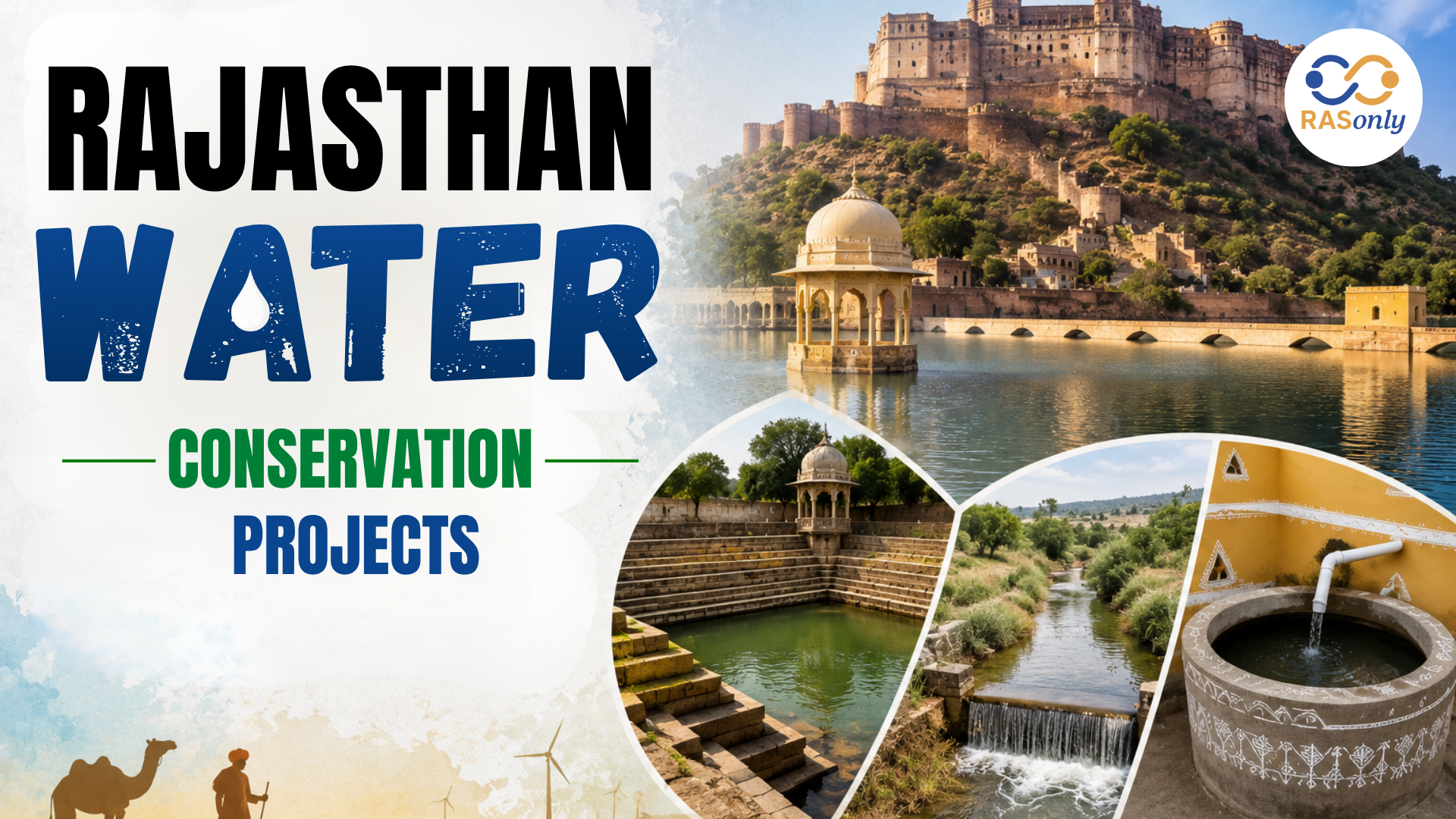
Rajasthan Water Conservation Projects are one of the most important topics of Geography, Environment, and Rajasthan GK for RAS Prelims 2026, as questions are often asked about water scarcity, irrigation projects, traditional water harvesting systems, watershed management, ERCP, and Mukhyamantri Jal Swavlamban Abhiyan. In recent years, the weightage of Environment, Climate Change, Sustainable Development, Rajasthan Geography, and current affairs-related questions on governance has increased significantly, thus making water conservation one of the most important topics to prepare for serious aspirants of RAS.
Rajasthan is the largest state in India, in terms of area, and is one of the most water-stressed states in the country as a result of low rainfall, desert climate, groundwater depletion, drought, and imbalance in the distribution of water. In view of this, the government of Rajasthan has initiated several large-scale water conservation, irrigation, and watershed management projects where rainwater harvesting, recharge of groundwater resources, sustainable irrigation, drinking water supply, and participation of the community are the main priorities. Candidates should study this topic with conceptual clarity, project comparison, map work, current affairs, and repeated revision of MCQs, and not only through rote memorization.
Why Rajasthan Water Conservation Projects are Important for RAS 2026
Water conservation is related to the Geography of Rajasthan, Environment, Agriculture, Climate Change, Rural Development, and Sustainable Development. Conceptual, factual, and statement-based questions are commonly asked by RAS about irrigation projects, river linking schemes, rainwater harvesting systems, groundwater recharge, and Government water conservation programmes.
Benefits of Strong Preparation
- Improves Rajasthan Geography preparation
- Helps in Environment & Ecology topics
- Useful for Agriculture & Irrigation linkage
- Important for current affairs integration
- Helpful in both Prelims and Mains
- Scoring with proper map practice and revision
Rajasthan Water Crisis & Water Conservation Background
The rainfall in Rajasthan is scanty and irregular, and the state, with a large part of its area, is of an arid and semi-arid type of climate. Water conservation is one of the major governance and environmental issues faced in Rajasthan due to groundwater over-exploitation, frequent drought, desertification, and rising population pressure.
Major Water Challenges in Rajasthan
- Low rainfall
- Frequent droughts
- Groundwater depletion
- Desertification
- Drinking water scarcity
- Uneven river distribution
- Climate change impacts
Traditional Water Conservation Systems of Rajasthan
Traditional water harvesting systems have great importance as a large number of questions in the RAS are asked from the water management systems of Rajasthan.
Important Traditional Water Systems
| Traditional System | Main Purpose |
|---|---|
| Johad | Rainwater harvesting |
| Baori/Bawdi | Stepwell water storage |
| Tanka | Household water storage |
| Khadin | Runoff farming system |
| Nadi | Village pond storage |
Smart Strategy
- Learn traditional systems conceptually
- Compare structures visually
- Focus on desert adaptation
- Practice Rajasthan-specific MCQs
Traditional water harvesting systems helped Rajasthan communities survive in arid climatic conditions for centuries.
Mukhyamantri Jal Swavlamban Abhiyan (MJSA) Strategy for RAS 2026
Mukhyamantri Jal Swavlamban Abhiyan is one of the most important Rajasthan government water conservation programmes for RAS preparation. It focuses on village-level water self-reliance through rainwater harvesting, watershed development, groundwater recharge, and community participation.
Important Features
- Launched in 2016
- Focus on water self-reliance
- Watershed development approach
- Rainwater harvesting structures
- Groundwater recharge
- Community participation model
Important Objectives
- Increase groundwater levels
- Improve irrigation availability
- Promote water conservation
- Reduce drought vulnerability
- Strengthen rural water security
Smart Strategy
- Revise objectives carefully
- Learn watershed concepts
- Focus on village-level water planning
- Practice current-affairs-based MCQs
Rajasthan revived MJSA 2.0 with expanded water conservation targets and large-scale water harvesting structure development.
Jal Jeevan Mission & Rajasthan Strategy
Jal Jeevan Mission is highly important because drinking water supply, rural infrastructure, and water governance are frequently linked with current affairs and sustainable development topics.
Important Features
- Har Ghar Nal Se Jal
- Functional household tap connections
- Rural drinking water supply
- Groundwater sustainability focus
- Rainwater harvesting integration
Rajasthan Linkage
- Rural water supply expansion
- Canal-based drinking water projects
- Groundwater recharge efforts
- Water grid development
Smart Strategy
- Learn mission objectives carefully
- Link with sustainable water management
- Revise current affairs repeatedly
- Practice governance-based MCQs
Eastern Rajasthan Canal Project (ERCP) Strategy for RAS 2026
ERCP is one of the most important Rajasthan water infrastructure and river-linking projects for RAS preparation because questions are increasingly linked with irrigation, drinking water supply, inter-basin transfer, and regional water imbalance.
Important Features
- River-linking project
- Chambal basin water utilization
- Drinking water & irrigation support
- Eastern Rajasthan coverage
- Multi-district water supply system
Important Objectives
- Reduce regional water imbalance
- Expand irrigation coverage
- Improve drinking water availability
- Support agriculture and industries
Smart Strategy
- Practice ERCP map-based revision
- Learn river linkage carefully
- Focus on irrigation benefits
- Revise current affairs updates
Watershed Development Projects Strategy
Watershed management is one of the most important Environment and Geography topics because it helps improve groundwater recharge, soil conservation, irrigation, and drought resilience.
Important Watershed Components
- Check dams
- Contour trenches
- Farm ponds
- Soil conservation
- Afforestation
- Runoff management
Smart Strategy
- Learn watershed concepts visually
- Link with groundwater recharge
- Focus on drought management
- Practice statement-based MCQs
Rajasthan’s watershed projects have significantly improved groundwater levels and converted wasteland into cultivable land in several districts.
Indira Gandhi Canal Project Strategy
Indira Gandhi Canal Project is one of the most important irrigation projects in Rajasthan and frequently asked in RAS Geography.
Important Features
Rajasthan’s lifeline canal project
- Water from Sutlej & Beas rivers
- Irrigation in western Rajasthan
- Desert agriculture support
Important Beneficiary Areas
- Ganganagar
- Hanumangarh
- Bikaner
- Jaisalmer
- Barmer
Smart Strategy
- Practice canal mapping
- Learn desert irrigation concepts
- Focus on agriculture transformation
- Revise Rajasthan geography linkage
Rainwater Harvesting Strategy for RAS 2026
Rainwater harvesting is increasingly important because climate change, groundwater depletion, and drought conditions are major Environment issues.
Important Methods
- Rooftop rainwater harvesting
- Check dams
- Percolation tanks
- Farm ponds
- Recharge wells
Smart Strategy
- Compare harvesting methods
- Link with groundwater recharge
- Practice environment-based MCQs
- Focus on sustainability concepts
Rajasthan Water Grid & Water Infrastructure Strategy
Rajasthan is expanding large-scale water infrastructure and runoff water management projects to improve long-term water security.
Important Concepts
- Water grid system
- Runoff water transfer
- Inter-basin water management
- Drinking water connectivity
- Irrigation expansion
Smart Strategy
- Focus on water security concepts
- Link with climate adaptation
- Practice infrastructure-based MCQs
- Revise current affairs repeatedly
Climate Change & Water Conservation Linkage
Climate change has intensified droughts, heatwaves, groundwater stress, and rainfall variability in Rajasthan, making water conservation increasingly important.
Important Climate Concerns
- Heatwaves
- Drought frequency
- Desertification
- Rainfall variability
- Groundwater depletion
Smart Strategy
- Link climate change with water scarcity
- Focus on adaptation measures
- Practice environment MCQs
- Revise sustainability concepts
Important Organizations & Institutions
Various government departments and institutions play a major role in Rajasthan’s water conservation, irrigation management, groundwater recharge, and drinking water supply systems. Understanding their functions helps aspirants connect governance, sustainable development, and environmental management topics more effectively for RAS 2026 preparation.
| Organization | Main Role |
|---|---|
| Water Resources Department Rajasthan | Water infrastructure |
| PHED Rajasthan | Drinking water supply |
| Jal Jeevan Mission | Rural tap water |
| Watershed Department | Groundwater recharge |
| Ministry of Jal Shakti | National water policy |
Understanding institutional roles improves conceptual clarity in governance and Environment-related MCQs.
Map Practice Strategy for Rajasthan Water Conservation
Maps are something most aspirants underestimate until they sit in the exam hall and realize they cannot place a project in the state. A lot of RAS Geography and Environment questions are location-based — they do not just ask what a project is, they ask where it operates, which districts it covers, and which river it draws from. That kind of question cannot be answered through reading alone.
The habit to build is simple: take a blank Rajasthan map, and at the end of every study session, mark what you studied that day. Do this consistently, and after a few weeks, the locations become automatic.
What to cover on your map:
- ERCP — districts in eastern Rajasthan it is meant to serve
- Indira Gandhi Canal — its route from Punjab through western Rajasthan
- Drought-prone districts — know which parts of the state are most vulnerable
- Watershed development areas — especially districts where results have been significant
- Traditional water systems — regions where Johad, Khadin, and Tanka were historically used
- Major rivers — Chambal, Luni, Banas, Ghaggar, Sabarmati tributaries
A few things that actually help:
- Never just look at a labelled map and call it revision — always try to recall first, then check
- Link each river to the project connected to it
- Revisit canal routes specifically, since they are a common source of map-based questions
Rajasthan Water Conservation MCQ Practice Strategy
Solving MCQs is where you find out whether your preparation is solid or just surface-level. Water conservation questions in RAS are rarely straightforward recall — they tend to be framed as statements where one is correct, and others are slightly off, or they test whether you understand the purpose of a scheme rather than just its name.
Topics to prioritise in MCQ practice:
- MJSA — its objectives, launch year, what MJSA 2.0 added
- ERCP — what it is, which basin it uses, which districts it covers
- Jal Jeevan Mission — targets, what "functional tap connection" means, progress
- Traditional water systems — functions and regional relevance of each
- Watershed development — components and what outcomes they produce
- Irrigation projects — especially the Indira Gandhi Canal's coverage and source
The right way to handle wrong answers: Most people circle the correct answer and move on. That is a waste of a learning opportunity. When you get a question wrong, go back and figure out exactly where your understanding broke down. Was it a map-based gap? A confused objective? A scheme you mixed up with another? That diagnosis is more valuable than solving ten more questions.
Solve previous year RAS GK questions from this topic. The pattern of how questions are framed tells you a lot about what to focus on.
Most Important Rajasthan Water Conservation Topics for RAS 2026
Some water conservation topics are repeatedly asked in RAS because they are directly linked with Rajasthan Geography, irrigation, climate adaptation, groundwater management, and sustainable development. Aspirants should revise these high-weightage topics repeatedly through maps, comparison tables, and MCQ practice.
High-Weightage Topics
- Mukhyamantri Jal Swavlamban Abhiyan
- ERCP
- Indira Gandhi Canal
- Traditional water harvesting systems
- Jal Jeevan Mission
- Watershed development
- Rainwater harvesting
| Topic | Importance Level |
|---|---|
| MJSA | Very High |
| ERCP | Very High |
| Indira Gandhi Canal | High |
| Traditional Water Systems | High |
| Jal Jeevan Mission | High |
Revision Strategy for Rajasthan Water Conservation
The real problem with this topic is not learning it the first time — it is keeping things distinct after multiple revisions. MJSA and Jal Jeevan Mission start sounding similar. ERCP and the water grid blur together. Watershed components get mixed up with rainwater harvesting methods.
What actually works:
- Make a one-page summary for each major project — just the key points: what it is, what it aims to do, where it operates, what is unique about it
- Use comparison tables when two schemes seem similar — writing out the differences side by side forces clarity
- Do not revise objectives by reading them repeatedly — test yourself by trying to write them out from memory
- Mix your static content revision with current affairs updates, especially for ERCP and Jal Jeevan Mission, where things are still developing
| Revision Stage | Focus Area |
|---|---|
| First Revision | Concepts & projects |
| Second Revision | Maps & irrigation |
| Final Revision | MCQs & quick notes |
How Toppers Prepare Rajasthan Water Conservation for RAS
Most toppers prepare water conservation topics through maps, conceptual understanding, project comparison, current affairs integration, and repeated MCQ practice instead of rote memorization.
Toppers’ Strategy
- Practice Rajasthan maps consistently
- Revise water projects repeatedly
- Focus on conceptual clarity
- Solve statement-based MCQs
- Prepare short revision notes
What Makes Toppers Different?
- Better map retention
- Strong current affairs linkage
- Smart MCQ analysis
- Better conceptual understanding
- Consistent revision habits
Rajasthan’s increasing focus on water security, irrigation expansion, groundwater recharge, watershed management, and sustainable development makes Water Conservation Projects one of the most important Rajasthan-specific topics for RAS 2026 preparation. Aspirants should prepare this topic through conceptual clarity, maps, project comparison, current affairs integration, and repeated MCQ practice to maximize scoring potential in Geography, Environment, Agriculture, and Rajasthan GK sections.
Conclusion
Rajasthan Water Conservation Projects have become one of the most important Rajasthan-specific topics for RAS 2026 because they connect Geography, Environment, Agriculture, Climate Change, Irrigation, and Sustainable Development together. Projects like Mukhyamantri Jal Swavlamban Abhiyan, ERCP, Jal Jeevan Mission, watershed development programmes, and traditional water harvesting systems are highly important from both Prelims and Mains perspectives.
Aspirants should prepare this topic through conceptual clarity, Rajasthan map practice, irrigation-project comparison, current affairs integration, and repeated MCQ revision instead of rote memorization. Strong preparation of water conservation topics can significantly improve scoring potential in Rajasthan Geography, Environment, and Rajasthan GK sections.
FAQ
These projects are important because RAS frequently asks questions from irrigation, groundwater conservation, river-linking projects, watershed management, climate change, and Rajasthan Geography.
Mukhyamantri Jal Swavlamban Abhiyan (MJSA), ERCP, Indira Gandhi Canal Project, and Jal Jeevan Mission are among the most important topics for RAS preparation.
ERCP is important because it focuses on river-linking, irrigation expansion, drinking water supply, and reducing regional water imbalance in Eastern Rajasthan.
Many RAS questions are directly map-based and location-oriented, especially from canals, rivers, irrigation regions, drought-prone districts, and watershed areas.
Aspirants should focus on conceptual understanding, Rajasthan map practice, project comparison tables, current affairs linkage, and repeated MCQ practice for effective preparation.
BEST SELLER
🏆 PRELIMS
RAS Pass
Prelims focused Hindi & English
₹399
✓
Prelims Topic-Wise Tests
✓
Subject-Wise Tests
✓
Full-Length Prelims Tests
✓
Daily Current Affairs Tests
✓
Prelims PYQs Tests
✓
Detailed Solutions & Analysis
✓
All Rajasthan Ranking
✓
Unlimited Reattempts
✓
Mains Tests
✓
Hindi & English Tests
✓
All Rajasthan Ranking
Trusted by 5,000+ Students
Post Category
- RAS Salary
- Result
- RAS Admit Card
- RAS Job
- RAS Cutoff
- Preparation Tips
- RAS Answer Key
- RAS Exam Analysis
- RAS Syllabus
- RAS Previous Year Papers
- RPSC RAS Exam Pattern
- RAS Interview
- RAS Exam Date
- RAS Vacancy
- RAS Test Series
- RAS Best Books
- RAS Preparation Resources
- RAS Coaching Centre
- History
- Polity
- Geography
- Economics
- Science
- Art and Culture
- RPSC RAS Application Form
- RPSC RAS Notification
- RAS Eligibility Criteria
- UPSC Exam
- RPSC RAS Mains
Visit Our RASonly Offline Center
Our Expert Faculty

Bhunesh Sir
Current Affairs · 13+ Yrs

Aamir Khan Sir
RAS-2017 · IIM Ahm.

Akash Sir
Polity · 8+ Yrs
Free Resources
Official Mobile App

RASOnly App
by OTSAdda · Free
Full Video Lectures
Mock Tests & PYQs
Daily Current Affairs
AI Mock Interview
Free Download · No subscription needed to install
RAS 2024 Toppers — RASonly
Rank 2
Virendra Charan
Rank 9
Bhoopinder Singh
Rank 26
Aanchal Nagpal
Rank 33
Lokendra Singh
Rank 45
Amar Rathore
Rank 46
Manasvini Verma

Join RASonly WhatsApp Community
Get daily current affairs, exam alerts, free study material and tips from expert faculty — right on WhatsApp.
Join for Free →RASonly Interview Guidance Program

Mr. Ashok Jain
Ex-Chief Secretary Govt of Rajasthan
- IAS officer of the 1981 batch, Rajasthan cadre.
- Passionate about mentoring the next generation of RAS officers with real-world insights.
- Got retired in Dec 2017 from the post of Chief Secretary of the state of Rajasthan.

Mr. Guru Charan Rai
Ex-ASP / SP in Jaisalmer
- Guru Charan Rai, IPS (Retd), retired as Inspector General of Police (Security), Rajasthan, Jaipur in 2017.
- Served as ASP and SP in Jaisalmer, Nagaur, Sri Ganganagar, Sawai Madhopur, Dausa, Sikar, and Karauli.
- He also held key positions as DIGP and IGP in the Law and Order division.

Mr. Rakesh Verma
Ex-IAS Officer, B.Tech, MBA, and M.A. (Economics)
- IAS officer of the 1981 batch and retired in Chief Secretary Rank.
- Civil servant of high repute and vast experience.
- Has been teaching UPSC CSE subjects for the last six years.
Related Post

Daily Current Affairs for RAS Exam Preparation 2026
Rajasthan Initiative to Build India’s First UNESCO Global Geopark
October 07, 2026
Indigenous Tejas Mk-1 Inducted into IAF
October 07, 2026
Vedanta to Increase Oil Production in Rajasthan
October 06, 2026