Kushan Empire: History, Rulers, Administration, Economy, Art, Decline
RAS Mains 2027: How to Use Current Affairs in Answer Writing

Get in Touch with RASonly!

Learn how to effectively integrate current affairs with static concepts for RAS Mains 2027. Discover answer writing techniques, Rajasthan-focused examples, revision strategies, common mistakes, and practical ways to improve your answers and score better.


Success in the Mains examination depends not only on knowledge but also on the ability to connect static concepts with relevant contemporary developments. The Rajasthan Public Service Commission (RPSC) has already modified the structure of RAS Mains with the updated RAS Scheme, and the message is clear: static knowledge is not sufficient. Examiners now demand that candidates link textbook concepts with the actual happenings in governance, economy, environment, science, and issues of Rajasthan.
This is why aspirants should not simply follow last year's preparation strategy. Integrating recent developments with static concepts is a key part of good answers; aspirants must learn to structure their responses instead of collecting random information from newspapers. This blog explains a practical, realistic, and exam-centric methodology for using recent developments effectively in RAS Mains answers.
Why Current Affairs Matter More in the Revised RAS Mains Pattern
The RPSC RAS Mains exam comprises four descriptive papers with a total of 800 marks, which was taken by the commission in a recent revision of their syllabus to develop a more analytical and applied approach to writing. Two-mark questions have been removed, and five- and ten-mark descriptive questions have been given more weight - the examiners are looking for depth rather than rote learning.
- The use of artificial intelligence in governance, cybersecurity, digital currency, and new legislation has been explicitly mentioned in the General Studies Papers II and III.
- The syllabus's unit structure makes it easier to see exactly where current developments fit within each paper.
- Rajasthan-specific developments, including schemes, policies, and institutional changes, are important areas of the examination.
| Mains Paper | Core Focus | Current Affairs Relevance |
|---|---|---|
| GS Paper I | History, Culture, Economy of Rajasthan | State schemes, heritage updates, economic surveys |
| GS Paper II | Governance, Ethics, Science & Technology | Policy reforms, tech innovations, ethical case studies |
| GS Paper III | Polity, Public Administration, Law | New legislations, administrative reforms, judgments |
| Paper IV | Hindi, English, Essay | Essay themes drawn from contemporary social issues |
Understanding the RAS Mains Answer Writing Framework
It is important for the aspirants to understand the basic structure of writing answers in the RAS Mains Exam that RPSC expects before they can start writing the answers to the present questions. It's much better to have an organised answer with weak content than an answer based on facts with no structure.
- Introduction: Define the term or set the context in two to three lines.
- Body: Structure arguments, data, and examples, usually in points or short paragraphs, in a logical way.
- Current affairs linkage: Give a recent or relevant example or data point to support the argument.
- Conclusion: Conclude with a forward-looking or a balanced statement, preferably with a governance or policy connection.
How to Add Contemporary Examples to Your Answers
The real advantage comes from using selected examples to strengthen a static concept rather than trying to reproduce everything read in the news. Not so that they can remember all the items of news, but so that they can use selected examples of news to reinforce a static concept.
- One or two relevant examples should be sufficient for a 150–200 word answer – do not let recent developments become the main body of your response.
- Answer local administrative knowledge of Rajasthan whenever a question is asked, as it is given weightage in the RPSC exam.
- Don't add an example just because it's popular – it needs to support the argument that is presented.
- Ensure that your answers are accurate in terms of facts; half-remembered or vague facts can detract from a strong answer.
Linking Static Syllabus with Current Affairs: A Practical Method
Preparation should not treat static subjects and recent developments as two separate areas of study. The smartest ones tend to make it a practice to make a connection between the topic of the static with the current event as soon as they read the latter, irrespective of the time of the actual exam.
- While reading news, ask: "Which static topic from Paper I, II, or III does this belong to?"
- Keep your notes organised by subject rather than maintaining date-wise records, making revision more focused.
- Review static chapters regularly and update with new examples as needed and in preparation for exams.
- Compile notes on a monthly basis to form one document that can be easily edited.
Building a Sustainable Reading and Revision Routine
A RAS Mains strategy based entirely on the last-minute learning cramming technique is not likely to serve you well in the stress of a 3-hour descriptive paper. Consistency across the preparation cycle matters far more than short bursts of intense reading before the exam.
- Read one reliable newspaper every day – not only headlines – but also analysing the editorial and opinion pages.
- Use a monthly magazine for RAS to supplement the important news that may not have been covered in the daily reading.
- Take dedicated time to study Rajasthan current affairs weekly, as it is one of the areas that is not prepared by non-Rajasthanites often.
- Update your existing notes regularly so that important developments from six months earlier are not forgotten at exam time.
Practising with Contemporary Examples
Reading about recent developments is only half the work; the other half is practising answers with relevant examples under timed conditions. This is because candidates who forget to do this in the actual exam may find it hard to bring up examples that are relevant.
- Solve at least 2-3 questions every day, preferably with previous-year or model questions, deliberately putting in a current affairs point in each.
- To get the most marks, practice all answers within the per-question time limit as RPSC's revised pattern emphasises concise and structured responses.
- Regularly review and receive answers to see if they are integrated naturally or forced.
- Keep a value addition file—a shortlist of quality facts, committees, or data points—to be easily inserted into multiple answers.
Common Mistakes Aspirants Make While Using Current Affairs
Even prepared candidates lose marks because of certain practices that can be avoided in the application of current affairs. An understanding of the patterns can save many hours of preparation and enhance answer quality.
| Common Mistake | Why It Hurts the Answer | Better Approach |
|---|---|---|
| Overloading answers with too many examples | Dilutes the core argument | Use one strong, relevant example |
| Ignoring Rajasthan-specific developments | Misses state-level weightage | Prioritise state current affairs equally |
| Copying news developments without understanding | Leads to factual errors under pressure | Understand context before noting it down |
| Treating current affairs as separate revision | Creates disconnected preparation | Integrate with static notes from day one |
Sample Approach: Editorial Analysis for Mains
Editorial analysis for Mains is one of the most underused yet high-value habits among RAS aspirants. A well-analysed editorial can provide arguments, examples, and perspectives for multiple topics across the GS papers and essay writing.
- Describe the main topic(s) of the editorial and the primary arguments of the author in the author's own words.
- Remove data, committee references, and government schemes as these frequently emerge as value-added features.
- Analyze the editorial's point of view and compare it to an alternate opinion to develop well-rounded, multi-dimensional responses.
Final Revision Strategy Before the Mains Exam
It's time to switch from learning new material to reviewing what you've learned as the test nears. A disciplined revision strategy in the final weeks can prevent information overload and last-minute panic.
- Revise consolidated notes rather than scrolling through raw daily updates during the final month.
- Focus on the last 6 to 8 months of developments as they are more likely to be in questions in the past.
- To maintain freshness of the integration skill during revision, write 2-3 full-length answers per week until the actual exam.
Conclusion
It is not very important for aspirants to read a lot of current affairs for Success in RAS Mains 2027, but it is important that the current affairs are integrated with structured and static concept-based answers. With the revised RPSC pattern, this is almost inevitable – the candidates who can relate the governance, economy, ethics, and development of Rajasthan with the core syllabus were rewarded while the rest were not. If aspirants develop the habit of reading regularly, categorize topics into static material, regularly practice answer writing, and stay away from common mistakes such as examples on every topic and overloading, then current affairs should not be a source of anxiety; instead, it should be a source of strength in scoring. Preparation that starts early, stays consistent, and remains exam-focused will always outperform preparation that begins late and relies on last-minute cramming.
FAQs
A major part of Current Affairs is significant as well, as it permits the contender to link the subjects provided in the Static Syllabus with the prevailing events, particularly in the field of Government, Economy, Environment, Science and Technology, and the issues relating to Rajasthan.
Use recent developments as value addition rather than the main content. Add one or two relevant examples, facts, schemes, reports, judgments, or recent developments to strengthen your core argument.
Usually, one or two strong and relevant examples are enough for a 150–200 word answer. Too many examples can result in undue focus on the examples themselves, and away from the main argument.
Yes. Rajasthan-specific schemes, policies, government initiatives, administrative developments, economic issues, and other state-level developments should receive dedicated attention.
While reading current affairs, identify the related syllabus topic. For example, a new government scheme can be linked to governance, welfare, public administration, economy, or social justice depending on its context.
BEST SELLER
🏆 PRELIMS
RAS Pass
Prelims focused Hindi & English
₹399
✓
Prelims Topic-Wise Tests
✓
Subject-Wise Tests
✓
Full-Length Prelims Tests
✓
Daily Current Affairs Tests
✓
Prelims PYQs Tests
✓
Detailed Solutions & Analysis
✓
All Rajasthan Ranking
✓
Unlimited Reattempts
✓
Mains Tests
✓
Hindi & English Tests
✓
All Rajasthan Ranking
Trusted by 5,000+ Students
Post Category
- RAS Salary
- Result
- RAS Admit Card
- RAS Job
- RAS Cutoff
- Preparation Tips
- RAS Answer Key
- RAS Exam Analysis
- RAS Syllabus
- RAS Previous Year Papers
- RPSC RAS Exam Pattern
- RAS Interview
- RAS Exam Date
- RAS Vacancy
- RAS Test Series
- RAS Best Books
- RAS Preparation Resources
- RAS Coaching Centre
- History
- Polity
- Geography
- Economics
- Science
- Art and Culture
- RPSC RAS Application Form
- RPSC RAS Notification
- RAS Eligibility Criteria
- UPSC Exam
- RPSC RAS Mains
Visit Our RASonly Offline Center
Our Expert Faculty

Bhunesh Sir
Current Affairs · 13+ Yrs

Aamir Khan Sir
RAS-2017 · IIM Ahm.

Akash Sir
Polity · 8+ Yrs
Free Resources
Official Mobile App

RASOnly App
by OTSAdda · Free
Full Video Lectures
Mock Tests & PYQs
Daily Current Affairs
AI Mock Interview
Free Download · No subscription needed to install
RAS 2024 Toppers — RASonly
Rank 2
Virendra Charan
Rank 9
Bhoopinder Singh
Rank 26
Aanchal Nagpal
Rank 33
Lokendra Singh
Rank 45
Amar Rathore
Rank 46
Manasvini Verma

Join RASonly WhatsApp Community
Get daily current affairs, exam alerts, free study material and tips from expert faculty — right on WhatsApp.
Join for Free →RASonly Interview Guidance Program

Mr. Ashok Jain
Ex-Chief Secretary Govt of Rajasthan
- IAS officer of the 1981 batch, Rajasthan cadre.
- Passionate about mentoring the next generation of RAS officers with real-world insights.
- Got retired in Dec 2017 from the post of Chief Secretary of the state of Rajasthan.

Mr. Guru Charan Rai
Ex-ASP / SP in Jaisalmer
- Guru Charan Rai, IPS (Retd), retired as Inspector General of Police (Security), Rajasthan, Jaipur in 2017.
- Served as ASP and SP in Jaisalmer, Nagaur, Sri Ganganagar, Sawai Madhopur, Dausa, Sikar, and Karauli.
- He also held key positions as DIGP and IGP in the Law and Order division.

Mr. Rakesh Verma
Ex-IAS Officer, B.Tech, MBA, and M.A. (Economics)
- IAS officer of the 1981 batch and retired in Chief Secretary Rank.
- Civil servant of high repute and vast experience.
- Has been teaching UPSC CSE subjects for the last six years.



Daily Current Affairs for RAS Exam Preparation 2026

Niharika Rathore Wins MIS Global India Title
October 03, 2026
Rajasthan Achieves 90.19 Lakh Farmer ID Target
October 03, 2026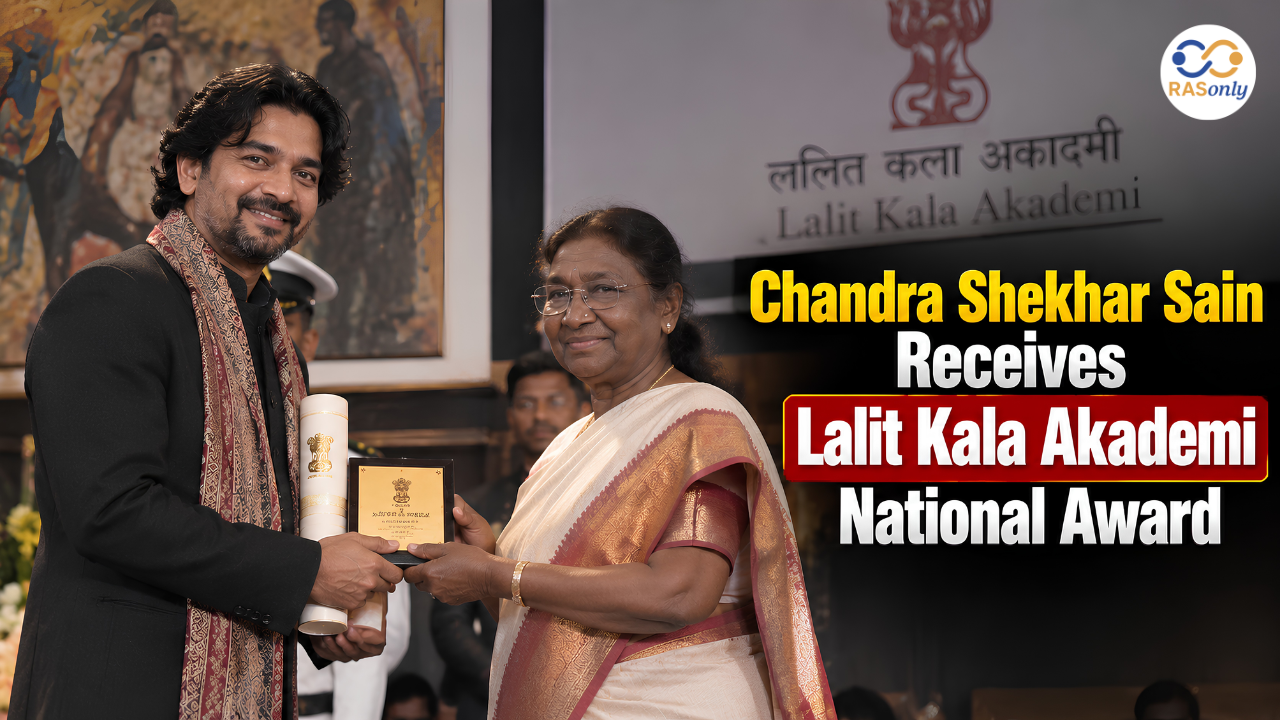
Chandra Shekhar Sain Receives Lalit Kala Akademi National Award
October 01, 2026