UPSC Mains Result 2026 Out: Download PDF, Selection List, Cut Off & Interview Details
RAS Prelims Time Management: 3-Hour Exam Strategy

Get in Touch with RASonly!

Learn how to manage 180 minutes effectively in the RAS Prelims exam. Explore the three-round strategy, section-wise time allocation, negative marking rules, question-solving techniques, and mock test tips to improve accuracy, maintain speed, and boost your chances of clearing the cutoff.

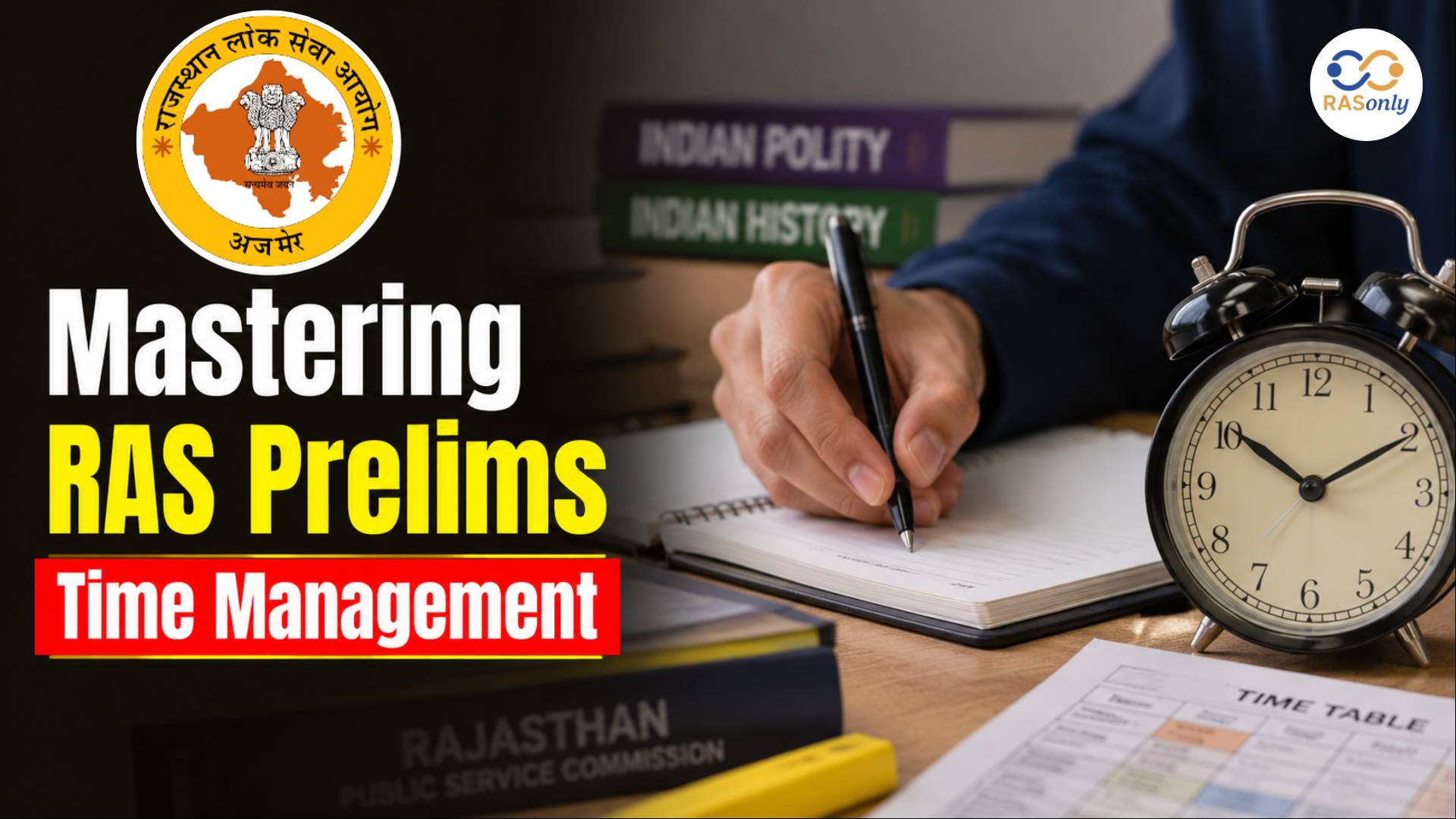
RAS Prelims time management decides whether a well-prepared candidate clears the cutoff or falls short. Each year, good candidates miss marks due to their taking too much time on a few difficult questions and panicking in the final 30 minutes and filling the OMR sheet carelessly. Speed alone is not the answer. You need a repeatable system to work 150 questions accurately, calmly and with control of negative marking.
This is a simple roadmap that will help you practice the RPSC RAS prelims paper in 3 hours, which can be helpful for you to follow from now. It includes the exam pattern, a three-round approach, a recommended section-wise time strategy with simple math, a negative marking strategy, and a checklist for the last 30 minutes. At the end, you will not have to use your best judgment when it comes to paper plans for the test day.
Understanding the RAS Prelims Exam Pattern
The RAS Prelims is a single objective paper that works as a screening test for the Mains stage. You need to aim for getting the right answers rather than for completing all questions, as it only shortlists you. If you have a pattern, you know what to expect, allowing you to set reasonable time goals.
| Exam Detail | Information |
|---|---|
| Total Questions | 150 MCQs |
| Total Marks | 200 |
| Duration | 3 Hours (180 minutes) |
| Marks per Question | 4/3 (about 1.33) |
| Negative Marking | 1/3 of the marks allotted to the question (about 0.44) |
| Purpose | Screening test for Mains |
Always confirm these details against the latest official RPSC notification before the exam, as the commission can revise rules.
How to Manage Time in RAS Prelims
Prelims time management is not about solving questions all at once but about solving the right questions at the right time. Easy questions should be answered quickly, and hard questions should wait until you've got your sure marks. If you do all 150 questions the same way, you'll lose valuable time trying to get marks elsewhere.
- The average time per question is 72 seconds (180 minutes ÷ 150 questions).
- Direct fact-based questions often take 30–45 seconds, which saves time for harder ones.
- Lengthy statement-based and reasoning questions may need 1.5–2 minutes.
- If you have a question you aren't sure about, move on and don't get stuck.
The Three-Round Method
The three-round method is a popular method among serious aspirants that defends easy marks first. Rather than trying to answer the questions in order, you read the paper in layers, starting with the easiest questions. This develops confidence at a young age, and pressure is not introduced.
| Round | Task | Suggested Time |
|---|---|---|
| Round 1 | Attempt only easy and direct questions. | About 90 minutes |
| Round 2 | Solve moderate questions using logic or elimination. | About 55 minutes |
| Round 3 | Review marked questions and verify the OMR sheet. | About 35 minutes |
Keep the last 10–15 minutes strictly for final revision. These timings are a suggested framework, so adjust them after a few mock tests based on your strengths.
Section-Wise Time Allocation for RAS Prelims
A subject plan assists you to maintain a sustained pace and prevents one challenging topic from taking up the entire paper. The table below is a guide rather than a rule for the first two rounds, as the number of questions per subject may vary from year to year. It totals 180 minutes.
| Subject | Suggested Time |
|---|---|
| Rajasthan GK | 30 minutes |
| History & Polity | 25 minutes |
| Geography | 20 minutes |
| Economy | 20 minutes |
| Science & Technology | 15 minutes |
| Current Affairs | 15 minutes |
| Reasoning & Mental Ability | 20 minutes |
| Final Revision & OMR Check | 35 minutes |
Use your mock test data to adjust these limits. If Geography is your strong area, finish it faster and give the extra minutes to Reasoning or Economy.
RAS Prelims Negative Marking Strategy
A wrong answer is worth about 0.44 marks, while a correct answer is worth about 1.33 marks, meaning that a wrong answer does roughly cancel one-third of a correct answer. Because of this, the two are tightly related in the context of the RAS Prelims—time management and risk control. This means that the two are closely related in the context of the RAS Prelims—time management and risk control—as the rushed guesses are small points lost. The simple math below shows when a guess is worth taking.
| Options Left After Elimination | Chance of Being Correct | Expected Gain per Attempt |
|---|---|---|
| 4 (blind guess) | 25% | About 0 |
| 3 | 33% | About +0.15 |
| 2 | 50% | About +0.44 |
These figures assume four options per question and the marking scheme above. Use the following rules while attempting:
- Attempt a question only after eliminating at least one wrong option.
- Avoid blind guessing, since it has zero expected benefit.
- Leave confusing questions for Round 2 or Round 3.
- Read the OMR instructions in the notification carefully, including how to mark unattempted questions.
Answer Attempting Strategy by Question Type
There are different types of questions, which require different approaches when time is limited. Static facts are about recall, current affairs are about freshness, and reasoning is about time limits. You should match your style and speed to the type of question to ensure that your speed is uniform throughout the paper.
Static GK Questions
Static GK questions covering history, polity, geography, and Rajasthan topics should be solved immediately if you know them. They are the safest marks on the paper because the answer is either in your memory or it is not. Never attempt to remember something that will not be remembered for longer than a minute.
Current Affairs Questions
Current affairs questions must be attempted at the beginning of the pass when there is freshness in recall. These questions are often based on a single fact that has just happened, so it is not much help to spend much time deliberating. If you don't remember, remove answers and proceed quickly.
Reasoning and Numerical Questions
Reasoning and numerical questions can silently drain time if left unchecked. Set a fixed limit, such as 90 seconds, and skip anything that exceeds it. Approximate and do option elimination whenever possible.
Common Time Management Mistakes
Many candidates lose marks because of poor exam planning rather than weak preparation. Recognizing these errors before exam day keeps you from repeating them under pressure.
| Common Mistake | Better Approach |
|---|---|
| Spending too long on one question | Follow the three-round method and mark it. |
| Overthinking easy questions | Trust your first confident answer. |
| Delaying OMR filling | Fill the OMR regularly in small batches. |
| Skipping timed practice | Attempt full-length mock tests every week. |
| Blind guessing at the end | Attempt only after logical elimination. |
Mock Test Practice and Exam Temperament
Mock tests turn theory into skill. A timed paper reveals exactly where your minutes are going, develops speed, and trains you to be composed when under exam-like pressure. Without them, even a good strategy tends to fall apart on the actual day.
- Attempt at least one full-length mock every week in a 3-hour window.
- Note which section consumes the most time and set tighter limits.
- Look at incorrect responses to distinguish between gaps in understanding and careless errors.
- Practice filling the OMR sheet so it becomes a natural habit.
How Toppers Manage Time in RPSC RAS Prelims
Successful candidates rarely depend on last-minute tricks. They build a fixed attempt order, practise it through many timed papers, and refine their pacing section by section. This discipline keeps them calm and accurate even when the paper turns out harder than expected.
- They decide their attempt order well before exam day.
- They solve previous year papers under strict time limits.
- They skip tough questions without emotional attachment.
- They protect the final revision window and never use it for new questions.
Last 30 Minutes Exam Strategy
The final 30 minutes can change your result, so use them for verification, not for experiments. Do not start questions you have never seen before. Concentrate on marked questions and on removing avoidable errors, since a single OMR mistake can undo good work.
| Time Left | Action |
|---|---|
| 30–15 minutes | Revisit marked questions and apply elimination. |
| 15–5 minutes | Cross-check OMR bubbles against your question paper. |
| Last 5 minutes | Keep as a safety buffer and avoid risky guesses. |
Managing Exam Anxiety During the Paper
Anxiety slows decision-making and can ruin even strong RAS Prelims time management. When a difficult question appears, pause, take a slow breath, and move on without judging the paper. One tough set of questions does not mean the entire paper is tough.
- Remember that the paper is a screening test, not a perfect-score contest.
- Skip a hard question instead of fighting it.
- Use the three-round method to stay in control of your progress.
- Keep a steady pace and avoid checking the clock every minute.
Conclusion
Clearing the RAS Prelims depends less on how much you have studied and more on how well you use the 180 minutes you are given. A clear plan built on the three-round method, sensible section-wise limits, and strict control over negative marking will improve both your accuracy and your confidence. Regular timed mock tests turn this plan into a habit, so the strategy feels natural when exam day arrives. Protect your final revision window, avoid risky guesses, and stay calm even if the paper feels difficult. With consistent practice and a disciplined approach, you can maximise your correct attempts and strengthen your chances of clearing the RPSC RAS Prelims cutoff.
FAQs
Split the paper into three rounds. Solve easy questions first, handle moderate ones in the second round, and use the final 10–15 minutes to check marked answers and the OMR sheet.
The average is about 72 seconds per question, since 180 minutes are available for 150 questions. Easy questions should take less, which leaves extra time for harder ones.
A workable plan is about 90 minutes for Round 1, 55 minutes for Round 2, and 35 minutes for review and OMR checking. Adjust these limits after taking mock tests.
Attempt only those questions where you can eliminate at least one option. Avoid blind guessing, since a wrong answer costs about 0.44 marks.
Attempt questions you know first, return to moderate ones with elimination, and leave the most doubtful for last. Fill the OMR sheet regularly instead of leaving it all for the end.
BEST SELLER
🏆 PRELIMS
RAS Pass
Prelims focused Hindi & English
₹399
✓
Prelims Topic-Wise Tests
✓
Subject-Wise Tests
✓
Full-Length Prelims Tests
✓
Daily Current Affairs Tests
✓
Prelims PYQs Tests
✓
Detailed Solutions & Analysis
✓
All Rajasthan Ranking
✓
Unlimited Reattempts
✓
Mains Tests
✓
Hindi & English Tests
✓
All Rajasthan Ranking
Trusted by 5,000+ Students
Post Category
- RAS Salary
- Result
- RAS Admit Card
- RAS Job
- RAS Cutoff
- Preparation Tips
- RAS Answer Key
- RAS Exam Analysis
- RAS Syllabus
- RAS Previous Year Papers
- RPSC RAS Exam Pattern
- RAS Interview
- RAS Exam Date
- RAS Vacancy
- RAS Test Series
- RAS Best Books
- RAS Preparation Resources
- RAS Coaching Centre
- History
- Polity
- Geography
- Economics
- Science
- Art and Culture
- RPSC RAS Application Form
- RPSC RAS Notification
- RAS Eligibility Criteria
- UPSC Exam
- RPSC RAS Mains
Visit Our RASonly Offline Center
Our Expert Faculty

Bhunesh Sir
Current Affairs · 13+ Yrs

Aamir Khan Sir
RAS-2017 · IIM Ahm.

Akash Sir
Polity · 8+ Yrs
Free Resources
Official Mobile App

RASOnly App
by OTSAdda · Free
Full Video Lectures
Mock Tests & PYQs
Daily Current Affairs
AI Mock Interview
Free Download · No subscription needed to install
RAS 2024 Toppers — RASonly
Rank 2
Virendra Charan
Rank 9
Bhoopinder Singh
Rank 26
Aanchal Nagpal
Rank 33
Lokendra Singh
Rank 45
Amar Rathore
Rank 46
Manasvini Verma

Join RASonly WhatsApp Community
Get daily current affairs, exam alerts, free study material and tips from expert faculty — right on WhatsApp.
Join for Free →RASonly Interview Guidance Program

Mr. Ashok Jain
Ex-Chief Secretary Govt of Rajasthan
- IAS officer of the 1981 batch, Rajasthan cadre.
- Passionate about mentoring the next generation of RAS officers with real-world insights.
- Got retired in Dec 2017 from the post of Chief Secretary of the state of Rajasthan.

Mr. Guru Charan Rai
Ex-ASP / SP in Jaisalmer
- Guru Charan Rai, IPS (Retd), retired as Inspector General of Police (Security), Rajasthan, Jaipur in 2017.
- Served as ASP and SP in Jaisalmer, Nagaur, Sri Ganganagar, Sawai Madhopur, Dausa, Sikar, and Karauli.
- He also held key positions as DIGP and IGP in the Law and Order division.

Mr. Rakesh Verma
Ex-IAS Officer, B.Tech, MBA, and M.A. (Economics)
- IAS officer of the 1981 batch and retired in Chief Secretary Rank.
- Civil servant of high repute and vast experience.
- Has been teaching UPSC CSE subjects for the last six years.
Related Post



Daily Current Affairs for RAS Exam Preparation 2026

Vivaan Kapoor Wins Silver at ISSF World Championship 2026
November 18, 2026
Shekhawati Heritage Meet 2026
November 18, 2026
Yatharth Sanstha’s Maqtoob at Asian Youth Theatre Festival
November 17, 2026