Kushan Empire: History, Rulers, Administration, Economy, Art, Decline
RAS 2026 Preparation: Topper Strategy and Daily Timetable

Get in Touch with RASonly!

Prepare for RAS 2026 with a practical strategy covering the exam pattern, revision cycle, mock tests, Rajasthan GK, subject-wise tips, daily timetable, answer writing, and common mistakes.

RAS 2026 preparation demands more than long study hours. It needs a clear plan, steady revision, regular mock tests, and a daily routine you can actually follow. With the RPSC notification out and the Prelims scheduled for 29 November 2026, aspirants have a defined window to build that routine.
This guide covers the exam pattern, verified data from the last RAS cycle, a topper-style strategy, a sample daily timetable, subject-wise tips, and the most common mistakes. Use it as a practical starting point, and always cross-check the syllabus and dates on the official RPSC website.
Key Dates for RAS 2026 Preparation
The official timeframe gives you an idea of the date you'll take the exam and allows you to make realistic monthly goals. The details below come from the RPSC RAS/RTS 2026 notification. It is important that candidates keep an eye on these dates, as the process could be completed without them being able to apply for the position they had in mind for a year. Make sure to check the official website for the most recent information.
| Event | Details |
|---|---|
| Notification released | 27 May 2026 |
| Total vacancies | 607 (192 State Service, 415 Subordinate Service) |
| Application window | 4 June 2026 to 3 July 2026 |
| Prelims exam | Sunday, 29 November 2026 |
Understand the RAS Exam Pattern First
Once you understand the pattern, it becomes easier to prepare for the RAS 2026 as you will know where to get your marks from and where you should invest your time. The structure of an exam is typically the first thing Toppers look at before they start flipping through a book. This helps them not to cover unnecessary topics and to plan each step individually. The RAS exam consists of three parts, with each part assessing a different skill.
Stage-Wise Exam Structure
The RAS exam moves from a screening test to a descriptive written exam and finally a personality test. Only the Mains and Interview marks decide the final merit, while Prelims marks are used just for shortlisting. This means your real ranking is built on writing quality and personality. The table below summarises each stage clearly.
| Stage | Format | Marks | Key Points |
|---|---|---|---|
| Prelims | 1 paper, 150 objective questions | 200 | 3 hours, 1/3 negative marking, not counted in final merit |
| Mains | 4 descriptive papers | 800 (200 each) | 3 General Studies papers and 1 Hindi and English language paper |
| Interview | Personality test | 100 | Final merit is based on Mains + Interview (900 marks) |
Core Subject Areas
The syllabus for the RAS is wide, but it also has a strong flavor of Rajasthan as compared to other State Exams. It's important to develop a strong foundation in these areas to help you perform well in Prelims and answer Mains questions effectively. Candidates are advised to allocate equal time to the static subjects and current developments. The list below covers the main areas to prepare.
- Rajasthan history, art and culture
- Rajasthan geography, economy and government schemes
- Indian history, geography and polity
- Indian economy and Science & Technology
- Current affairs at the national and state level
RPSC RAS 2024 Result Snapshot
The selected results for the last completed cycle illustrate the real-life application of selection. The final result of the RAS 2024 was announced on 18th April 2026 after the completion of the interview round. The numbers below give aspirants a realistic idea of the scale of competition and the marks that toppers scored. By learning them, you can get a good benchmark of what your target should be for your own study.
| Parameter | Data |
|---|---|
| Rank 1 | Dinesh Vishnoi: 302.50 (Mains) + 49 (Interview) = 351.50 |
| Rank 2 | Virendra Charan: 293.00 (Mains) + 58 (Interview) = 351.00 |
| Prelims (held 2 Feb 2025) | 21,539 candidates qualified for Mains |
| Mains | 2,168 candidates qualified for Interview |
| Candidates in final merit list | 2,391 |
| Posts | Roughly 1,100 (RPSC revised the count to 1,096 earlier) |
The key takeaway is that the topper scored about 86% of his final marks in the Mains. This clearly shows that descriptive answer writing decides the rank.
Topper Strategy for RAS 2026 Preparation
The key to being successful is having a few core habits; there is no secret trick. These habits focus on knowing the syllabus, revising often, and testing yourself regularly. The six steps below are commonly followed by toppers and coaching mentors. Use them sequentially and tailor them to suit your weaknesses and strengths.
1. Start With the Complete Syllabus
Reading the official syllabus line by line should be the very first task of your preparation. Indicates what topics are essential, what topics are repeated, and what topics can be safely skipped. Have a printed-out version on your study table and cross out each topic when it is done. This is an easy trick to stay on track and measurable while preparing.
- Recognize common and high-frequency topics
- Drop topics that are not in the syllabus
- Track your progress every week
2. Make Short Notes From Day One
Short notes save hours when revising – nobody has to read complete books before the exam. Use the words in your own way, as that helps to increase understanding and memory. All notes should be stored in the same location for easy access and/or updating. Over time, these notes become your most valuable revision material.
- Current affairs and important facts
- Rajasthan GK and government schemes
- Constitutional articles and reports
3. Build a Strong Revision Cycle
Revision is never a part of every RAS 2026 preparation plan, as it is not possible to do it in isolation. If you don't revise it within days of studying it, it is forgotten. A spaced revision schedule aids in the transfer to LTM. The schedule below is widely recommended by toppers and mentors.
| Revision | When |
|---|---|
| First | Within 24 hours of studying |
| Second | After 7 days |
| Third | Monthly, until the exam |
4. Practise Mock Tests Regularly
Mock tests let you see where you lose marks before the actual test. They also train you to manage time and handle the 1/3 negative marking in Prelims. Early start is sufficient to put in place weak points. The following sequence is a feasible approach to gradually build up the difficulty.
- Start with 1 to 2 tests a week in the early phase
- Increase to 3 to 4 tests a week close to the exam
- Analyse every wrong answer and note the reason
5. Give Current Affairs Equal Importance
Current affairs are mentioned in both Prelims and Mains and Rajasthan-specific ones are of great value. Reading regularly each day is much more effective than reading a whole year in the final month. Make brief notes as you read, to keep revision short and simple. Choose a few reliable sources instead of following everything available.
- One reliable newspaper
- A compilation of current affairs for the month
- Government schemes and updates in Rajasthan state.
6. Strengthen Rajasthan GK
Rajasthan GK is the area where local candidates can gain a clear edge over other aspirants. This section tends to be easier to guess than the national topics and can be a scoring chance. Set aside whole periods of time for this in your timetable. Revise it more often than other subjects to keep facts fresh.
- History, art and culture
- Geography and economy
- Government schemes and policies
Daily Timetable for RAS 2026 Preparation
If it doesn't align with your energy and your schedule, a timetable is not going to work for you. The sample below is a full-time routine that balances static subjects, current affairs, revision, practice, and rest. You can begin with 6 or 8 hours of study, and build up as you progress. It's better to have a consistent routine than to duplicate the topper's.
| Time | Activity |
|---|---|
| 5:30 AM – 6:00 AM | Wake up and freshen up |
| 6:00 AM – 8:00 AM | Static subjects (History, Polity, Geography) |
| 8:00 AM – 9:00 AM | Breakfast and short break |
| 9:00 AM – 11:00 AM | Rajasthan GK |
| 11:00 AM – 12:00 PM | Current affairs |
| 12:00 PM – 1:00 PM | Revision |
| 1:00 PM – 2:00 PM | Lunch and rest |
| 2:00 PM – 4:00 PM | Weak subjects |
| 4:00 PM – 5:00 PM | Break, walk, refresh |
| 5:00 PM – 7:00 PM | MCQ practice and mock tests |
| 7:00 PM – 8:00 PM | Dinner |
| 8:00 PM – 10:00 PM | Mains answer writing and revision |
| 10:30 PM | Sleep |
Subject-Wise Preparation Tips
Don't use the same approach for every subject. There are subjects that require memory and repetition, and there are subjects that require concept clarity and practice. A syllabus plan helps you prepare for your RAS 2026 in an efficient and stress-free manner. The table below gives a quick focus area for each major subject.
| Subject | What to Focus On |
|---|---|
| History | Modern India and Rajasthan history; timelines and short notes |
| Polity | Constitutional articles; daily MCQ practice |
| Geography | Regular map work; Rajasthan geography as a separate unit |
| Economy | Concepts over memorisation; Budget and Economic Survey |
| Science & Technology | NCERT basics; current developments |
Importance of Answer Writing Practice
Since the Mains carries 800 of the 900 final marks, answer writing is the biggest scoring lever in the RAS exam. It tests your knowledge, your structure, your analysis, and your time management all at once. Candidates who take the initiative to compose daily answers will steadily enhance their speed and lucidity. Use the tips below to make every practice answer count.
- Write a short introduction and a clear conclusion
- Use headings, subheadings, and points
- Add maps or diagrams wherever relevant
- Practise within time limits every day
Common Mistakes RAS Aspirants Should Avoid
Many candidates fall short because of avoidable errors, not because of a lack of ability. The early identification of such errors helps in saving your RAS 2026 preparation time and effort. Most of them come down to poor revision habits, too many resources, and irregular study. The table below lists each mistake with a simple fix.
| Mistake | Why It Hurts | Fix |
|---|---|---|
| Skipping revision | Topics are forgotten quickly | Follow a fixed revision cycle |
| Too many sources | Creates confusion and wastes time | Stick to a few reliable sources |
| Avoiding mock tests | Weak speed and accuracy | Test weekly and analyse results |
| Inconsistency | Breaks momentum | Follow a daily routine |
Conclusion
The three key foundations of preparing for RAS 2026 are smart planning, disciplined revision, and regular practice. Know the pattern of the exams, plan a realistic timetable, focus on Rajasthan GK and Answer writing, and practice regularly. Little things do make a big difference, and they compound over the course of months. Be patient and follow through, and you'll eventually get to the point of being able to crack the exam.
FAQs
Yes, they increase speed, accuracy and confidence.
Toppers usually revise within 24 hours of studying a topic, again after one week, and then monthly for long-term retention.
Yes, if you plan well, are disciplined, revise regularly and practice diligently, then beginners could crack the RAS exam even in their initial attempt.
Most toppers study consistently for 6-10 hrs a day. Practice on quality study, revision and mock test is more important than studying for very long hours.
Yes, current affairs are important for Prelims and Mains. Short notes are encouraged and reading the daily newspaper is strongly recommended.
BEST SELLER
🏆 PRELIMS
RAS Pass
Prelims focused Hindi & English
₹399
✓
Prelims Topic-Wise Tests
✓
Subject-Wise Tests
✓
Full-Length Prelims Tests
✓
Daily Current Affairs Tests
✓
Prelims PYQs Tests
✓
Detailed Solutions & Analysis
✓
All Rajasthan Ranking
✓
Unlimited Reattempts
✓
Mains Tests
✓
Hindi & English Tests
✓
All Rajasthan Ranking
Trusted by 5,000+ Students
Post Category
- RAS Salary
- Result
- RAS Admit Card
- RAS Job
- RAS Cutoff
- Preparation Tips
- RAS Answer Key
- RAS Exam Analysis
- RAS Syllabus
- RAS Previous Year Papers
- RPSC RAS Exam Pattern
- RAS Interview
- RAS Exam Date
- RAS Vacancy
- RAS Test Series
- RAS Best Books
- RAS Preparation Resources
- RAS Coaching Centre
- History
- Polity
- Geography
- Economics
- Science
- Art and Culture
- RPSC RAS Application Form
- RPSC RAS Notification
- RAS Eligibility Criteria
- UPSC Exam
- RPSC RAS Mains
Visit Our RASonly Offline Center
Our Expert Faculty

Bhunesh Sir
Current Affairs · 13+ Yrs

Aamir Khan Sir
RAS-2017 · IIM Ahm.

Akash Sir
Polity · 8+ Yrs
Free Resources
Official Mobile App

RASOnly App
by OTSAdda · Free
Full Video Lectures
Mock Tests & PYQs
Daily Current Affairs
AI Mock Interview
Free Download · No subscription needed to install
RAS 2024 Toppers — RASonly
Rank 2
Virendra Charan
Rank 9
Bhoopinder Singh
Rank 26
Aanchal Nagpal
Rank 33
Lokendra Singh
Rank 45
Amar Rathore
Rank 46
Manasvini Verma

Join RASonly WhatsApp Community
Get daily current affairs, exam alerts, free study material and tips from expert faculty — right on WhatsApp.
Join for Free →RASonly Interview Guidance Program

Mr. Ashok Jain
Ex-Chief Secretary Govt of Rajasthan
- IAS officer of the 1981 batch, Rajasthan cadre.
- Passionate about mentoring the next generation of RAS officers with real-world insights.
- Got retired in Dec 2017 from the post of Chief Secretary of the state of Rajasthan.

Mr. Guru Charan Rai
Ex-ASP / SP in Jaisalmer
- Guru Charan Rai, IPS (Retd), retired as Inspector General of Police (Security), Rajasthan, Jaipur in 2017.
- Served as ASP and SP in Jaisalmer, Nagaur, Sri Ganganagar, Sawai Madhopur, Dausa, Sikar, and Karauli.
- He also held key positions as DIGP and IGP in the Law and Order division.

Mr. Rakesh Verma
Ex-IAS Officer, B.Tech, MBA, and M.A. (Economics)
- IAS officer of the 1981 batch and retired in Chief Secretary Rank.
- Civil servant of high repute and vast experience.
- Has been teaching UPSC CSE subjects for the last six years.



Daily Current Affairs for RAS Exam Preparation 2026

Niharika Rathore Wins MIS Global India Title
October 03, 2026
Rajasthan Achieves 90.19 Lakh Farmer ID Target
October 03, 2026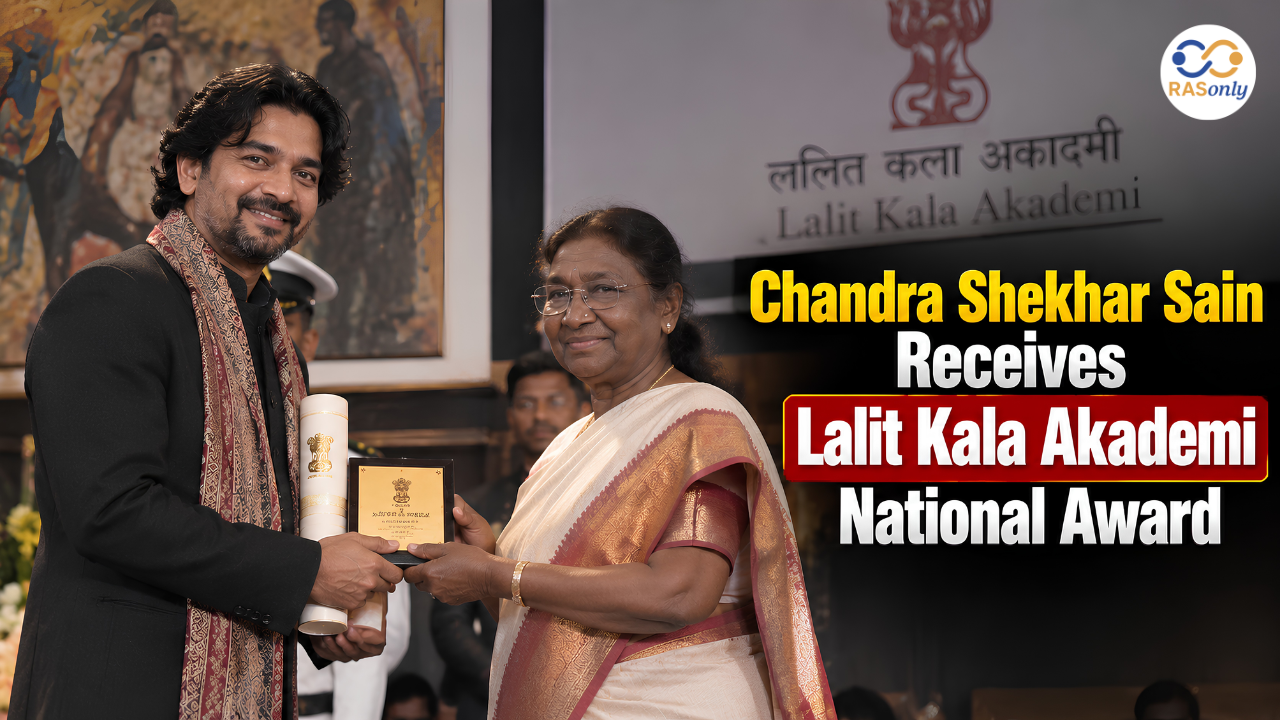
Chandra Shekhar Sain Receives Lalit Kala Akademi National Award
October 01, 2026