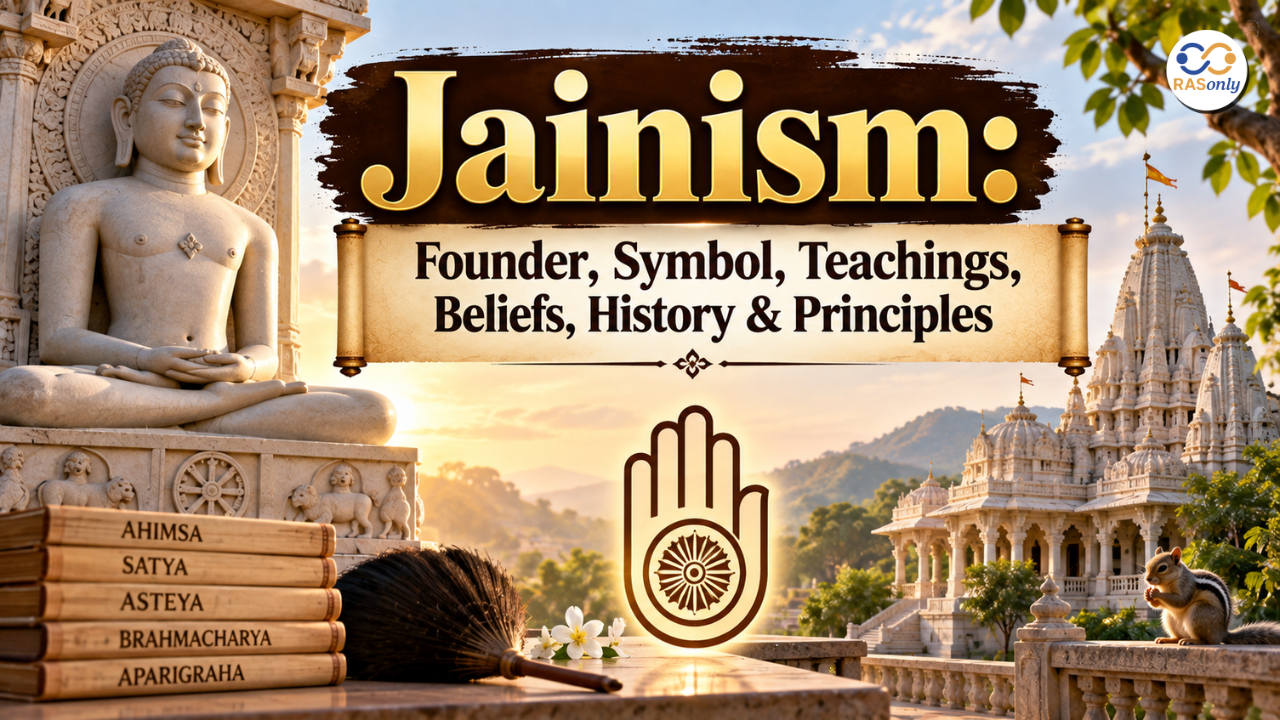
Jainism: Founder, Symbol, Teachings, Beliefs, History & Principles
RPSC RAS Mains Exam Pattern 2026: New Scheme, Paper-Wise Structure & Marking

Get in Touch with RASonly!

The RPSC RAS Mains Exam is the second and most important stage of the Rajasthan Administrative Service selection process. The RPSC RAS Mains Exam Pattern 2026 has changed. It consists of four descriptive papers—three General Studies papers and one Language paper—each carrying 200 marks. The exam tests candidates' analytical ability, subject knowledge, and writing skills. Performance in the Mains determines shortlisting for the final interview round.

The RPSC RAS Mains Examination 2026 pattern has been officially announced by the Rajasthan Public Service Commission. With this announcement, aspirants now have clarity on the structure, subjects, marks distribution, and the nature of questions to be expected in the mains stage. Since RAS is one of the most competitive state civil services examinations in India, understanding the exam pattern in detail is the first and most important step towards effective preparation.
This article provides a complete and accurate explanation of the RPSC RAS Mains Exam Pattern 2026, including paper-wise details, syllabus coverage, marking scheme, and preparation strategy aligned with the new pattern.
Overview of RPSC RAS Exam New Pattern 2026
The RPSC RAS (Rajasthan Administrative Service) exam is the largest state-level civil service exam in Rajasthan. The RPSC RAS Exam Pattern change, announced on January 9th, is conducted by the Rajasthan Public Service Commission. Selection takes place in three stages:
- Preliminary Exam
- Main Examination
- Personality Test (Interview)
The main stage is typically the most important writing phase and determines who will be shortlisted for the interview. The 2026 Mains Pattern rpsc ras exam pattern change. Which is significantly different from the 2025 pattern.
Below is a high-level table for quick comparison between RAS Mains Pattern 2025 and 2026:
High-Level Comparison: RPSC RAS Mains Pattern 2025 vs 2026
Now, in the RAS Prelims, the 20-mark module of Sports and Yoga has been removed. In its place, the provisions of the Rajasthan Examination Act, 2022 have been included. Till now, the Main Examination consisted of four question papers, out of which three were of General Studies and the fourth was of Hindi and English.
Earlier, General Studies had a total of 13 modules, out of which one module related to Sports and Yoga has now been reduced/removed. At the same time, some parts in other modules have been increased, for example, the portion related to Law and Management has been expanded. Additionally, all questions carrying 2 marks have been removed. Instead of 2-mark questions, the number of 5-mark and 10-mark questions has been increased.
In the Hindi and English paper, the question paper has now been divided into Part A, Part B, and Part C.
- Part A (Hindi) has been allotted 90 marks
- Part B (English) has been allotted 70 marks
In the same paper, Part C carries 40 marks, which is an Essay section. In this section, six topics will be given, out of which the candidate has to write an essay on any one topic, either in Hindi or English, as per their choice.
| Aspect | RAS Mains 2025 | RAS Mains 2026 (Revised – Jan 9) |
|---|---|---|
| Overall Structure | 4 descriptive papers | 4 descriptive papers (unchanged) |
| Total Mains Marks | 800 | 800 |
| Interview Marks | 100 | 100 |
| Total Selection Marks | 900 | 900 |
| Paper I–III | General Studies (I, II, III) | General Studies (I, II, III) |
| Paper IV | General Hindi & General English | General Hindi & General English |
| Nature of Questions | Descriptive | Descriptive with clearer structure |
| Question Distribution | Less clearly defined | Clearly defined unit-wise distribution |
| Unit-wise Breakup | Not officially detailed | Officially specified (Unit I, II, III) |
| Short / Long Answers | Mixed, not specified clearly | Clearly defined by marks & word limit |
| Word Limit Guidance | Limited clarity | Explicit word limits (50 / 150 words) |
| Focus of Evaluation | Content knowledge | Content + structure + expression |
| Official Scheme Document | Older format | New scheme officially notified |
Next, we break this down in detail so aspiring candidates understand each paper, its intent, and how to prepare.
Detailed RPSC RAS Mains Exam Pattern 2026
1. RPSC RAS Mains Exam Pattern: Paper Structure
This table shows the structure of the four mains papers:
| Paper No. | Paper Name | Max Marks | Duration |
|---|---|---|---|
| I | General Studies-I | 200 | 3 hours |
| II | General Studies-II | 200 | 3 hours |
| III | General Studies-III | 200 | 3 hours |
| IV | General Hindi & General English | 200 | 3 hours |
| Total | 800 | 12 hours (4 papers) | |
All candidates must take all four papers. The total of those papers will be calculated to qualify for the interview round. The final merit list directly includes the marks obtained in the Mains result, and therefore, performance is critical. The Mains pattern has changed in 2026, so you'll need to study even harder. You'll also need to work on your writing speed.
Download RPSC RAS Mains Exam Pattern 2026 PDF
PAPER – I: General Knowledge and General Studies
| Part | No. of Questions | Marks per Question | Total Marks | Word Limit |
|---|---|---|---|---|
| Unit-I | 08 | 05 | 40 | 50 |
| 03 | 10 | 30 | 150 | |
| Unit-II | 06 | 05 | 30 | 50 |
| 03 | 10 | 30 | 150 | |
| Unit-III | 14 | 05 | 70 | 50 |
| Total | 200 | |||
Unit I – HISTORY: Part A – History, Art, Culture, Literature, Tradition and Heritage of Rajasthan
- Pre-historic culture and various ancient historic sites and their importance; political and cultural achievements of various rulers of Rajasthan (up to 18th century).
- Revenue and administrative system and changing patterns.
- 19th and 20th century: Revolt of 1857, peasant and tribal movements, political awakening, mass movements and integration of Rajasthan.
- Art and culture: Performing and fine arts, handicraft, architecture and monuments, folk music and folk dances, folk stories and folk lores.
- Fairs and festivals.
- Tribes and their traditions.
- Heritage: Major sites of heritage and tourism in Rajasthan.
- Rajasthani language and important literary works.
- Religious beliefs, saints and folk deities.
Part B – Indian History and Culture
- Indian heritage: Fine art, performing art, architecture and literature from Indus Civilization to British era.
- Religious movements and philosophy in ancient and medieval India.
- British policies and their impact: Political, economic and administrative unification of the country.
- Indian National Movement: Its various stages and streams, important contributors.
- Socio-religious reform movements in 19th and 20th centuries and intellectual awakening.
- Post-independence India: Accession of princely states and linguistic reorganisation of states; development of science and technology; women empowerment and women reform movements.
Part C – History of Modern World (up to 1991 A.D.)
- Renaissance and Reformation.
- American War of Independence, French Revolution, Industrial Revolution, Russian Revolution.
- Nazism in Germany and Fascism in Italy.
- Impact of World Wars; world during Cold War.
Unit II: ECONOMICS Part A – Indian Economy
- Growth and development: Concept and measurement; income approach; HDI and other indices; climate change and environmental degradation.
- Agriculture: Productivity and progress; land reforms; agricultural finance; agricultural marketing; food security; food processing; major policy initiatives.
- Industry: Policy and reforms; globalization, liberalization and privatization; industrial finance; MSMEs and policy initiatives.
- Service sector and infrastructure: Energy, transport and communication.
- International trade and balance of payments; foreign aid and investment.
- Public finance: Union budget; revenue and expenditure; budget deficit and public debt; fiscal policy and reforms; centre–state financial relations; Finance Commission.
- RBI and Monetary management; banking and financial reforms.
- Social sector: Health, education, poverty, unemployment; employability schemes; welfare schemes for weaker sections.
Part B – World Economy
Global economic issues; role of WTO, World Bank and IMF.
Part C – Economy of Rajasthan
- Economic growth indicators; SDP, per capita income; inclusive growth; Viksit Rajasthan 2047; green growth; SDGs.
- State budget; fiscal management and deficits.
- Agricultural growth; irrigation; animal husbandry; marketing; farmer welfare schemes.
- Rural development; Panchayati Raj; State Finance Commission.
- Industrial development; investment promotion; MSMEs; petroleum and oil resources.
- Infrastructure; power; transport; PPP; externally aided projects.
- Human resource development; health; education; employment; poverty eradication.
- Good governance and digital transformation.
- Major welfare schemes for SC/ST, backward classes, minorities, disabled, women, children and elderly.
PAPER – II: General Knowledge and General Studies
| Part | No. of Questions | Marks per Question | Total Marks | Word Limit |
|---|---|---|---|---|
| Unit-I | 07 | 05 | 35 | 50 |
| 03 | 10 | 30 | 150 | |
| Unit-II | 14 | 05 | 70 | 50 |
| Unit-III | 07 | 05 | 35 | 50 |
| 03 | 10 | 30 | 150 | |
| Total | 200 | |||
Unit I – Administrative Ethics
- Ethics and human values; role of family, society and education.
- Ethical concepts; Karmavada; duty; good and virtue.
- Ethics in public and private relationships; integrity, impartiality, non-partisanship; transparency, media and bureaucracy.
- Ethics of Bhagavad Gita.
- Gandhian ethics.
- Moral thinkers and philosophers of India and world.
- Ethical dilemmas in administration; AI versus conscience.
- Ethical decision-making; social justice; accountability; value vs instrumental rationality
- Non-factual case studies.
Unit II – General Science & Technology (Short Notes)
- ChemistryC in Everyday Life: Atomic structure; metals, non-metals and metalloids; metallurgy; ores and alloys; acids, bases and salts; pH and buffers; drugs (synthetic and natural); antioxidants and preservatives; agro-chemicals (insecticides, pesticides, fertilizers); carbon compounds and their uses; fuels and octane rating; radioactivity; green chemistry.
- Physics in Everyday Life: Motion, work, power and energy; gravitation; light and heat; electricity (static and current); magnetism and electromagnetism; sound and electromagnetic waves; medical applications of physics; nuclear fission and fusion; radiation safety.
- Biology & Life Sciences: Cell and plant parts; plant nutrition and growth regulators; sexual and asexual reproduction in plants; human physiology (digestive, respiratory, circulatory, excretory, reproductive and nervous systems); nutrition, immunity and diseases; public health; microbes and fermentation; biotechnology and genetic engineering; GMOs and ELSI issues; recent advances like vaccines, CRISPR, mRNA technology and artificial organs.
- Computer Science & ICT: Networking; analog and digital communication; frequency spectrum; mobile telephony; emerging technologies such as AI, machine learning, big data, cloud and edge computing, IoT, blockchain, digital currency, virtual and augmented reality; OTT platforms and social media.
- Indian Science & Technology: Contributions of Indian scientists; major scientific institutions; advancements in robotics, nanotechnology and quantum computing; development of science and technology in India and Rajasthan; government policies; Digital India initiatives; cyber security and data privacy.
- Space & Defence Technology: Indian space programme; satellites and their applications; launch vehicles; remote sensing; defence research and indigenous technologies; missile programme; drone technology; chemical and biological weapons.
Unit III – Earth Science (Geography & Geology): Part A – World
- Interior of the earth and geological time scale.
- Broad physical features: mountains, plateaus, plains and deserts – types and distribution.
- Earthquakes and volcanoes: types, distribution and their impact.
- Climate: insolation, atmospheric circulation, humidity and precipitation.
- Major environmental issues.
Part B – India
- Physiography of India
- Drainage pattern and important rivers.
- Climate: monsoon, climatic characteristics, distribution of rainfall and climatic regions.
- Natural resources: types and uses of water, natural vegetation, soil, minerals and power resources.
- Population: growth, distribution and density; sex ratio; literacy; urban and rural population.
Part C – Rajasthan
- Physiography.
- Important rivers and lakes.
- Climatic characteristics and their classification.
- Natural vegetation, wildlife and biodiversity.
- Soil resources.
- Agriculture: major crops, production and distribution.
- Mineral resources: types, distribution and industrial uses.
- Demographic characteristics.
- Tribes.
- Concept of UNESCO Geo-parks and geo-heritage sites: potential in Rajasthan.
- Tourism.
Paper III: General Knowledge and General Studies
| Part | No. of Questions | Marks per Question | Total Marks | Word Limit |
|---|---|---|---|---|
| Unit-I | 11 | 05 | 55 | 50 |
| 03 | 10 | 30 | 150 | |
| Unit-II | 06 | 05 | 30 | 50 |
| 03 | 10 | 30 | 150 | |
| Unit-III | 11 | 05 | 55 | 50 |
| Total | 200 | |||
Unit I – Indian Polity, Governance, India & International Affairs
Constitution & Governance
- Constitution of India: origin, features, principles, amendments and basic structure doctrine.
- Fundamental rights, directive principles and duties.
- Recent constitutional developments, judicial pronouncements, constitutional morality and transformative constitutionalism.
Institutions & Federalism
- President, Vice-President, Prime Minister, Council of Ministers and Parliament.
- Federalism and centre–state relations.
- Supreme Court and High Courts: judicial review, judicial activism, virtual courts, e-courts.
Dynamics of Indian Polity
- Party system, coalition politics and regionalism.
- Shift from identity-based to issue-based politics; gender participation.
- Electoral reforms, voting behaviour and election process.
- Internal security: threats, forces, agencies, roles and challenges.
Rajasthan Polity & Governance
- Political participation, leadership and electoral behaviour.
- Political parties and coalition politics in Rajasthan.
- Panchayati Raj and urban local self-government: structure and challenges.
- Public policy making in Rajasthan and implementation issues.
- E-governance initiatives: achievements and challenges.
India & International Affairs
- Post-Cold War world order: US hegemony, multipolarity, global political economy, terrorism.
- Indian foreign policy: determinants, relations with major powers and neighbours, diaspora and cultural diplomacy.
- India in global forums: UN, WTO, EU, ASEAN, BRICS, G-20, QUAD, I2U2, AUKUS, DAKSHIN.
- Climate and green diplomacy: COP summits, ISA, Mission LiFE.
- Recent strategic initiatives in foreign policy.
Current Affairs & Issues
- Major national and international events and personalities.
- Welfare schemes and government initiatives of Rajasthan.
- Awards, literature, science, technology and ICT developments.
- Sports policies, institutions and achievements of India and Rajasthan.
- Role of yoga in health, wellness and stress management.
Unit II – Concepts, Issues and Dynamics of Public Administration (Short Notes)
Public Administration: Theories & Principles
- Meaning, nature, scope and significance of public administration.
- Evolution of public administration as a discipline; role in developed and developing societies.
- New Public Administration, New Public Management, Good Governance and New Public Service.
- Administrative theories: Scientific management, human relations, behavioural, structural-functional and ecological approaches.
- Principles of organisation: hierarchy, unity of command, span of control, delegation, centralisation and decentralisation, coordination, authority, responsibility and accountability.
- Administrative behaviour: leadership, communication and morale.
Union Government & Administrative Institutions
- Major institutions: UPSC, Election Commission, Finance Commission, C&AG, Lokpal, NITI Aayog.
- Personnel administration: recruitment, training, promotion, neutrality and anonymity; code of conduct.
- Issues in administration: Centre–State relations, minister–civil servant relations, generalists vs specialists, administrative reforms and social audit.
- Control over administration: legislative, executive and judicial control.
Comparative Public Administration
Administrative systems of USA, UK, France and China – key features.
State & District Administration
- State administration: Governor, Chief Minister, Council of Ministers, State Secretariat, Chief Secretary, Directorates.
- Police administration, revenue board, State Election Commission, State Human Rights Commission, Lokayukta.
- District administration: District Collector; law and order, revenue and development administration.
Unit III – Behavior and Law (Short Notes): Part A – Behavior
Intelligence & Personality
- Intelligence: cognitive, social and emotional intelligence.
- Cultural intelligence; appreciative, ethical and spiritual intelligence.
- Leadership: theories, styles, challenges and effectiveness at workplace.
- Communication: models and networks; barriers and distortions; electronic communication; cyber security.
- Work behaviour: ethics and values; RAISEC model; person–fit.
- Stress and coping: occupational stress, burnout, stress management and gender issues at workplace.
Part B – Law
Contemporary Legal Issues
- Right to Information Act, 2005.
- Information Technology Act, 2000: cyber crimes, digital signatures, electronic records.
- Intellectual Property Rights: concept, types and purpose.
- Crimes against women and children:
- Domestic Violence Act, 2005
- Sexual Harassment at Workplace Act, 2013
- POCSO Act, 2012
- Maintenance and Welfare of Parents and Senior Citizens Act, 2007
Important Land Laws in Rajasthan
- Rajasthan Tenancy Act, 1955.
- Rajasthan Land Revenue Act, 1956.
- Rajasthan Panchayati Raj Act, 1994.
- Bharatiya Nyaya Sanhita, 2023.
- Bharatiya Nagarik Suraksha Sanhita, 2023.
Criminal Procedure (Basic Knowledge)
- Cognizable and non-cognizable offences; bailable and non-bailable offences.
- FIR, arrest, search, seizure, summons, warrants and charge-sheet.
- Jurisdiction of police, magistrate and courts.
Paper – IV: General Hindi and General English
| Part | Total Marks |
|---|---|
| Unit-I | 90 |
| Unit-II | 70 |
| Unit-III | 40 |
| Total | 200 |
Unit – I : सामान्य हिन्दी
सामान्य हिन्दी: कुल अंक 90, इस प्रश्न पत्र का उद्देश्य अभ्यर्थी की भाषा-विषयक क्षमता तथा उसके विचारों की सही, स्पष्ट एवं प्रभावपूर्ण अभिव्यक्ति की परीक्षा करना है।
भाग – अ (अंक 30)
- उपसर्ग एवं प्रत्यय – शब्दों में से उपसर्ग एवं प्रत्यय पृथक करना
- पर्यायवाची शब्द का वाक्यों में प्रयोग द्वारा अर्थ स्पष्ट करना
- शब्द शुद्धि
- वाक्य शुद्धि
- मुहावरे – मुहावरों का प्रयोग से अर्थ स्पष्ट करना
- कहावत / लोकोक्ति प्रयोग से अर्थ स्पष्ट करना
- पारिभाषिक शब्दावली – प्रशासन से संबंधित अंग्रेज़ी शब्दों के समानार्थी हिन्दी पारिभाषिक शब्द
भाग – ब (अंक 30)
- संक्षेपण – गद्यावतरण का लगभग एक-तिहाई शब्दों में संक्षेपण
- (शब्द सीमा – लगभग 150 शब्द)
- पल्लवन – किसी सूक्ति, काव्य पंक्ति, प्रसिद्ध कथन आदि का भाव विस्तार
- (शब्द सीमा – लगभग 100 शब्द)
- अनुवाद – दिए हुए अंग्रेज़ी अनुच्छेद का हिन्दी में अनुवाद
- (शब्द सीमा – लगभग 50 शब्द)
भाग – स (अंक 30)
- पत्र-लेखन – सामान्य कार्यालयी पत्र, कार्यालय आदेश, अर्द्धशासकीय पत्र, अनुस्मारक, प्रतिवेदन (रिपोर्ट)
- प्रारूप-लेखन – अधिसूचना, निविदा सूचना, परिपत्र, प्रेस विज्ञप्ति, कार्यालय ज्ञापन
Unit – II : General English (Total Marks 70): Part A – Grammar & Usage (20 Marks)
- Preposition
- The same word used as different parts of speech
- Phrasal verbs and idioms (application)
- One-word substitution (application)
- Words often confused or misused (application)
Part B – Comprehension, Translation & Precis Writing (30 Marks)
- Comprehension of an unseen passage (approximately 300 words)
- Five questions based on the passage and precis writing of the same passage (approximately 100 words)
- Translation of five sentences from Hindi to English
Part C – Composition & Letter Writing (20 Marks)
- Elaboration of a given theme (any one out of three, approximately 150 words)
- Writing: Official letter / Demi-official / Official memorandum / Report writing (approximately 150 words)
Unit – III : Essay (Total Marks 40)
- There will be six thematic areas in the essay part of the question paper.
- Candidates have to write one essay of about 600 words in either Hindi or English, as per their choice.
- The essay topics will be based on the following themes:
- Language, Literature and Cultural Heritage
- Society, Governance and Public Affairs
- Science, Technology, Environment and Sustainable Development
- Economy, Agriculture, Industry and Commerce
- Current Affairs, Disasters and National Development Initiatives
- Tourism, Culture and Contemporary Issues with reference to Rajasthan
Comparison: RPSC RAS Mains Exam Pattern 2025 vs 2026
While both years continue to follow the same broad framework, the 2026 revision notified in January introduces better clarity and structure in the examination scheme. The key points to note are outlined below.
Structure Consistency
Both RAS Mains 2025 and 2026 maintain a consistent examination structure:
- Four descriptive papers
- 200 marks allotted to each paper
- Same duration and marks distribution
- One compulsory language paper (Hindi & English)
This structural continuity helps candidates plan their preparation confidently, without the need to overhaul their study strategy due to unexpected changes in the exam framework.
Syllabus Focus Trends
The core syllabus remains aligned across both years, covering:
- General Studies, with emphasis on Rajasthan’s history, culture, society, and economy
- Governance and public administration, including policy implementation
- Polity, law, and contemporary issues
- Language proficiency in Hindi and English
But in the 2026 pattern, more distinctly represented are the administrative relevance, ethical insight, and depth of analysis, as the patterns of civil service examination are wider.
Greater Clarity in 2026
A key improvement in 2026 is not the addition of new subjects but the clearer definition of question structure, including:
- Unit-wise question distribution
- Defined short and long answer formats
- Clear word-limit guidance
This makes answer writing more disciplined and evaluation more transparent.
No Additional Optional Paper
The RPSC RAS Mains continues to have no optional subjects, unlike UPSC. All candidates attempt the same four compulsory papers, ensuring:
- Uniform evaluation standards
- Equal opportunity for all aspirants
This feature remains unchanged in 2026 and continues to be a defining aspect of the RAS examination.
RPSC RAS Mains Exam 2026: Marking Scheme
The RPSC RAS Mains 2026 marking scheme is a key to successful preparation in that the final merit list is built on the basis of the marks in the Mains examination, which is supplemented by the interview score.
Key Elements of the RPSC RAS Mains 2026 Marking Scheme
Total Marks
- The Mains examination consists of four compulsory papers
- Each paper carries 200 marks
- otal Mains marks: 800
Nature of Questions
- All papers are descriptive and analytical
- Answers are evaluated on content accuracy, structure, clarity, and relevance
- Emphasis is placed on analytical ability and administrative orientation
Revised Question Distribution (2026 Update)
- The 2026 scheme clearly specifies a unit-wise distribution
- Questions are divided into:
- Short-answer questions (with defined word limits, generally around 50 words)
- Long-answer questions (with higher marks and word limits, generally around 150 words)
- The number of questions and marks per unit are now officially notified, improving transparency
Word Limit Clarity (New in 2026)
- Explicit word limits are mentioned for each type of question
- Exceeding word limits may affect scoring
- This makes concise and structured answer writing more important than before
No Negative Marking
- There is no negative marking in the RPSC RAS Mains Exam
- Candidates are advised to attempt all questions, even if partially prepared
Merit List Consideration
- Mains marks (800) are combined with Interview marks (100)
- Final merit list = 900 marks
- Prelims marks are not counted in the final ranking
Paper-Specific Level
- General Studies Papers (I–III):
- Questions are broadly at the graduate level, with emphasis on Rajasthan and governance
- General Hindi & General English (Paper IV):
- Standard is approximately Senior Secondary level
- Focus on language proficiency, comprehension, and expression
Important Note for 2026 Aspirants
The redefined marking scheme does not alter the overall marks and the number of papers, but the evaluation of the answers is greatly influenced. The next RPSC RAS Mains 2026 will be more than ever dependent upon:
- Writing within word limits
- Clear structure and presentation
- Administrative relevance and analytical depth
In short, preparation strategy remains the same, but execution must be sharper and more disciplined.
Why Understanding the RPSC RAS Mains Pattern Matters
Preparing for the RAS mains without knowing the structure is like shooting without aim. Here’s why pattern awareness matters:
1. Time Management: Each paper is three hours long. Knowing the weight of each section helps allocate time smartly during the exam.
2. Focused Study Plan: Once you know topics and marks, you can choose where to invest hours to maximize output (for example, strong topics vs weak spots).
3. Marks Strategy: Descriptive papers reward clarity and structured answers. Understanding how questions are framed lets you practise like the real exam.
4. Interview Prep: Mains performance influences interview call. Breaking down syllabus early lets candidates build confidence for stage-wise selection.
RPSC RAS Mains Exam Pattern 2026: Key Instructions for Candidates
To take the RPSC RAS Mains Exam 2026 successfully, candidates should observe certain rules that will ensure the process of testing becomes both trouble-free and effective. The guidelines are to be used to reduce disruptions and ensure that the requirements to be fulfilled during the exam in regard to admit cards and identification proof are completed properly.
Significant guidelines for the RPSC RAS Mains Exam:
- Admit Card: Carry along the admit card together with a valid ID document.
- Be on Time: Be at the exam center early before the exam.
- Paper Type: The Mains exam will be descriptive papers. drill answers and essays.
- No Negative Marking: in the Mains, there is no negative marking.
- Pen Requirements: You need to write your answers in a blue or black pen.
Sample Preparation Plan Based on Pattern
Here’s a simple weekly plan brands often recommend:
Morning (3 hours)
- General Studies core topics (History, Polity)
- Rajasthan unique segments
Midday (2 hours)
- Language practice (English + Hindi)
Evening (3 hours)
- Current affairs and ethics
- Mock writing and answer practice
Weekly Review
- Timed full paper attempt
- Feedback assessment
Conclusion: RPSC RAS Mains Exam Pattern 2026
The RPSC RAS Mains New Pattern 2026 brings much-needed clarity, structure, and transparency to the examination. While the core syllabus remains stable, the clearly defined unit-wise distribution, word limits, and marking scheme demand sharper answer writing and better time management. Aspirants preparing as per the RAS exam new pattern and RAS Mains New Syllabus will have a strong edge. This year, disciplined writing practice aligned with the revised pattern is the key to success.
FAQ
The RAS Mains New Pattern 2026 introduces clearly defined unit-wise question distribution, fixed word limits (50/150 words), and improved transparency in evaluation.
No major topics have been added, but the RAS exam new syllabus is better structured with clearer emphasis on administration, ethics, and Rajasthan-specific issues.
No. The total marks remain 800 for Mains and 100 for Interview, making the total selection marks 900.
The RAS prelims new syllabus remains unchanged; the revisions apply mainly to the Mains examination pattern and evaluation scheme.
Focus on answer writing within word limits, unit-wise preparation, Rajasthan-centric content, and regular mock practice aligned with the new structure.
BEST SELLER
🏆 PRELIMS
RAS Pass
Prelims focused Hindi & English
₹399
✓
Prelims Topic-Wise Tests
✓
Subject-Wise Tests
✓
Full-Length Prelims Tests
✓
Daily Current Affairs Tests
✓
Prelims PYQs Tests
✓
Detailed Solutions & Analysis
✓
All Rajasthan Ranking
✓
Unlimited Reattempts
✓
Mains Tests
✓
Hindi & English Tests
✓
All Rajasthan Ranking
Trusted by 5,000+ Students
Post Category
- RAS Salary
- Result
- RAS Admit Card
- RAS Job
- RAS Cutoff
- Preparation Tips
- RAS Answer Key
- RAS Exam Analysis
- RAS Syllabus
- RAS Previous Year Papers
- RPSC RAS Exam Pattern
- RAS Interview
- RAS Exam Date
- RAS Vacancy
- RAS Test Series
- RAS Best Books
- RAS Preparation Resources
- RAS Coaching Centre
- History
- Polity
- Geography
- Economics
- Science
- Art and Culture
- RPSC RAS Application Form
- RPSC RAS Notification
- RAS Eligibility Criteria
- UPSC Exam
- RPSC RAS Mains
Visit Our RASonly Offline Center
Our Expert Faculty

Bhunesh Sir
Current Affairs · 13+ Yrs

Aamir Khan Sir
RAS-2017 · IIM Ahm.

Akash Sir
Polity · 8+ Yrs
Free Resources
Official Mobile App

RASOnly App
by OTSAdda · Free
Full Video Lectures
Mock Tests & PYQs
Daily Current Affairs
AI Mock Interview
Free Download · No subscription needed to install
RAS 2024 Toppers — RASonly
Rank 2
Virendra Charan
Rank 9
Bhoopinder Singh
Rank 26
Aanchal Nagpal
Rank 33
Lokendra Singh
Rank 45
Amar Rathore
Rank 46
Manasvini Verma

Join RASonly WhatsApp Community
Get daily current affairs, exam alerts, free study material and tips from expert faculty — right on WhatsApp.
Join for Free →RASonly Interview Guidance Program

Mr. Ashok Jain
Ex-Chief Secretary Govt of Rajasthan
- IAS officer of the 1981 batch, Rajasthan cadre.
- Passionate about mentoring the next generation of RAS officers with real-world insights.
- Got retired in Dec 2017 from the post of Chief Secretary of the state of Rajasthan.

Mr. Guru Charan Rai
Ex-ASP / SP in Jaisalmer
- Guru Charan Rai, IPS (Retd), retired as Inspector General of Police (Security), Rajasthan, Jaipur in 2017.
- Served as ASP and SP in Jaisalmer, Nagaur, Sri Ganganagar, Sawai Madhopur, Dausa, Sikar, and Karauli.
- He also held key positions as DIGP and IGP in the Law and Order division.

Mr. Rakesh Verma
Ex-IAS Officer, B.Tech, MBA, and M.A. (Economics)
- IAS officer of the 1981 batch and retired in Chief Secretary Rank.
- Civil servant of high repute and vast experience.
- Has been teaching UPSC CSE subjects for the last six years.


Daily Current Affairs for RAS Exam Preparation 2026

Women’s Cricket Team Wins Gold Medal
September 23, 2026
9th India International Water Week 2026
September 23, 2026
United Nations General Assembly
September 22, 2026