Kushan Empire: History, Rulers, Administration, Economy, Art, Decline
Wildlife Conservation Projects in India for RAS 2026 | Complete Strategy

Get in Touch with RASonly!

Wildlife Conservation Projects are highly important for RAS 2026 because questions are frequently asked from Project Tiger, endangered species, wildlife laws, biodiversity conservation, and Rajasthan wildlife. Proper preparation through maps, species-location linkage, current affairs, and MCQ practice makes this topic highly scoring in Environment and Ecology sections.

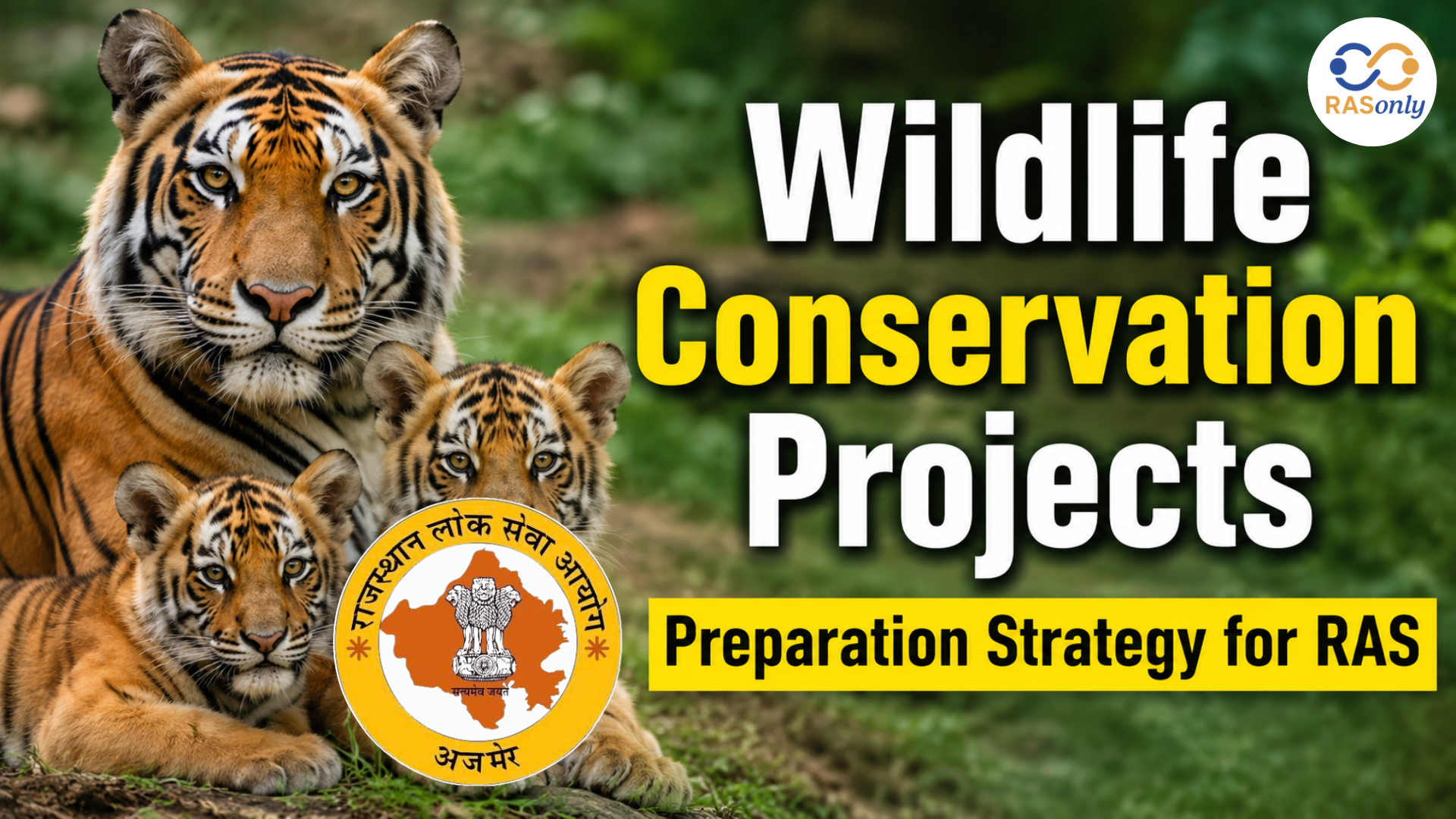
The Wildlife Conservation Projects is one of the most important and scoring Environment topics for RAS Prelims 2026, as questions have been frequently asked from Project Tiger, Project Elephant, Project Snow Leopard, Project Dolphin, Endangered species conservation, Biodiversity protection, wildlife laws, protected areas, and wildlife organizations. The weightage of Environment, Ecology, Biodiversity, Climate Change, and wildlife-related current affairs has increased a lot in recent years, thus it has become extremely important for serious aspirants.
Many aspirants find Wildlife Conservation confusing because multiple species, conservation projects, wildlife reserves, environmental laws, and biodiversity concepts are interconnected. However, with proper conceptual clarity, species-project linkage, protected-area mapping, current affairs integration, comparison tables, and repeated MCQ revision, this section becomes one of the easiest and most scoring parts of Environment and Geography preparation for RAS 2026.
Why Wildlife Conservation Projects are Important for RAS 2026
Wildlife Conservation Projects is one of the most significant parts of Environment and Ecology as it is directly associated with conservation of biodiversity, protection of endangered species, climate sustainability, ecological balance, wildlife laws, and environmental governance. RAS often poses both types of questions – direct and statement – to conservation schemes, flagships, tiger reserves, biosphere reserves, and environment organisations.
Benefits of Strong Wildlife Conservation Preparation
- Improves Environment & Ecology preparation
- Helps in Biodiversity & Conservation topics
- Useful for current affairs linkage
- Strengthens species-location understanding
- Helpful in both Prelims and Mains
- Scoring with proper revision and MCQ practice
Wildlife Conservation Projects Syllabus for RAS 2026
The syllabus coverage of Wildlife Conservation Projects is primarily under the topics of Environment, Biodiversity, Ecology, Forest Resources, Climate Change, and Rajasthan Geography in the RAS syllabus. The questions are normally taken from endangered species, conservation programmes, wildlife laws, and ecological protection mechanisms.
Important Wildlife Conservation Topics for RAS 2026
- Project Tiger
- Project Elephant
- Project Snow Leopard
- Project Dolphin
- Project Lion
- Project Cheetah
- Crocodile Conservation Project
- Great Indian Bustard Conservation
- Wildlife Protection Act 1972
- NTCA
- Biodiversity Conservation
- Endangered Species
- Rajasthan Wildlife Conservation
- National Parks & Tiger Reserves
Topic-Wise Importance Table
Wildlife Conservation preparation becomes much easier when species, reserves, and conservation projects are studied systematically through maps, biodiversity linkage, and current affairs integration instead of memorizing facts randomly.
| Topic | Preparation Focus |
|---|---|
| Project Tiger | Tiger reserves & conservation |
| Project Elephant | Elephant corridors |
| Project Snow Leopard | Himalayan ecology |
| Project Dolphin | River biodiversity |
| Rajasthan Wildlife | Desert species & reserves |
| Wildlife Laws | Conservation framework |
Wildlife conservation topics are very scoreable if done based on species-project linkage, conservation maps, current affairs related to the environment, and repeated MCQ practice.
Best Wildlife Conservation Preparation Strategy for RAS 2026
Wildlife Conservation cannot be purely memorized because species, habitats, conservation projects, biodiversity, and laws of the environment are interrelated. Systematic preparation strategy increases the understanding and retention to a great extent.
Smart Preparation Approach
- Start with biodiversity basics
- Learn the flagship species carefully
- Revise conservation projects repeatedly
- Focus on Rajasthan wildlife separately
- Link current affairs with conservation
- Practice map-based MCQs regularly
- Prepare short revision notes weekly
Smart Wildlife Conservation Preparation Flow
The preparation flow has been provided, which can help the aspirants to prepare for Wildlife Conservation systematically without any confusion. For RAS Prelims 2026, conceptual preparation is key to the retention of the concepts and solving the MCQs accurately.
| Step | Focus Area |
|---|---|
| Step 1 | Biodiversity basics |
| Step 2 | Flagship conservation projects |
| Step 3 | Wildlife reserves & protected areas |
| Step 4 | Rajasthan wildlife |
| Step 5 | MCQs & revision |
Project Tiger Strategy for RAS 2026
Project Tiger is one of the key Wildlife Conservation Programmes in India and a very important Environment topic to study for RAS. Tiger Reserves, NTCA, conservation measures, flagship species, and trends in tiger population are frequently asked questions. Having the correct knowledge of Tiger Reserve Mapping and Tiger Conservation mechanisms helps considerably in solving Statement-Based Environment MCQs.
Important Features
- Launched in 1973
- Protects Bengal Tigers
- Managed by NTCA
- Focus on habitat conservation
- Anti-poaching initiatives
Important Tiger Reserve States
- Madhya Pradesh
- Rajasthan
- Karnataka
- Maharashtra
- Uttarakhand
Important Tiger Reserves
| Tiger Reserve | State |
|---|---|
| Ranthambore | Rajasthan |
| Corbett | Uttarakhand |
| Bandipur | Karnataka |
| Kanha | Madhya Pradesh |
| Sundarbans | West Bengal |
Smart Strategy
- Revise tiger reserves state-wise
- Practice tiger reserve mapping
- Focus on NTCA linkage
- Practice statement-based MCQs
India currently has 58 Tiger Reserves under Project Tiger conservation initiatives.
Project Elephant Strategy for RAS 2026
Project Elephant holds great significance as elephant conservation, elephant migration, and elephant vs. human conflict are often associated with current affairs and the conservation of biodiversity. Questions are frequently asked on Elephant Habitat, Elephant Conservation Measures, and Elephant Conservation Reserve areas in India.
Important Features
- Launched in 1992
- Elephant habitat protection
- Elephant corridors conservation
- Human-elephant conflict management
Important Elephant States
- Karnataka
- Kerala
- Assam
- Odisha
- Tamil Nadu
Smart Strategy
- Focus on elephant corridors
- Revise elephant reserve mapping
- Link conservation with current affairs
- Practice wildlife conflict MCQs
Project Elephant mainly focuses on habitat conservation, migration corridors, and reducing human-elephant conflict through sustainable wildlife management.
Project Snow Leopard Strategy for RAS 2026
One of the major topics for RAS Environment preparation is Project Snow Leopard. Questions are mostly related to high mountain biodiversity, mountain ecosystems, climate change, and endangered species conservation.
Important Features
- High-altitude conservation project
- Himalayan ecosystem protection
- Focus on Snow Leopard habitat
- Community participation
Important Regions
- Ladakh
- Himachal Pradesh
- Uttarakhand
- Sikkim
- Arunachal Pradesh
Smart Strategy
- Learn Himalayan ecology carefully
- Practice mountain-region mapping
- Link climate change with species survival
- Revise cold-desert ecosystems
Project Snow Leopard focuses on protecting fragile Himalayan ecosystems along with community-based wildlife conservation.
Project Dolphin Strategy for RAS 2026
Project Dolphin is gaining more significance as Aquatic Biodiversity, River Ecosystems and Fresh Water Conservation are significant Environment related topics for competitive examinations. Gangetic Dolphin habitat, river biodiversity, and aquatic conservation initiatives are frequently asked questions.
Important Features
- Focus on Gangetic Dolphin conservation
- River ecosystem protection
- Aquatic biodiversity conservation
Important Dolphin Regions
- Ganga River
- Brahmaputra River
- Chambal River
Smart Strategy
- Focus on river biodiversity
- Revise dolphin habitats carefully
- Practice aquatic ecosystem MCQs
Project Dolphin is one of India’s important flagship conservation initiatives for protecting freshwater biodiversity and river ecosystems.
Project Lion Strategy for RAS 2026
Project Lion is highly important because Asiatic Lion conservation is frequently asked in the Wildlife and Environment sections. Questions are usually linked with Gir Forest, habitat protection, and species conservation mechanisms.
Important Features
- Asiatic Lion conservation
- Gir Forest ecosystem protection
- Habitat management
Important Region
- Gir National Park, Gujarat
Smart Strategy
- Revise Gir ecosystem carefully
- Focus on Asiatic Lion habitat
- Practice species-location MCQs
Project Lion mainly focuses on long-term conservation, habitat improvement, and population protection of Asiatic Lions in Gujarat.
Project Cheetah Strategy for RAS 2026
Project Cheetah is one of the most current-affairs-oriented wildlife conservation topics in India. Questions are frequently linked with species reintroduction, biodiversity restoration, and grassland ecosystem conservation.
Important Features
- Reintroduction of cheetahs in India
- Grassland ecosystem conservation
- Species restoration programme
Important Region
- Kuno National Park, Madhya Pradesh
Smart Strategy
- Focus on species reintroduction concepts
- Link with biodiversity restoration
- Practice current-affairs-based MCQs
Project Cheetah is India’s major wildlife restoration initiative aimed at reviving grassland ecosystems and reintroducing cheetahs after decades.
Great Indian Bustard Conservation Strategy
Great Indian Bustard conservation is extremely important for RAS because Rajasthan-related wildlife and desert ecology questions are frequently asked in the exam. The topic is strongly linked with endangered species conservation and grassland ecosystems.
Important Features
- Critically endangered bird species
- Found mainly in Rajasthan
- Desert ecosystem linkage
Important Region
- Desert National Park, Rajasthan
Smart Strategy
- Focus on Rajasthan wildlife
- Revise desert ecosystem concepts
- Practice species-conservation MCQs
Great Indian Bustard conservation is one of the most important Rajasthan wildlife topics because the species is critically endangered and closely associated with the Thar Desert ecosystem.
Wildlife Protection Act & Conservation Laws Strategy
Wildlife laws are highly important because Environment questions are increasingly linked with biodiversity governance, conservation policies, and environmental protection mechanisms. Basic conceptual clarity of important laws helps significantly in statement-based MCQs.
Important Topics
- Wildlife Protection Act 1972
- Biodiversity Act
- Forest Conservation Act
- National Green Tribunal
- Environmental Protection mechanisms
Smart Strategy
- Focus on basic provisions only
- Revise conservation authorities
- Practice law-based MCQs
- Link laws with species protection
Wildlife conservation laws form the legal foundation for biodiversity protection, protected areas, and environmental governance in India.
Wildlife Conservation Organizations Strategy
Questions are regularly asked from wildlife conservation organizations, environmental bodies, and conservation authorities because they are directly linked with biodiversity governance and wildlife protection projects.
Important Organizations
| Organization | Role |
|---|---|
| NTCA | Tiger conservation |
| Wildlife Institute of India | Wildlife research |
| NBWL | Wildlife policy |
| MoEFCC | Environment governance |
Smart Strategy
- Learn organization functions carefully
- Revise abbreviation-based MCQs
- Link organizations with projects
Understanding conservation organizations helps aspirants connect wildlife projects, environmental governance, and biodiversity protection mechanisms more effectively.
Rajasthan Wildlife Conservation Strategy
Rajasthan wildlife is extremely important because RAS frequently asks questions from desert ecology, tiger reserves, bird sanctuaries, and biodiversity conservation in the state. Rajasthan-specific wildlife preparation gives a major advantage in both Prelims and Mains.
Important Rajasthan Wildlife Areas
- Ranthambore Tiger Reserve
- Sariska Tiger Reserve
- Desert National Park
- Keoladeo National Park
Smart Strategy
- Focus on Rajasthan reserves
- Practice Rajasthan wildlife maps
- Revise desert biodiversity repeatedly
Rajasthan wildlife preparation should mainly focus on desert ecosystems, tiger reserves, bird sanctuaries, and species-location linkage through maps and MCQ practice.
Map Practice Strategy for Wildlife Conservation
Map practice is extremely important because many RAS Environment questions are directly map-based and location-oriented. Visual revision improves retention of species habitats, reserves, and conservation regions.
Important Areas to Practice
- Tiger reserves
- Elephant corridors
- Snow Leopard regions
- National Parks
- Rajasthan wildlife regions
Smart Map Practice Tips
- Practice blank India maps regularly
- Mark conservation regions repeatedly
- Revise species-location linkage visually
- Practice biodiversity hotspot mapping weekly
Consistent map practice improves accuracy in Environment MCQs and helps aspirants quickly identify wildlife regions during the exam.
Wildlife Conservation MCQ Practice Strategy
MCQ practice is essential because Environment questions are mostly conceptual, factual, statement-oriented, and current-affairs-linked. Regular MCQ solving improves both conceptual clarity and accuracy.
Best MCQ Practice Method
- Solve topic-wise MCQs daily
- Practice PYQs regularly
- Analyze wrong answers carefully
- Revise weak conservation topics repeatedly
- Practice map-based questions consistently
Important Focus Areas
- Conservation projects
- Endangered species
- Tiger reserves
- Wildlife laws
- Rajasthan wildlife
- Biodiversity hotspots
Consistent MCQ practice helps aspirants improve speed, accuracy, and conceptual understanding in Environment preparation.
Most Important Wildlife Conservation Topics for RAS 2026
Some Wildlife Conservation topics are repeatedly asked in RAS Prelims because they form the foundation of Environment, Biodiversity, Ecology, and current-affairs-based preparation.
High-Weightage Topics
- Project Tiger
- Project Elephant
- Project Snow Leopard
- Project Dolphin
- Rajasthan Wildlife
- Wildlife Protection Act
- Tiger Reserves
Topic Priority Table
| Topic | Importance Level |
|---|---|
| Project Tiger | Very High |
| Tiger Reserves | Very High |
| Project Elephant | High |
| Rajasthan Wildlife | High |
| Wildlife Laws | High |
High-weightage topics should be revised repeatedly through maps, species linkage, comparison tables, and MCQ practice.
Conclusion
Wildlife Conservation Projects are one of the most important Environment and Ecology topics for RAS Prelims 2026 because they combine biodiversity conservation, current affairs, protected areas, environmental laws, and species protection concepts in a single section. Questions are frequently asked from Project Tiger, endangered species, Rajasthan wildlife, conservation organizations, and wildlife laws, making this topic highly scoring for serious aspirants.
A smart preparation strategy should focus on conceptual clarity, species-project linkage, map practice, current affairs integration, and repeated MCQ revision instead of rote memorization. Aspirants who revise wildlife conservation through maps, comparison tables, and PYQs regularly can significantly improve both accuracy and retention in RAS Environment preparation.
FAQ
Project Tiger is considered the most important wildlife conservation topic for RAS because questions are frequently asked from Tiger Reserves, NTCA, and tiger conservation mechanisms.
Wildlife Conservation Projects are important because they are directly linked with Environment, Biodiversity, Climate Change, Ecology, Rajasthan Geography, and current affairs.
Ranthambore Tiger Reserve, Sariska Tiger Reserve, Desert National Park, and Keoladeo National Park are among the most important Rajasthan wildlife areas for RAS preparation.
Aspirants should prepare through map practice, species-location linkage, conservation project comparison, current affairs integration, and repeated MCQ revision.
Wildlife Protection Act 1972, Biodiversity Act, Forest Conservation Act, and environmental protection mechanisms are highly important for RAS Environment preparation.
BEST SELLER
🏆 PRELIMS
RAS Pass
Prelims focused Hindi & English
₹399
✓
Prelims Topic-Wise Tests
✓
Subject-Wise Tests
✓
Full-Length Prelims Tests
✓
Daily Current Affairs Tests
✓
Prelims PYQs Tests
✓
Detailed Solutions & Analysis
✓
All Rajasthan Ranking
✓
Unlimited Reattempts
✓
Mains Tests
✓
Hindi & English Tests
✓
All Rajasthan Ranking
Trusted by 5,000+ Students

Post Category
- RAS Salary
- Result
- RAS Admit Card
- RAS Job
- RAS Cutoff
- Preparation Tips
- RAS Answer Key
- RAS Exam Analysis
- RAS Syllabus
- RAS Previous Year Papers
- RPSC RAS Exam Pattern
- RAS Interview
- RAS Exam Date
- RAS Vacancy
- RAS Test Series
- RAS Best Books
- RAS Preparation Resources
- RAS Coaching Centre
- History
- Polity
- Geography
- Economics
- Science
- Art and Culture
- RPSC RAS Application Form
- RPSC RAS Notification
- RAS Eligibility Criteria
- UPSC Exam
- RPSC RAS Mains
Visit Our RASonly Offline Center
Our Expert Faculty

Bhunesh Sir
Current Affairs · 13+ Yrs

Aamir Khan Sir
RAS-2017 · IIM Ahm.

Akash Sir
Polity · 8+ Yrs
Free Resources
Official Mobile App

RASOnly App
by OTSAdda · Free
Full Video Lectures
Mock Tests & PYQs
Daily Current Affairs
AI Mock Interview
Free Download · No subscription needed to install
RAS 2024 Toppers — RASonly
Rank 2
Virendra Charan
Rank 9
Bhoopinder Singh
Rank 26
Aanchal Nagpal
Rank 33
Lokendra Singh
Rank 45
Amar Rathore
Rank 46
Manasvini Verma

Join RASonly WhatsApp Community
Get daily current affairs, exam alerts, free study material and tips from expert faculty — right on WhatsApp.
Join for Free →RASonly Interview Guidance Program

Mr. Ashok Jain
Ex-Chief Secretary Govt of Rajasthan
- IAS officer of the 1981 batch, Rajasthan cadre.
- Passionate about mentoring the next generation of RAS officers with real-world insights.
- Got retired in Dec 2017 from the post of Chief Secretary of the state of Rajasthan.

Mr. Guru Charan Rai
Ex-ASP / SP in Jaisalmer
- Guru Charan Rai, IPS (Retd), retired as Inspector General of Police (Security), Rajasthan, Jaipur in 2017.
- Served as ASP and SP in Jaisalmer, Nagaur, Sri Ganganagar, Sawai Madhopur, Dausa, Sikar, and Karauli.
- He also held key positions as DIGP and IGP in the Law and Order division.

Mr. Rakesh Verma
Ex-IAS Officer, B.Tech, MBA, and M.A. (Economics)
- IAS officer of the 1981 batch and retired in Chief Secretary Rank.
- Civil servant of high repute and vast experience.
- Has been teaching UPSC CSE subjects for the last six years.


Daily Current Affairs for RAS Exam Preparation 2026

Chandra Shekhar Sain Receives Lalit Kala Akademi National Award
October 01, 2026
Jodhpur to Get India’s Third Dedicated Tropical Medicine Institute
October 01, 2026
Establishment of the Aesthetic Office
September 30, 2026