UPSC Mains Result 2026 Out: Download PDF, Selection List, Cut Off & Interview Details
Rajasthan Police SI Question Paper 2026

Get in Touch with RASonly!


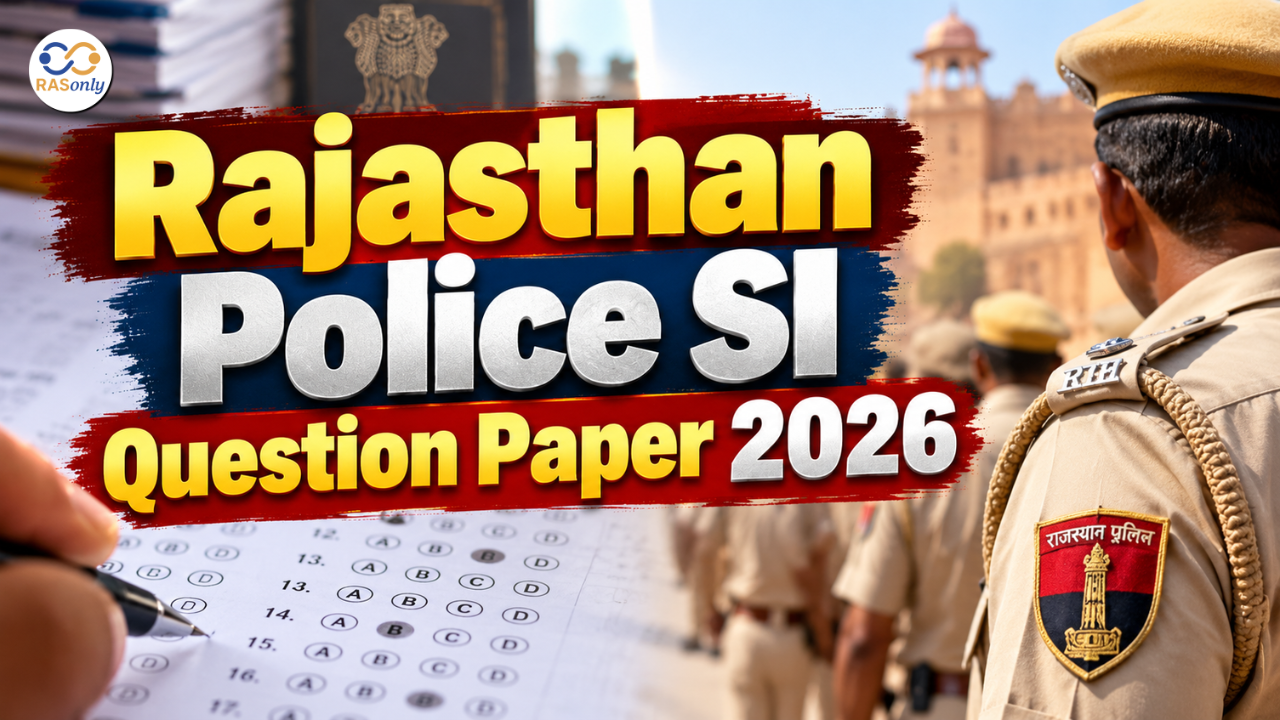
Rajasthan Police SI Question Paper 2026 is now available for candidates who appeared in RPSC Sub-Inspector Platoon Commander Re-Exam 2021 on 20th September 2026. General Hindi was examined in the first shift, and General Knowledge & General Science in the second shift.
RPSC SI Question Paper 2026 PDF, candidates can analyse the questions that have been included in the examination, understand the level of difficulty, and analyse their responses to the questions. The paper is also beneficial for understanding the nature and level of questions of the Rajasthan Public Service Commission in the SI test.
In this article, candidates can get the Rajasthan SI Question Paper 2026 PDF, question paper pattern, shift-wise details, subject-wise details, difficulty level and important information.
Rajasthan Police SI Question Paper 2026
The key details of the RPSC SI Re-Exam Question Paper 2026 are given below:
| Particulars | Details |
|---|---|
| Exam Name | RPSC Sub-Inspector / Platoon Commander Combined Competitive Re-Exam 2021 |
| Conducting Authority | Rajasthan Public Service Commission |
| Exam Date | 20 September 2026 |
| Paper 1 | General Hindi |
| Paper 2 | General Knowledge & General Science |
| Exam Mode | Offline (OMR-based) |
| Questions per Paper | 100 |
| Total Questions | 200 |
| Marks per Paper | 200 |
| Total Marks | 400 |
| Duration | 2 Hours per Paper |
| Negative Marking | 1/3 mark for each incorrect answer |
| Exam Shifts | Two |
| Official Website | rpsc.rajasthan.gov.in |
Rajasthan Police SI Question Paper 2026 PDF
Rajasthan Police SI Question Paper PDF is available for download for both Paper 1 and 2 for candidates. The first paper was based on General Hindi, and the second paper was on General Knowledge and General Science.
Candidates can download the respective question paper, which will help them to review the questions during the examination.
| Paper | Subject | Exam Date | Question Paper |
|---|---|---|---|
| Paper 1 | General Hindi | 20 September 2026 | Download PDF |
| Paper 2 | General Knowledge & General Science | 20 September 2026 | Download PDF |
RPSC SI Exam Schedule 2026
The Rajasthan Police SI Re-Exam 2026 was conducted in two shifts on 20 September 2026. Both papers were conducted on the same day.
| Paper | Subject | Timing | Duration | Marks |
|---|---|---|---|---|
| Paper 1 | General Hindi | 10:00 AM – 12:00 PM | 2 Hours | 200 |
| Paper 2 | General Knowledge & General Science | 3:00 PM – 5:00 PM | 2 Hours | 200 |
To Watch The Solution:
RPSC SI Question Paper Analysis 2026
RPSC SI paper Analysis 2026 - candidates can understand the overall nature of the paper after checking the questions of the RPSC series and asking candidates who appeared for RPSC SI exam.
The difficulty of the papers wasn't consistent. General Hindi was given as moderate to difficult, and General Knowledge and General Science were revealed to be more challenging according to many.
The following factors had a major impact on the paper experience: type of questions, factual depth, length of questions, and time for analysing the options.
Click: Rajasthan Police SI Interview Letter Released
RPSC SI Paper 1 Analysis: General Hindi
The first paper was General Hindi, which consisted of questions on the language and grammar of Hindi.
The paper was not only factual but also challenging. Some questions and options required careful interpretation; grammatical rules had to be applied by the candidates.
Difficulty Level: Moderate to Difficult
Important areas included:
- Hindi Grammar
- Sandhi
- Samas
- Vocabulary
- Synonyms
- Antonyms
- Idioms and phrases
- Sentence usage
- Grammar-based questions
There were questions on Hindi grammar which candidates with a great command of the same could handle with greater efficiency, and also questions with similar options needed more of the candidate's attention.
RPSC SI Paper 2 Analysis: General Knowledge & General Science
The second paper examined a wider-ranging area of topics. Candidates' feedback said this paper imposed greater difficulty and time pressure in comparison to the other papers.
The paper had candidates changing topics of Rajasthan GK, current events, Polity, Science, and other general knowledge.
Difficulty Level: Moderate to Very Difficult
Major areas included:
- Rajasthan History
- Rajasthan Geography
- Rajasthan Art and Culture
- Indian Polity
- Current Affairs
- Government Schemes
- General Science
- Science and Technology
Click to Know: Rajasthan Police SI Cut-Off
Why Was the Rajasthan SI Paper Considered Difficult?
According to the Rajasthan SI Question Paper Analysis, there were various factors involved responsible for its difficulty, instead of a single subject.
Length and Time Management
Some questions demand more consideration of both reading and understanding before choosing an answer. In an examination where time is predetermined, extended questions may impact how many questions a candidate can answer.
Detailed Questions
Some Candidates indicated that some questions were not simply about a general understanding, but specific knowledge of the topic.
In particular, current affairs, government schemes and general knowledge stood out.
Wide Subject Coverage
In Paper 2, there were multiple subjects. Due to the necessity, candidates were required to move from one area to the other area in the examination, and so selection of questions is an important aspect regarding time management.
Negative Marking
The examination was negatively marked by ¼ for a wrong answer. So the difficulty was to strike a balance between the number of attempts and the accuracy of candidates.
If a candidate tries more questions but makes many mistakes, they do not necessarily get more marks.
Know Your Rajasthan Police SI Interview Date
How to Calculate RPSC SI Expected Marks?
Candidates can calculate their expected marks in the RPSC SI exam using the number of correct and incorrect answers.
Formula:
Expected Marks = (Correct Answer x Marks) – (Wrong Answer x Negative Marks)
Example
Suppose you have 70 correct and 30 wrong answers. If each question carries 2 marks and 1/3rd negative marking applies:
Correct: 70 × 2 = 140 marks
Negative: 30 × 0.67 = 20.10 marks
Expected Score = 140 − 20.10 = 119.90 marks
FAQs on RPSC SI Expected Marks
You can calculate expected marks by adding marks for correct answers and subtracting the negative marks for incorrect answers.
Yes, candidates should consider the prescribed negative marking while calculating their expected score.
Expected marks give an approximate idea of your score. The final marks may change after the official answer key is released or revised.
You can calculate your expected score after comparing your answers with the official or reliable answer key.
Yes. If any question or answer is changed after objections, the final score may differ from the initial expected score.
BEST SELLER
🏆 PRELIMS
RAS Pass
Prelims focused Hindi & English
₹399
✓
Prelims Topic-Wise Tests
✓
Subject-Wise Tests
✓
Full-Length Prelims Tests
✓
Daily Current Affairs Tests
✓
Prelims PYQs Tests
✓
Detailed Solutions & Analysis
✓
All Rajasthan Ranking
✓
Unlimited Reattempts
✓
Mains Tests
✓
Hindi & English Tests
✓
All Rajasthan Ranking
Trusted by 5,000+ Students
Visit Our RASonly Offline Center
Our Expert Faculty

Bhunesh Sir
Current Affairs · 13+ Yrs

Aamir Khan Sir
RAS-2017 · IIM Ahm.

Akash Sir
Polity · 8+ Yrs
Free Resources
Official Mobile App

RASOnly App
by OTSAdda · Free
Full Video Lectures
Mock Tests & PYQs
Daily Current Affairs
AI Mock Interview
Free Download · No subscription needed to install
RAS 2024 Toppers — RASonly
Rank 2
Virendra Charan
Rank 9
Bhoopinder Singh
Rank 26
Aanchal Nagpal
Rank 33
Lokendra Singh
Rank 45
Amar Rathore
Rank 46
Manasvini Verma

Join RASonly WhatsApp Community
Get daily current affairs, exam alerts, free study material and tips from expert faculty — right on WhatsApp.
Join for Free →RASonly Interview Guidance Program

Mr. Ashok Jain
Ex-Chief Secretary Govt of Rajasthan
- IAS officer of the 1981 batch, Rajasthan cadre.
- Passionate about mentoring the next generation of RAS officers with real-world insights.
- Got retired in Dec 2017 from the post of Chief Secretary of the state of Rajasthan.

Mr. Guru Charan Rai
Ex-ASP / SP in Jaisalmer
- Guru Charan Rai, IPS (Retd), retired as Inspector General of Police (Security), Rajasthan, Jaipur in 2017.
- Served as ASP and SP in Jaisalmer, Nagaur, Sri Ganganagar, Sawai Madhopur, Dausa, Sikar, and Karauli.
- He also held key positions as DIGP and IGP in the Law and Order division.

Mr. Rakesh Verma
Ex-IAS Officer, B.Tech, MBA, and M.A. (Economics)
- IAS officer of the 1981 batch and retired in Chief Secretary Rank.
- Civil servant of high repute and vast experience.
- Has been teaching UPSC CSE subjects for the last six years.
Related Post

Daily Current Affairs for RAS Exam Preparation 2026

BRICS Sustainable Lifestyle Week 2026
November 06, 2026
STARS Programme: Objectives, States & Key Highlights 2026
November 06, 2026
RIICO to Develop Private Industrial Parks in Rajasthan
November 05, 2026