Kushan Empire: History, Rulers, Administration, Economy, Art, Decline
Transforming Agriculture & Rural Economy 2047

Get in Touch with RASonly!

Rajasthan is redefining its agricultural and rural economy through innovation, sustainability, and inclusive growth. With a strong focus on climate-resilient farming, water conservation, and advanced agri-technologies, the state aims to boost productivity and farmers’ income. Livestock development, cooperative strengthening, and women empowerment remain central pillars of transformation. Post-harvest infrastructure, micro-irrigation, and digital agriculture will enhance efficiency and reduce losses. By Vision 2047, Rajasthan aspires to build a self-reliant, resilient, and globally competitive rural economy.

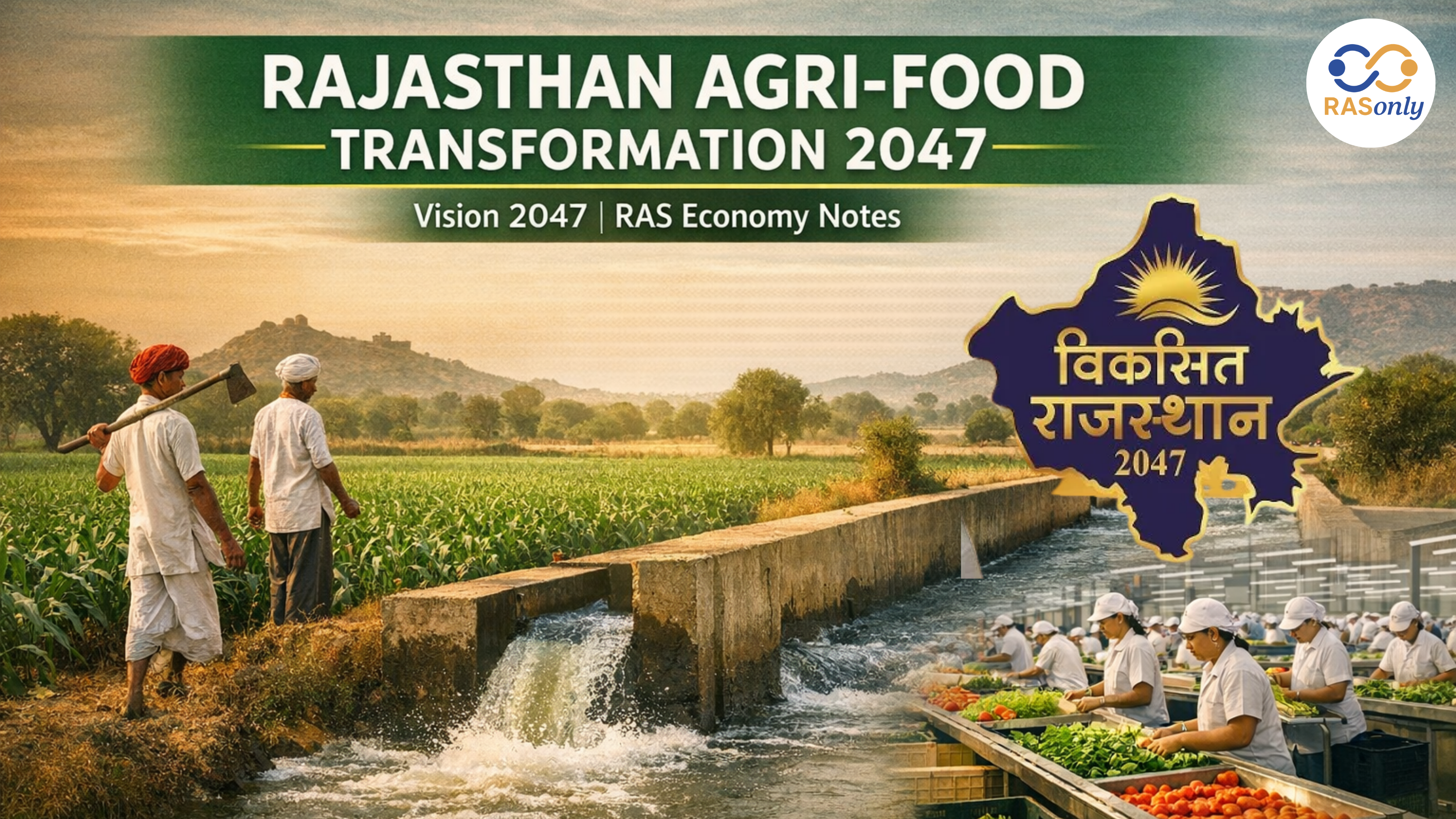
Rajasthan, with 270.86 lakh hectares of cultivable land, leads in diversified crop and livestock production. 83% of agriculture is rainfed, posing challenges due to scarce water resources and degraded land. The state has 568 lakh livestock and more than 42,000 cooperative societies supporting farmers. Integrated watershed management, pasture development and agro processing are key to sustainable rural livelihoods and food security.
- 26.92% GSVA contribution from agriculture
- 12.86% of India's net sown area
- Rajasthan produces 14.44% of India's milk and 47.98% of wool
- 568 lakh livestock and 146 lakh poultry vital for rural livelihoods
- 35% of cultivable land is net irrigated Rainfall-Avg. 486 mm - (range 200 mm - 950 mm)
- 36 lakh hectares of culturable wasteland require restoration and sustainable practices
- Fodder scarcity affects livestock pasture development is essential
- Watershed development in 115 lakh hectares for rainwater harvesting, wasteland development and soil conservation
- Agro-processing and integrated farming systems to enhance rural income sources
VISION 2047
By 2047, Rajasthan will be India's leading agricultural powerhouse, enhancing productivity, farmers income and environmental sustainability.
We envision equitable rural growth through livestock empowerment, cooperative-driven economies and advanced agri-technologies. Saturation-based watershed interventions, afforestation, biodiversity conservation and climate-resilient farming will restore degraded lands and ensure water security. By integrating technology, micro-irrigation, post-harvest innovations and grassroots democracy, Rajasthan will create a self-sustaining, resilient rural economy that fuels national prosperity and global competitiveness.
Thrust Areas
- Climate Resilient Agriculture: Rajasthan aims to bring 30% of cultivated land under climate-smart techniques, reducing emissions and enhancing sustainability.
- High-Tech Farming: Advanced techniques like precision farming, AI-based monitoring and automation can increase crop yields by 20-30%.
- Technology & Automation: Digitalisation of cooperative societies, AI-driven farm advisories and smart irrigation can improve productivity by 25%.
- Post-Harvest Management & Exports: Strengthening cold storage and logistics can reduce post-harvest losses by 25-40% and boost agricultural exports.
- Crop Diversification: Promoting pulses, oilseeds and horticulture to reduce dependence on traditional crops and increase farmers' income by 40%.
- Livestock & Fodder Infrastructure: Rajasthan contributes 14.44% of India's milk production and 47.98% of wool production, with plans for breed improvement.
- Fisheries Development: With 15,561 water bodies, fish seed production targets 368.50 million fingerlings annually, enhancing rural livelihoods.
- Cooperative Credit Access: Expanding financial support through cooperative banks to reach more than 55 lakh farmers for inclusive growth.
- Women & Youth in Agriculture: 90% of rural women participate in dairy farming, boosting engagement in cooperatives and ensuring financial empowerment.
- Water & Climate Resilience: Rajasthan targets 100% coverage of villages under the watershed project by 2047, reducing wastelands and increasing water availability and enhancing agricultural production.
Sowing Seeds of Progress
- Nutritional Security & Diversification: Growing focus on health-conscious agriculture, promoting diversified nutrient-rich crops to enhance food security and wellness.
- Climate-Resilient Agriculture: Expanding drought-resistant crops, micro-irrigation and rainwater harvesting, ensuring timely access to climate-adapted seeds for sustainable farming in Rajasthan's arid zones.
- Agro-Processing & Value Addition: Establishing processing units, branding and packaging solutions to increase farmers' income and employment, boosting Rajasthan's agricultural exports and competitiveness.
- Post-Harvest Infrastructure & Mechanisation: Expanding climate-resilient cold storage, logistics and mechanisation hubs in key farming zones to reduce post-harvest losses and enhance market access.
- Water-Saving Agricultural Practices: Implementing efficient irrigation techniques like drip and sprinkler systems, reducing water wastage in one of India's driest states.
- Organic & Natural Farming Promotion: Launching 'Organic Rajasthan' brand, securing GI tags, expanding organic-certified farms and supporting global exports through trade facilitation and infrastructure development.
- Precision Farming Adoption: Use of AI, IoT, drones and GPS for optimised input usage, higher crop yields and sustainable farming across 270.86 lakh hectares of cultivable land.
- Solar Energy in Agriculture: Promoting solar-powered irrigation pumps, refrigeration and cold storage, with a focus on Solar-Agri Panchayats to reduce reliance on conventional energy sources.
- Agricultural Research & Innovation: Strengthening R&D collaborations with universities, ensuring farmers access climate-resilient and high-yield crop varieties.
- Watershed Development in 115 lakh hectare
- Financial & Policy Support: Offering incentives, training and subsidies for organic farming, mechanisation and post-harvest storage, boosting Rajasthan's agriculture-based economy and exports.
Land use pattern percentage in Rajasthan
- NET AREA SOWN: 53.10%
- CULTURABLE WASTE LAND: 10.26%
- FOREST: 8.13%
- BARREN & UNCULTURABLE: 6.89%
- AREA UNDER NON AGRICULTURE USE: 5.93%
- FALLOW LANDS OTHER THAN CURRENT FALLOW: 5.72%
- CURRENT FALLOW: 5.05%
- PERMANENT PASTURE & OTHER GRAZING: 4.81%
From Pasture to Prosperity
- Livestock as Rural Employment Backbone: Over 80% of rural households rely on livestock for subsistence income, with the sector growing at 6% annually, ensuring year-round employment in drought-prone regions.
- Women's Dominance in Dairy & Livestock: More than 90% of labour in livestock, dairy and fisheries is managed by women, with Self-Help Groups (SHGs) playing a crucial role in economic empowerment.
- Advanced Breeding Management: Implementation of Artificial Insemination (AI) and Embryo Transfer Technology (ETT) to improve genetic quality, alongside sexed semen uses to control male population in cattle and buffalo herds.
- Sheep & Goat Breeding Programs: Indigenous Chokla, Nali and Marwari breeds are being improved and distributed to farmers, enhancing wool and meat production across Rajasthan.
- Camel Conservation & Utilisation: Rajasthan's Camel Conservation Mission promotes eco-tourism and dairy, utilising camel milk, hair and dung for rural economic sustainability.
- Technological Advancements & Value Addition: Adoption of automated milking, milk testing and cold chain logistics, while value-added dairy & meat processing increases farmers' income.
- Improved Market Linkages & Supply Chain: Enhanced digital tracking, direct transport and e-commerce reduces product wastage, ensuring timely market delivery of animal, dairy and fish products.
- Sustainable Livestock Management: Livestock policies promote ecological balance, encouraging participatory resource management to reduce habitat degradation and enhance community-environment synergy.
- Climate Change Resilience in Livestock: Adoption of heat-resistant breeds, improved fodder management and water-efficient livestock practices to mitigate climate impact on animal farming.
- Carbon Reduction & Sustainable Fodder: Promotion of biogas, solar-powered irrigation, carbon tracking and fodder banks to ensure cost-effectively, drought-resistant fodder supply and lower emissions in Rajasthan's livestock sector.
Pushkar Fair, (Pushkar) Ajmer
Number of livestock category (as per livestock census 2019)
- GOAT: 2.08 Cr. (14.00% of the country)
- CATTLE: 1.39 Cr. (7.20% of the country)
- BUFFALO: 1.37 Cr. (12.50% of the country)
- SHEEP: 0.79 Cr. (10.64% of the country)
- CAMEL: 2,12,739 (85.09% of the country)
- OTHERS: 2,13,000
Empowering Communities
- Improving Agri-marketing & Processing: Develop storage capacity, supply systems and processing units for agriculture produce thereby increasing cooperative market participation and economic potential.
- Skilled Human Resources: Enhancing skill potential through regular training, field visit and adopt available best practices. Increasing women and youth participation to ensure workforce diversity.
- Expanding Credit Availability: Expanding customer base adopting technology integration & better customer service.
- Technology & Gender Inclusion: Automation, digitalisation and women-focused cooperatives for modernising services, expanding reach to villages and improve gender participation in cooperative initiatives.
- Strengthening Consumer Cooperatives: Strengthening consumer cooperatives through improved branding, marketing and adopting modern distribution mechanisms.
- Encouraging a Cooperative-Based Economy: Developing cooperation based economy by strengthening cooperative societies through improved market access, technological & infrastructure upgradation, business diversification promotion & improved training & skilling facilities.
Numbers of Registered Cooperative Societies and their major types in Rajasthan
- DAIRY SOCIETIES: 19,100
- CREDIT SOCIETIES: 8,676
- OTHER SOCIETIES: 8,225
- WOMEN SOCIETIES: 5,538
- MARKETING & CONSUMER SOCIETIES: 954
Goals - Agriculture
| Indicators | Current Status | Target (2030) | Target (2035) | Target (2040) | Target (2047) |
|---|---|---|---|---|---|
| Yield of Cereal Crops (MT/ha.) | 2.20 | >2.40 | >2.63 | >2.80 | >3.10 |
| Yield of Pulse Crops (MT/ha.) | 0.66 | >0.68 | >0.70 | >0.71 | >0.75 |
| Yield of Oilseed Crops (MT/ha.) | 1.45 | >1.60 | >1.73 | >1.86 | >2.00 |
| Yield of Fruit Crops (MT/ha.) | 11.00 | >12.40 | >13.95 | >15.40 | >17.70 |
| Yield of Vegetable Crops (MT/ha.) | 12.16 | >14.50 | >17.33 | >20.00 | >22.10 |
| Post-harvest losses (%) - Perishable Commodities | 7.44-12.4 | <7.3-12.2 | <6.75-11.2 | <6.2-10.3 | <5.2-8.8 |
| Post-harvest losses (%) - Non-Perishable Commodities | 5.03-6.21 | <5.00 | <4.60 | <4.25 | <3.50 |
| Enhancing Seed Replacement Rate (%) | 25 | 28 | 30 | 33 | 40 |
| Mechanisation of Cropped Land (%) | 15 | 25 | 34.50 | 42 | 60 |
| Area under Micro-Irrigation (%) | 24 | 51 | 74 | 90 | 95 |
| Land under Organic/Natural Farming (%) | 3.68 | >10 | >13.75 | >17 | >25 |
| Irrigation Water Use Efficiency (%) | 40 | 52 | 65 | 75 | >80 |
| Sustainable Irrigation Source Penetration (%) | 10.40 | 17.50 | 23.46 | 29.30 | >50 |
| Agricultural Land under Horticulture (Lakh ha.) | 17 | >20 | >24 | >28 | >34 |
| Market & Storage Infrastructure | Main Markets-173 Sub Yards-335 |
All Blocks | 6,500 GP | All GP | All GP |
| Installed Solar Pumps (Lakh) | 1.14 | 2.40 | 3.20 | 4.00 | 5.00 |
| Weather Reports Accessibility (Stations) | 2,635 | 11,175 | 11,175 | 11,175 | 11,175 |
| Insurance Coverage | 48 Crops | All Crops | All Crops | All Crops | All Crops |
Goals
Animal Husbandry & Dairy
| Indicators | Current Status | Target (2030) | Target (2035) | Target (2040) | Target (2047) |
|---|---|---|---|---|---|
| Vaccination (Lakh) | 613.50 | 1,248.35 | 1373.18 | 1,497 | All livestock |
| Treatment (Lakh) | 388.10 | 450 | 517.50 | 562 | All livestock |
| Artificial Insemination (Lakh) | 21.51 | 40 | 69 | 90 | All Breeds of Cattle & Horses etc. |
| Milk Procurement (Lakh Kg. per day) | 33.63 | 75 | 92 | 110 | 150 |
| Export of Milk and Milk Products (MT per annum) | - | 1,000 | 1,750 | 2,500 | 5,000 |
| Functional DCS/PDCS (Numbers) | 13,217 | 22,000 | 27,500 | 33,000 | 44,000 |
| Registered Women Members (Lakh) | 4.03 | 7.00 | 7.50 | 8.00 | 9.00 |
| Milk Processing Capacity (Lakh litres per day) | 51.40 | 100 | 125 | 150 | 200 |
| Milk and Milk Products Sale Points (Numbers) | 25,842 | 60,000 | 70,000 | 80,000 | 1,00,000 |
| Cattle Feed Production & Marketing (MT per day) | 1,800 | 3,000 | 3,750 | 4,500 | 6,000 |
| Fish Seed Production (Million Fry) | 1,364 | 2,000 | 2,250 | 2,500 | 3,000 |
| Fish Production (MT) | 91,349.43 | 1,20,000 | 1,27,500 | 1,35,000 | 1,50,000 |
Cooperative
| Indicators | Current Status | Target (2030) | Target (2035) | Target (2040) | Target (2047) |
|---|---|---|---|---|---|
| Cooperative Credit to Farmers (Lakh) | 35 | 40 | 44 | 49 | 55 |
| Agricultural Credit (Crore) | 25,000 | 30,000 | 35,000 | 42,000 | 50,000 |
| Storage (Lakh MT) | 7.50 | 15 | 19 | 23 | 30 |
| Computerisation of PACS (Numbers) | 4,500 | 8,500 | All PACS | All PACS | All PACS |
| Custom Hiring Centers (Numbers) | 1,330 | 3,500 | 5,500 | 8,000 | 11,000 |
Soil Conservation & Water Harvesting
| Indicators | Current Status | Target (2030) | Target (2035) | Target (2040) | Target (2047) |
|---|---|---|---|---|---|
| Reclamation of Ravines (Area in Lakh Ha.) | - | 0.50 | 1.50 | 2.50 | 4.00 |
| Coverage of Watershed Project Area (Area in Lakh Ha.) | 124 | 149 | 179 | 209 | 247 |
| Development of Degraded Wastelands (Area in Lakh Ha.) | - | 1.40 | 2.30 | 3.20 | 4.60 |
Mid-Term Action Plan
- High-Tech Farming Methods: Promote precision farming, AI-based advisory systems & micro-irrigation to increase agricultural productivity by 20%.
- Improved Seed & Nursery Development: Establish certified hi-tech nurseries & tissue culture labs to increase the availability of superior seed varieties by 30%.
- Sustainable Agriculture Practices: Expand organic farming, bio-fertilisers & bio-pest control to reduce synthetic chemical use by 25%.
- Crop Diversification: Encourage millets, pulses & oilseeds to boost agri-income by 15% through Food and Nutritional Security (FNS) and National Mission on Edible Oil (NMEO).
- Post-Harvest Management: Invest in cold chains, food processing units & logistics to reduce post-harvest losses by 40%.
- Climate-Smart Agriculture: Develop drought-resistant crop varieties & solar-powered irrigation to improve farm resilience & productivity.
- Women's Role in Agriculture: Expand Self-Help Groups (SHGs) to provide credit & training for 25% more women-led agri-businesses.
- Horticulture Cluster Development: Create 15 Mega, 40 Mid & 100 Mini Clusters to boost horticulture exports by 50%.
- Animal Husbandry & Dairy Growth: Improve cattle genetics, fodder availability & veterinary services to increase milk production by 25%.
- Cooperative Credit Expansion: Increase zero-interest crop loans to cover 60% of small & marginal farmers.
- Storage & Market Linkages: Develop village-level grain & cold storage to cut wastage & enhance farmer earnings.
- Tech Integration in Cooperatives: Fully digitise multi-purpose cooperative societies to ensure faster transactions & transparent credit facilities.
- Watershed Development: Invest 50% project funds in soil & water conservation, increasing agriculture production in project areas by 20%.
- Water Resilient Villages: Construct 2 lakh check dams, anicuts, percolation tanks & farm ponds, diggi/jalhoj and 3 lakh tanks and rooftop harvesting structures.
- Climate-Resilient Agriculture: Implement soil and water conservation, afforestation project in 10 lakh hectares area to mitigate climate change.
- Wasteland Reduction: Convert 1.9 lakh hectares wasteland into productive land.
- Digital Agriculture Solutions: Implement e-Krishi platforms, AI-driven farm advisories & satellite-based monitoring for 10 lakh farmers.
- FPO & Agri-Startup Growth: Strengthen 1,100 Farmer Producer Organisations (FPOs) & promote agri-startups under Rajasthan Agriculture Accelerator Mission.
- Sustainable Livestock Management: Promote eco-friendly fodder production & AI-driven animal healthcare, increasing livestock productivity by 30%.
- Enhancing Farmers Income: Boost farmers income through improved productivity, cost-efficiency, better market access, and agri-tech innovation.
Long-Term Action Plan
- High-Tech Farming Expansion: Precision farming, mechanisation & AI-driven advisory systems to increase agricultural productivity by 40%.
- Seed Banks & Tissue Culture Labs: Establish village-level hi-tech seed banks to ensure 100% access to superior-quality seeds & planting materials.
- Sustainable Agriculture Practices: Bring 95% of farmland under micro-irrigation & 25% under organic farming to reduce chemical dependency.
- Climate Resilient Agriculture: Deploy drought-resistant crop varieties & solar-powered irrigation to reduce crop failures & increase yields by 25%.
- Post-Harvest & Market Linkages: Develop crop-specific Mandis at block level, export-focused food parks & reduce post-harvest losses by 50%.
- AI-Based Supply Chain System: Implement real-time market intelligence to increase farmer profits by 30% through better price forecasting & logistics.
- Horticulture Cluster Development: Create 100+ horticulture clusters with modern storage, processing & e-commerce linkages to double farmers' income.
- Women in Agriculture & Allied Sectors: Establish Women-Led Processing Centres in every Gram Panchayat & boost female workforce participation by 50%.
- Livestock & Dairy Growth: Expand veterinary services, establish livestock product warehouses & increase milk production by 40%.
- Genetic Breed Improvement: Upgrade frozen semen stations, promote Embryo Transfer Technology (ETT) & increase high-yield livestock population by 60%.
- Technological Integration in Livestock: Implement AI, blockchain & traceability systems to ensure better disease management & supply chain efficiency.
- Cold Storage & Supply Chain Modernisation: Establish solar-powered cold storage at village levels to cut perishable losses by 50%.
- Cooperative Market Expansion: Launch cooperative malls & digital trade hubs to boost rural market linkages & product branding.
- Climate-Resilient Villages: Convert 4.6 lakh hectares of degraded land into productive land.
- Afforestation & Biodiversity Conservation: Increase green cover by 6000 hectares, restoring degraded lands & mitigating climate change.
- Water Security & Groundwater Recharge: Construct 8 lakh check dams, anicuts, percolation tanks & farm ponds, diggi/jalhoj and 15 lakh tanks and rooftop harvesting structure.
- Renewable Energy in Agriculture: Deploy solar-powered irrigation & cold storage systems across 50% of agricultural holdings.
- Integrated Dairy & Fisheries Growth: Establish modern fish hatcheries & shrimp farms to boost fish production by 70%.
- Agricultural Waste-to-Wealth Projects: Expand biogas, compost & biofertiliser production to reduce farm waste by 60%.
- Saturation-Based Watershed Development: Treat 115 lakh hectares with soil & water conservation techniques to reduce erosion & enhance production.
These transformation plans will empower Rajasthan's farmers with innovation, sustainability and inclusive growth by 2047.
BEST SELLER
🏆 PRELIMS
RAS Pass
Prelims focused Hindi & English
₹399
✓
Prelims Topic-Wise Tests
✓
Subject-Wise Tests
✓
Full-Length Prelims Tests
✓
Daily Current Affairs Tests
✓
Prelims PYQs Tests
✓
Detailed Solutions & Analysis
✓
All Rajasthan Ranking
✓
Unlimited Reattempts
✓
Mains Tests
✓
Hindi & English Tests
✓
All Rajasthan Ranking
Trusted by 5,000+ Students

Post Category
- RAS Salary
- Result
- RAS Admit Card
- RAS Job
- RAS Cutoff
- Preparation Tips
- RAS Answer Key
- RAS Exam Analysis
- RAS Syllabus
- RAS Previous Year Papers
- RPSC RAS Exam Pattern
- RAS Interview
- RAS Exam Date
- RAS Vacancy
- RAS Test Series
- RAS Best Books
- RAS Preparation Resources
- RAS Coaching Centre
- History
- Polity
- Geography
- Economics
- Science
- Art and Culture
- RPSC RAS Application Form
- RPSC RAS Notification
- RAS Eligibility Criteria
- UPSC Exam
- RPSC RAS Mains
Visit Our RASonly Offline Center
Our Expert Faculty

Bhunesh Sir
Current Affairs · 13+ Yrs

Aamir Khan Sir
RAS-2017 · IIM Ahm.

Akash Sir
Polity · 8+ Yrs
Free Resources
Official Mobile App

RASOnly App
by OTSAdda · Free
Full Video Lectures
Mock Tests & PYQs
Daily Current Affairs
AI Mock Interview
Free Download · No subscription needed to install
RAS 2024 Toppers — RASonly
Rank 2
Virendra Charan
Rank 9
Bhoopinder Singh
Rank 26
Aanchal Nagpal
Rank 33
Lokendra Singh
Rank 45
Amar Rathore
Rank 46
Manasvini Verma

Join RASonly WhatsApp Community
Get daily current affairs, exam alerts, free study material and tips from expert faculty — right on WhatsApp.
Join for Free →RASonly Interview Guidance Program

Mr. Ashok Jain
Ex-Chief Secretary Govt of Rajasthan
- IAS officer of the 1981 batch, Rajasthan cadre.
- Passionate about mentoring the next generation of RAS officers with real-world insights.
- Got retired in Dec 2017 from the post of Chief Secretary of the state of Rajasthan.

Mr. Guru Charan Rai
Ex-ASP / SP in Jaisalmer
- Guru Charan Rai, IPS (Retd), retired as Inspector General of Police (Security), Rajasthan, Jaipur in 2017.
- Served as ASP and SP in Jaisalmer, Nagaur, Sri Ganganagar, Sawai Madhopur, Dausa, Sikar, and Karauli.
- He also held key positions as DIGP and IGP in the Law and Order division.

Mr. Rakesh Verma
Ex-IAS Officer, B.Tech, MBA, and M.A. (Economics)
- IAS officer of the 1981 batch and retired in Chief Secretary Rank.
- Civil servant of high repute and vast experience.
- Has been teaching UPSC CSE subjects for the last six years.




Daily Current Affairs for RAS Exam Preparation 2026

Niharika Rathore Wins MIS Global India Title
October 03, 2026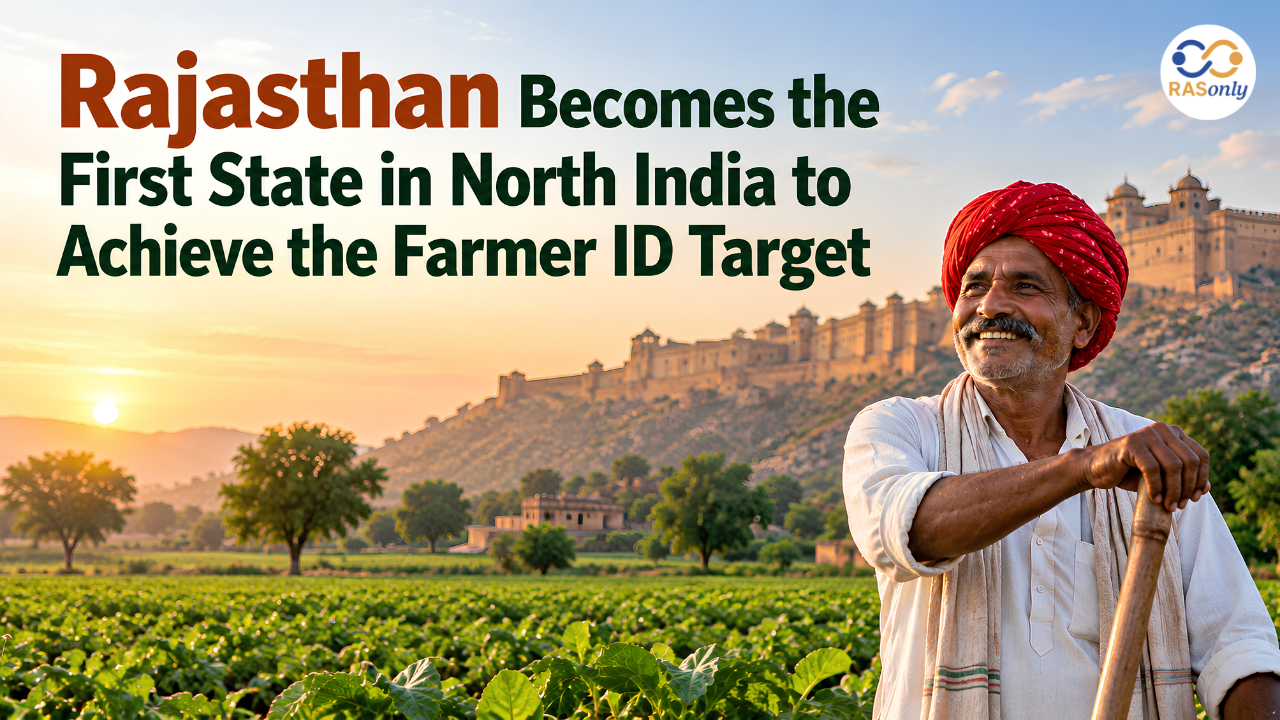
Rajasthan Achieves 90.19 Lakh Farmer ID Target
October 03, 2026
Chandra Shekhar Sain Receives Lalit Kala Akademi National Award
October 01, 2026