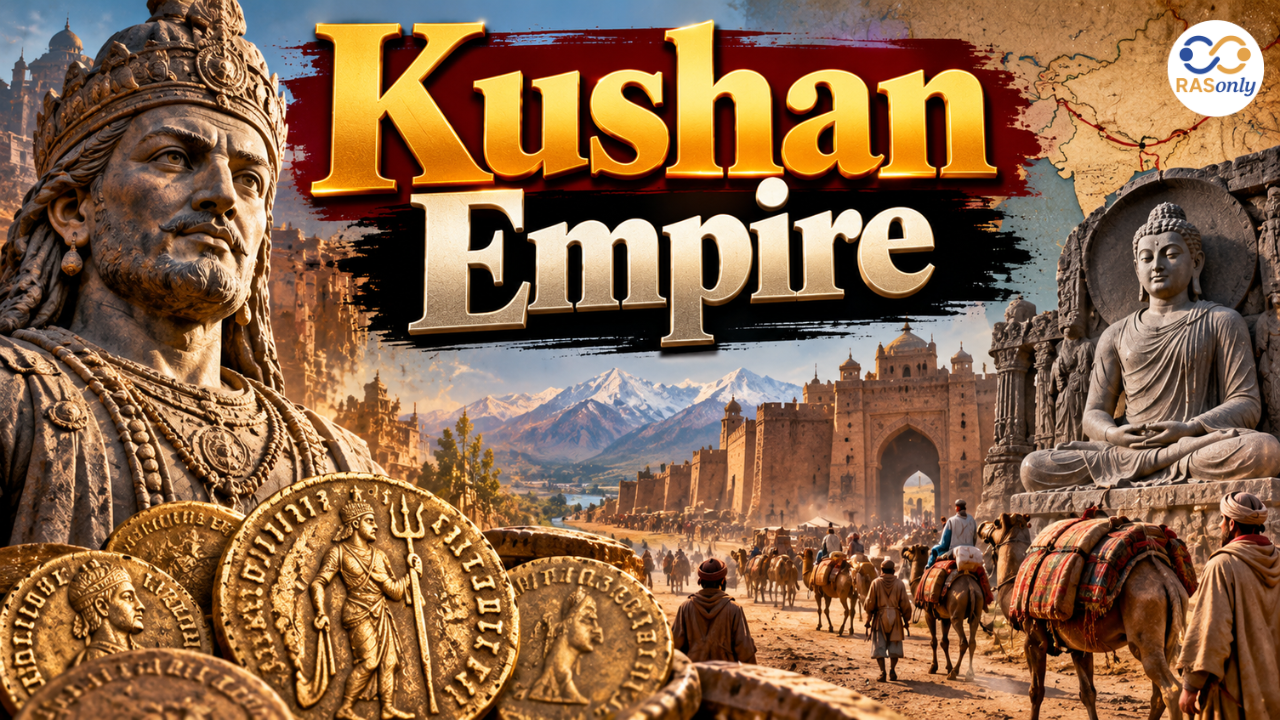
Kushan Empire: History, Rulers, Administration, Economy, Art, Decline
Ancient History Preparation Strategy for RAS Prelims 2026 (Complete Topic-wise Study, Revision & MCQ Plan)

Get in Touch with RASonly!

Learn the complete Ancient History Preparation Strategy for RAS 2026 including important topics, best preparation methods, revision techniques, MCQ practice, timelines, Buddhism, Mauryan Empire, Gupta Empire, literature, and art & culture. This detailed guide helps aspirants prepare Ancient History in a smart, scoring, and exam-oriented way for RAS Prelims 2026.

Ancient History is an important part of Indian History and culture-related topics for the General Studies syllabus of the RAS Prelims 2026 exam. Many aspirants skip Ancient History as the subject may appear factual and have a lot of syllabus that they cannot remember. This section can be very scoring if prepared with the correct strategy. The questions are mostly concept-based, civilisational in nature, religion-oriented, and they are related to art, culture, architecture, literature, and Buddhism-Jainism. There is still a high level of importance in the updated pattern of the RAS on Indian History and heritages.
The smart approach of an Ancient History strategy for RAS Prelims 2026 is selective study, repeated revision, NCERT clarity, and MCQ practice rather than unnecessary in-depth study. Most toppers make concise notes, a revision of the timeline, maps, and previous year trend analysis of Ancient History. With careful preparation, Ancient History can be one of the most easily scored portions of the RAS Prelims 2026.
Why Ancient History is Important for RAS 2026
Ancient History is considered as an important role in the RAS Prelims as questions are frequently asked from civilisations, Vedic culture, Buddhism, Jainism, Mauryan Empire, Gupta Empire, art & culture, literature, architecture, and ancient Indian society. Over the years, factual and conceptual questions from Ancient India have helped the aspirants to score easy marks.
Benefits of Strong Ancient History Preparation
- Improves overall History score
- Helps in Art & Culture preparation
- Useful for Buddhism & Jainism topics
- Supports static GK preparation
- Scoring with proper revision
- Helpful in both Prelims and Mains
RAS Ancient History Syllabus 2026
Ancient History is an important part of the RAS Prelims 2026 General Studies syllabus, and questions are regularly asked from Indian civilization, religion, dynasties, literature, art, and culture. The syllabus preparation procedure in this part should be a revision and structured with most of the questions factual and concept-based.
Important Ancient History Topics for RAS 2026
- Indus Valley Civilization
- Vedic Civilization
- Mahajanapadas
- Religious Movements
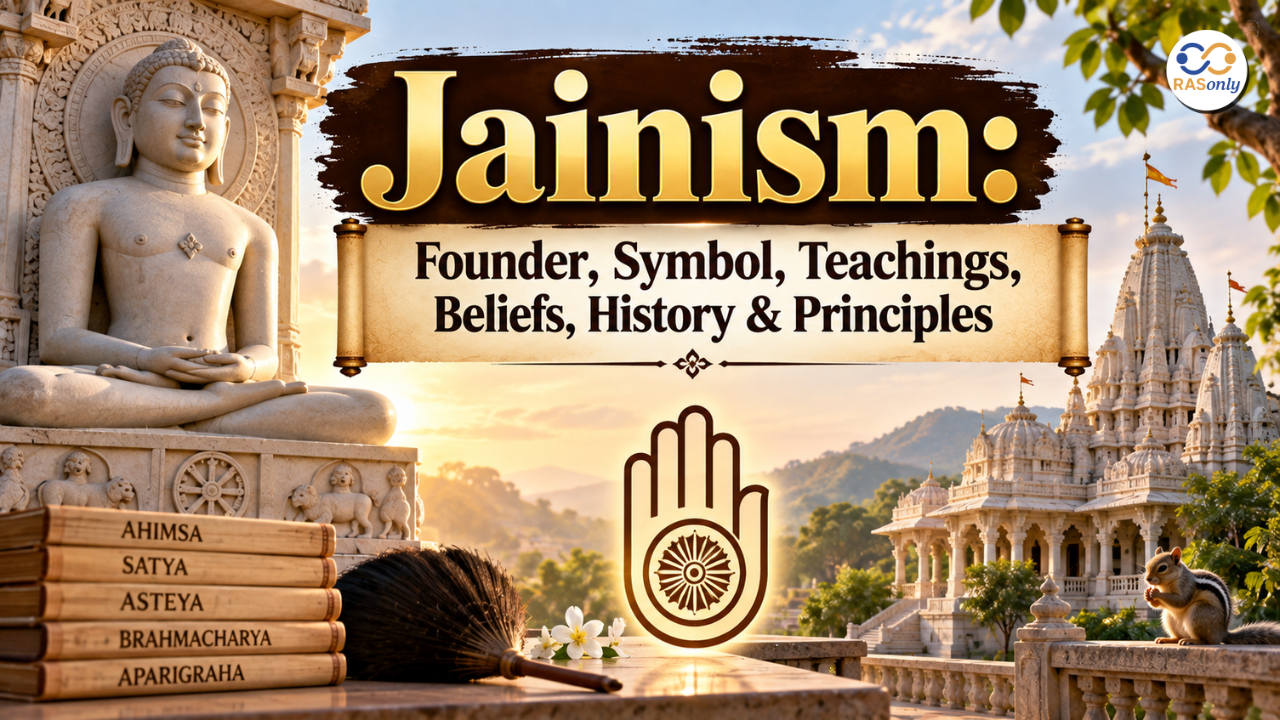
- Buddhism & Jainism
- Mauryan Empire
- Gupta Empire
- Sangam Age
- Ancient Indian Literature
- Art, Architecture & Culture
- Ancient Education Centers
- Foreign Travelers
- Ancient Indian Science & Mathematics
Topic-Wise Importance Table
| Topic | Preparation Focus |
|---|---|
| Indus Valley Civilization | Sites, features, discoveries |
| Vedic Age | Society, religion, literature |
| Buddhism & Jainism | Teachings, councils, symbols |
| Mauryan Empire | Ashoka, administration, inscriptions |
| Gupta Empire | Literature, science, culture |
| Art & Architecture | Stupas, caves, temples |
Ancient History is a scoring section, and Indian History, Indian Heritage, Religion, and Culture-related topics are given importance in the RAS syllabus.
Best Ancient History Preparation Strategy for RAS 2026
The material for Ancient History should never be prepared randomly, as there are numerous dynasties, time-lines, religions, literature, and cultural topics that can confuse during revision. RAS Prelims 2026 preparation strategy is very important as it helps aspirants retain the content, comprehend the concepts, and boost their performance in MCQs.
Smart Preparation Approach
- Start preparation with the NCERT basics first
- Focus more on repeated and high-weightage topics
- Prepare timeline charts regularly for quick revision
- Revise maps, locations, and archaeological sites carefully
- Link religion with art, architecture, and culture topics
- Practice MCQs after completing every topic
- Make short and easy-to-revise notes
Smart Ancient History Preparation Flow
| Step | Focus Area |
|---|---|
| Step 1 | Build NCERT foundation |
| Step 2 | Prepare important dynasties & religions |
| Step 3 | Revise timelines and maps |
| Step 4 | Practice topic-wise MCQs |
| Step 5 | Revise short notes regularly |
Topic-wise Ancient History Strategy for RAS 2026
With a proper strategy, it's much easier to prepare for Ancient History individually, rather than memorizing it all at once. Important Topics such as Civilizations, Religion, Dynasties, Literature, Art & Culture are covered separately to enhance the understanding, revision, and accuracy while solving MCQs for RAS Prelims 2026.
Indus Valley Civilization StrategyThe
Indus Valley Civilization is one of the most important Ancient History topics for the RAS Prelims. Questions are usually asked:
- Important sites
- Features of cities
- Drainage system
- Trade & economy
- Seals and script
- Important discoveries
Important Sites to Focus
| Site | Important Feature |
|---|---|
| Harappa | Granary |
| Mohenjo-daro | Great Bath |
| Lothal | Dockyard |
| Kalibangan | Fire altar |
| Dholavira | Water management |
Preparation Tips
- Learn site-location mapping
- Revise archaeological features repeatedly
- Focus on differences between sites
- Practice direct MCQs
Vedic Civilization Strategy
Vedic Age questions are mostly concept-based and comparative.
Important Areas
- Early Vedic vs Later Vedic Society
- Political system
- Economy & agriculture
- Religion & rituals
- Vedic literature
Smart Strategy
- Focus on comparison tables
- Revise Vedas and associated concepts
- Understand social structure clearly
- Practice statement-based MCQs
Buddhism & Jainism Strategy
This is one of the highest-weightage Ancient History sections in RAS.
Important Topics
- Life of Buddha & Mahavira
- Four Noble Truths
- Eightfold Path
- Jain principles
- Buddhist Councils
- Jain literature
- Symbols and sects
Preparation Tips
- Focus on concepts instead of memorization only
- Learn councils and locations carefully
- Prepare a comparison between Buddhism & Jainism
- Revise symbols, teachings, and philosophies repeatedly
Mauryan Empire Strategy
Questions are commonly asked:
- Chandragupta Maurya
- Ashoka
- Administration
- Arthashastra
- Ashokan inscriptions
Important Areas
| Topic | Focus Area |
|---|---|
| Ashoka | Dhamma policy |
| Kautilya | Arthashastra |
| Administration | Centralized governance |
| Inscriptions | Rock & pillar edicts |
Preparation Tips
- Focus on Ashoka-related questions
- Learn inscriptions and locations
- Study administration basics
- Practice map-based MCQs
Gupta Empire Strategy
The Gupta period is called the “Golden Age” of Ancient India and remains important for RAS.
Important Topics
- Chandragupta I & II
- Samudragupta
- Administration
- Literature
- Science & mathematics
- Art & architecture
Important Personalities
| Personality | Contribution |
|---|---|
| Aryabhata | Mathematics & astronomy |
| Kalidasa | Literature |
| Varahamihira | Astronomy |
Preparation Tips
- Focus on literature and science contributions
- Revise Gupta art & architecture
- Learn the achievements of rulers carefully
Ancient Indian Literature Strategy
Ancient Indian Literature is one of the major areas of preparation for the RAS Prelims 2026, as questions are mostly direct, factual, and based on statements. Literature is the section that many aspirants neglect, but by making proper revision with short notes, it is very easy to score in this section, and it can be revised in time before the exam.
Important Literature Topics
- Vedas
- Upanishads
- Ramayana & Mahabharata
- Sangam Literature
- Buddhist Literature
- Jain Literature
Smart Revision Method
- Prepare author-book and text-theme lists
- Use one-page short notes for quick revision
- Revise important literature repeatedly through MCQs
- Focus on religious and philosophical concepts
- Link literature with dynasties and religions
Literature Preparation Focus
| Literature Topic | Important Focus Area |
|---|---|
| Vedas | Types and features |
| Upanishads | Philosophy and teachings |
| Ramayana & Mahabharata | Authors and themes |
| Sangam Literature | Tamil literature and society |
| Buddhist Literature | Tripitaka and councils |
| Jain Literature | Jain texts and teachings |
Ancient Art & Architecture Strategy
The importance of Art and Architecture in RAS Prelims is on the rise as many questions are now related to Buddhism, Dynasties, Temples, Caves, Sculptures, and Cultural Heritage. This section is highly scoring when presented visually in maps, monuments, and revisions based on images.
Important Areas
- Stupas
- Rock-cut caves
- Temple architecture
- Pillars and sculptures
- Buddhist architecture
Important Examples
| Site | Importance |
|---|---|
| Sanchi | Buddhist Stupa |
| Ajanta | Buddhist caves and paintings |
| Ellora | Rock-cut architecture |
| Sarnath | Ashokan pillar |
| Amaravati | Buddhist art |
Preparation Tips
- Learn monuments through maps and images
- Focus more on Buddhism-linked architecture
- Revise dynasties associated with monuments
- Prepare architecture comparison tables
- Practice image-based MCQs regularly
Best Note-Making Strategy for Ancient History
Ancient History contains many timelines, dynasties, religions, and factual details, so proper note-making becomes extremely important for long-term retention and quick revision before the exam.
Smart Notes Strategy
- Prepare timeline charts for dynasties
- Use flowcharts and comparison tables
- Write one-line factual notes
- Make separate religion and literature notes
- Revise short notes every week
Best Notes Format
| Notes Type | Purpose |
|---|---|
| Timeline Notes | Quick dynasty revision |
| Flowcharts | Fast conceptual understanding |
| One-Line Facts | Final revision |
| Comparison Tables | Avoid confusion |
| MCQ Notes | Improve retention |
Short, organized, and revision-friendly notes help save time and improve Ancient History retention for RAS 2026.
Ancient History MCQ Practice Strategy
Basically, MCQ practice is one of the most crucial sections while preparing for RAS on the basis of Ancient History, as many questions are in statement, confusing, and fact-oriented. Solve the MCQ questions regularly to increase accuracy, confidence, and quickness in solving the questions.
Best MCQ Practice Method
- Solve topic-wise MCQs daily
- Practice PYQs regularly
- Analyze wrong answers carefully
- Revise weak areas repeatedly
- Maintain an error notebook for mistakes
Smart MCQ Practice Tips
- Practice after completing every topic
- Focus more on elimination techniques
- Revise incorrect questions weekly
- Solve mixed-topic quizzes regularly
Consistent MCQ practice along with revision is the best way to improve Ancient History performance in RAS Prelims 2026.
Most Important Ancient History Topics for RAS 2026
Some Ancient History topics are repeatedly asked in RAS Prelims and should be prepared more seriously because of their higher weightage and scoring potential.
High-Weightage Topics
- Indus Valley Civilization
- Buddhism & Jainism
- Mauryan Empire
- Gupta Empire
- Vedic Civilization
- Ancient Literature
- Art & Architecture
Topic Priority Table
| Topic | Importance Level |
|---|---|
| Buddhism & Jainism | Very High |
| Indus Valley Civilization | Very High |
| Mauryan Empire | High |
| Gupta Empire | High |
| Art & Architecture | High |
Common Mistakes Students Make in Ancient History
Many aspirants find Ancient History difficult, not because the syllabus is too vast, but because of a poor preparation strategy and a lack of revision. Avoiding common mistakes can improve both retention and accuracy.
Mistakes to Avoid
- Memorizing without understanding concepts
- Ignoring timelines and chronology
- Skipping revision repeatedly
- Studying too many books and sources
- Not practicing MCQs regularly
- Ignoring maps, monuments, and architecture
Smart Improvement Strategy
- Focus on conceptual clarity first
- Revise regularly instead of cramming
- Practice topic-wise MCQs consistently
- Use maps and visual learning methods
30-Day Ancient History Study Plan for RAS 2026
A systematic approach of a 30-day study plan helps the aspirants to complete Ancient History with a systematic approach without getting overwhelmed. Revising week-wise enhances the revision and retention.
30-Day Study Plan
| Week | Focus Area |
|---|---|
| Week 1 | Indus Valley + Vedic Age |
| Week 2 | Buddhism + Jainism |
| Week 3 | Mauryan + Gupta Empire |
| Week 4 | Art, Culture, Literature + MCQs |
Best Study Approach
- Revise daily for 30–45 minutes
- Practice MCQs after every topic
- Maintain short notes for revision
- Keep one day weekly for revision only
Consistent weekly revision and MCQ practice make Ancient History preparation much more manageable for RAS 2026.
Ancient History Revision Strategy for RAS 2026
The most important aspect of Ancient History preparation is revision, which is easy to forget topics in as the topic is factual in nature. Long-term retention and exam confidence - proper revision strategy.
Smart Revision Tips
- Revise timelines weekly
- Practice MCQs regularly
- Use short notes for quick revision
- Revise maps and monuments visually
- Focus more on repeated exam topics
Best Revision Cycle
| Revision Stage | Focus |
|---|---|
| First Revision | Concept understanding |
| Second Revision | Facts and timelines |
| Final Revision | MCQs and quick notes |
How Toppers Prepare Ancient History for RAS
Most toppers do not study Ancient History through excessive memorization. Instead, they mug up on limited resources, revise repeatedly, pay attention to deadlines and practice MCQs to enhance retention and accuracy.
Toppers’ Preparation Strategy
- Follow limited and reliable sources
- Revise topics multiple times
- Solve PYQs regularly
- Focus on conceptual clarity first
- Practice statement-based MCQs
- Prepare short revision notes
What Makes Toppers Different?
- Consistent revision habits
- Smart MCQ analysis
- Better timeline retention
- Selective and focused preparation
Conclusion
With the appropriate strategy, consistent revision, and smart MCQ practice, Ancient History can prove to be one of the highest-scoring sections in RAS Prelims 2026. The candidates are advised not to think of Ancient History as a factual subject but as a subject of study of civilizations, religions, dynasties, literature, art, and architecture in a connected and structured way. The subjects such as Buddhism & Jainism, Indus Valley Civilization, Mauryan Empire, Gupta Empire, and Ancient Art & Culture are still very significant for the RAS Exam.
Limited resources, revision and revision, learning the timeline, short notes, and continuous practice of MCQs are the keys to a successful preparation for Ancient History in RAS 2026. Usually, the candidates who revise regularly and think conceptually do very well in this section in the actual test.
FAQ
Yes, Ancient History is an important part of the RAS syllabus and questions are regularly asked from civilizations, dynasties, Buddhism, Jainism, literature, and art & culture.
Indus Valley Civilization, Buddhism & Jainism, Mauryan Empire, Gupta Empire, Vedic Civilization, and Ancient Art & Architecture are the most important topics.
NCERT books, RS Sharma’s Ancient India, and standard Art & Culture resources are considered very useful for Ancient History preparation.
Use short notes, timelines, MCQs, maps, and repeated revision cycles for better retention and faster recall during the exam.
No, Ancient History becomes much easier and scoring when prepared through structured study, smart revision, and regular MCQ practice.

BEST SELLER
🏆 PRELIMS
RAS Pass
Prelims focused Hindi & English
₹399
✓
Prelims Topic-Wise Tests
✓
Subject-Wise Tests
✓
Full-Length Prelims Tests
✓
Daily Current Affairs Tests
✓
Prelims PYQs Tests
✓
Detailed Solutions & Analysis
✓
All Rajasthan Ranking
✓
Unlimited Reattempts
✓
Mains Tests
✓
Hindi & English Tests
✓
All Rajasthan Ranking
Trusted by 5,000+ Students
Post Category
- RAS Salary
- Result
- RAS Admit Card
- RAS Job
- RAS Cutoff
- Preparation Tips
- RAS Answer Key
- RAS Exam Analysis
- RAS Syllabus
- RAS Previous Year Papers
- RPSC RAS Exam Pattern
- RAS Interview
- RAS Exam Date
- RAS Vacancy
- RAS Test Series
- RAS Best Books
- RAS Preparation Resources
- RAS Coaching Centre
- History
- Polity
- Geography
- Economics
- Science
- Art and Culture
- RPSC RAS Application Form
- RPSC RAS Notification
- RAS Eligibility Criteria
- UPSC Exam
- RPSC RAS Mains
Visit Our RASonly Offline Center
Our Expert Faculty

Bhunesh Sir
Current Affairs · 13+ Yrs

Aamir Khan Sir
RAS-2017 · IIM Ahm.

Akash Sir
Polity · 8+ Yrs
Free Resources
Official Mobile App

RASOnly App
by OTSAdda · Free
Full Video Lectures
Mock Tests & PYQs
Daily Current Affairs
AI Mock Interview
Free Download · No subscription needed to install
RAS 2024 Toppers — RASonly
Rank 2
Virendra Charan
Rank 9
Bhoopinder Singh
Rank 26
Aanchal Nagpal
Rank 33
Lokendra Singh
Rank 45
Amar Rathore
Rank 46
Manasvini Verma

Join RASonly WhatsApp Community
Get daily current affairs, exam alerts, free study material and tips from expert faculty — right on WhatsApp.
Join for Free →RASonly Interview Guidance Program

Mr. Ashok Jain
Ex-Chief Secretary Govt of Rajasthan
- IAS officer of the 1981 batch, Rajasthan cadre.
- Passionate about mentoring the next generation of RAS officers with real-world insights.
- Got retired in Dec 2017 from the post of Chief Secretary of the state of Rajasthan.

Mr. Guru Charan Rai
Ex-ASP / SP in Jaisalmer
- Guru Charan Rai, IPS (Retd), retired as Inspector General of Police (Security), Rajasthan, Jaipur in 2017.
- Served as ASP and SP in Jaisalmer, Nagaur, Sri Ganganagar, Sawai Madhopur, Dausa, Sikar, and Karauli.
- He also held key positions as DIGP and IGP in the Law and Order division.

Mr. Rakesh Verma
Ex-IAS Officer, B.Tech, MBA, and M.A. (Economics)
- IAS officer of the 1981 batch and retired in Chief Secretary Rank.
- Civil servant of high repute and vast experience.
- Has been teaching UPSC CSE subjects for the last six years.

Daily Current Affairs for RAS Exam Preparation 2026

India Wins Bronze Medal in Men’s Double Sculls
September 25, 2026
India-France Maritime Exercise VARUNA 2026
September 25, 2026
Mirabai Chanu wins a silver medal in Asian Games
September 24, 2026