Free Rajasthan GK One-Liner Notes for RAS
Battle of Haldighati (1576): Complete History, Causes, Events, Result & Significance for RAS 2026

Get in Touch with RASonly!

The Battle of Haldighati (1576) was a historic conflict fought between Maharana Pratap and the Mughal army under Akbar, representing a major struggle between independence and imperial expansion. It stands as a powerful symbol of Rajput bravery, resistance, and determination in Rajasthan history. This topic holds high importance for RPSC RAS 2026, Rajasthan GK, and competitive exam preparation due to its factual and analytical relevance.

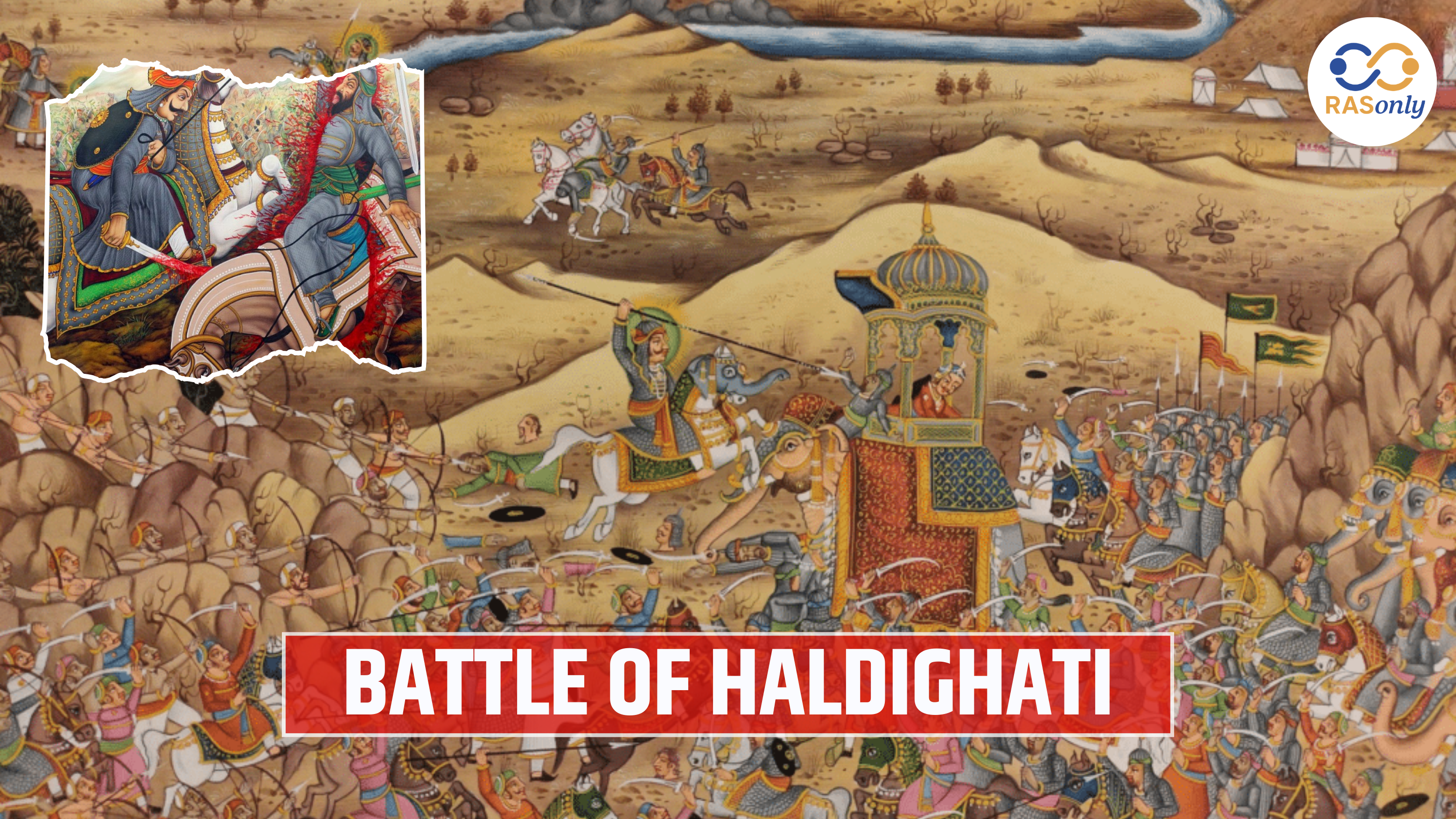
The Battle of Haldighati (1576) is one of the most important topics in Rajasthan History, especially for candidates preparing for RPSC RAS 2026, Rajasthan GK, and competitive exams. This historic battle was fought between Maharana Pratap of Mewar and the Mughal army led by Raja Man Singh I under Emperor Akbar, representing a major conflict between regional independence and imperial expansion. Understanding the Battle of Haldighati history, causes, and results is essential for both prelims and mains examination.
The significance of the Battle of Haldighati 1576 goes beyond just a military event, as it symbolizes Rajput bravery, resistance, and the spirit of independence. Despite facing a much stronger Mughal army, Maharana Pratap refused to surrender, making this battle a powerful example of courage and determination. Due to its importance in Rajasthan history for RAS, exam-oriented facts, and analytical relevance, this topic is frequently asked in RPSC exams and should be prepared in detail.
Battle of Haldighati: Quick Overview
This section provides a quick factual summary of the battle, which is highly useful for revision and frequently asked in exams like RAS and other state services.
The Battle of Haldighati 1576 is a crucial topic in Rajasthan History for RAS 2026, covering important details like date, location, participants, and result. Questions related to Maharana Pratap vs Akbar, Haldighati Pass location, and battle outcome are frequently asked in competitive exams. This quick overview table helps aspirants revise key facts efficiently and strengthens their preparation for RPSC RAS, Rajasthan GK, and history sections.
| Particular | Details |
|---|---|
| Battle Name | Battle of Haldighati |
| Date | 18 June 1576 |
| Location | Haldighati Pass, Aravalli Hills (near Gogunda, Rajasthan) |
| Between | Maharana Pratap vs Mughal Empire |
| Mughal Commander | Raja Man Singh I |
| Mughal Emperor | Akbar |
| Result | Mughal Tactical Victory |
| Nature of Outcome | Inconclusive |
| Importance | Symbol of Rajput Resistance |
What is the Battle of Haldighati?
The Battle of Haldighati (1576) was a major conflict between Maharana Pratap of Mewar and the Mughal army led by Raja Man Singh under Akbar. It was fought at Haldighati Pass in the Aravalli Hills, Rajasthan, as part of Akbar’s expansion policy in Rajputana.
This battle represents the struggle between Mewar’s independence and Mughal dominance. Despite being outnumbered, Maharana Pratap chose resistance over surrender, making the Battle of Haldighati a symbol of Rajput bravery and determination, and an important topic for RPSC RAS 2026 and Rajasthan GK.
Historical Background
The Historical Background of the Battle of Haldighati (1576) explains the long conflict between Mewar and the Mughal Empire under Akbar. It developed due to Mughal expansion in Rajasthan and Maharana Pratap’s refusal to accept Mughal supremacy.
This was not a sudden war but the result of political tension, strategic importance of Mewar, and failed diplomatic missions, making the battle inevitable in Rajasthan history.
Background Summary Table
| Event | Description |
|---|---|
| Mughal Expansion | Akbar aimed to control all Rajput states |
| Chittorgarh Capture (1568) | Mewar weakened but not defeated |
| Maharana Pratap’s Rule (1572) | Refused Mughal supremacy |
| Diplomatic Missions | Failed attempts by Akbar |
| Rising Conflict | Led to direct military confrontation |
The Battle of Haldighati background clearly shows that Mewar’s independence and its strategic location made it a key target for the Mughals. While Akbar focused on expansion and control, Maharana Pratap strongly defended the sovereignty of Mewar.
Causes of the Battle of Haldighati
The Causes of the Battle of Haldighati (1576) were mainly related to Mughal expansion policy and the resistance of Maharana Pratap. The conflict arose due to political ambition, strategic importance of Mewar, and the refusal to accept Mughal authority.
This battle reflects the clash between Akbar’s imperial expansion in Rajasthan and Mewar’s determination to remain independent, making it an important topic for RPSC RAS 2026 and Rajasthan History.
Major Causes Table
| Cause | Explanation |
|---|---|
| Refusal of Supremacy | Maharana Pratap rejected Mughal authority |
| Strategic Importance | Mewar controlled key trade routes |
| Mughal Expansion Policy | Akbar aimed for unified control |
| Rajput Pride | Mewar symbol of independence |
| Diplomatic Failure | Peace talks failed |
The main reason behind the Battle of Haldighati was the conflict between imperial control and regional sovereignty. While many Rajput rulers accepted Mughal rule, Maharana Pratap continued to resist, making Mewar the center of opposition.
Forces and Military Strength
The Forces and Military Strength in the Battle of Haldighati (1576) show a clear contrast between the smaller army of Maharana Pratap and the powerful Mughal army led by Raja Man Singh I. The Mughals had a strong advantage in terms of numbers, weapons, and military resources.
However, the Mewar army relied on courage, local terrain knowledge, and support from Bhil and Afghan warriors, which helped them challenge a much larger Mughal force. This comparison is important for understanding the Battle of Haldighati result and strategy in RAS exams.
Comparison of Armies
| Feature | Mewar Army | Mughal Army |
|---|---|---|
| Leader | Maharana Pratap | Raja Man Singh I |
| Strength | 3000–4000 | 15,000–20,000 |
| Support | Bhils, Afghans | Rajputs + Mughals |
| Weapons | Traditional | Advanced + Artillery |
| Advantage | Terrain knowledge | Numbers & technology |
Despite the Mughal army’s superiority, the Mewar forces used strategic positioning and high morale to fight effectively in the early stages of the Battle of Haldighati.
Course of the Battle (Step-by-Step Events)
The Course of the Battle of Haldighati (1576) explains how the conflict unfolded between Maharana Pratap and the Mughal army led by Raja Man Singh I. The battle was marked by intense fighting, strategic use of terrain, and remarkable acts of bravery.
Understanding the step-by-step events of the Battle of Haldighati is important for RPSC RAS 2026, Rajasthan History, and exam-oriented preparation, as questions are often asked from battle sequence and key incidents.
Key Events Table
| Stage | Description |
|---|---|
| Initial Attack | Rajputs launched a sudden and aggressive attack |
| Close Combat | Intense hand-to-hand fighting |
| Maharana’s Charge | Direct attack on Man Singh |
| Role of Chetak | Saved Maharana Pratap |
| Jhala Manna | Sacrificed himself |
| Retreat | Tactical withdrawal by Pratap |
The battle began with a powerful offensive by Maharana Pratap, which initially created pressure on the Mughal army. However, due to their numerical superiority and better resources, the Mughals gradually gained control, forcing Maharana Pratap to retreat strategically.
Important Personalities
The Important Personalities in the Battle of Haldighati played crucial roles in shaping the course and outcome of the battle. Their contributions are frequently asked in RAS exams and Rajasthan GK.
These individuals represent bravery, leadership, and sacrifice, making them essential for understanding the complete history of the Battle of Haldighati 1576.
Key Personalities Table
| Name | Role |
|---|---|
| Maharana Pratap | Leader of Mewar |
| Raja Man Singh I | Mughal Commander |
| Akbar | Mughal Emperor |
| Hakim Khan Sur | Afghan ally of Pratap |
| Jhala Manna | Sacrificed his life |
| Rana Punja | Bhil tribal leader |
| Chetak | Loyal horse of Pratap |
Each personality had a significant impact on the battle, especially Maharana Pratap, whose leadership and determination made him a symbol of resistance in Indian history.
Result of the Battle of Haldighati
The Result of the Battle of Haldighati (1576) is often confusing for students, so it is important to clearly understand both tactical and strategic outcomes.
While the Mughal army gained control of the battlefield, they failed to achieve their main objective of defeating Maharana Pratap completely.
- Mughals captured the battlefield → Tactical victory
- Maharana Pratap escaped safely
- Mewar remained independent
Thus, the Battle of Haldighati is considered inconclusive, as the Mughal Empire could not fully conquer Mewar or end its resistance.
Aftermath of the Battle
The Aftermath of the Battle of Haldighati shows how Maharana Pratap continued his struggle even after the battle. It highlights his determination and long-term resistance against the Mughal Empire. This phase is important for understanding the continuity of Mewar’s independence and guerrilla warfare strategy.
Aftermath Table
| Event | Details |
|---|---|
| Guerrilla Warfare | Adopted by Maharana Pratap |
| Continued Resistance | Attacks on Mughal forces |
| Battle of Dewair (1582) | Regained major territories |
| Independence | Mewar remained unconquered |
After the battle, Maharana Pratap used guerrilla tactics in the Aravalli Hills and successfully regained lost territories, proving that the Mughal victory was not decisive.
Significance of the Battle
The Significance of the Battle of Haldighati lies in its impact on history, culture, and exam relevance. It is one of the most important events in Rajasthan History and RAS syllabus. This battle is remembered not for its result, but for the spirit of resistance, courage, and independence shown by Maharana Pratap.
Key Significance Points
| Aspect | Importance |
|---|---|
| Political | Resistance against Mughal expansion |
| Military | Use of guerrilla warfare |
| Cultural | Symbol of Rajput pride |
| Historical | Inspirational event |
| Exam Relevance | Important for RAS |
The Battle of Haldighati stands as a powerful example of how determination and leadership can challenge even a powerful empire like the Mughals.
Battle of Haldighati for RAS 2026
The Battle of Haldighati for RAS 2026 is an important topic for quick revision, especially for prelims and mains exams. Key facts are often directly asked in objective and descriptive questions.
This section helps aspirants revise the most important points of the Battle of Haldighati 1576 in a short and exam-friendly format.
Quick Revision Table
| Topic | Key Point |
|---|---|
| Date | 18 June 1576 |
| Location | Haldighati Pass |
| Between | Mewar vs Mughals |
| Result | Inconclusive |
| Strategy | Guerrilla warfare |
| Importance | Symbol of resistance |
Conclusion
The Battle of Haldighati (1576) remains one of the most significant events in Rajasthan History and Medieval Indian History. Although the Mughal army achieved a tactical victory, they failed to capture Maharana Pratap or completely control Mewar, making the battle effectively inconclusive.
This battle is remembered as a symbol of Rajput bravery, resistance, and the spirit of independence, which makes it highly important for RPSC RAS 2026, Rajasthan GK, and history preparation. Understanding its causes, events, and outcomes helps aspirants build strong conceptual clarity for both prelims and mains exams.
FAQs
The Battle of Haldighati was fought on 18 June 1576 between Maharana Pratap and the Mughal army.
The battle was fought between Maharana Pratap of Mewar and the Mughal army led by Raja Man Singh I under Emperor Akbar.
The Mughals won a tactical victory, but the battle is considered inconclusive as Maharana Pratap escaped and continued resistance.
The battle is important because it represents Rajput bravery, resistance against Mughal rule, and Mewar’s independence, making it a key topic in Rajasthan history.
The battle was fought at Haldighati Pass in the Aravalli Hills near Gogunda, Rajasthan.
BEST SELLER
🏆 PRELIMS
RAS Pass
Prelims focused Hindi & English
₹399
✓
Prelims Topic-Wise Tests
✓
Subject-Wise Tests
✓
Full-Length Prelims Tests
✓
Daily Current Affairs Tests
✓
Prelims PYQs Tests
✓
Detailed Solutions & Analysis
✓
All Rajasthan Ranking
✓
Unlimited Reattempts
✓
Mains Tests
✓
Hindi & English Tests
✓
All Rajasthan Ranking
Trusted by 5,000+ Students
Post Category
- RAS Salary
- Result
- RAS Admit Card
- RAS Job
- RAS Cutoff
- Preparation Tips
- RAS Answer Key
- RAS Exam Analysis
- RAS Syllabus
- RAS Previous Year Papers
- RPSC RAS Exam Pattern
- RAS Interview
- RAS Exam Date
- RAS Vacancy
- RAS Test Series
- RAS Best Books
- RAS Preparation Resources
- RAS Coaching Centre
- History
- Polity
- Geography
- Economics
- Science
- Art and Culture
- RPSC RAS Application Form
- RPSC RAS Notification
- RAS Eligibility Criteria
- UPSC Exam
- RPSC RAS Mains
Visit Our RASonly Offline Center
Our Expert Faculty

Bhunesh Sir
Current Affairs · 13+ Yrs

Aamir Khan Sir
RAS-2017 · IIM Ahm.

Akash Sir
Polity · 8+ Yrs
Free Resources
Official Mobile App

RASOnly App
by OTSAdda · Free
Full Video Lectures
Mock Tests & PYQs
Daily Current Affairs
AI Mock Interview
Free Download · No subscription needed to install
RAS 2024 Toppers — RASonly
Rank 2
Virendra Charan
Rank 9
Bhoopinder Singh
Rank 26
Aanchal Nagpal
Rank 33
Lokendra Singh
Rank 45
Amar Rathore
Rank 46
Manasvini Verma

Join RASonly WhatsApp Community
Get daily current affairs, exam alerts, free study material and tips from expert faculty — right on WhatsApp.
Join for Free →RASonly Interview Guidance Program

Mr. Ashok Jain
Ex-Chief Secretary Govt of Rajasthan
- IAS officer of the 1981 batch, Rajasthan cadre.
- Passionate about mentoring the next generation of RAS officers with real-world insights.
- Got retired in Dec 2017 from the post of Chief Secretary of the state of Rajasthan.

Mr. Guru Charan Rai
Ex-ASP / SP in Jaisalmer
- Guru Charan Rai, IPS (Retd), retired as Inspector General of Police (Security), Rajasthan, Jaipur in 2017.
- Served as ASP and SP in Jaisalmer, Nagaur, Sri Ganganagar, Sawai Madhopur, Dausa, Sikar, and Karauli.
- He also held key positions as DIGP and IGP in the Law and Order division.

Mr. Rakesh Verma
Ex-IAS Officer, B.Tech, MBA, and M.A. (Economics)
- IAS officer of the 1981 batch and retired in Chief Secretary Rank.
- Civil servant of high repute and vast experience.
- Has been teaching UPSC CSE subjects for the last six years.


Daily Current Affairs for RAS Exam Preparation 2026

Shyam Sunder Swami Wins Bronze at World Archery Para...
September 14, 2026
Viksit Bharat Jan Seva Abhiyan 2026
September 14, 2026
Rajasthan Universities in the QS World University Rankings 2027
September 12, 2026