Chola Dynasty: Capital, Founder, Kings, Time Period and History
Livestock and Animal Resources of Rajasthan

Get in Touch with RASonly!

Livestock and Animal Resources of Rajasthan form the backbone of the state's rural economy, especially in the arid and semi-arid regions where farming alone can't sustain families. Home to the country's largest camel population and one of the most diverse sheep and goat populations, Rajasthan's animal husbandry sector supports millions through dairy, wool, and meat production. This guide covers cattle breeds, camel breeds, government schemes, livestock fairs, and key facts every RAS aspirant needs for exam preparation.

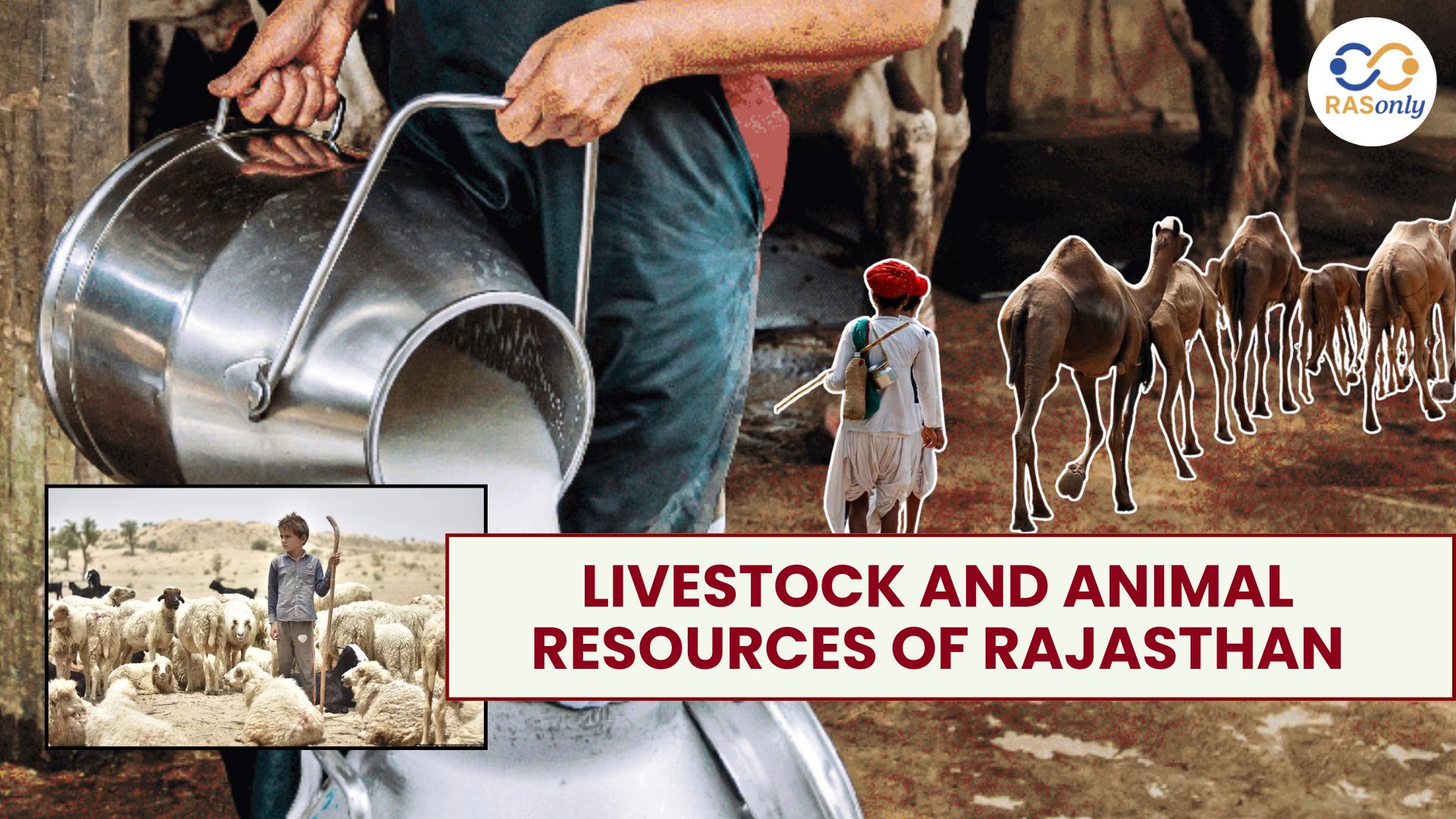
Rajasthan is often called the "livestock capital" of India, and honestly, this title fits well when you look at the numbers. The state has a huge desert and semi-arid area where farming alone can't support the rural economy, so animal husbandry has always played a backup role - sometimes even the main role - for millions of families here. Livestock isn't just a side business in Rajasthan; for a large section of the rural population, especially in districts like Barmer, Jaisalmer, Bikaner, and Nagaur, it is the primary source of livelihood.
Also Check: Migration in Rajasthan 2026
A few points that explain why this sector matters so much:
- Rajasthan contributes a significant share to India's total livestock population despite covering only about 10% of the country's geographical area.
- The state's arid and semi-arid climate is not ideal for regular crop farming, which naturally pushed people toward livestock rearing as a more reliable source of income.
- Livestock provides milk, meat, wool, hides, and manure - all of which support both the rural economy and allied industries.
- It acts as a form of insurance during droughts, which are common in western Rajasthan, since animals can survive on scrub vegetation when crops fail.
- The sector supports the dairy industry, leather industry, and wool-based industries, creating employment beyond just farming.
Note for the exam: Questions often ask about livestock's contribution to Rajasthan's GSDP (Gross State Domestic Product) and its role in the rural economy. Keep this framing in mind while writing answers - livestock isn't just "animals," it's an economic backbone for arid Rajasthan.
2. Livestock Census Data - Trends and Rankings
The Livestock Census is conducted every five years by the Ministry of Fisheries, Animal Husbandry and Dairying, Government of India. The most recent one referenced in most RAS materials is the 20th Livestock Census (2019).
Key highlights to remember:
- Rajasthan ranks among the top states in India in terms of total livestock population.
- The state holds the highest population of camels in the entire country - this is a very frequently asked fact.
- Rajasthan also ranks very high in sheep and goat population, largely due to the wool and meat economy in western districts.
- In terms of cattle population, Rajasthan is consistently among the top states, though not always number one.
- There has been a declining trend in camel population over successive censuses, which is a major concern and a hot topic for policy-based questions.
- Districts like Barmer, Jaisalmer, Bikaner, and Nagaur dominate in camel and sheep population, while areas with better irrigation (like Ganganagar) show more cattle and buffalo concentration.
Exam tip: Numbers change with each census, so instead of memorizing exact figures blindly, focus on trends - which species are increasing, which are decreasing, and why. Examiners love asking "reason-based" questions like "why is camel population declining in Rajasthan?"
Also Check: Desert Ecosystem of Rajasthan 2026
3. Major Livestock Breeds of Rajasthan
This is the heart of the topic and where most RAS questions come from. Let's go breed by breed.
A. Cattle Breeds
Rajasthan is home to some of India's most well-known indigenous cattle breeds.
- Rathi - Found mainly in Bikaner, Ganganagar, and Churu. Known for good milk yield among indigenous breeds; often called the best dairy breed of Rajasthan.
- Tharparkar - Native to the Thar region (Jaisalmer, Barmer). Known as a dual-purpose breed - good for both milk and draft (farm labor). Very hardy and drought-resistant, white or grey in color.
- Nagauri - Found in Nagaur district. Famous as a draught breed, meaning it's primarily used for pulling carts and ploughing rather than milk.
- Kankrej - Found in the Gujarat-Rajasthan border areas (Jalore, Barmer, Sirohi). Known for strength and used both for draught and milk.
- Malvi - Found in southeastern Rajasthan (Kota, Jhalawar area), a draught breed known for its working capacity in agricultural fields.
- Mewati - Found in the Alwar-Bharatpur region, another draught-type breed.
Quick note: When asked "which is the best milch (milk-giving) cattle breed of Rajasthan," the standard answer is Rathi. When asked about drought-resistant and dual-purpose, the answer is usually Tharparkar.
Also Check: Wildlife Conservation in Rajasthan
B. Buffalo Breeds
- Murrah - Though originally from Haryana, Murrah is widely reared in Rajasthan (especially Ganganagar, Hanumangarh) due to its excellent milk yield. It's considered one of the best buffalo breeds in the world for dairy purposes.
C. Sheep Breeds
Rajasthan has a large number of sheep breeds, mostly reared for wool, meat, or both.
- Marwari - Found across western Rajasthan (Jodhpur, Barmer, Nagaur). Known for coarse wool, hardy and well-adapted to desert conditions.
- Magra - Found in Bikaner, Jaisalmer, and Churu. Known for producing good quality carpet wool.
- Chokla - Found in Sikar, Jhunjhunu, and Churu regions. Known for fine wool quality, among the better wool breeds of the state.
- Nali - Found in Ganganagar and Hanumangarh. A dual-purpose breed known for both wool and meat.
- Pugal - Found in Bikaner region, adapted well to arid conditions, known for meat and wool both.
- Sonadi (Chanothar) - Found in Udaipur and southern Rajasthan, primarily reared for meat.
Note: Rajasthan is often described as having the largest and most diverse sheep population in India, which directly links to the wool production keyword - the state contributes a major share of India's total wool output. However, much of it is coarse/carpet-grade wool rather than fine wool.
Also Check: Luni-Jawai Basin of Rajasthan
D. Goat Breeds
- Marwari - Widely found goat breed across the state, hardy and multipurpose.
- Jamunapari - Though native to UP, reared in parts of Rajasthan too; known for good milk yield.
- Sirohi - Found in Sirohi and surrounding districts, known for meat production and good body size.
- Jakhrana - Found in Alwar region, considered a good dairy goat breed, sometimes compared to Jamunapari for milk quality.
E. Camel Breeds
The camel deserves special focus since it's the State Animal of Rajasthan.
- Bikaneri - Found in Bikaner region, used for both riding and load-carrying, considered a strong and reliable working breed.
- Jaisalmeri - Found in Jaisalmer, known for speed and used traditionally by the Border Security Force (BSF) for patrolling.
- Mewari - Found in southern Rajasthan (Mewar region), a hill-adapted camel breed used more for load-carrying in hilly/rough terrain.
Important fact: The camel breeding tract of Rajasthan mainly covers Bikaner and Jaisalmer districts, which together host the largest camel population in the state. The Government of Rajasthan has declared the camel as the State Animal and has also passed a specific act for its conservation - this connects directly to the "Rajasthan Camel (State Animal) conservation act" keyword discussed later.
Also Check: Dams of Rajasthan and Their Types
4. State Animal and State Bird
Two quick but exam-critical facts:
- State Animal of Rajasthan: Camel (ऊंट) - declared in recognition of its role in desert transport, defense, and rural livelihood. Given the declining population trend, the state introduced conservation measures specifically for camels.
- State Bird of Rajasthan: Godawan (Great Indian Bustard) - while not technically "livestock," this is often clubbed with animal resource questions in RAS papers because of its conservation significance (Project Great Indian Bustard, "Sudasari" breeding centre in Jaisalmer).
Note: Don't confuse livestock (domesticated, economically reared animals) with state symbols like the Godawan - but do remember both together since exam papers often mix them in the same question or MCQ set.
5. Government Schemes and Institutions Related to Livestock
This is a heavily tested area because RAS exams love current-affairs-linked, scheme-based questions.
A. Godhan Nyay Yojana / Mukhyamantri Nirashrit Govansh Yojana
- Aimed at the welfare of stray and abandoned cattle (govansh) roaming in rural and urban areas.
- Focuses on providing shelter, fodder, and medical care through gaushalas (cow shelters).
- Part of a broader push to reduce stray cattle-related accidents and agricultural damage while improving animal welfare.
B. Kamdhenu Bima Yojana
- An insurance-based scheme for livestock owners, protecting them financially in case of death of their animals (cattle/buffalo) due to disease or accident.
- Helps reduce the economic shock faced by small and marginal livestock keepers when they lose an animal.
C. Rajasthan State Livestock and Poultry Development Corporation
- A state-run body responsible for improving breed quality, distributing quality breeding stock, and supporting poultry and livestock development programs across the state.
- Works alongside veterinary departments to implement breeding improvement and vaccination drives.
D. Rajasthan Veterinary Council
- The regulatory body overseeing veterinary practice, registration of veterinarians, and maintaining professional standards in animal healthcare across the state.
E. Rajasthan Co-operative Dairy Federation (RCDF) - Saras Dairy
- The umbrella dairy cooperative body of Rajasthan, popularly known through its brand Saras.
- Works on the pattern of Gujarat's Amul model (cooperative dairy structure) - collects milk from village-level cooperative societies and processes/markets it under the Saras brand.
- Plays a major role in Rajasthan's dairy development sector, directly linking rural milk producers to urban markets.
Also Check: Water Resources of Rajasthan
F. Fodder Development Schemes
- Given Rajasthan's arid climate, fodder scarcity is a chronic issue, especially during droughts.
- The state runs multiple fodder development and fodder bank schemes to ensure animals have access to feed during dry seasons - this becomes especially important during drought years.
Exam tip: Scheme names and their exact provisions can get updated or renamed by different governments, so while writing answers, focus on the objective of each scheme (welfare, insurance, breed improvement, or fodder security) rather than only the name - examiners give credit for correct understanding even if a scheme's current name has slightly changed.
6. Livestock Fairs and Markets of Rajasthan
Livestock fairs are a unique cultural and economic feature of Rajasthan, and this is a favorite topic for both prelims and mains.
- Pushkar Fair (Pushkar Mela) - Held in Ajmer district, world-famous, primarily known for camel and cattle trading. It's as much a religious and cultural event (tied to Pushkar Lake and Brahma Temple) as it is a livestock market, which makes it a popular question topic connecting culture + economy.
- Nagaur Cattle Fair - One of the largest cattle fairs in Asia, held in the Nagaur district, known specifically for bullock and camel trading, along with a large market for indigenous farm equipment.
- Tilwara Fair - Held in Balotra (Barmer district) on the banks of the Luni River, another major livestock trading fair, known for cattle and camel trade.
- Ramdevra Fair and other regional fairs also have livestock trading components, though smaller in scale compared to the above three.
Note: These fairs serve real economic functions - they're not just cultural events. They act as major trading hubs where breeders and farmers buy and sell animals, exchange breeding stock, and even showcase prize animals. This economic angle is important for answers that ask about the "role of livestock fairs in Rajasthan's rural economy."
Also Check: Land Degradation & Soil Erosion in Rajasthan
7. Poultry and Fisheries Development in Rajasthan
While cattle, sheep, goats, and camels dominate the "livestock" conversation, poultry and fisheries are smaller but growing sub-sectors.
- Poultry farming has been expanding in peri-urban areas as demand for eggs and meat grows.
- Fisheries development is naturally limited in a desert state, but areas around dams and reservoirs (like Jaisamand and Rana Pratap Sagar) support some inland fisheries activity.
- Both sectors are being promoted through state schemes to diversify rural incomes beyond traditional livestock.
8. Challenges Facing the Livestock Sector in Rajasthan
A good RAS answer always balances facts with analysis - so here are the key challenges you should be ready to discuss:
- Declining camel population - despite being the State Animal, camel numbers have been falling steadily across recent censuses, largely due to reduced use in transport (replaced by vehicles) and shrinking grazing lands.
- Fodder and water scarcity - recurring droughts in western Rajasthan make it difficult to sustain large livestock populations, especially during summer months.
- Shrinking grazing (Oran/Gochar) lands - encroachment and land-use change have reduced traditional common grazing lands, putting pressure on pastoral communities.
- Low productivity of indigenous breeds - compared to crossbred or exotic breeds, many indigenous breeds have lower milk yield, though they are far more climate-resilient.
- Limited veterinary infrastructure in remote desert areas, making disease control and breeding support difficult to access for many rural households.
- Marketing and price realization issues - livestock owners, especially small and marginal ones, often don't get fair prices due to weak market linkages outside the big fairs.
Also Check: Rainfall Distribution in Rajasthan
9. Future Prospects and Way Forward
- Strengthening the camel conservation program, including better breeding support and possibly promoting camel milk as a niche dairy product (camel milk has been gaining attention as a specialty health product).
- Expanding fodder development and fodder bank networks to drought-proof the livestock economy.
- Improving veterinary healthcare access in remote desert districts through mobile veterinary units.
- Strengthening cooperative dairy structures like Saras/RCDF to ensure better price realization for milk producers.
- Promoting breed improvement programs to boost the productivity of indigenous cattle, sheep, and goat breeds without compromising their natural hardiness.
- Encouraging value addition - wool processing, leather industry linkages, and camel-based tourism/products - to create more income streams from the same livestock base.
Quick Revision Table
| Category | Key Names to Remember |
|---|---|
| Best milch cattle breed | Rathi |
| Dual-purpose (milk + draught) cattle | Tharparkar |
| Draught cattle breeds | Nagauri, Malvi, Mewati, Kankrej |
| Buffalo breed | Murrah |
| Sheep breeds (fine wool) | Chokla |
| Sheep breeds (carpet wool) | Magra, Marwari |
| Camel breeds | Bikaneri, Jaisalmeri, Mewari |
| State Animal | Camel |
| State Bird | Godawan (Great Indian Bustard) |
| Dairy cooperative brand | Saras (RCDF) |
| Largest cattle fair (Asia) | Nagaur Fair |
| Famous cultural + livestock fair | Pushkar Fair |
| Camel breeding tract | Bikaner, Jaisalmer |
Final Note for Revision
This topic connects geography (arid climate), economy (rural livelihoods, dairy sector), governance (schemes, institutions), and culture (fairs) - so when writing main answers, try to touch multiple angles rather than just listing facts. Examiners reward answers that show why Rajasthan's livestock sector looks the way it does, not just what the breeds and numbers are.
Also Check: Climate Change Impact on Rajasthan
Conclusion
The Livestock and Animal Resources of Rajasthan sector is far more than just numbers and breed names - it's a lifeline for the state's rural economy, particularly in drought-prone western districts like Barmer, Jaisalmer, and Bikaner. From indigenous cattle breeds like Rathi and Tharparkar to the declining camel population and government schemes like Kamdhenu Bima Yojana, this topic connects geography, economy, and governance in a way that RAS examiners love to test. For exam preparation, focus not just on memorizing breed names and fair locations, but also on understanding the why behind trends - declining camel numbers, fodder scarcity, and shrinking grazing lands are just as important as knowing which district produces which breed. A well-rounded answer that ties facts to real challenges and future solutions will always score better in mains.
FAQs
Rathi is considered the best milch (dairy) cattle breed of Rajasthan, known for its good milk yield among indigenous breeds and mainly found in Bikaner, Ganganagar, and Churu.
The Camel is the State Animal of Rajasthan, recognized for its role in desert transport, defense, and rural livelihood. Its population has been declining, prompting specific conservation measures.
Bikaner and Jaisalmer together form the main camel breeding tract of Rajasthan and host the largest camel population in the state.
The Pushkar Fair is a world-famous cultural and religious event combined with camel and cattle trading, while the Nagaur Fair is one of the largest cattle fairs in Asia, known for bullock and camel trade.
Key sheep breeds include Marwari, Magra, Chokla, Nali, Pugal, and Sonadi - reared mainly for wool and meat, making Rajasthan one of the largest wool-producing states in India.
BEST SELLER
🏆 PRELIMS
RAS Pass
Prelims focused Hindi & English
₹399
✓
Prelims Topic-Wise Tests
✓
Subject-Wise Tests
✓
Full-Length Prelims Tests
✓
Daily Current Affairs Tests
✓
Prelims PYQs Tests
✓
Detailed Solutions & Analysis
✓
All Rajasthan Ranking
✓
Unlimited Reattempts
✓
Mains Tests
✓
Hindi & English Tests
✓
All Rajasthan Ranking
Trusted by 5,000+ Students
Post Category
- RAS Salary
- Result
- RAS Admit Card
- RAS Job
- RAS Cutoff
- Preparation Tips
- RAS Answer Key
- RAS Exam Analysis
- RAS Syllabus
- RAS Previous Year Papers
- RPSC RAS Exam Pattern
- RAS Interview
- RAS Exam Date
- RAS Vacancy
- RAS Test Series
- RAS Best Books
- RAS Preparation Resources
- RAS Coaching Centre
- History
- Polity
- Geography
- Economics
- Science
- Art and Culture
- RPSC RAS Application Form
- RPSC RAS Notification
- RAS Eligibility Criteria
- UPSC Exam
- RPSC RAS Mains
Visit Our RASonly Offline Center
Our Expert Faculty

Bhunesh Sir
Current Affairs · 13+ Yrs

Aamir Khan Sir
RAS-2017 · IIM Ahm.

Akash Sir
Polity · 8+ Yrs
Free Resources
Official Mobile App

RASOnly App
by OTSAdda · Free
Full Video Lectures
Mock Tests & PYQs
Daily Current Affairs
AI Mock Interview
Free Download · No subscription needed to install
RAS 2024 Toppers — RASonly
Rank 2
Virendra Charan
Rank 9
Bhoopinder Singh
Rank 26
Aanchal Nagpal
Rank 33
Lokendra Singh
Rank 45
Amar Rathore
Rank 46
Manasvini Verma

Join RASonly WhatsApp Community
Get daily current affairs, exam alerts, free study material and tips from expert faculty — right on WhatsApp.
Join for Free →RASonly Interview Guidance Program

Mr. Ashok Jain
Ex-Chief Secretary Govt of Rajasthan
- IAS officer of the 1981 batch, Rajasthan cadre.
- Passionate about mentoring the next generation of RAS officers with real-world insights.
- Got retired in Dec 2017 from the post of Chief Secretary of the state of Rajasthan.

Mr. Guru Charan Rai
Ex-ASP / SP in Jaisalmer
- Guru Charan Rai, IPS (Retd), retired as Inspector General of Police (Security), Rajasthan, Jaipur in 2017.
- Served as ASP and SP in Jaisalmer, Nagaur, Sri Ganganagar, Sawai Madhopur, Dausa, Sikar, and Karauli.
- He also held key positions as DIGP and IGP in the Law and Order division.

Mr. Rakesh Verma
Ex-IAS Officer, B.Tech, MBA, and M.A. (Economics)
- IAS officer of the 1981 batch and retired in Chief Secretary Rank.
- Civil servant of high repute and vast experience.
- Has been teaching UPSC CSE subjects for the last six years.
Related Post

Daily Current Affairs for RAS Exam Preparation 2026

Kundan Art Display in Hong Kong
October 23, 2026
Rajasthan International Folk Festival 2026
October 23, 2026
Inauguration of 100 New Kalika Patrolling Units in Rajasthan
October 21, 2026