Chola Dynasty: Capital, Founder, Kings, Time Period and History
Mastering RAS Prelims Time Management: A Complete 3-Hour Exam Strategy

Get in Touch with RASonly!

Master RAS Prelims time management with a practical 3-hour exam strategy. Learn the three-round method, section-wise time allocation, negative marking techniques, OMR management, and topper-inspired exam tips to improve speed, accuracy, and your chances of clearing the RPSC RAS Prelims.

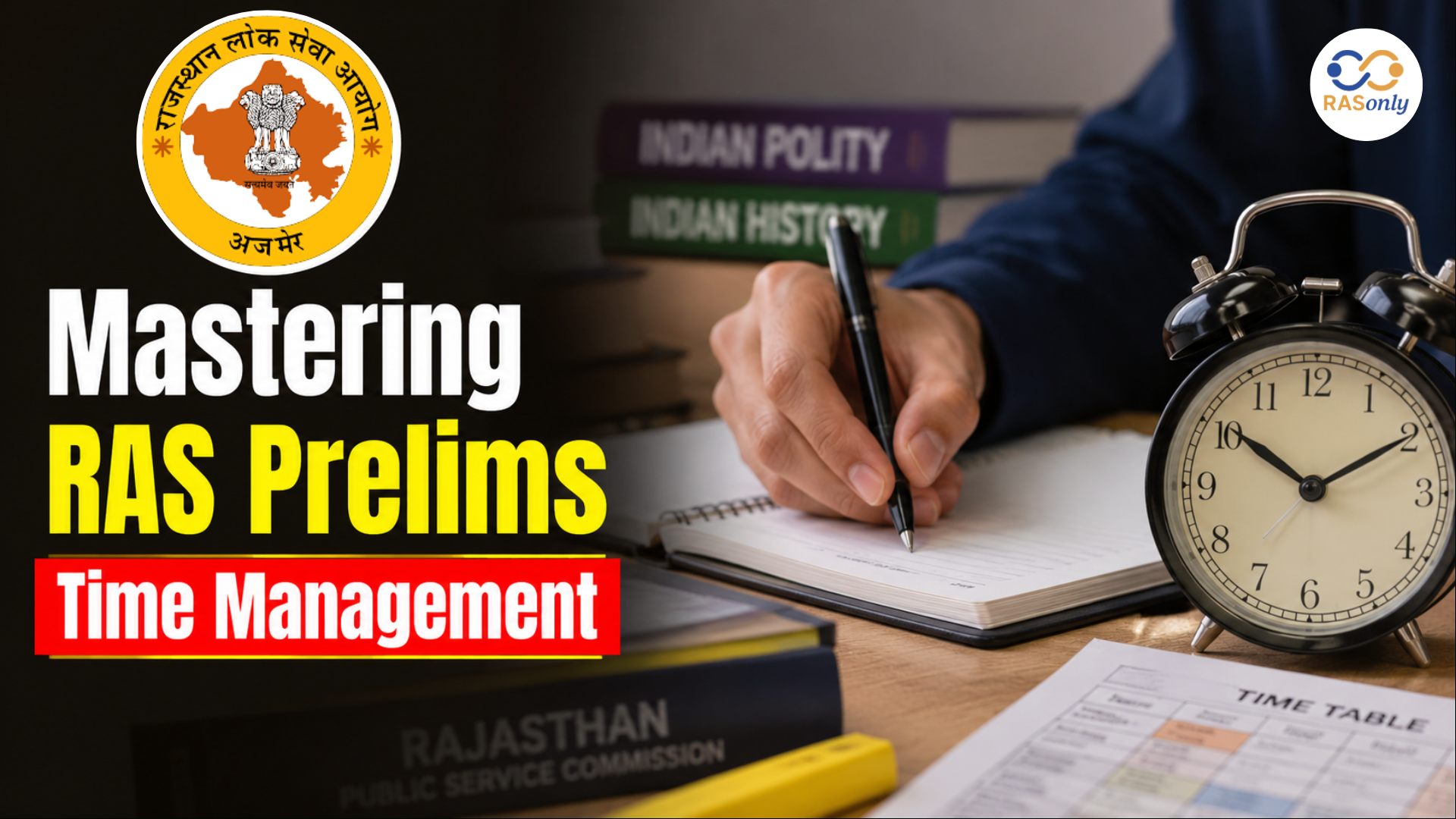
Time management is the most crucial aspect of RAS Prelims, which makes all the difference between a candidate passing this exam with a good score and another one failing. Each year, thousands of well-prepared candidates suffer poor performance simply because they don't have enough time, panic in the final 30 minutes, or spend too long on a few difficult questions. Time management is not all about speed; it is about creating a repeatable system that will have you manage the paper's 150 questions with accuracy, negative marking, and mental composure.
This blog explains one strategy for the 3-hour RAS prelims that is exam-day ready, and you can begin practising it now. We will cover all that you need to walk into the RPSC RAS Prelims exam with a clear plan without any guesswork by knowing the exam pattern, dividing the examination section-wise, avoiding negative marking traps, and handling the last part of the paper.
Understanding the RAS Prelims Exam Pattern
Before creating a time management strategy, it is important to understand the RAS Prelims exam pattern. This exam is a single objective paper of 150 multiple-choice questions for 200 marks to be completed in three hours. The Prelims is a screening stage, and the candidates should not aim to answer all the questions but maximise accurate attempts.
| Exam Detail | Information |
|---|---|
| Total Questions | 150 MCQs |
| Total Marks | 200 |
| Duration | 3 Hours |
| Negative Marking | 1/3 Mark |
| Exam Type | Objective |
| Purpose | Screening Test |
How to Manage Time in RAS Prelims
Time Management in the RAS Prelims is not about solving the questions quickly, but solving the right questions at the right time. Every question demands a different level of effort, so spending equal time on all questions can reduce your overall score. A planned strategy can ensure speed, accuracy, and adequate time for revision leading up to the end of the exam.
RAS Exam Time Management Tips: The Three-Round Method
The three-round method is most popular among RAS successful candidates as it ensures securing the maximum marks without applying too much pressure. Candidates divide the paper into 3 phases depending on confidence and difficulty level, rather than trying to attempt the questions in a linear order. This helps to make the exam go faster and to make better choices in the exam.
- Round 1: Attempt only easy and direct questions.
- Round 2: Solve moderate questions using logic or elimination.
- Round 3: Review marked questions and verify the OMR sheet.
- Keep the last 10–15 minutes for final revision.
Time Allocation in RAS Prelims: Section-Wise Strategy
Each subject takes different time, so it is better to plan according to the sections rather than according to the particular questions. Giving an approximate time limit for each topic will help you maintain a steady pace throughout the paper and prevent spending too much time on the more difficult topics.
| Subject | Recommended Time |
|---|---|
| Rajasthan GK | 25–30 Minutes |
| History & Polity | 20–25 Minutes |
| Geography | 20–25 Minutes |
| Economy | 20–25 Minutes |
| Science & Technology | 20–25 Minutes |
| Current Affairs | 15–20 Minutes |
| Reasoning | 20–25 Minutes |
| Revision & OMR | 20–25 Minutes |
RAS Prelims Negative Marking Strategy
Negative marking can have a huge impact on the final score if not used judiciously. Candidates should not take chances on questions that lack a clear correct answer, and should not attempt any questions unless they can eliminate one or more of the wrong answers. A disciplined approach in maintaining a better balance between attempts and accuracy.
- Solve questions after logical elimination.
- Avoid blind guessing.
- Focus on accuracy rather than making lots of attempts.
- Swiftly pass over confusing questions.
RAS Prelims Answer Attempting Strategy
During the exam, if there is a structured answer-attempting strategy, then there is no need to lose extra time. Successful candidates typically finish answering questions they can first, then go back to the ones that require more thought, and finish with the most vague questions. This approach allows quick shots to not be missed because of bad sequences.
Paper Strategy for Different Question Types
Not all questions in the RAS Prelims are the same and should be solved in the same way. When it comes to static GK, current affairs, reasoning, and numerical questions, different strategies are required under time constraints. Knowing how to manage them according to their type enhances efficiency and performance.
- Solve Static GK questions immediately.
- Attempt Current Affairs while recall is fresh.
- Set a time limit for Reasoning questions.
- Use approximation wherever possible in numerical questions.
Common Time Management Mistakes
Unfortunately, many candidates lose marks for poorly planned exams, rather than a lack of preparation. It is important to recognize them before the exam so that you are not thrown into a panic at the end of the paper.
| Common Mistake | Better Approach |
|---|---|
| Spending too much time on one question | Follow the three-round method |
| Overthinking easy questions | Trust your first confident answer |
| Delaying OMR filling | Fill OMR regularly |
| No timed mock practice | Attempt weekly mock tests |
Mock Test Practice and Exam Temperament
Mock tests are the best way to convert theoretical strategies into practical skills. The timed practice enhances their confidence, speed, and accuracy, and familiarizes candidates with real exam pressure. It also emphasizes the parts that are not as strong as they should be, so they can be improved before the real test.
- Attempt one full-length mock every week.
- Analyse where maximum time is spent.
- Improve section-wise speed after every test.
- Practice in a real exam-like environment.
How Toppers Manage Time in RPSC RAS Prelims
Most of the RAS toppers are not concerned with last-minute tricks, but they are fixed on practicing regularly. They develop a set approach for their attempt, constantly review model papers, and adjust their pacing for each section over time. They are disciplined so they can stay cool and accurate during the exam.
Last 30 Minutes Exam Strategy
The last 30 minutes of the test can determine the outcome. Candidates must not try to attempt any questions that they have never seen before, but should use this time to go over questions marked and verify OMR answers and check for any avoidable errors. A well-structured revision will save you important marks.
- Review only marked questions.
- Verify every OMR response carefully.
- Avoid risky guesses in the last few minutes.
- Keep a 5-minute safety buffer.
Managing Exam Anxiety During the Paper
Without proper management, exam anxiety can impact your performance both in terms of speed and decision-making. Calm, use a strategy, and do not panic if difficult questions come up to sustain the pace. Maintaining a calm attitude helps you to think clearly and carry out the exam with an uninterrupted flow of thought.
Also Read
| RPSC RAS 2026 Exam Pattern | RPSC RAS Exam Pattern |
| RAS Prelims Syllabus 2026 | Rajasthan Current Affairs for RAS |
| Previous Year Question Papers | RAS 2026 Eligibility for Other State Candidates |
Conclusion
It is important to recognise that being successful in the RAS Prelims isn't about how much you learn, but about how you learn in the time during the test! Following a well-planned approach, asking smart questions, giving a balanced time to the questions, a disciplined approach with respect to negative marking, and regular practice of mock tests can give you a huge boost in your score. By following a consistent strategy and maintaining your composure throughout the three-hour paper, you can maximize accurate attempts, avoid common mistakes, and greatly increase your chances of clearing the RPSC RAS Prelims cutoff.
FAQs
It's best to split the paper into three rounds. Solve the easy questions first, the moderate ones in the second round, and use the last 10 minutes to check your marked answers and OMR sheet.
Since the exam has 150 questions to be completed in 180 minutes, you have an average of 70–72 seconds per question. However, easier questions should take much less time, leaving extra time for difficult ones.
Allocate your time subject-wise instead of question-wise. Reserve approximately 20–25 minutes for revision and OMR verification, while distributing the remaining time according to the difficulty of each section.
Don't guess and try – try only when you can rule out one or more of the alternatives. When it comes to accuracy, it is better to stick with the correct answer and not make it harder for the student to get right, as negative marking will be reduced.
Select questions you are sure of, then go back to the questions that need logical thinking or calculations, then skip the hard ones. The technique is used to get easy shots before the clock expires.
BEST SELLER
🏆 PRELIMS
RAS Pass
Prelims focused Hindi & English
₹399
✓
Prelims Topic-Wise Tests
✓
Subject-Wise Tests
✓
Full-Length Prelims Tests
✓
Daily Current Affairs Tests
✓
Prelims PYQs Tests
✓
Detailed Solutions & Analysis
✓
All Rajasthan Ranking
✓
Unlimited Reattempts
✓
Mains Tests
✓
Hindi & English Tests
✓
All Rajasthan Ranking
Trusted by 5,000+ Students
Post Category
- RAS Salary
- Result
- RAS Admit Card
- RAS Job
- RAS Cutoff
- Preparation Tips
- RAS Answer Key
- RAS Exam Analysis
- RAS Syllabus
- RAS Previous Year Papers
- RPSC RAS Exam Pattern
- RAS Interview
- RAS Exam Date
- RAS Vacancy
- RAS Test Series
- RAS Best Books
- RAS Preparation Resources
- RAS Coaching Centre
- History
- Polity
- Geography
- Economics
- Science
- Art and Culture
- RPSC RAS Application Form
- RPSC RAS Notification
- RAS Eligibility Criteria
- UPSC Exam
- RPSC RAS Mains
Visit Our RASonly Offline Center
Our Expert Faculty

Bhunesh Sir
Current Affairs · 13+ Yrs

Aamir Khan Sir
RAS-2017 · IIM Ahm.

Akash Sir
Polity · 8+ Yrs
Free Resources
Official Mobile App

RASOnly App
by OTSAdda · Free
Full Video Lectures
Mock Tests & PYQs
Daily Current Affairs
AI Mock Interview
Free Download · No subscription needed to install
RAS 2024 Toppers — RASonly
Rank 2
Virendra Charan
Rank 9
Bhoopinder Singh
Rank 26
Aanchal Nagpal
Rank 33
Lokendra Singh
Rank 45
Amar Rathore
Rank 46
Manasvini Verma

Join RASonly WhatsApp Community
Get daily current affairs, exam alerts, free study material and tips from expert faculty — right on WhatsApp.
Join for Free →RASonly Interview Guidance Program

Mr. Ashok Jain
Ex-Chief Secretary Govt of Rajasthan
- IAS officer of the 1981 batch, Rajasthan cadre.
- Passionate about mentoring the next generation of RAS officers with real-world insights.
- Got retired in Dec 2017 from the post of Chief Secretary of the state of Rajasthan.

Mr. Guru Charan Rai
Ex-ASP / SP in Jaisalmer
- Guru Charan Rai, IPS (Retd), retired as Inspector General of Police (Security), Rajasthan, Jaipur in 2017.
- Served as ASP and SP in Jaisalmer, Nagaur, Sri Ganganagar, Sawai Madhopur, Dausa, Sikar, and Karauli.
- He also held key positions as DIGP and IGP in the Law and Order division.

Mr. Rakesh Verma
Ex-IAS Officer, B.Tech, MBA, and M.A. (Economics)
- IAS officer of the 1981 batch and retired in Chief Secretary Rank.
- Civil servant of high repute and vast experience.
- Has been teaching UPSC CSE subjects for the last six years.
Related Post




Daily Current Affairs for RAS Exam Preparation 2026

Ustad Bismillah Khan Yuva Puraskar
October 24, 2026
Marwar Festival 2026
October 24, 2026
Kundan Art Display in Hong Kong
October 23, 2026