Satavahana Dynasty: History, Rulers, Administration, Art and Culture
Blue Economy of India Preparation Strategy for RAS Prelims 2026

Get in Touch with RASonly!

Blue Economy has become one of the most important emerging topics for RAS 2026 because it connects Geography, Environment, Economy, International Relations, and Current Affairs together. Questions are increasingly asked from marine resources, EEZ, Sagarmala Project, fisheries, maritime security, and coastal ecosystems. With proper map practice, conceptual clarity, and current affairs integration, this topic can become highly scoring in both Prelims and Mains.

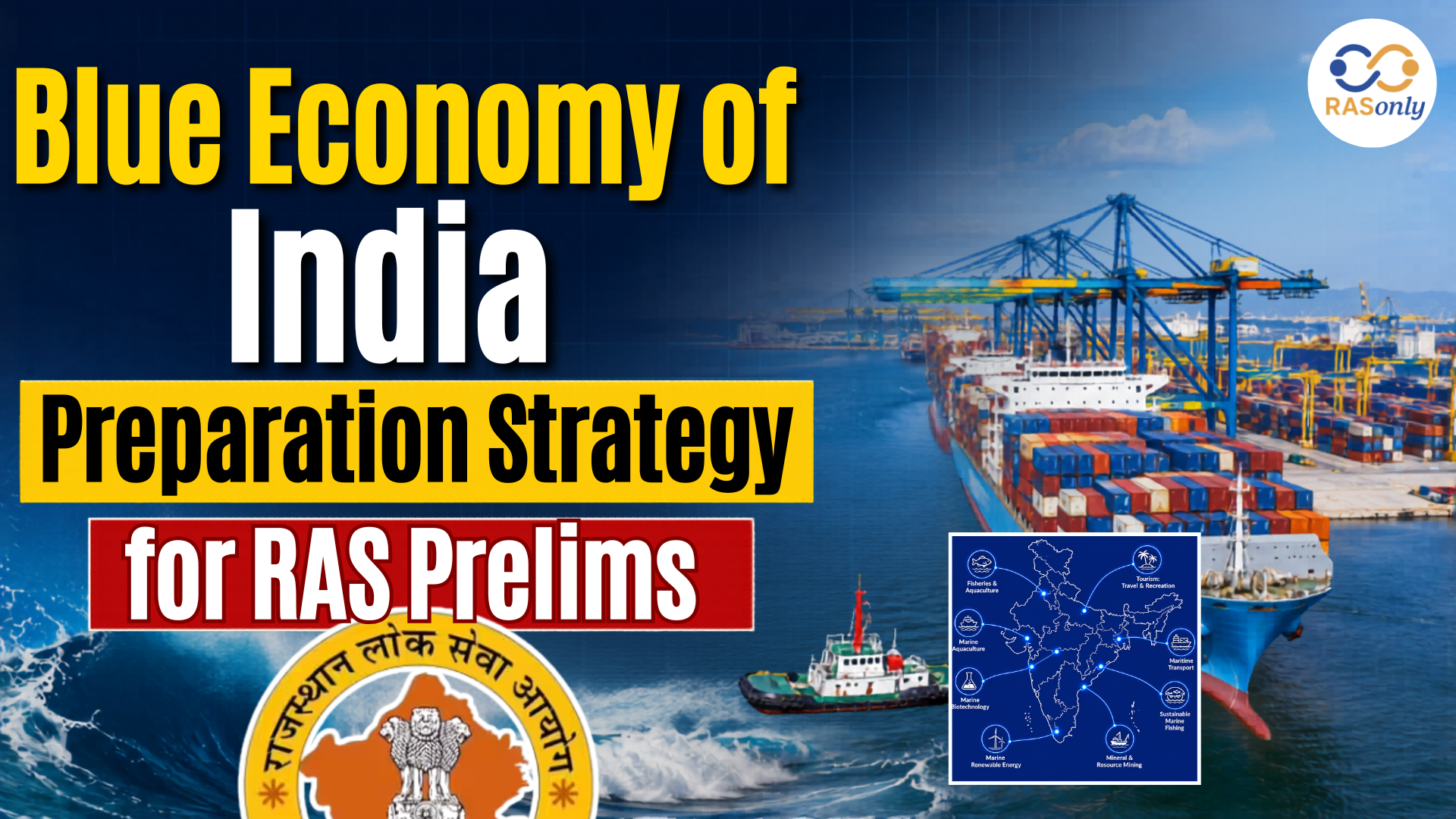
Blue Economy has become one of the most important emerging topics for RAS Prelims 2026 because questions are increasingly linked with marine resources, coastal economy, sustainable development, ports, fisheries, maritime security, renewable energy, climate change, and India’s strategic ocean policies. In recent years, Geography, Environment, Economy, International Relations, and Current Affairs have become highly interconnected in competitive exams, making Blue Economy a very high-potential topic for serious RAS aspirants.
India’s growing focus on the Sagarmala Project, Maritime India Vision 2030, Deep Ocean Mission, coastal infrastructure, renewable marine energy, and Indo-Pacific strategy has further increased the importance of the Blue Economy for competitive examinations. Questions are usually conceptual, map-based, statement-oriented, current-affairs-linked, and policy-based. A smart Blue Economy preparation strategy for RAS 2026 should focus on marine resources, coastal geography, maritime trade, ocean conservation, strategic importance, government initiatives, map practice, MCQs, and repeated revision instead of rote memorization only.
Why Blue Economy is Important for RAS 2026
Blue Economy is highly important because oceans and coastal regions play a major role in economic growth, international trade, fisheries, energy production, climate regulation, marine biodiversity, and national security. RAS frequently asks conceptual and current-affairs-based questions from marine resources, ocean economy, coastal infrastructure, and environmental sustainability.
Benefits of Strong Blue Economy Preparation
- Improves Geography & Environment Preparation
- Helps in Economy & International Relations topics
- Useful for current affairs linkage
- Strengthens coastal geography concepts
- Helpful in both Prelims and Mains
- Scoring with conceptual clarity and revision
Why is Blue Economy?
Blue Economy refers to the sustainable use of ocean resources for economic growth, improved livelihoods, employment generation, and marine ecosystem conservation. It aims to balance economic development with environmental sustainability.
The concept of Blue Economy promotes sustainable fisheries, renewable marine energy, coastal tourism, maritime transport, seabed resources, and ocean-based industries while protecting marine biodiversity and coastal ecosystems.
Major Components of Blue Economy
- Fisheries & aquaculture
- Ports & shipping
- Coastal tourism
- Offshore energy
- Marine biotechnology
- Seabed mining
- Ocean renewable energy
- Maritime trade
- Coastal infrastructure
- Marine ecosystem conservation
Blue Economy & India’s Strategic Importance
India has a coastline of more than 7,500 km and a vast Exclusive Economic Zone (EEZ), making Blue Economy strategically important for economic growth, maritime security, trade, and resource development.
Important Strategic Features
- Long coastline and island territories
- Major maritime trade routes
- Rich marine biodiversity
- Large fishing economy
- Indo-Pacific strategic location
- Important ports and shipping routes
Smart Strategy
- Learn coastal geography
- Revise India's maritime boundaries
- Focus on EEZ and Indo-Pacific linkage
- Practice map-based MCQs regularly
India's maritime location in the Indian Ocean makes the Blue Economy highly important for trade, defence, and strategic security.
Exclusive Economic Zone (EEZ) Strategy for RAS 2026
Exclusive Economic Zone is one of the most important concepts in Blue Economy because questions are frequently asked about maritime rights, ocean resources, and international maritime law.
Important Features
- Extends up to 200 nautical miles
- Coastal country gets resource rights
- Includes fishing and mineral rights
- Governed under UNCLOS
Smart Strategy
- Learn EEZ concept conceptually
- Link EEZ with marine resources
- Focus on UNCLOS provisions
- Practice statement-based MCQs
India possesses a vast EEZ in the Indian Ocean region that is important for fisheries, energy resources, and seabed minerals.
Fisheries & Aquaculture Strategy for RAS 2026
Fisheries are one of the most important components of India’s Blue Economy because they support employment, exports, food security, and coastal livelihoods.
Important Fisheries Topics
- Marine fisheries
- Inland fisheries
- Aquaculture
- Shrimp farming
- Sustainable fishing
- Deep-sea fishing
Important Fishing States
| State | Importance |
|---|---|
| Gujarat | Marine fisheries |
| Kerala | Coastal fishing |
| Tamil Nadu | Marine exports |
| Andhra Pradesh | Aquaculture |
| West Bengal | Inland fisheries |
Smart Strategy
- Learn fishing regions through maps
- Focus on sustainable fisheries
- Link fisheries with exports
- Practice fisheries-based MCQs
India is one of the world’s leading fish-producing countries, and fisheries contribute significantly to the coastal economy.
Sagarmala Project Strategy for RAS 2026
Sagarmala Project is one of the highest-weightage current-affairs-linked infrastructure topics in RAS preparation because it focuses on port-led development and coastal economic growth.
Important Objectives
- Port modernization
- Coastal infrastructure development
- Logistics efficiency
- Coastal economic zones
- Employment generation
Important Components
- Port connectivity
- Coastal industrialization
- Inland waterways
- Smart ports
Smart Strategy
- Focus on port-led development
- Revise coastal corridor concepts
- Link with logistics and trade
- Practice infrastructure-based MCQs
Sagarmala aims to reduce logistics costs and strengthen India’s maritime economy through integrated coastal development.
Maritime India Vision 2030 Strategy
Maritime India Vision 2030 is India’s long-term roadmap for port modernization, shipping expansion, maritime infrastructure, and Blue Economy development.
Important Areas
- Port modernization
- Green shipping
- Cruise tourism
- Shipbuilding
- Maritime logistics
- Digital ports
Smart Strategy
- Focus on maritime infrastructure
- Link with Blue Economy growth
- Revise current affairs repeatedly
- Practice policy-based MCQs
Deep Ocean Mission Strategy for RAS 2026
Deep Ocean Mission is one of the most important Science & Technology and Blue Economy topics because it focuses on deep-sea exploration and marine resource development.
Important Objectives
- Deep-sea mining
- Ocean biodiversity research
- Underwater technology
- Exploration of polymetallic nodules
- Climate and ocean studies
Smart Strategy
- Learn mission objectives carefully
- Link with strategic resources
- Focus on ocean technology
- Practice science-based MCQs
India’s Deep Ocean Mission is important for marine research, strategic minerals, and ocean resource exploration.
Blue Economy & Renewable Energy Linkage
Marine renewable energy is becoming increasingly important because oceans can support clean and sustainable energy generation.
Important Marine Energy Sources
- Offshore wind energy
- Tidal energy
- Wave energy
- Ocean thermal energy
Smart Strategy
- Link Blue Economy with clean energy
- Revise renewable energy concepts
- Focus on sustainability linkage
- Practice environment-based MCQs
Blue Economy & Climate Change Strategy
Climate change has become one of the biggest challenges for the Blue Economy because rising sea levels, cyclones, coastal erosion, ocean warming, and marine pollution are directly affecting fisheries, coastal livelihoods, marine biodiversity, and ocean ecosystems. RAS questions are increasingly linked with coastal vulnerability, marine sustainability, disaster management, and environmental conservation, making this topic highly important for Geography and Environment preparation.
Important Climate Issues
- Sea-level rise
- Coastal erosion
- Cyclones
- Coral bleaching
- Marine pollution
- Ocean warming
Smart Strategy
- Link oceans with climate change
- Revise coastal ecosystem concepts
- Practice environment-based MCQs
- Focus on sustainability and conservation
Marine Biodiversity & Coastal Ecosystems Strategy
Marine biodiversity and coastal ecosystems are extremely important because they help maintain ecological balance, support fisheries, regulate climate, protect coastlines, and preserve marine life. Questions in RAS are frequently asked from mangroves, coral reefs, estuaries, coastal wetlands, and marine conservation regions through map-based and statement-oriented MCQs.
Important Coastal Ecosystems
- Mangroves
- Coral reefs
- Estuaries
- Seagrass beds
- Coastal wetlands
Important Regions
| Ecosystem | Important Region |
|---|---|
| Mangroves | Sundarbans |
| Coral Reefs | Gulf of Mannar |
| Coral Reefs | Lakshadweep |
| Mangroves | Bhitarkanika |
Smart Strategy
- Revise marine ecosystems visually
- Practice coastal mapping
- Link biodiversity with climate change
- Practice statement-based MCQs
Blue Economy & International Relations Linkage
Blue Economy is strongly connected with Indo-Pacific geopolitics, maritime security, international trade, and global cooperation because oceans play a major role in economic growth and strategic security. RAS questions are increasingly linked with maritime diplomacy, the Indian Ocean Region, UNCLOS, sea trade routes, and strategic maritime partnerships.
Important Concepts
- Indo-Pacific strategy
- Maritime security
- Sea lanes of communication
- Indian Ocean Region
- UNCLOS
- Maritime diplomacy
Smart Strategy
- Link oceans with geopolitics
- Focus on the importance of the Indian Ocean
- Revise maritime trade routes
- Practice current-affairs-based MCQs
Rajasthan & Blue Economy Linkage
Although Rajasthan is a landlocked state, Blue Economy remains important for RAS because it connects with export logistics, industrial corridors, inland trade connectivity, renewable energy integration, and national economic development. Questions may be indirectly linked with infrastructure growth, dry ports, industrial connectivity, and trade networks.
Important Rajasthan Linkages
- Export logistics
- Industrial corridors
- Dry ports
- Inland trade connectivity
- Renewable energy integration
Important Organizations Related to Blue Economy
Various national and international organizations are involved in maritime development, fisheries management, ocean governance, marine security, and coastal protection. Understanding institutional roles helps aspirants connect Blue Economy with environmental governance, maritime policies, and coastal management.
| Organization | Role |
|---|---|
| Ministry of Ports, Shipping & Waterways | Maritime development |
| Indian Navy | Maritime security |
| Indian Coast Guard | Coastal protection |
| National Fisheries Development Board | Fisheries development |
| IMO | Maritime regulations |
| UNESCO-IOC | Ocean research |
Understanding these organizations improves conceptual clarity in maritime governance and environment-related MCQs.
Map Practice Strategy for Blue Economy
Map practice is one of the most important parts of Blue Economy preparation because many Geography and Environment questions are directly map-based and location-oriented. Visual revision improves retention of ports, coastal ecosystems, EEZ regions, marine biodiversity areas, and maritime trade routes.
Important Areas to Practice
- Major ports of India
- Coastal states
- EEZ regions
- Coral reef regions
- Mangrove regions
- Indian Ocean trade routes
Smart Map Practice Tips
- Practice blank India maps regularly
- Mark ports and coastal regions repeatedly
- Revise marine ecosystem mapping visually
- Link ports with trade corridors
Blue Economy MCQ Practice Strategy
MCQ practice is extremely important because Blue Economy questions are conceptual, current-affairs-linked, statement-oriented, and map-based. Regular MCQ solving improves conceptual understanding, revision efficiency, and exam accuracy significantly for RAS Prelims 2026.
Important Focus Areas
- Blue Economy concepts
- Sagarmala Project
- Deep Ocean Mission
- EEZ
- Marine biodiversity
- Maritime security
- Fisheries & coastal economy
Smart MCQ Strategy
- Solve topic-wise MCQs daily
- Practice current-affairs-based questions
- Analyze wrong answers carefully
- Revise map-based concepts repeatedly
Most Important Blue Economy Topics for RAS 2026
Blue Economy has become one of the most important emerging topics because it connects Geography, Economy, Environment, Science & Technology, and International Relations together. Aspirants should focus more on marine resources, coastal infrastructure, maritime security, fisheries economy, and government initiatives for better scoring potential in RAS 2026.
High-Weightage Topics
- Blue Economy concept
- Sagarmala Project
- Deep Ocean Mission
- EEZ
- Marine biodiversity
- Fisheries economy
- Indo-Pacific strategy
- Maritime India Vision 2030
Topic Priority Table
| Topic | Importance Level |
|---|---|
| Blue Economy Concept | Very High |
| Sagarmala Project | Very High |
| EEZ | High |
| Deep Ocean Mission | High |
| Marine Biodiversity | High |
Revision Strategy for Blue Economy
Revision is extremely important because maritime concepts, coastal regions, marine ecosystems, and government initiatives are easy to confuse during the exam. Repeated revision through maps, comparison tables, and MCQs improves retention and conceptual clarity significantly.
Smart Revision Tips
- Revise coastal maps weekly
- Practice comparison tables regularly
- Revise current affairs repeatedly
- Focus on the marine ecosystem linkage
- Practice statement-based MCQs
Best Revision Cycle
| Revision Stage | Focus Area |
|---|---|
| First Revision | Concepts & policies |
| Second Revision | Maps & ecosystems |
| Final Revision | MCQs & quick notes |
How Toppers Prepare Blue Economy for RAS
Most toppers prepare Blue Economy through maps, conceptual clarity, current affairs integration, marine ecosystem linkage, and repeated MCQ practice instead of rote memorization.
Toppers’ Strategy
- Practice coastal mapping consistently
- Revise current affairs repeatedly
- Focus on conceptual understanding
- Solve statement-based MCQs
- Prepare short revision notes
What Makes Toppers Different?
- Better map retention
- Strong current affairs linkage
- Smart MCQ analysis
- Better conceptual understanding
- Consistent revision habits
India’s increasing focus on maritime trade, coastal infrastructure, strategic ocean resources, renewable marine energy, fisheries development, and Indo-Pacific security makes Blue Economy one of the most important emerging topics for RAS 2026 preparation. Aspirants should prepare this topic through conceptual clarity, maps, current affairs integration, comparison tables, and repeated MCQ practice to maximize scoring potential in Geography, Environment, Economy, and International Relations sections.
Conclusion
Blue Economy is becoming increasingly important for India because oceans and coastal resources play a major role in economic growth, trade, renewable energy, fisheries, maritime security, and environmental sustainability. Government initiatives such as Sagarmala Project, Maritime India Vision 2030, Deep Ocean Mission, and coastal infrastructure development have made this topic highly relevant for RAS Prelims 2026.
Aspirants should prepare Blue Economy through conceptual understanding, coastal mapping, marine ecosystem linkage, current affairs integration, and repeated MCQ practice instead of rote memorization. Strong preparation of EEZ, fisheries, marine biodiversity, maritime security, and strategic ocean policies can significantly improve scoring potential in Geography, Environment, Economy, and International Relations sections of RAS.
FAQ
Blue Economy refers to the sustainable use of ocean and marine resources for economic growth, employment generation, and environmental conservation while protecting marine ecosystems.
Blue Economy is important because RAS questions are increasingly linked with marine resources, EEZ, fisheries, Sagarmala Project, climate change, maritime security, and coastal ecosystem conservation.
Important topics include EEZ, Sagarmala Project, Deep Ocean Mission, fisheries, marine biodiversity, maritime security, Indo-Pacific strategy, and Maritime India Vision 2030.
India’s EEZ extends up to 200 nautical miles from its coastline, where India has rights over marine resources, fisheries, seabed minerals, and ocean-based economic activities.
Aspirants should focus on conceptual clarity, coastal mapping, current affairs, marine ecosystem linkage, comparison tables, and repeated MCQ practice for effective Blue Economy preparation.
BEST SELLER
🏆 PRELIMS
RAS Pass
Prelims focused Hindi & English
₹399
✓
Prelims Topic-Wise Tests
✓
Subject-Wise Tests
✓
Full-Length Prelims Tests
✓
Daily Current Affairs Tests
✓
Prelims PYQs Tests
✓
Detailed Solutions & Analysis
✓
All Rajasthan Ranking
✓
Unlimited Reattempts
✓
Mains Tests
✓
Hindi & English Tests
✓
All Rajasthan Ranking
Trusted by 5,000+ Students
Post Category
- RAS Salary
- Result
- RAS Admit Card
- RAS Job
- RAS Cutoff
- Preparation Tips
- RAS Answer Key
- RAS Exam Analysis
- RAS Syllabus
- RAS Previous Year Papers
- RPSC RAS Exam Pattern
- RAS Interview
- RAS Exam Date
- RAS Vacancy
- RAS Test Series
- RAS Best Books
- RAS Preparation Resources
- RAS Coaching Centre
- History
- Polity
- Geography
- Economics
- Science
- Art and Culture
- RPSC RAS Application Form
- RPSC RAS Notification
- RAS Eligibility Criteria
- UPSC Exam
- RPSC RAS Mains
Visit Our RASonly Offline Center
Our Expert Faculty

Bhunesh Sir
Current Affairs · 13+ Yrs

Aamir Khan Sir
RAS-2017 · IIM Ahm.

Akash Sir
Polity · 8+ Yrs
Free Resources
Official Mobile App

RASOnly App
by OTSAdda · Free
Full Video Lectures
Mock Tests & PYQs
Daily Current Affairs
AI Mock Interview
Free Download · No subscription needed to install
RAS 2024 Toppers — RASonly
Rank 2
Virendra Charan
Rank 9
Bhoopinder Singh
Rank 26
Aanchal Nagpal
Rank 33
Lokendra Singh
Rank 45
Amar Rathore
Rank 46
Manasvini Verma

Join RASonly WhatsApp Community
Get daily current affairs, exam alerts, free study material and tips from expert faculty — right on WhatsApp.
Join for Free →RASonly Interview Guidance Program

Mr. Ashok Jain
Ex-Chief Secretary Govt of Rajasthan
- IAS officer of the 1981 batch, Rajasthan cadre.
- Passionate about mentoring the next generation of RAS officers with real-world insights.
- Got retired in Dec 2017 from the post of Chief Secretary of the state of Rajasthan.

Mr. Guru Charan Rai
Ex-ASP / SP in Jaisalmer
- Guru Charan Rai, IPS (Retd), retired as Inspector General of Police (Security), Rajasthan, Jaipur in 2017.
- Served as ASP and SP in Jaisalmer, Nagaur, Sri Ganganagar, Sawai Madhopur, Dausa, Sikar, and Karauli.
- He also held key positions as DIGP and IGP in the Law and Order division.

Mr. Rakesh Verma
Ex-IAS Officer, B.Tech, MBA, and M.A. (Economics)
- IAS officer of the 1981 batch and retired in Chief Secretary Rank.
- Civil servant of high repute and vast experience.
- Has been teaching UPSC CSE subjects for the last six years.
Related Post



Daily Current Affairs for RAS Exam Preparation 2026

Financial Approval Granted for the Development of Religious Sites
October 05, 2026
IIT Madras Signs MoU for Joint Educational Programmes
October 05, 2026
Niharika Rathore Wins MIS Global India Title
October 03, 2026