Vedic Age in India: History, Society, Economy, Religion & Culture
Can Average Students Crack RAS

Get in Touch with RASonly!

Can Average Students Crack RAS? Yes, absolutely. Success in the RAS exam depends more on consistency, smart planning, and regular revision than exceptional academic performance. With the right study strategy, dedication, and focused preparation, even average students can achieve their dream of becoming RAS officers.

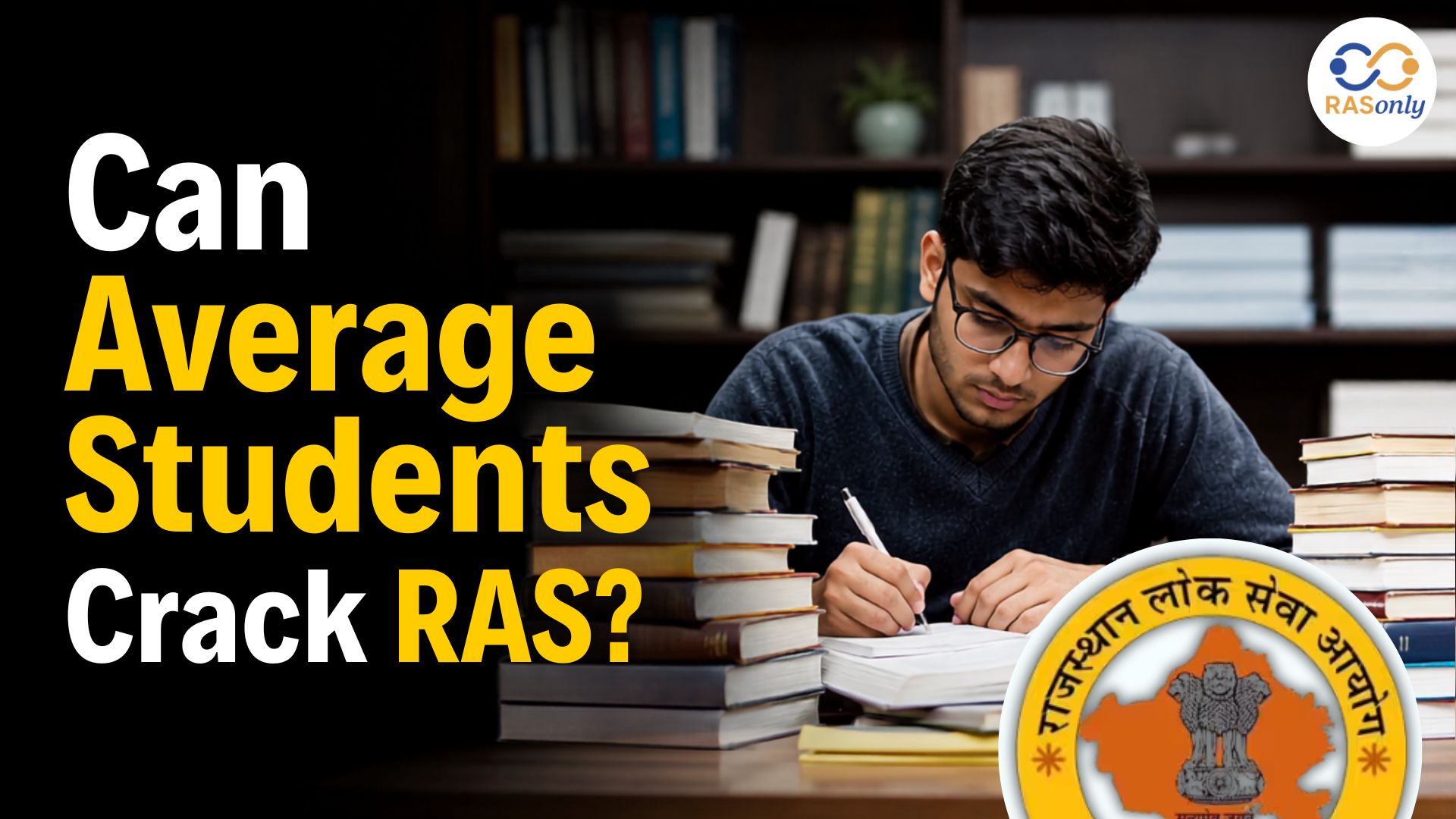
If you have ever typed can average students crack RAS exam into Google, you are not alone. Many people wonder about themselves every year whether they can become a RAS officer. The answer is: Yes, definitely! The RAS exam is not related to IQ or college percentage, but it is about your preparation, strategy and consistency. This Guide describes how an average student with the proper approach can crack RPSC RAS and how it can pave the way for a career in the administrative services of Rajasthan. From RAS Preparation to RAS Exam Study Plan 1 Year, everything is covered here.
What Is the RAS Exam? — RPSC RAS Overview
The RPSC RAS — Rajasthan Administrative Service — is a state-level Civil Services Examination organised by the Rajasthan Public Service Commission (RPSC). It is responsible for recruiting candidates for the Group A and Group B administrative positions in the Rajasthan government. Eligibility for the RAS exam is a graduate degree from any recognised university. There are three stages to the selection process: Preliminary (Prelims), Main Examination (Mains) and Personality Test (Interview). The first and foremost step in the smart preparation journey is to understand the RAS syllabus and the RPSC RAS exam pattern.
| Stage | Type | Subjects | Marks | Counts In Merit? |
|---|---|---|---|---|
| Prelims | Objective (MCQ) | General Knowledge & General Science | 200 | No (Qualifying Only) |
| Mains | Descriptive | 4 Papers – GS I, GS II, GS III, Hindi & English | 800 | Yes |
| Interview | Personality Test | Communication Skills, General Knowledge, Rajasthan Culture | 100 | Yes |
Can Average Students Crack RAS — The Truth
The RPSC RAS exam is taken by almost 6 to 8 lakhs candidates annually for 700–900 job positions. So that selection ratio sounds frightening, but that's not the case: Most of the top students were not necessarily academic superstars. The RAS exam does not pay for a student to write structured answers, revise well, and cover the RAS syllabus systematically, but rather for those who get top marks at the university. Students from rural Rajasthan, Hindi medium students and even from small towns have overcome the hurdles with flying colours and have successfully cleared the RAS exam to the best of their abilities with an average academic background.
- The selection for RAS is not based on your college's percentage; it is based solely on your exam performance!
- Students studying in Hindi medium outperform other students in all the competitive exams, including RAS Mains, every time.
- There are many villages and small towns in Rajasthan that have produced many RAS toppers.
- 2-3 attempts are absolutely fine — persistence is more important than talent.
- Having a clear strategy for preparing the RAS and self-belief is what makes a difference!
How to Crack RAS Without Coaching — Self-Study Roadmap
One of the most common fallacies is that coaching is required. The question of how to crack RAS without coaching is searched by thousands of people every month, and what is obvious is that it is absolutely possible. New times have made the learning process free, with free YouTube lectures, Telegram notes, and test series at a low cost. While preparation strategy self-study for RAS requires discipline and careful planning of the day, it is a cost-effective and time-saving process. Many candidates who have passed the RAS selection test without coaching attribute it to their daily self-study of 6–8 hours for a period of 12–18 months.
- Before doing anything else, download the latest Ras syllabus from RPSC's official website.
- Use L.R. Bhalla's Rajasthan Adhyan as a main textbook for Rajasthan GK.
- Read the state-level current affairs daily in Rajasthan Patrika or Dainik Bhaskar
- RAS preparation with free Telegram groups – notes and daily MCQs are shared regularly
- Try at least one practice paper every week and critically review your errors.
- Daily practice of RAS Mains answer writing (Write daily at least one answer every evening)
RAS Exam Preparation for Beginners — Step-by-Step Plan
The first step in preparing for the RAS exam for beginners is to grasp the broad perspective before getting into books. The beginning student frequently reads sporadically without a plan; this takes months. Instead, it's a better idea to study the RPSC RAS exam pattern, find out which topics have more weightage in the RPSC RAS syllabus and then make a list of topics for the month. Below is a successful 12-month plan that can be carried out by an average student.
| Month | Focus Area | Weekly Target |
|---|---|---|
| 1–2 | Syllabus Analysis + NCERT Basics | Complete NCERT Class 6–12 (History, Geography, Science, Polity) |
| 3–5 | Rajasthan GK – History, Art & Culture, Geography | Make one-page notes for each topic and revise every Sunday |
| 6–8 | Indian Polity, Economy & Science & Technology | Complete standard reference books and begin Previous Year Question Paper practice |
| 9–10 | Mock Tests & Mains Answer Writing | Attempt 1 full mock test daily and write 2 Mains answers every day |
| 11–12 | Revision & Current Affairs (Last 12 Months) | Revise all notes 3 times and solve the last 5 years' question papers completely |
RAS Exam Success Tips for Average Students
The best tips for passing the RAS exam are not really secrets; they are things that everyone who passes the exam does. The RAS journey is long and tough, but if the students can make a daily commitment to prepare, they will reap the rewards in the future. Emphasise quality over quantity, revision over new reading, and writing practice rather than passively studying. Here are some of the effective success habits which have been found in successful students of the RAS (Toppers) who have prepared themselves according to the RAS preparation guides.
- Read the syllabus, not random material — only topics covered in the RAS syllabus will be in the exam.
- Stick to the 3-Revision Rule: revise each topic at least three times prior to the exam.
- Rajasthan – Rajasthan GK, Rajasthan history, Art, Culture and geography are given more marks in both Prelims and Mains.
- Answer writing is a must for RAS Mains — structure and presentation are valued rather than knowledge, as each day counts.
- Take timing for each mock test — the time constraint is huge, RAS Prelims is 150 questions in 3 hours — so speed is critical
- Read the success story of RAS toppers as they provide a sense of encouragement that it is possible to become a topper in the RAS with the right mindset.
- Don't become a coach-dependent person — Prepare using self-study to gain deep understanding and retention.
RAS Preparation Strategy Self-Study — Subject-Wise Breakdown
The key of a winning RAS preparation strategy is subject-wise prioritisation. The weight of each of the subjects in the RAS syllabus is different, and they approach each differently. A common error which is made by students is spending equal time on all the subjects; that is, high-weightage subjects like Rajasthan GK, Indian Polity, and Economy require more time and revision. The ideal subject-wise plan for preparing for the RAS exam is given below.
| Subject | Key Topics | Best Books | Daily Time |
|---|---|---|---|
| Rajasthan GK | History, Art & Culture, Geography, Economy, Polity | L.R. Bhalla, RPSC Notes | 2 Hours |
| Indian History | Ancient, Medieval & Modern India | NCERT Class 6–12, Spectrum Modern History | 1 Hour |
| Geography | Physical, Indian & World Geography | NCERT, G.C. Leong, Atlas | 45 Minutes |
| Indian Polity | Constitution, Governance, Fundamental Rights, Amendments | M. Laxmikanth | 45 Minutes |
| Economy | Indian Economy, Budget, Government Schemes | Ramesh Singh, Economic Survey | 45 Minutes |
| Science & Technology | General Science, Space, IT, Environment | NCERT Class 6–10, Lucent GK | 30 Minutes |
| Current Affairs | National, State & International News | Rajasthan Patrika, Vision IAS Monthly Magazine | 45 Minutes |
How Many Attempts to Clear the RAS Exam?
One of the most frequently asked questions by first-time aspirants is the number of attempts to clear the RAS exam. The good news is that RPSC hasn't fixed any number for the number of attempts in RAS. Re-takes are permitted, but subject to the age requirement. In the case of the General category, the maximum age is 40 years, while there is relaxation as per the Rajasthan government norms in the case of reserved categories. In most cases, the candidates take 2-3 attempts to clear the RPSC RAS. Take your first throw as a complete diagnostic, and go back to areas of weakness with greater strength.
- No fixed number of attempts required to be eligible for the RAS exam; eligibility is determined by age only
- Gender: No restriction on gender. The age for the General category is 18 - 40 years as on the date of applying for the job.
- Candidates belonging to the SC/ST/OBC/Women category are eligible for age relaxation as per the Government Norms in the State.
- Proof will be required before the main, final year graduation. Students may apply.
- Try 2–3 times to crack RAS — it is not necessary to crack it on the first attempt, it is a bonus
RAS Exam Study Plan 1 Year — Weekly Schedule
Any student can prepare for a realistic RAS exam study plan in 1 year. Targeting the entire RAS syllabus in 12 months will take 7-8 hours of concentrated study per day, a weekly study schedule and strict revision on Sundays. The schedule given below has been prepared considering the workload of an average student who might be preparing for RAS along with other responsibilities.
| Day | Morning Session (3–4 hrs) | Evening Session (2–3 hrs) | Night Session (1 hr) |
|---|---|---|---|
| Mon–Tue | Rajasthan History / Culture / GK | Current Affairs + Newspaper Reading | Short Notes Revision |
| Wed–Thu | Indian Polity + Economy | Mains Answer Writing Practice | MCQ Drill (50 Questions) |
| Fri–Sat | Geography + Science & Technology | Previous Year Paper Solving | Topic-wise Short Notes |
| Sunday | Full Mock Test (3 hrs) | Mock Test Analysis + Weak Area Targeting | Complete Weekly Revision |
RAS Selection Without Coaching — Free Resources
RAS selection without coaching is no longer an exception — it's the rule. With the advent of digital resources, the aspirants of Jaipur, Jodhpur, Barmer and even from the smallest villages can prepare at zero or minimal cost with quality RAS preparation material. It's all about knowing where to get the information you can trust and how you can use it regularly. Here are the best free and low-cost resources that have been used to select students to the RAS without coaching in recent years.
- YouTube: Free lectures for the entire RAS syllabus are available on a number of channels, such as RPSC Rajasthan, Raj GK and Drishti IAS Hindi.
- Telegram Groups: Active RAS preparation communities share daily current affairs, notes and MCQ sets for free.
- RPSC RAS Online Test Series: Testbook, Gradeup, and Drishti IAS provide affordable RPSC RAS Mock Test with detailed analysis.
- Download RPSC Official Website - previous year papers, RPSC Notification & RAS Syllabus.
- Google Drive: Most of the RAS toppers publish their handwritten notes online — go to Google search and type in ‘RAS Topper Notes PDF'
- Newspaper Reading: Rajasthan Patrika is the best newspaper for State Current Affairs and Rajasthan GK.
Is the RAS Exam Difficult for Average Students?
Is the RAS exam difficult for average students? Truthfully, it's a fierce competition. The number of applicants, 6–8 lakh and the limited number of seats, 900, seem to be a bad mix. However, it is not impossible; it is difficult. The true difficulty is not the content of the RAS syllabus; it's staying consistent for 12-18 months for a year, while everyone else is dropping the ball. Students who approach each revision session with seriousness, those who answer the RAS Mains daily, and those who don't miss out on analysing mock tests are the ones who make it, irrespective of their style of learning.
| Common Myths About RAS | The Real Facts |
|---|---|
| Only toppers and city students crack RAS | Rural and average background students clear it every year |
| Coaching is mandatory to crack the RPSC RAS | Self-study with the right resources is fully sufficient |
| English medium gives a big advantage | Hindi medium students dominate the RAS topper lists |
| You must clear RAS in the first attempt | 2–3 attempts are normal; there is no attempt limit |
| RAS preparation needs 3+ years minimum | 1 focused year is enough with the right study plan |
RAS Officer Salary, Powers & Career Growth
The primary reason for preparing for the RAS is the career that comes after selection. The officer of RAS can be appointed at the Sub-Divisional Magistrate (SDM) or equivalent level and can be promoted to the positions of District Collector, Divisional Commissioner and even Secretary level in the Rajasthan Government. The basic salary at the starting level of 7th Pay Commission is Rs. 56,100 per month (Pay Level 10) along with various allowances such as DA, HRA and TA. In addition to earning more, the position also comes with a lot of administrative power, public esteem and long-term job security, which makes it a very worthwhile investment to prepare for the RAS exam.
| Category | Details |
|---|---|
| Starting Salary (Basic Pay) | ₹56,100 (Pay Level 10, 7th Pay Commission) |
| In-Hand Salary | ₹80,000 – ₹90,000 per month (after DA, HRA, NPS, and tax deductions) |
| Gross Salary | ~₹1,00,000 – ₹1,06,000 per month |
| Allowances | DA (~50%), HRA (8%–24%), TA, Medical, Government Accommodation |
| Postings (Early Career) | SDM (Sub-Divisional Magistrate), Assistant Collector |
| Key Powers | Law & Order Control, Revenue Administration, Implementation of Government Schemes, Disaster Management |
| Administrative Role | Works as a District-Level Executive Authority under the State Government |
| Promotions (Career Growth) | SDM → ADM → District Collector → Divisional Commissioner → Secretary-Level Posts |
| Time for Senior Posts | ~15–25 Years, Depending on Performance & Vacancies |
| Final Career Rank | Principal Secretary / Secretary (State Government) |
| Retirement Age | 60 Years |
| Career Stability | Very High (Permanent State Civil Service) |
| Prestige & Influence | High Respect at District and State Levels; Key Decision-Maker in Administration |
RAS Prelims vs Mains — What to Focus On
Understanding the difference between RAS Prelims and RAS Mains is critical for RAS exam preparation for beginners. RAS Prelims is an objective paper of 200 marks for the breadth of knowledge, and is a qualifying paper, the marks of which will not be used in the final merit list. RAS Mains is, however, four descriptive papers (800 marks) and that is where the real competition takes place. Underachievers generally tend to take Mains lightly; they read well, but don't write well. This is the most important failure reason of candidates, even if they know the content.
- RAS Prelims: 150 MCQs, 200 marks, 3 hours — emphasis is on speed and accuracy over the entire syllabus
- RAS Mains Paper I: History, Art & Culture, Rajasthan Economy (analytical writing required)
- To download the application-based Answer of the RAS Mains Paper II: Indian Polity, Governance, General Management, click on the link provided below.
- RAS Mains Paper III: General Science, Technology, Reasoning, Current Affairs
- Part IV: General Hindi & General English (Language and Essay Writing) for RAS Mains Exam
- RAS Interview (100 marks): Personality test, Communication skills, Knowledge about Rajasthan culture and current affairs
Conclusion
Yes: average students can crack the RAS exam — backed by evidence. The RAS exam is not a test of your outstanding intellect; it's a test of the quality of your preparation. You can either be a fresher starting your preparation or have already appeared in the RAS exam once; either way, your journey ahead of preparation is the same: Understand the syllabus of the RAS exam thoroughly, prepare for 1 Year according to a planned study schedule, practise answer writing for the RAS mains daily, and remain consistent for 12-18 Months.
FAQ
Yes, average students can easily crack RAS by applying a suitable strategy, regular studies and revision. The exam is not based on IQ, but it is based on preparation and answer-writing skills.
No, it is not a requirement to coach. The candidates clear RAS through self-study with NCERT books, standard reference books, newspapers, and video lectures on YouTube, test series and material online.
As a rule, one concentrated year of 6-8 hours of study a day is sufficient if the syllabus is methodically studied and is regularly revised and tested (mock Tests).
There is no fixed limit. Most aspirants clear RAS in 2–3 attempts, depending on their preparation level and consistency.
It's a competitive, but not impossible, qualification. The problem is not with the syllabus, but by being consistent and practising how to answer the questions.
BEST SELLER
🏆 PRELIMS
RAS Pass
Prelims focused Hindi & English
₹399
✓
Prelims Topic-Wise Tests
✓
Subject-Wise Tests
✓
Full-Length Prelims Tests
✓
Daily Current Affairs Tests
✓
Prelims PYQs Tests
✓
Detailed Solutions & Analysis
✓
All Rajasthan Ranking
✓
Unlimited Reattempts
✓
Mains Tests
✓
Hindi & English Tests
✓
All Rajasthan Ranking
Trusted by 5,000+ Students
Post Category
- RAS Salary
- Result
- RAS Admit Card
- RAS Job
- RAS Cutoff
- Preparation Tips
- RAS Answer Key
- RAS Exam Analysis
- RAS Syllabus
- RAS Previous Year Papers
- RPSC RAS Exam Pattern
- RAS Interview
- RAS Exam Date
- RAS Vacancy
- RAS Test Series
- RAS Best Books
- RAS Preparation Resources
- RAS Coaching Centre
- History
- Polity
- Geography
- Economics
- Science
- Art and Culture
- RPSC RAS Application Form
- RPSC RAS Notification
- RAS Eligibility Criteria
- UPSC Exam
- RPSC RAS Mains
Visit Our RASonly Offline Center
Our Expert Faculty

Bhunesh Sir
Current Affairs · 13+ Yrs

Aamir Khan Sir
RAS-2017 · IIM Ahm.

Akash Sir
Polity · 8+ Yrs
Free Resources
Official Mobile App

RASOnly App
by OTSAdda · Free
Full Video Lectures
Mock Tests & PYQs
Daily Current Affairs
AI Mock Interview
Free Download · No subscription needed to install
RAS 2024 Toppers — RASonly
Rank 2
Virendra Charan
Rank 9
Bhoopinder Singh
Rank 26
Aanchal Nagpal
Rank 33
Lokendra Singh
Rank 45
Amar Rathore
Rank 46
Manasvini Verma

Join RASonly WhatsApp Community
Get daily current affairs, exam alerts, free study material and tips from expert faculty — right on WhatsApp.
Join for Free →RASonly Interview Guidance Program

Mr. Ashok Jain
Ex-Chief Secretary Govt of Rajasthan
- IAS officer of the 1981 batch, Rajasthan cadre.
- Passionate about mentoring the next generation of RAS officers with real-world insights.
- Got retired in Dec 2017 from the post of Chief Secretary of the state of Rajasthan.

Mr. Guru Charan Rai
Ex-ASP / SP in Jaisalmer
- Guru Charan Rai, IPS (Retd), retired as Inspector General of Police (Security), Rajasthan, Jaipur in 2017.
- Served as ASP and SP in Jaisalmer, Nagaur, Sri Ganganagar, Sawai Madhopur, Dausa, Sikar, and Karauli.
- He also held key positions as DIGP and IGP in the Law and Order division.

Mr. Rakesh Verma
Ex-IAS Officer, B.Tech, MBA, and M.A. (Economics)
- IAS officer of the 1981 batch and retired in Chief Secretary Rank.
- Civil servant of high repute and vast experience.
- Has been teaching UPSC CSE subjects for the last six years.


Daily Current Affairs for RAS Exam Preparation 2026

India-US Yudh Abhyas 2026
September 17, 2026
Western Region Official Language Conference 2026
September 17, 2026
Rajasthan Ranks First in Mission Karmayogi
September 16, 2026