Chalukya Dynasty: Origin, Rulers, Three Branches and Architecture
Chalukya Dynasty: Origin, Rulers, Three Branches and Architecture

Get in Touch with RASonly!

The Chalukya Dynasty was a major power in medieval Deccan India, known for its three branches: Badami, Eastern and Western Chalukyas. Learn about important Chalukya rulers such as Pulakeshin II, Vikramaditya I and Vikramaditya VI, along with Chalukya administration, religion, literature, conflicts and remarkable Chalukya architecture at Badami, Aihole and Pattadakal.

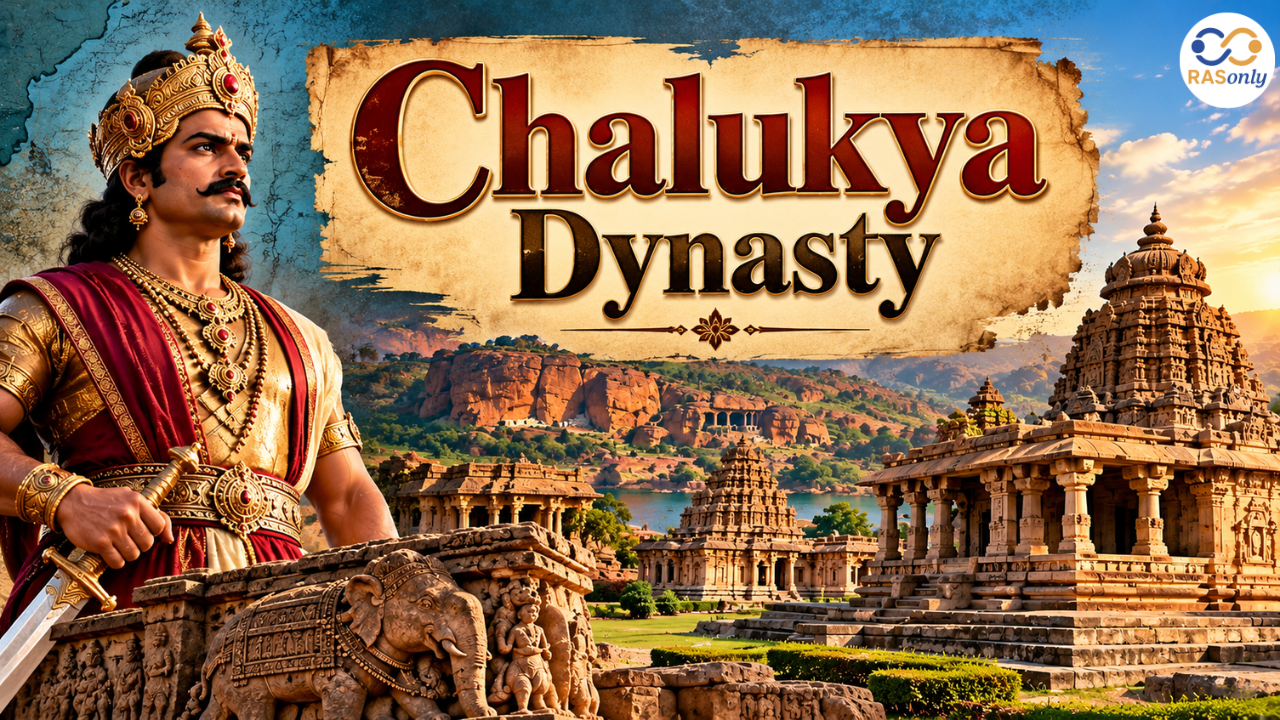
The Chalukyas were among the most important dynasties of the Deccan in early medieval India. At various times, they ruled over different portions of the lands currently known as Karnataka, Maharashtra, Andhra Pradesh and Telangana, respectively. The Chalukyas were actually divided into three dynasties that had different areas of dominion: the Badami Chalukyas, Eastern Chalukyas and Western Chalukyas. They fought with the Pallavas, Rashtrakutas and Cholas. They also had a long-lasting impact on religion by constructing temples, writing texts and copper-plate inscriptions and forming religious institutions. Badami, Aihole and Pattadakal are monuments that give some of the best evidence on architectural achievements.
How Did the Chalukyas Rise in the Deccan?
- The Chalukyas of Badami became a major regional power in the Deccan by the close of the 6th century CE. Vatapi, or present-day Badami in Karnataka, was their original political hub.
- The location of Badami was strategically useful because of its rocky terrain and access to important routes across the Deccan. From this base, the early Chalukya rulers expanded their authority over neighbouring territories.
- In particular, the rule of Pulakeshin II saw the Badami Chalukyas clash directly with large powers such as Harsha and the Pallavas.
- Gradually, its branches separated in various regions, coming to form three main political traditions of the Chalukyas.
Three Branches of the Chalukyas
Chalukya Dynasty is an umbrella term that describes three main royal lineages that arose during different periods of time and reigned over various regions.
Badami Chalukyas
- Badami dynasty was the most ancient of all major Chalukya dynasties. They dominated roughly between the 6th and 8th centuries AD.
- Capital: Vatapi (Badami)
- In the Deccan, they built a powerful kingdom and reached their maximum political power in the era of Pulakeshin II.
Eastern Chalukyas
- The Eastern Chalukyas appeared in the Vengi region from the 7th century.
- This dynasty traces its roots to Kubja Vishnuvardhana, an elder brother of Pulakeshin II. Later, the Eastern Chalukyas had close ties, both political and familial, with the Cholas.
- Their rule was significant for the political and cultural history of Andhra Pradesh.
Western Chalukyas
- The Western Chalukyas (or Kalyani Chalukyas) rose to power in the late 10th century.
- Founder: Tailapa II
- Important centres: Manyakheta and Kalyani
- After the fall of Rashtrakuta rule, this branch re-established Chalukya power in the Deccan and controlled it as a significant regional power till the 12th century.
Badami Chalukya Rulers
Rulers of the Badami Chalukyas grew this kingdom over a number of generations in warfare that spanned the subcontinent, competing with rival powers as well as promoting architecture and culture.
Pulakeshin I
- Reign: c. 543–566 CE
- They consider Pulakeshin I as the founder of an independent Badami Chalukya kingdom.
Important facts:
- He founded Vatapi (Badami) as the capital of Chalukya power.
- He consolidated the dynasty's hold on the Deccan.
- He is connected with the conduct of the Ashvamedha sacrifice.
- He laid the political framework for subsequent Chalukya expansion.
- By now, he had built up a kingdom which his successors would obviously keep enriching through military ventures.
Kirtivarman I
- Reign: c. 566–597 CE
- His son Kirtivarman I expanded the kingdom beyond the original territory.
Important facts:
- In this fight, he opposed the Banavasi Kadambas.
- He also carried the Chalukya sway into the Western Deccan.
- His campaigns also kept the Mauryas of Konkan on their toes.
- He made the political position of the Chalukyas before his brother Mangalesha succeeded him.
- His military expeditions assisted the rise of the Chalukyas as a great power in the Deccan.
Mangalesha
- Reign: c. 597–609 CE
- Mangalesha was the brother of Kirtivarman I and ruled as an agent for Kirtivarman's minor son Pulakeshin II.
Important facts:
- He further pursued the expansionist policy of his dynasty.
- He campaigned against the Kalachuris.
- He expanded the reach of the Chalukyas in the Northern Deccan.
- Later, a quarrel arose between Mangalesha and Pulakeshin II over the throne.
- This conflict ended with Mangalesha's ultimate defeat and death.
- Pulakeshin II then ruled the kingdom.
Pulakeshin II
- Reign: c. 610–642 CE
- A significant ruler of the Badami Chalukyas was Pulakeshin II. This would mark the apogee of their political power.
Important facts:
- He then used his resources to overcome Mangalesha and inherit the crown.
- Through conquest, he greatly increased Chalukya power in many parts of the Deccan.
- He successfully defeated Harsha's attempts at southward expansion near the Narmada.
- Subscriptions to The Economic Times.
- It was written by his court poet, Ravikirti.
- He conquered or subjected most of the southern powers to Chalukya suzerainty.
- He pushed Chalukya control toward Vengi.
- His brother Kubja Vishnuvardhana was assigned responsibility for Vengi.
- He waged a great battle against the Pallavas of Kanchipuram.
- The Pallava king Narasimhavarman I defeated him and conquered Vatapi.
- His rule is known for diplomatic interaction with Persian king Khosrow II.
- It is during this period that the Chinese traveller Xuanzang came to the Deccan.
Thus, Pulakeshin II matters not merely when we come to the expansion of the Chalukyas, but is also key to grasping what happened in the balance of power between north and south India in the 7th century.
Vikramaditya I
- Reign: c. 655–681 CE
- Pulakeshin II, Vikramaditya, to one of his sons. After the defeat of his father, he reconstructed Chalukya power.
Important facts:
- He recovered the city of Vatapi from the Pallavas.
- He restored the lost power of the Badami Chalukyas.
- He carried on the fight against the Pallavas.
- His campaigns succeeded in regaining lost territory from the earlier political crisis.
- His rule was an important period in the revival of the Chalukyas.
Vinayaditya
- Reign: c. 681–696 CE
- Vinayaditya followed Vikramaditya I, reigning during a relatively calmer time.
Important facts:
- He successfully kept Chalukya political power in the Deccan.
- His measure was continuing to centralise the kingdom.
- The achievements of Vikramaditya I were in part maintained during his rule.
- During this time, religious institutions and activity at the temples continued.
Vijayaditya
- Reign: c. 696–733 CE
- The period of Vijayaditya I was a long and comparatively stable period in the history of the Badami Chalukyas.
Important facts:
- He continued to hold the kingdom together territorially
- His long reign offered a sense of political stability.
- Temple construction received considerable attention.
- During this period, the Chalukya tradition was further developed.
- His rule was a precursor to Vikramaditya II, who would follow as ruler over the kingdom.
Vikramaditya II
- Reign: c. 733–744/745 CE
- Vikramaditya II, leading military king and a prominent figure in the latter history of the Badami Chalukyas.
Important facts:
- He fought against the Pallavas.
- He successfully campaigned against Kanchipuram.
- These victories enhanced Chalukya prestige around southern India.
- His reign relates well to significant temple activity at Pattadakal.
- The Virupaksha Temple was built by Queen Lokamahadevi to commemorate his
Kirtivarman II
- Reign: c. 744/745–753 CE
- The last notable ruler of the line and of the Badami Chalukyas, Kirtivarman II.
Important facts:
- He threatened the rising power of the Rashtrakutas.
- Rashtrakuta ruler Dantidurga defeated him.
- The Chalukyas' hold over the Deccan crumbled fast.
- This defeat marked the end of the Badami Chalukyas' political dominance.
- The next major power was the Rashtrakutas, who then dominated much of the Deccan region.
Eastern Chalukya Rulers
The Eastern Chalukyas settled in Vengi and maintained their political significance for several hundred years. They were later associated with the Cholas.
Kubja Vishnuvardhana
- Reign: c. 624–641 CE
- Pulakeshin II had a brother named Kubja Vishnuvardhana, who was the founder of the Eastern Chalukya line.
Important facts:
- He was earlier attributed with the expansion of the Chalukyas towards Vengi.
- He built an independent political base for the Chalukya dynasty in eastern Deccan.
- The new branch was largely centred around Vengi.
- The groundwork was laid during his reign and continued for generations.
- Andhra and Chola politics saw the Eastern Chalukyas play an important role later.
Mangi Yuvaraja
The Eastern Chalukyas were initially ruled by Mangi Yuvaraja.
Important facts:
- His rule was in the early phase of consolidation of the Eastern Chalukyas.
- There were succession disputes and threats from neighbouring powers.
- The Eastern Chalukyas faced constant struggle to defend their position in Vengi.
- The Vengi kingdom remained politically relevant for future generations due to their survival.
Rajaraja Narendra
- Reign: 1019–1061 CE
- Rajaraja Narendra was one of the notable rulers among the Eastern Chalukyas.
Important facts:
- He was very close to the Chola dynasty.
- His marriage alliance further reinforced the ties between the two royal houses.
- His court was an important literary centre in Telugu.
- Nannaya was connected with his court.
One of the most-quoted claims comes from Nannaya, who started the Telugu translation of the Mahabharata.
His rule thus has a name for both political history as well as the history of Telugu literature.
The burgeoning Chalukya-Chola nexus eventually became a significant factor in the political unification of the Vengi area with the Chola domain.
Western Chalukya Rulers
The Badami branch fell in the 6th century to several enemies, but some centuries later Chalukya power was restored in the Deccan by the Western Chalukyas.
Tailapa II
- Reign: c. 973–997 CE
- The Western Chalukya or Kalyani Chalukya kingdom was established by Tailapa II.
Important facts:
- This weak Rashtrakuta dominance was challenged by him.
- He vanquished the Rashtrakuta king Karka II.
- With it, he revived Chalukya political authority in the Deccan.
- It became a significant political centre in the first half of his rule.
- His rise heralded a new era of Chalukya rule in much of western Deccan.
Satyashraya
- Reign: c. 997–1008 CE
- Satyashraya succeeded Tailapa II.
Important facts:
- He was also instrumental in the consolidation of the Western Chalukya empire.
- He fought many wars with the Cholas.
- The fight for dominance in the Deccan and Vengi took on new significance.
- His court was a centre of Kannada literary culture.
- Renowned Kannada poet Ranna also belonged to his court.
Someshvara I
- Reign: c. 1042–1068 CE
- Someshvara I was an important Western Chalukya ruler during the long Chalukya-Chola rivalry.
Important facts:
- He strengthened Western Chalukya authority.
- He moved the political centre to Kalyani (present-day Basavakalyan).
- Thus Kalyani grew as a major centre of administration and culture.
- He waged multiple wars against the Cholas.
- Together with the dominion over Vengi became a critical aspect of the larger Chalukya-Chola conflict.
Vikramaditya VI
- Reign: 1076–1126 CE
- The best-known king of the Western Chalukya branch is Vikramaditya VI.
Important facts:
- He rose to power in the wake of a battle for succession.
- He instituted the Chalukya-Vikrama era in 1076 CE.
- He ruled for many years and brought a large degree of political stability.
- He consolidated Western Chalukya power in the Deccan.
- His court was an active centre of literature and learning.
- Bilhana wrote Vikramankadevacharita about him.
- Vijnaneshvara is connected to his rule and is one of the famous ones for the Mitakshara.
- The Western Chalukyas gave a boost to the development of temple architecture.
- His rule has been regarded as the zenith of Western Chalukya supremacy.
Chalukya Administration
The large and varied territories of the Chalukyas required effective administration through both royal powers and local regional officials.
Main Features
- The king was the highest political authority.
- Secondly, and with perhaps greater effect than the first change already mentioned, the kingdom was divided into smaller administrative units.
- The king needed local rulers and feudatories to control lands far from his domain.
- It had local institutions and officials for villages.
- Land income was a significant component of government revenue.
- Religious institutions and individuals were rewarded with royal grants.
- Land and tax administration and the like are given by inscriptions.
The strength of local authorities sometimes helped the Chalukyas govern large territories, but powerful feudatories could also become a challenge to central authority.
Chalukya Economy and Trade
The primary economic activity was agriculture, but trade and craft production also sustained the kingdoms.
Important Economic Features
- Most of the population was employed in agriculture.
- Irrigation played a key role in agricultural lands.
- They were instrumental in the administration of rural areas and land grants
- The urban economy and the temples were partly made up of traders and artisans.
- Deccan routes linked western and eastern coastal regions to centres in the interior.
- The temples began to play an important role as centres of economic life.
Religion During Chalukya Rule
Unlike the Pallavas, who followed a single religious system, the Chalukyas patronised various religions.
Major Religious Traditions
- Shaivism became highly influential.
- Vaishnavism also received royal patronage.
- An important sect that had a place here was Jainism, especially in the state of Karnataka.
- Land and other forms of patronage were granted to religious institutions.
- The temples were also the centres of worship, culture and social activity.
- The monuments at Badami and several other centres of the Chalukyas show that there was a wide range of religious beliefs during this period.
Chalukya Art and Architecture
Architecture constitutes one of the most tangible and visible contributions of the Chalukyas. Their builders experimented with plans for temples, carving of stone, pillars and sculptures and different architectural traditions.
All three have significance in the context of early Chalukya Architecture; they are Badami, Aihole and Pattadakal.
Badami Cave Temples
The sandstone hills have had caves cut into them at Badami.
The caves carry sculptures belonging to Shaivism, Vaishnavism and Jainism.
Important features include:
- Large religious sculptures
- Rock-cut halls
- Pillared interiors
- Detailed carvings
- Representation of different religious traditions
Aihole
Aihole is a major hub where various temple styles were conceived and implemented.
The monuments show that the Chalukya architects experimented with:
- Temple plans
- Roof forms
- Pillar designs
- Decorative elements
- Different approaches to shrine construction
- The Aihole inscription is also historically significant in that it chronicles the deeds of Pulakeshin II.
Pattadakal
Pattadakal is also an advanced stage of early Chalukya temple architecture.
Not only are the monuments here aesthetically significant, but they also represent a confluence of Nagara as well as Dravida styles.
Major monuments include:
- Virupaksha Temple
- Mallikarjuna Temple
- Papanatha Temple
- Sangameshwara Temple
Virupaksha Temple during the time of Vikramaditya II of the Early Chalukyas by queen Lokamahadevi.
Western Chalukya Architecture
In the 11th century, the Western Chalukyas began promoting their own architectural styles, particularly in Karnataka.
Their temples are known for:
- Highly decorated pillars
- Detailed stone carving
- Elaborate ceilings
- Sculpted doorways
- Complex temple plans
- Fine ornamental work
- Important examples include:
- Mahadeva Temple at Itagi
- Kashivisvesvara Temple at Lakkundi
- Dodda Basappa Temple at Dambal
- The architectural evolution of the Hoysalas was also similarly influenced by this later tradition.
Chalukya Literature
The Chalukya period contributed to the growth of Sanskrit and regional languages.
Important Literary Personalities
Ravikirti
- Court poet of Pulakeshin II.
- Composed the Aihole inscription.
Nannaya
- Associated with Rajaraja Narendra.
- An early major Telugu poet.
- Started writing the Mahabharata in Telugu.
Ranna
- Associated with Satyashraya.
- Folk character of Classical Kannada Literature.
- Wrote Gadayuddha.
Bilhana
- Associated with Vikramaditya VI.
- Wrote Vikramankadevacharita.
Vijnaneshvara
- Associated with Vikramaditya VI's period.
- Known for the Mitakshara, an influential legal commentary.
Chalukya–Pallava Conflict
- The Chalukyas vs Pallavas rivalry was among the major political rivalries of southern India
- At first, Pulakeshin II had to fight against the Pallavas, and he reinforced Chalukya power in the south. But later Pulakeshin II was defeated by the Pallava king Narasimhavarman I, who conquered Vatapi.
- Later monarchs carried the war on. Vikramaditya I regained Chalukya control, and his successor Vikramaditya II led a successful campaign into Pallava regions.
- The rivalry was significant in shaping not only the political front, but also tempering the temple architecture of the Deccan and southern India.
Chalukya–Chola Relations
- The Chalukya- Chola relationship was both war and politics.
- Marriages made the Eastern Chalukyas of Vengi especially connected with the Chola royal family.
- This dynamic subsequently affected succession politics of both polities as well as the existence of the Vengi region as a part of the Chola political realm.
- The Western Chalukyas had a series of wars with the Cholas for power in the Deccan and Vengi.
Decline of the Chalukyas
Different factors contributed to the decline of three different Chalukya branches at different times.
Decline of Badami Chalukyas
The Badami Chalukyas lost power to the Rashtrakutas in the 8th century AD. Their dominance in the Deccan came to an end with their defeat by Kirtivarman II.
Decline of Eastern Chalukyas
With time, the Eastern Chalukyas became more enmeshed in Chola politics. As the Vengi region continued to be absorbed into the expanding Chola orbit, their independent political identity diminished.
Decline of Western Chalukyas
Western Chalukyas came under increasing pressure from regional powers like the Hoysalas, Seunas/Yadavas and Kalachuris.
The dynasty was also weakened by internal political changes. The Western Chalukya power had almost completely waned by the end of the 12th century.
Also Read
| Kushan Empire | Maurya Empire |
| Jainism | Buddhism |
| Cultural Foundations of India | Vedic Age in India |
FAQs About Chalukya Dynasty
Pulakeshin I is generally regarded as the founder of the independent Badami Chalukya kingdom.
Pulakeshin II was the most powerful ruler of the Badami Chalukyas and expanded their influence across much of the Deccan.
The three major branches were the Badami Chalukyas, Eastern Chalukyas and Western Chalukyas.
The capital was Vatapi, now called Badami, in present-day Karnataka.
Kubja Vishnuvardhana, the brother of Pulakeshin II, established the Eastern Chalukya branch in the Vengi region.
BEST SELLER
🏆 PRELIMS
RAS Pass
Prelims focused Hindi & English
₹399
✓
Prelims Topic-Wise Tests
✓
Subject-Wise Tests
✓
Full-Length Prelims Tests
✓
Daily Current Affairs Tests
✓
Prelims PYQs Tests
✓
Detailed Solutions & Analysis
✓
All Rajasthan Ranking
✓
Unlimited Reattempts
✓
Mains Tests
✓
Hindi & English Tests
✓
All Rajasthan Ranking
Trusted by 5,000+ Students
Post Category
- RAS Salary
- Result
- RAS Admit Card
- RAS Job
- RAS Cutoff
- Preparation Tips
- RAS Answer Key
- RAS Exam Analysis
- RAS Syllabus
- RAS Previous Year Papers
- RPSC RAS Exam Pattern
- RAS Interview
- RAS Exam Date
- RAS Vacancy
- RAS Test Series
- RAS Best Books
- RAS Preparation Resources
- RAS Coaching Centre
- History
- Polity
- Geography
- Economics
- Science
- Art and Culture
- RPSC RAS Application Form
- RPSC RAS Notification
- RAS Eligibility Criteria
- UPSC Exam
- RPSC RAS Mains
Visit Our RASonly Offline Center
Our Expert Faculty

Bhunesh Sir
Current Affairs · 13+ Yrs

Aamir Khan Sir
RAS-2017 · IIM Ahm.
Akash Sir
Polity · 8+ Yrs
Free Resources
Official Mobile App

RASOnly App
by OTSAdda · Free
Full Video Lectures
Mock Tests & PYQs
Daily Current Affairs
AI Mock Interview
Free Download · No subscription needed to install
RAS 2024 Toppers — RASonly
Rank 2
Virendra Charan
Rank 9
Bhoopinder Singh
Rank 26
Aanchal Nagpal
Rank 33
Lokendra Singh
Rank 45
Amar Rathore
Rank 46
Manasvini Verma

Join RASonly WhatsApp Community
Get daily current affairs, exam alerts, free study material and tips from expert faculty — right on WhatsApp.
Join for Free →RASonly Interview Guidance Program

Mr. Ashok Jain
Ex-Chief Secretary Govt of Rajasthan
- IAS officer of the 1981 batch, Rajasthan cadre.
- Passionate about mentoring the next generation of RAS officers with real-world insights.
- Got retired in Dec 2017 from the post of Chief Secretary of the state of Rajasthan.

Mr. Guru Charan Rai
Ex-ASP / SP in Jaisalmer
- Guru Charan Rai, IPS (Retd), retired as Inspector General of Police (Security), Rajasthan, Jaipur in 2017.
- Served as ASP and SP in Jaisalmer, Nagaur, Sri Ganganagar, Sawai Madhopur, Dausa, Sikar, and Karauli.
- He also held key positions as DIGP and IGP in the Law and Order division.

Mr. Rakesh Verma
Ex-IAS Officer, B.Tech, MBA, and M.A. (Economics)
- IAS officer of the 1981 batch and retired in Chief Secretary Rank.
- Civil servant of high repute and vast experience.
- Has been teaching UPSC CSE subjects for the last six years.
Related Post

Daily Current Affairs for RAS Exam Preparation 2026

Vedanta to Increase Oil Production in Rajasthan
October 06, 2026
Rajasthan Longest High-Level Bridge
October 06, 2026
Financial Approval Granted for the Development of Religious Sites
October 05, 2026