Cultural Foundations of India, Indus and Vedic Age
Cultural Foundations of India, Indus and Vedic Age

Get in Touch with RASonly!

India's cultural foundations trace back to the Harappan Civilisation, known for advanced town planning, drainage systems, and trade networks, followed by the Vedic Age, documented through Vedic literature. Together, these periods shaped early Indian society, religion, economy, and philosophy, laying the groundwork for social institutions, spiritual thought, and cultural practices that influenced later Indian civilisation.

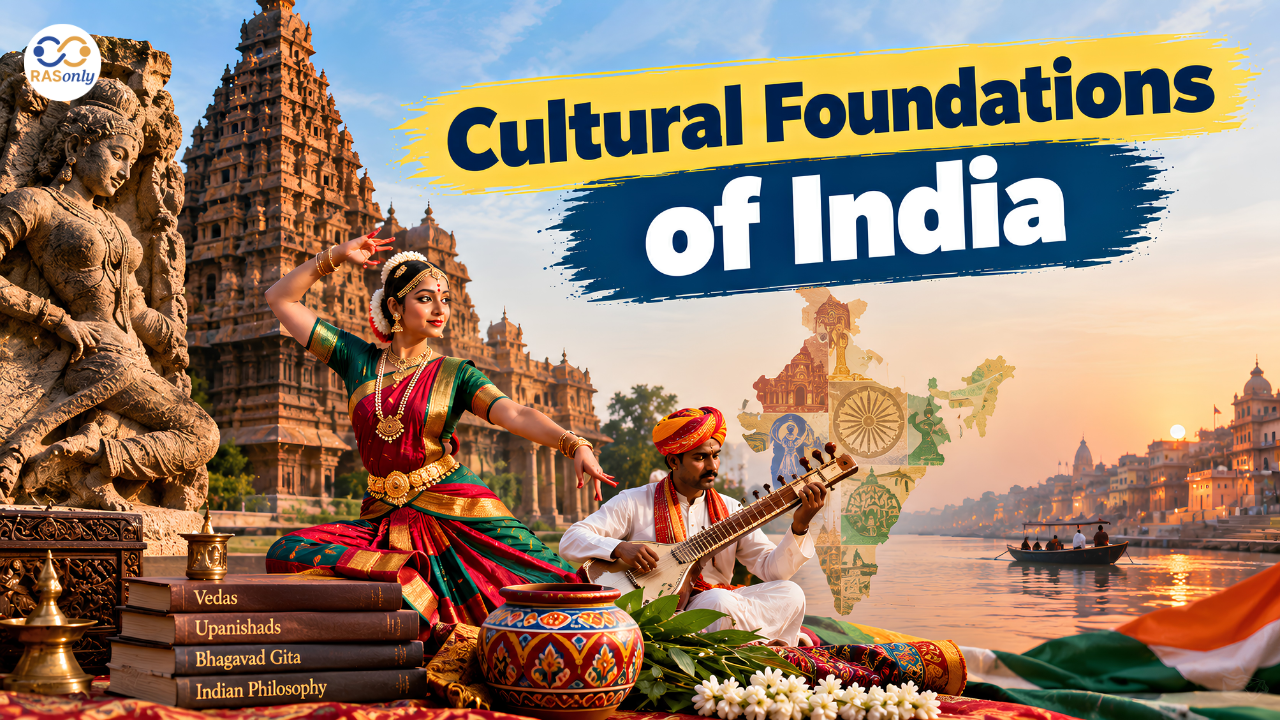
Cultural Foundations of India evolved through various phases of settlement, agriculture, urbanisation, social organisation, religious ideas, literature, and philosophical thought. The earliest important period was the Harappan, or Indus, Civilisation, followed by the Vedic Age.
The Harappan civilisation is also renowned for its well-developed urban systems, sanitation infrastructure, artisanal traditions, trade routes, and even uniformity of weights and some peculiar artefacts. Vedic period has been studied primarily through the study of Vedic literature, and the development of social institutions, organisation, religion, language and philosophical ideas can be understood from it.
An introduction to the Indus Valley Civilisation.
- The Indus Valley Civilisation, also known as the Harappan Civilisation, is one of the earliest urbanised civilisations of South Asia.
- The Harappan Civilisation is sometimes preferred because its settlements are much beyond the Indus Valley. Harappa was the first to be named after the ruins of a major settlement, and thus the archaeological culture.
- The civilisation evolved in several phases - the most advanced level being attained during the Mature Harappan period (c. 2600-1900 BCE).
Main Phases of Harappan Civilisation
| Phase | Approximate Period | Main Features |
|---|---|---|
| Early Harappan | c. 3300–2600 BCE | Growth of villages, regional cultures and early settlements |
| Mature Harappan | c. 2600–1900 BCE | Major urban centres, planned cities, trade and craft specialisation |
| Late Harappan | c. 1900–1300 BCE | Decline of large cities and regionalisation |
Geographical Extent of Harappan Civilisation
The Harappan settlements stretched over a broad area in present-day India and Pakistan, with a few sites even into Afghanistan.
Important regions include:
- Northwestern India
- Punjab
- Haryana
- Rajasthan
- Gujarat
- Sindh
- Balochistan
- Parts of Uttar Pradesh
- Jammu region
Important Harappan Sites
| Site | Present Location | Important Feature |
|---|---|---|
| Harappa | Punjab, Pakistan | Major urban centre; cemetery and craft evidence |
| Mohenjo-daro | Sindh, Pakistan | Great Bath and planned urban settlement |
| Dholavira | Gujarat | Water-management system and city planning |
| Lothal | Gujarat | Craft production and maritime-trade evidence |
| Kalibangan | Rajasthan | Ploughed field and fire-related structures |
| Rakhigarhi | Haryana | One of the major Harappan urban sites |
| Banawali | Haryana | Planned settlement and Harappan cultural remains |
| Ropar | Punjab, India | Harappan settlement in the Sutlej region |
| Alamgirpur | Uttar Pradesh | Eastern limit of Harappan cultural expansion |
Kalibangan: Important Harappan Site in Rajasthan
Harappan culture in the area is Kalibangan, located in present-day Hanumangarh district of Rajasthan. Here, there is some evidence from pre-Harappan and Harappan phases.
Major Features of Kalibangan
- Evidence of a ploughed agricultural field
- Fire-related structures
- Planned settlement
- Fortified areas
- Shape and face material of pottery and terracotta objects
- Evidence around agricultural activity
- The proximity to the Ghaggar river system
The ploughed field is particularly important because it provides archaeological evidence relative to activities of farming during the Harappan era.
Harappan Water Management at Dholavira
In Gujarat, Dholavira contributes valuable information on the adaptation of Harappan communities to their environment.
The settlement included:
- Reservoirs
- Water channels
- Storage structures
- Well-planned urban areas
- Systems for collecting and managing water
Town Planning in Harappan Civilisation
One of the uniquely Harappan cultural adaptations is urban planning.
Many major settlements show evidence of:
- Planned streets
- Residential areas
- Drainage systems
- Wells
- Brick-built structures
- Public buildings
- Fortified areas
- Standardised construction practices
Drainage System
The Harappans had drainage systems.
Drains were often:
- Covered
- Connected to houses
- Constructed along streets
- Designed to remove wastewater
Houses and Buildings
The houses of the Harappans were made of bricks (except for regional and period variations).
Many houses contained:
- Courtyards
- Bathing areas
- Drains
- Water wells in some settlements
The existence of bathing facilities and drainage systems implies the importance of water management and cleanliness in city life.
Agriculture in Harappan Civilisation
Harappan economy was largely agriculture-based.
Major crops included:
- Wheat
- Barley
- Pulses
- Sesame
- Mustard
- Cotton
Rice and other crops are found at some sites, but in different patterns in different regions and times.
Ploughed Field sites in Kalibangan
The discovery of a ploughed field at Kalibangan has been valuable as evidence of agricultural techniques.
- Field preparation
- Farming practices
- Crop cultivation
- The connection between agriculture and settlement development.
- Animal Husbandry
Animal Husbandry
Evidence has been found for the use of:
- Cattle
- Buffalo
- Sheep
- Goat
- Dog
- Camel in some contexts
- Elephant
Harappan Crafts and Industries
Artisanal specialisation was found in Harappan cities.
Important crafts included:
- Pottery
- Bead-making
- Metalworking
- Jewellery making
- Shell working
- Stone working
- Textile-related activities
- Terracotta production
Metals
Harappan people used metals such as:
- Copper
- Bronze
- Gold
- Silver
Harappan Trade
- Trading was a key aspect of the Harappan economy.
- Indications of both internal and inter-farm exchange networks.
- Evidence of contacts with communities of West Asia, and Harappan objects and seals have been recovered outside the settlement zone.
Important Trade Materials
These were exchanged or utilised between Harappan communities:
- Beads
- Metals
- Gems and handicrafts: -
- Shell objects
- Pottery
- Agricultural products
- Craft goods
Seals and the Harappan Script
One of the most recognisable objects of the archaeology of the Harappans is seals.
Some injections of sealing wax made from steatite include:
- Animal figures
- Short inscriptions
- Symbolic motifs
Harappan seals often feature stylised depictions of individuals such as the "unicorn" figure. The unicorn is a common feature on Harappan seals.
Harappan Script
- The language of the Harappan script is not yet known.
- This is indeed relevant as the Harappan inscriptions have yet to be read with certainty.
- Thus, the words carried by the texts of religious or political almsgiving must be taken with caution.
Religious and Cultural Practices
Religious life in the Harappan culture can be reconstructed primarily based on archaeology.
Important evidence includes:
- Terracotta figurines
- Animal motifs
- Sacred-tree representations
- Fire-related structures
- Burial practices
Burial Practices
Different burial practices have been found at Harappan sites.
These include:
- Extended burials
- Pottery attributed to graves selected for study.Pottery from selected graves for study.
- Other objects (e.g. ornaments)
- Variations in burial traditions
Why Did the Harappan Urban System Decline?
There was no one single definitive cause for the decay of Harappan city centres.
Multiple theories have been suggested regarding the reasons, such as:
- Climate change
- Changes in river systems
- Water stress
- Decline or transformation of long-distance trade
- Environmental changes
- Movement of populations
- Regional economic changes
A gradual and complex process of transformation and regionalisation rather than a single event wiping out an entire civilisation is a more accepted concept of modern archaeology.
Vedic Age: Introduction
Vedic Age is a significant period in ancient Indian history, as knowledge of this era is available in the literature of the Vedic Period.
This period is divided broadly into two:
- The earliest Vedic or Rigvedic Period
- Later Vedic Period
The Early Vedic period is commonly dated to 1500–1000 BCE, and the Later Vedic period is classically considered to be from 1000–600 BCE.
Sources of the Vedic Period
The most important source is Vedic literature.
Four Vedas
| Veda | Main Association |
|---|---|
| Rigveda | Hymns and prayers |
| Samaveda | Melodies and chants |
| Yajurveda | Sacrificial formulas |
| Atharvaveda | Spells, prayers and everyday concerns |
Early Vedic Period
The Rigveda constitutes the main source of information about the Early Vedic period.
In this general sense, a lot of society was based around:
- Tribes
- Clans
- Kinship
- Cattle ownership
- Pastoral activities
Political Organisation in Early Vedic Society
- Political organisation was, in the main, a tribal
- The rajan, as translated, would be king or chief, was a high-ranking political official.
- The Early Vedic political system, however, should not be interpreted as a completely developed territorial monarchy such as was seen during later periods of history.
Vedic literature refers to the following important assemblies:
Sabha
A key meeting regarding discussion and/or decision-making.
Samiti
- The broad assembly referred to in the Rigveda.
- The makeup and activities of these institutions are still the subject of historical debate.
Vedic Economy
There was a great change in the economy from the Early Vedic period to the Later Vedic period.
Early Vedic Economy
Important features included:
- Cattle rearing
- Agriculture
- Hunting
- Craft activities
- Exchange
- Pastoral production
Cattle were of major economic and social significance.
Later Vedic Economy
The significance of agriculture grew.
This expansion of the region towards the Ganga-Yamuna gave rise to the conditions for the emergence of:
- Larger settlements
- Agricultural surplus
- Territorial kingdoms
- Greater social differentiation
- Further developed political structures
Expansion During the Later Vedic Period
The area was extended towards the east even more during the Later Vedic period.
The Ganga-Yamuna plains emerged to great importance.
The major political groups and kingdoms were:
- Kuru
- Panchala
- Kosala
- Kashi
- Videha
The transition from a primarily tribal political structure to a more territorial pattern of political power thus took place fairly gradually in this period.
Social Organisation in Vedic Society
The way society is organised developed gradually.
- There were less definite social divisions in Early Vedic times than later on.
- The varna system gained more importance during the Later Vedic Period.
The four divisions were:
- Brahmana
- Kshatriya
- Vaishya
- Shudra
There is a need, however, to avoid the direct endorsement of the full development of the later caste system to apply it to the Early Vedic period.
Position of Women
Women were involved in various aspects of social and religious life, especially in the early Vedic age.
Mentioned in Vedic literature are people like:
- Gargi
- Maitreyi
- Lopamudra
There is also some evidence that the status of women changed over time: it grew more hierarchical in social institutions.
Hence, it cannot be said that throughout the Vedic age, women enjoyed the same status in society.
Vedic Religion
The Early Vedic period religion was bound to natural forces and sacrifices.
Important deities included:
- Indra
- Agni
- Varuna
- Surya
- Soma
- Ushas
- Vayu
- Indra
Indra
Indra occupies a prominent position in the Rigveda and is associated with warfare, storms and victory.
Agni
Agni was the focal point of the sacrificial ceremonies, and appeared to function as a middleman between human beings and the gods.
Varuna
Varuna was connected with Rita, cosmic and moral order.
Yajna and Sacrificial Tradition
The Yajna was an important feature in the Vedic religion.
Ritual sacrifices were given, usually in the form of:
- Fire
- Mantras
- Priests
- Offerings
- Ritual procedures
During the later Vedic period, rituals became more sophisticated, and there was a greater need for specialised priests.
Concept of Rita
Rita is a general term for the cosmic, moral and natural order in early Vedic thought.
It was the law of harmony and regularity of the universe.
The idea is important because it provides a link between:
- Nature
- Society
- Moral conduct
- Cosmic order
The ideas of many subsequent Indian philosophical schools regarding dharma, karma and the order of the cosmos were related to these concepts.
Development of Vedic Philosophy
Vedic thought gradually shifted away from ritual questions and toward philosophical ones.
In this development, the specific importance of the Upanishads is this.
These are the key elements of philosophy:
- Atman
- Brahman
- Karma
- Rebirth
- Moksha
This shift is significant: from the focus on ritual actions to having a deeper conversation about:
- Self
- Reality
- Knowledge
- Existence
- Liberation
Education in the Vedic Tradition
There is a strong relationship between teacher and student and education.
Gurukula is traditional education, which is under the guidance of a teacher.
Students learned about:
- Vedic texts
- Language
- Philosophy
- Ethics
- Ritual knowledge
- Memory-based learning
Oral transmission was extremely important in preserving Vedic literature.
Ashrama Concept
Ashrama refers to the four traditional stages of life described in later Vedic and post-Vedic traditions.
There are four major Ashramas, which are known as:
- Brahmacharya – student life
- Grihastha – household life
- Vanaprastha is the gradual withdrawal from worldly affairs.
- Sannyasa – renunciation
Indus and Vedic Culture: A Comparison
| Feature | Harappan Civilisation | Vedic Age |
|---|---|---|
| Main evidence | Archaeological remains | Vedic literature + archaeology |
| Urbanisation | Highly developed in the Mature phase | Mostly rural in early phase |
| Major economic activities | Agriculture, crafts, trade | Pastoralism and agriculture |
| Political organisation | Not clearly known | Tribal organisation in the Early Vedic period |
| Writing | Undeciphered script | Strong oral literary tradition |
| Important structures | Cities, drains, reservoirs | Ritual spaces and settlements |
| Religion | Reconstructed from archaeological evidence | Known largely through textual traditions |
| Metals | Copper and bronze prominent | Copper/bronze; iron becomes important later |
| Major cultural feature | Urban planning and craft production | Vedic literature, rituals and philosophical development |
| Geographical trend | Northwestern India and adjoining regions | Gradual movement from northwest towards Ganga plains |
Important Terms to Remember
| Term | Meaning / Significance |
|---|---|
| Harappan Civilisation | Major Bronze Age urban civilisation of South Asia |
| Mature Harappan | Main urban phase, c. 2600–1900 BCE |
| Great Bath | Famous structure at Mohenjo-daro |
| Dholavira | Known for sophisticated water management |
| Kalibangan | Important Harappan site in Rajasthan |
| Lothal | Important Harappan settlement in Gujarat |
| Rigveda | Earliest Vedic text |
| Sabha | Vedic assembly |
| Samiti | Important Early Vedic assembly |
| Rita | Concept of cosmic and moral order |
| Yajna | Vedic sacrificial ritual |
| Brahmana | Ritual-explanatory Vedic texts |
| Aranyaka | Texts associated with forest traditions and ritual-philosophical reflection |
| Upanishad | Philosophical texts dealing with concepts such as Atman and Brahman |
| Varna | Broad social classification in Vedic tradition |
| Ashram | Stages of life in later Indian thought |
Frequently Asked Questions
It can generally be used to describe the historical events that helped shape the nature of Indian society, economy, religion, political system, literature and cultural practices in early history.
The Harappan Civilisation was a significant Bronze Age South Asian civilisation characterised by its urbanised settlements, drainage systems, craft production, trading, and uniformity of material culture.
The three major periods are the Early Harappan, the Mature Harappan and the Late Harappan.
Kalibangan, located in present-day Hanumangarh district, is an important Harappan site in Rajasthan.
Dholavira is particularly important for its sophisticated urban planning and water-management system.

BEST SELLER
🏆 PRELIMS
RAS Pass
Prelims focused Hindi & English
₹399
✓
Prelims Topic-Wise Tests
✓
Subject-Wise Tests
✓
Full-Length Prelims Tests
✓
Daily Current Affairs Tests
✓
Prelims PYQs Tests
✓
Detailed Solutions & Analysis
✓
All Rajasthan Ranking
✓
Unlimited Reattempts
✓
Mains Tests
✓
Hindi & English Tests
✓
All Rajasthan Ranking
Trusted by 5,000+ Students
Post Category
- RAS Salary
- Result
- RAS Admit Card
- RAS Job
- RAS Cutoff
- Preparation Tips
- RAS Answer Key
- RAS Exam Analysis
- RAS Syllabus
- RAS Previous Year Papers
- RPSC RAS Exam Pattern
- RAS Interview
- RAS Exam Date
- RAS Vacancy
- RAS Test Series
- RAS Best Books
- RAS Preparation Resources
- RAS Coaching Centre
- History
- Polity
- Geography
- Economics
- Science
- Art and Culture
- RPSC RAS Application Form
- RPSC RAS Notification
- RAS Eligibility Criteria
- UPSC Exam
- RPSC RAS Mains
Visit Our RASonly Offline Center
Our Expert Faculty

Bhunesh Sir
Current Affairs · 13+ Yrs

Aamir Khan Sir
RAS-2017 · IIM Ahm.

Akash Sir
Polity · 8+ Yrs
Free Resources
Official Mobile App

RASOnly App
by OTSAdda · Free
Full Video Lectures
Mock Tests & PYQs
Daily Current Affairs
AI Mock Interview
Free Download · No subscription needed to install
RAS 2024 Toppers — RASonly
Rank 2
Virendra Charan
Rank 9
Bhoopinder Singh
Rank 26
Aanchal Nagpal
Rank 33
Lokendra Singh
Rank 45
Amar Rathore
Rank 46
Manasvini Verma

Join RASonly WhatsApp Community
Get daily current affairs, exam alerts, free study material and tips from expert faculty — right on WhatsApp.
Join for Free →RASonly Interview Guidance Program

Mr. Ashok Jain
Ex-Chief Secretary Govt of Rajasthan
- IAS officer of the 1981 batch, Rajasthan cadre.
- Passionate about mentoring the next generation of RAS officers with real-world insights.
- Got retired in Dec 2017 from the post of Chief Secretary of the state of Rajasthan.

Mr. Guru Charan Rai
Ex-ASP / SP in Jaisalmer
- Guru Charan Rai, IPS (Retd), retired as Inspector General of Police (Security), Rajasthan, Jaipur in 2017.
- Served as ASP and SP in Jaisalmer, Nagaur, Sri Ganganagar, Sawai Madhopur, Dausa, Sikar, and Karauli.
- He also held key positions as DIGP and IGP in the Law and Order division.

Mr. Rakesh Verma
Ex-IAS Officer, B.Tech, MBA, and M.A. (Economics)
- IAS officer of the 1981 batch and retired in Chief Secretary Rank.
- Civil servant of high repute and vast experience.
- Has been teaching UPSC CSE subjects for the last six years.


Daily Current Affairs for RAS Exam Preparation 2026

India-US Yudh Abhyas 2026
September 17, 2026
Western Region Official Language Conference 2026
September 17, 2026
Rajasthan Ranks First in Mission Karmayogi
September 16, 2026