Kushan Empire: History, Rulers, Administration, Economy, Art, Decline
Disaster Management Preparation Strategy for RAS Prelims 2026 (Complete Study Plan, Topics, MCQs & Revision Strategy)

Get in Touch with RASonly!

Learn the complete Disaster Management Preparation Strategy for RAS Prelims 2026 including natural disasters, floods, droughts, earthquakes, cyclones, climate change, NDMA, NDRF, Rajasthan disaster issues, maps, MCQ practice, and revision techniques. This detailed guide helps aspirants prepare Disaster Management in a smart, scoring, and exam-oriented way for RAS 2026.

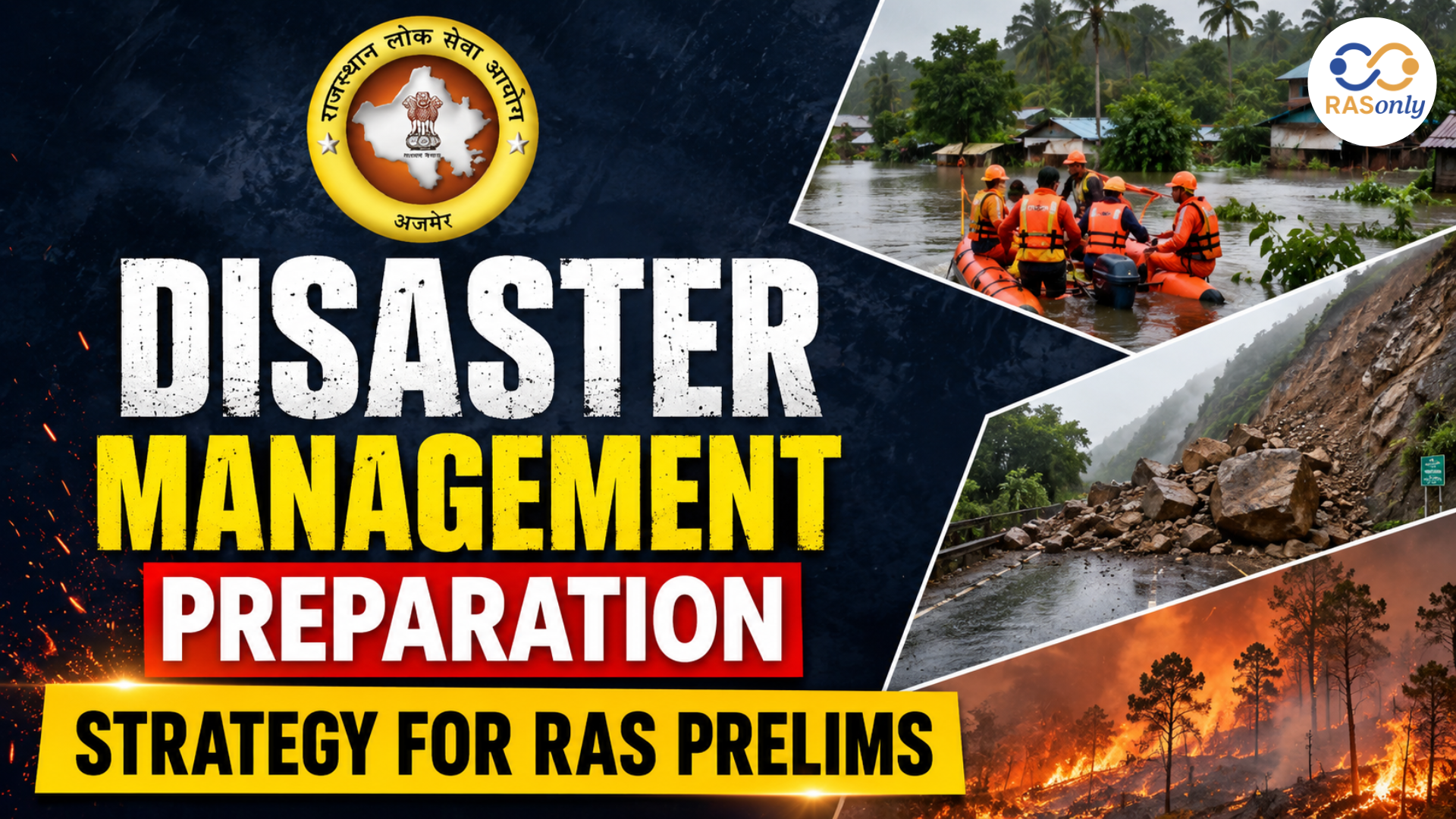
Disaster Management is becoming an increasingly important topic in RAS Prelims because questions are regularly asked about natural disasters, climate-related issues, environmental hazards, disaster response systems, and disaster mitigation strategies. The updated RAS syllabus for 2026 continues to emphasize environment, ecology, climatic regions, environmental pollution, and disaster management-related topics within General Studies.
Disaster Management has been a trending topic for the last few years and is set to get even more important for the upcoming RAS Prelims, with questions from Natural Disasters, Climate-Related Disasters, Environmental Hazards, Disaster Response Systems, and Disaster Mitigation Strategies being regularly asked. Environment, ecology, climatic regions, environmental pollution, and disaster management-related subjects will continue to be in the focus of the updated syllabus for RAS 2026 in General Studies.
Why Disaster Management is Important for RAS 2026
Environmental issues, climate change, floods, droughts, cyclones, earthquakes and ecological problems are on the rise and hence Disaster Management has become of paramount importance in the competitive exams. Direct questions are frequently asked about disaster types, disaster mitigation strategies, government bodies, and disaster preparedness systems.
Benefits of Strong Disaster Management Preparation
- Improves the Environment & Ecology preparation
- Helps in Current Affairs linkage
- Useful for Geography-related topics
- Strengthens conceptual understanding
- Helpful in both Prelims and Mains
- Scoring with proper revision and MCQ practice
RAS Disaster Management Syllabus 2026
Disaster Management is primarily part of Environment, Ecology, Geography, and Current Affairs in RAS Prelims. The new syllabus emphasizes environmental pollution, climatic regions, and disaster management-related topics, as well as sustainable development-related topics.
Important Disaster Management Topics for RAS 2026
- Natural Disasters
- Floods & Droughts
- Earthquakes & Tsunamis
- Cyclones & Landslides
- Climate Change
- Environmental Hazards
- Disaster Mitigation
- Disaster Preparedness
- Early Warning Systems
- Disaster Response Mechanisms
- NDMA & NDRF
- Sustainable Development
- Rajasthan Disaster Challenges
Topic-Wise Importance Table
| Topic | Preparation Focus |
|---|---|
| Natural Disasters | Causes and impact |
| Floods & Cyclones | Disaster response |
| Earthquakes | Seismic zones and effects |
| Climate Change | Environmental risks |
| Disaster Management Bodies | NDMA, NDRF |
| Rajasthan Disasters | Droughts and desertification |
Disaster Management becomes much easier when prepared through conceptual understanding, current affairs linkage, and repeated MCQ practice.
Best Disaster Management Preparation Strategy for RAS 2026
Disaster Management should not be prepared by rote learning, as most of the questions are based on concepts and are interconnected with environmental issues and developments. A good preparation approach really helps to enhance comprehension and retention.
Smart Preparation Approach
- Start with basic disaster concepts first
- Understand disaster types clearly
- Link current affairs with disasters
- Prepare maps and vulnerable regions
- Revise government initiatives regularly
- Practice MCQs after every topic
- Maintain short revision notes
Smart Preparation Flow
| Step | Focus Area |
|---|---|
| Step 1 | Learn disaster basics |
| Step 2 | Study natural disasters |
| Step 3 | Understand mitigation strategies |
| Step 4 | Revise government mechanisms |
| Step 5 | Solve MCQs and PYQs |
Natural Disasters Strategy for RAS 2026
The entire Disaster Management preparation for the RAS Prelims 2026 is based on Natural Disasters, as many questions are directly asked on the causes of natural disasters, the impact of natural disasters, vulnerable areas for the natural disasters, and mitigation of the natural disasters. Having a clear understanding of natural disasters assists aspirants to link topics in Geography, Environment, Climate Change, and Current Affairs in a better way while preparing.
Important Natural Disaster Topics
- Earthquakes
- Floods
- Droughts
- Cyclones
- Tsunamis
- Landslides
- Volcanic Eruptions
Smart Preparation Tips
- Understand causes and impacts conceptually instead of memorizing facts
- Learn about disaster-prone regions through maps and diagrams
- Focus on disaster mitigation and preparedness measures
- Practice statement-based and application-based MCQs regularly
- Link disasters with environmental and climate-related current affairs
Major Disaster Examples
| Disaster | Commonly Affected Areas |
|---|---|
| Earthquakes | Himalayan region |
| Cyclones | Coastal regions |
| Floods | River basins |
| Droughts | Arid and semi-arid regions |
Earthquake & Tsunami Strategy
Earthquakes and Tsunamis are directly related to the subjects of Geography, tectonic plates, seismic zones, and Disaster Preparedness Systems, and hence are very significant topics of disaster in RAS Prelims.
Important Topics
- Causes of earthquakes
- Seismic zones
- Earthquake waves
- Tsunami formation
- Disaster preparedness and mitigation
Smart Preparation Strategy
- Revise tectonic plate concepts carefully
- Learn India’s seismic zones through maps
- Practice map-based Geography questions regularly
- Focus on disaster mitigation and safety measures
- Understand tsunami formation visually through diagrams
Important Focus Areas
| Topic | Preparation Focus |
|---|---|
| Earthquakes | Causes, waves, seismic zones |
| Tsunami | Formation and impact |
| Tectonic Plates | Plate boundaries |
| Disaster Preparedness | Safety and mitigation |
Flood & Drought Strategy for RAS 2026
Floods and droughts are among the most important disaster topics for RAS because they are frequently linked with Indian geography, Rajasthan's environmental conditions, water scarcity, and climate change.
Important Flood Topics
- Causes of floods
- Flash floods
- Urban floods
- Flood management systems
Important Drought Topics
- Causes of drought
- Types of drought
- Desertification
- Water conservation methods
Smart Preparation Tips
- Link floods and droughts with climate change
- Focus on Rajasthan drought conditions and water scarcity
- Learn disaster mitigation and relief measures carefully
- Revise river systems and rainfall patterns regularly
- Practice current-affairs-linked MCQ
Flood vs Drought Focus Table
| Topic | Important Focus |
|---|---|
| Floods | Causes, management, river systems |
| Droughts | Water scarcity, desertification |
| Rajasthan Issues | Heat and water challenges |
| Climate Linkage | Extreme weather conditions |
Flood and drought preparation becomes easier when linked with Geography, Environment, and Rajasthan-specific issues.
Cyclone & Climate Disaster Strategy
Cyclones and climate-related disasters are becoming increasingly important in competitive exams because of rising climate change concerns and extreme weather events worldwide.
Important Topics
- Tropical cyclones
- Cyclone formation
- Storm surges
- Climate-induced disasters
- Heat waves and cold waves
Smart Strategy
- Understand cyclone formation conceptually
- Revise cyclone-prone coastal regions through maps
- Link climate change with extreme weather events
- Focus on heat waves, floods, and environmental hazards
- Practice environment-related MCQs regularly
Climate Disaster Focus Areas
| Topic | Preparation Focus |
|---|---|
| Cyclones | Formation and coastal impact |
| Storm Surges | Coastal disasters |
| Heat Waves | Climate-related risks |
| Climate Change | Extreme weather linkage |
Climate disaster topics are highly scoring when prepared through current affairs linkage and conceptual understanding.
Disaster Management Institutions & Government Mechanisms
Government disaster management institutions and response mechanisms are important for RAS Prelims because questions are often asked about disaster response systems, preparedness measures, and disaster-related authorities.
Important Organizations
- NDMA (National Disaster Management Authority)
- NDRF (National Disaster Response Force)
- SDRF
- Disaster Management Act
- State Disaster Management Authorities
Important Areas
- Early warning systems
- Relief and rehabilitation
- Disaster preparedness
- Risk reduction strategies
- Emergency response systems
Rajasthan Disaster Management Strategy
Rajasthan-specific disaster management topics are highly important because RAS frequently asks questions linked with Rajasthan’s environmental and climatic conditions.
Important Rajasthan Disaster Topics
- Droughts
- Desertification
- Water scarcity
- Heat waves
- Dust storms
- Climate challenges in Rajasthan
Smart Strategy
- Focus on Rajasthan environmental conditions carefully
- Revise drought-prone and desert regions regularly
- Link Rajasthan current affairs with disaster topics
- Practice Rajasthan-based MCQs consistently
- Understand water conservation measures
Rajasthan Disaster Focus Areas
| Topic | Important Focus |
|---|---|
| Droughts | Water scarcity |
| Desertification | Land degradation |
| Heat Waves | Climatic challenges |
| Dust Storms | Desert conditions |
Climate Change & Disaster Linkage Strategy
Modern disaster management questions are increasingly linked with climate change, environmental degradation, and extreme weather conditions.
Important Topics
- Global warming
- Environmental degradation
- Extreme weather events
- Sustainable development
- Biodiversity loss
Smart Preparation Tips
- Link the environment and climate change with disasters
- Revise international environmental discussions regularly
- Focus on adaptation and mitigation concepts
- Practice concept-based MCQs frequently
- Understand long-term environmental impacts
Climate Change Focus Table
| Topic | Preparation Focus |
|---|---|
| Global Warming | Causes and effects |
| Extreme Weather | Disaster risks |
| Sustainable Development | Environmental balance |
| Biodiversity Loss | Ecological impact |
Map Practice Strategy for Disaster Management
Map practice is extremely important in Disaster Management because many questions are linked with vulnerable regions, environmental zones, coastal areas, and seismic regions.
Important Areas for Map Practice
- Earthquake zones
- Cyclone-prone regions
- Flood-prone river basins
- Drought-prone regions
- Coastal vulnerability zones
Smart Map Practice Tips
- Practice blank maps regularly
- Mark disaster-prone regions repeatedly
- Revise environmental hotspots visually
- Link maps with current affairs events
- Practice map-based MCQs regularly
Consistent map practice improves geographical understanding and helps solve conceptual questions more accurately.
Best Note-Making Strategy for Disaster Management
Disaster Management contains many interconnected concepts, institutions, and environmental topics, so proper note-making becomes extremely important for quick revision before the exam.
Smart Notes Strategy
- Prepare flowcharts and diagrams
- Make disaster comparison tables
- Prepare short mitigation notes
- Write one-line factual points
- Revise notes weekly
Best Notes Format
| Notes Type | Purpose |
|---|---|
| Flowcharts | Fast conceptual revision |
| Disaster Tables | Easy comparison |
| One-Line Notes | Final quick revision |
| Map Notes | Better geographical understanding |
Disaster Management MCQ Practice Strategy
MCQ practice is essential because Disaster Management questions are often conceptual, statement-based, and linked with current affairs and Geography.
Best MCQ Practice Method
- Solve topic-wise MCQs daily
- Practice previous year questions regularly
- Analyze wrong answers carefully
- Maintain an error notebook
- Revise weak topics repeatedly
Smart MCQ Practice Tips
- Focus more on conceptual questions
- Link current affairs with MCQs
- Revise incorrect questions weekly
- Solve mixed Environment-Disaster quizzes regularly
Most Important Disaster Management Topics for RAS 2026
Some Disaster Management topics are repeatedly asked in RAS Prelims and should be prepared more seriously because of their higher scoring potential.
High-Weightage Topics
- Earthquakes & Tsunamis
- Floods & Droughts
- Cyclones
- Climate Change
- NDMA & NDRF
- Rajasthan Disaster Challenges
- Environmental Hazards
Topic Priority Table
| Topic | Importance Level |
|---|---|
| Climate Change | Very High |
| Floods & Droughts | Very High |
| Earthquakes & Tsunamis | High |
| NDMA & NDRF | High |
| Rajasthan Issues | High |
Common Mistakes Students Make in Disaster Management
Many aspirants find Disaster Management confusing because they study it only theoretically without linking it with Geography, Environment, and Current Affairs.
Mistakes to Avoid
- Memorizing without conceptual clarity
- Ignoring current affairs linkage
- Avoiding map practice
- Not revising government initiatives
- Skipping MCQ practice
- Studying too many sources
Smart Improvement Strategy
- Focus on conceptual understanding first
- Revise disaster maps regularly
- Link current affairs with concepts
- Practice statement-based MCQs consistently
- Maintain short revision notes
Disaster Management Revision Strategy for RAS 2026
Revision is the key to retaining Disaster Management concepts because environmental and disaster-related topics are easy to forget without repeated practice.
Smart Revision Tips
- Revise disaster types weekly
- Practice MCQs regularly
- Revise maps and vulnerable zones visually
- Focus on repeated current issues
- Use short notes for quick revision
Best Revision Cycle
| Revision Stage | Focus Area |
|---|---|
| First Revision | Concept understanding |
| Second Revision | Disaster mechanisms |
| Final Revision | MCQs and short notes |
How Toppers Prepare Disaster Management for RAS
Most toppers prepare Disaster Management through conceptual understanding, current affairs linkage, maps, and MCQ practice instead of memorizing isolated facts.
Toppers’ Strategy
- Follow limited and reliable sources
- Link current affairs with disasters
- Revise multiple times
- Solve PYQs regularly
- Focus on conceptual understanding
- Prepare short revision notes
What Makes Toppers Different?
- Better conceptual clarity
- Strong current affairs linkage
- Consistent revision habits
- Smart MCQ analysis
- Better map understanding
Conclusion
Disaster Management is one of the most important and scoring sections for RAS Prelims 2026 because it connects directly with Environment, Geography, Climate Change, and Current Affairs. Questions in this area are usually conceptual, application-based, and linked with real-world environmental challenges such as floods, droughts, earthquakes, cyclones, and climate-related disasters. Aspirants who prepare for Disaster Management in a structured and practical way usually perform much better in environment-related questions during the exam.
A smart Disaster Management preparation strategy for RAS 2026 should focus on conceptual clarity, disaster types, government mechanisms, Rajasthan-specific challenges, maps, current affairs linkage, and continuous MCQ practice. Regular revision, short notes, and map-based preparation can make this section highly scoring and easy to revise before the exam.
FAQ
Yes, Disaster Management is an important part of RAS preparation because questions are regularly asked from natural disasters, climate change, environmental hazards, and disaster response systems.
Earthquakes, floods, droughts, cyclones, climate change, NDMA, NDRF, environmental hazards, and Rajasthan disaster issues are the most important topics.
Focus on conceptual understanding, current affairs linkage, maps, government initiatives, short notes, and regular MCQ practice.
No, Disaster Management becomes much easier when prepared through diagrams, maps, conceptual understanding, and repeated revision.
Current affairs are extremely important because many Disaster Management questions are directly linked with recent environmental and climatic events.
BEST SELLER
🏆 PRELIMS
RAS Pass
Prelims focused Hindi & English
₹399
✓
Prelims Topic-Wise Tests
✓
Subject-Wise Tests
✓
Full-Length Prelims Tests
✓
Daily Current Affairs Tests
✓
Prelims PYQs Tests
✓
Detailed Solutions & Analysis
✓
All Rajasthan Ranking
✓
Unlimited Reattempts
✓
Mains Tests
✓
Hindi & English Tests
✓
All Rajasthan Ranking
Trusted by 5,000+ Students
Post Category
- RAS Salary
- Result
- RAS Admit Card
- RAS Job
- RAS Cutoff
- Preparation Tips
- RAS Answer Key
- RAS Exam Analysis
- RAS Syllabus
- RAS Previous Year Papers
- RPSC RAS Exam Pattern
- RAS Interview
- RAS Exam Date
- RAS Vacancy
- RAS Test Series
- RAS Best Books
- RAS Preparation Resources
- RAS Coaching Centre
- History
- Polity
- Geography
- Economics
- Science
- Art and Culture
- RPSC RAS Application Form
- RPSC RAS Notification
- RAS Eligibility Criteria
- UPSC Exam
- RPSC RAS Mains
Visit Our RASonly Offline Center
Our Expert Faculty

Bhunesh Sir
Current Affairs · 13+ Yrs

Aamir Khan Sir
RAS-2017 · IIM Ahm.

Akash Sir
Polity · 8+ Yrs
Free Resources
Official Mobile App

RASOnly App
by OTSAdda · Free
Full Video Lectures
Mock Tests & PYQs
Daily Current Affairs
AI Mock Interview
Free Download · No subscription needed to install
RAS 2024 Toppers — RASonly
Rank 2
Virendra Charan
Rank 9
Bhoopinder Singh
Rank 26
Aanchal Nagpal
Rank 33
Lokendra Singh
Rank 45
Amar Rathore
Rank 46
Manasvini Verma

Join RASonly WhatsApp Community
Get daily current affairs, exam alerts, free study material and tips from expert faculty — right on WhatsApp.
Join for Free →RASonly Interview Guidance Program

Mr. Ashok Jain
Ex-Chief Secretary Govt of Rajasthan
- IAS officer of the 1981 batch, Rajasthan cadre.
- Passionate about mentoring the next generation of RAS officers with real-world insights.
- Got retired in Dec 2017 from the post of Chief Secretary of the state of Rajasthan.

Mr. Guru Charan Rai
Ex-ASP / SP in Jaisalmer
- Guru Charan Rai, IPS (Retd), retired as Inspector General of Police (Security), Rajasthan, Jaipur in 2017.
- Served as ASP and SP in Jaisalmer, Nagaur, Sri Ganganagar, Sawai Madhopur, Dausa, Sikar, and Karauli.
- He also held key positions as DIGP and IGP in the Law and Order division.

Mr. Rakesh Verma
Ex-IAS Officer, B.Tech, MBA, and M.A. (Economics)
- IAS officer of the 1981 batch and retired in Chief Secretary Rank.
- Civil servant of high repute and vast experience.
- Has been teaching UPSC CSE subjects for the last six years.


Daily Current Affairs for RAS Exam Preparation 2026

India Wins Bronze Medal in Men’s Double Sculls
September 25, 2026
India-France Maritime Exercise VARUNA 2026
September 25, 2026
Mirabai Chanu wins a silver medal in Asian Games
September 24, 2026