Kushan Empire: History, Rulers, Administration, Economy, Art, Decline
Drainage Pattern Strategy for RAS Geography 2026 (Complete Types, Concepts, Maps, MCQs & Revision Plan)

Get in Touch with RASonly!

Learn the complete Drainage Pattern Strategy for RAS Geography 2026 including dendritic, trellis, radial, centripetal, rectangular, and parallel drainage systems with maps, diagrams, MCQs, and revision techniques. This detailed guide helps aspirants improve conceptual understanding, map practice, and Geography preparation for RAS Prelims 2026.

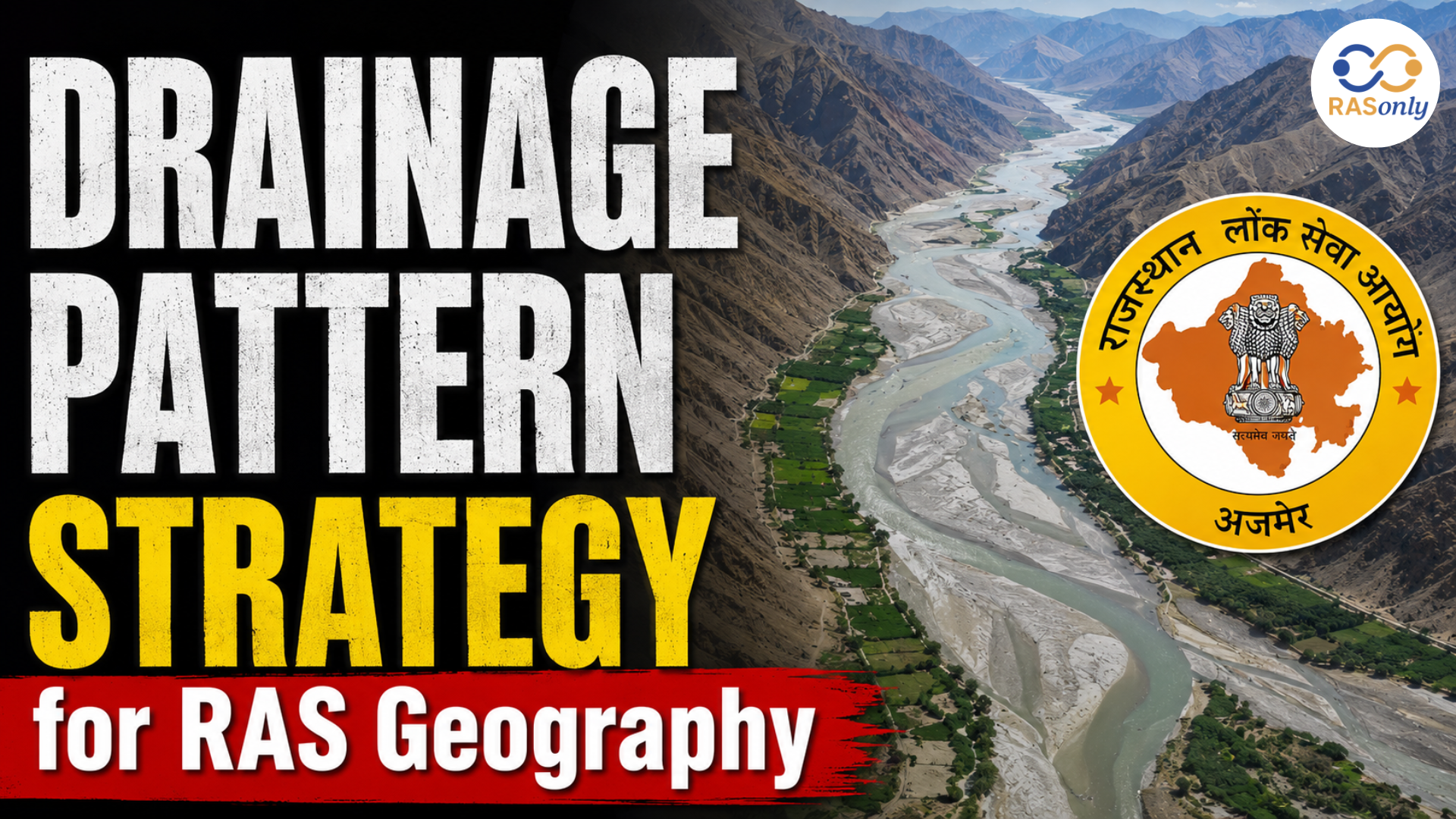
Drainage Pattern is one of the most important conceptual topics in Geography for RAS Prelims 2026 because questions are regularly asked from river systems, drainage types, landforms, geological structure, and map-based concepts. This topic is confusing for many aspirants because during revising, they do not understand the difference between various types of drainage patterns like dendritic, trellis, radial, rectangular, centripetal and parallel. But with some conceptual understanding and practice of visual mapping, Drainage Pattern is one of the easiest topics to score in Geography.
Physical Geography, Indian Geography, Geomorphology, Rivers and drainage system and Environmental Geography have remained as important topics for Points in General Studies in the latest RAS syllabus. Many questions are conceptual, statement based and associated with maps, landforms, mountains, plateaus, geological structure and river flow systems. RAS 2026 should focus more on conceptual clarity, learning through diagrams, mapping the rivers, MCQ practice and repeated revision rather than rote memorization.
Why Drainage Pattern is Important for RAS 2026
Drainage Pattern is significant in Physical Geography, as the questions of Geography and the Environment are directly or indirectly related to the river, slope systems, rock structure, tectonics, erosion and drainage developments. Conceptual and map based questions from Indian river systems and drainage features are often asked in RAS.
Benefits of Strong Drainage Pattern Preparation
- Improves Physical Geography preparation
- Helps in Indian River System topics
- Useful for map-based Geography questions
- Strengthens geomorphology concepts
- Improves understanding of rivers & landforms
- Helpful in both Prelims and Mains
What is Drainage Pattern?
Drainage Pattern is the pattern and arrangement of the river, stream and tributaries in a definite geographic area. It primarily evolves as a function of surface slope, geology, rock type, tectonic activity and erosional processes. As per the world, various physical and geological conditions give rise to various types of drainage systems, which makes the topic important in Physical Geography in RAS Prelims 2026.
Main Factors Affecting Drainage Patterns
- Slope and relief of the land
- Geological structure of rocks
- Rock hardness and composition
- Tectonic movements and faults
- Erosion and weathering processes
Understanding drainage patterns conceptually helps solve map-based and Geography MCQs more accurately in RAS Prelims.
Major Drainage Patterns for RAS 2026
Drainage Patterns is one of the most important conceptual areas in Geography in respect of which a number of the RAS questions are directly asked from river flow systems, geological structure, landforms etc. It is important for aspirants to know about the characteristics, formation process and examples of each drainage pattern rather than learning them up randomly.
Important Drainage Patterns Table
| Drainage Pattern | Main Feature | Common Example |
|---|---|---|
| Dendritic | Tree-like branching pattern | Northern Plains rivers |
| Trellis | Tributaries join at right angles | Folded mountain regions |
| Radial | Rivers flow outward from central highland | Amarkantak Plateau |
| Centripetal | Rivers flow inward toward depression | Sambhar Lake basin |
| Rectangular | Right-angle bends due to faults and joints | Vindhyan region |
| Parallel | Parallel river flow on steep slopes | Western Ghats rivers |
| Annular | Circular or ring-like drainage | Dome structures |
| Deranged | Irregular and poorly developed drainage | Glaciated regions |
Comparative revision through tables and diagrams makes Drainage Patterns much easier to remember for RAS Geography preparation.
Dendritic Drainage Pattern Strategy
The most common drainage pattern is dendritic drainage which looks like the branches of a tree. It forms in an area where rocks have a similar composition and are eroded at the same rate in any direction. The tributaries generally merge with the river at acute angles.
Important Features
- Tree-like branching structure
- Develops on homogeneous rocks
- No strong structural control
- Tributaries join at acute angles
Important Examples
- Ganga River System
- Indus River System
- Brahmaputra tributaries
- Godavari & Krishna river systems
Smart Preparation Tips
- Learn tree-like river branching visually
- Practice river mapping regularly
- Focus on Northern Plains examples
- Revise MCQs repeatedly
Trellis Drainage Pattern Strategy
Trellis drainage is formed in folded mountain areas where hard and soft rocks alternate. The main rivers run parallel with the tributaries joining at nearly right angles.
Important Features
- Parallel main streams
- Right-angle tributaries
- Develops in folded topography
- Controlled by geological structure
Important Examples
- Himalayan folded mountains
- Chotanagpur Plateau regions
Smart Strategy
- Focus on folded mountain linkage
- Understand hard & soft rock structure
- Compare with rectangular pattern
- Practice diagram-based questions
Radial Drainage Pattern Strategy
When rivers rise in the middle (a highland, hill, volcanic cone or dome) and run outwards in various directions, a radial pattern of drainage is formed.
Important Features
- Rivers flow outward like spokes of a wheel
- Central elevated landform present
- Common near domes & hills
Important Examples
| Region | River Example |
|---|---|
| Amarkantak Plateau | Narmada, Son, Mahanadi |
| Volcanic Mountains | Radial flow systems |
Preparation Tips
- Learn Amarkantak examples carefully
- Practice map-based questions
- Revise hill-origin rivers repeatedly
Centripetal Drainage Pattern Strategy
Centripetal drainage is opposite to radial drainage. Rivers flow inward toward a central depression, basin, or lake.
Important Features
- Rivers converge toward center
- Forms in inland basins
- Common in depression areas
Important Examples
- Sambhar Lake Basin
- Loktak Lake region
Smart Strategy
- Compare radial vs centripetal visually
- Focus on inland drainage systems
- Practice Rajasthan examples carefully
Rectangular Drainage Pattern Strategy
Rectangular drainage is found in areas where the rocks are very jointed or faulted. Rivers are right-angle bends that follow geological fractures.
Important Features
- Right-angle river bends
- Structural control present
- Develops in faulted regions
Important Examples
- Vindhyan region
- Chambal basin areas
Smart Preparation Tips
- Learn fault-joint relationship
- Compare with trellis pattern
- Practice diagram-based MCQs
Parallel Drainage Pattern Strategy
Parallel drainage develops in regions having steep slopes and elongated landforms where rivers flow almost parallel to each other.
Important Features
- Parallel river channels
- Steep slope regions
- Less branching
Important Examples
- Western Ghats rivers
- Short coastal rivers
Smart Strategy
- Revise Western Ghats river systems
- Understand slope control properly
- Practice map-based Geography questions
Annular Drainage Pattern Strategy
Annular drainage is formed around dome-like structures where rivers flow in circular paths, as a result of alternate hard and soft rock layers.
Important Features
- Ring-like drainage
- Circular river flow
- Develops around domes
Preparation Tips
- Learn dome structure concepts
- Revise geological control carefully
- Focus on conceptual MCQs
Deranged Drainage Pattern Strategy
Deranged drainage has no clear drainage pattern and usually develops in recently glaciated or geologically disturbed regions.
Important Features
- Irregular drainage
- Lakes and swamps common
- Poorly organized rivers
Examples
- Glaciated regions
- Canadian Shield
Map Practice Strategy for Drainage Patterns
Map practice is extremely important because many RAS Geography questions are directly map-oriented.
Important Areas to Practice
- Amarkantak Plateau
- Northern Plains rivers
- Western Ghats rivers
- Sambhar Lake region
- Himalayan drainage systems
Smart Map Practice Tips
- Practice blank maps regularly
- Mark important river systems repeatedly
- Revise drainage examples visually
- Link maps with MCQs
Best Note-Making Strategy for Drainage Patterns
Drainage Patterns contain many confusing concepts, so short visual notes help significantly in revision.
Smart Notes Strategy
- Prepare comparison tables
- Use flowcharts and diagrams
- Draw drainage pattern sketches
- Make one-line factual notes
- Revise weekly
Best Notes Format
| Notes Type | Purpose |
|---|---|
| Diagrams | Visual understanding |
| Comparison Tables | Avoid confusion |
| One-Line Facts | Quick revision |
| Maps | Better retention |
Drainage Pattern MCQ Practice Strategy
Drainage Pattern questions are mostly conceptual and diagram-based, so regular MCQ practice is essential.
Best MCQ Practice Method
- Solve topic-wise MCQs daily
- Practice PYQs regularly
- Analyze wrong answers carefully
- Revise weak concepts repeatedly
- Practice statement-based questions
Important Focus Areas
- Radial vs Centripetal
- Trellis vs Rectangular
- Dendritic identification
- Geological structure linkage
Most Important Drainage Patterns for RAS 2026
The Drainage Patterns repeatedly occurring in RAS Prelims are directly related to Physical Geography, River systems, Geological structures, map related concepts etc. All the aspirants need to concentrate in a more enhanced way on important drainage patterns with their weightages and revise them again and again through diagrams, maps and conceptual MCQs.
High-Weightage Drainage Patterns
- Dendritic Drainage
- Trellis Drainage
- Radial Drainage
- Rectangular Drainage
- Centripetal Drainage
- Parallel Drainage
Topic Priority Table
| Topic | Importance Level |
|---|---|
| Dendritic Pattern | Very High |
| Radial Pattern | High |
| Trellis Pattern | High |
| Rectangular Pattern | High |
| Parallel Pattern | Moderate |
Common Mistakes Students Make in Drainage Pattern Preparation
Many aspirants find the Drainage Patterns confusing, as they try to memorise the definitions without understanding diagrams, geological structure and river flow concepts. In the exam, students get confused while solving MCQs due to small preparation errors.
Mistakes to Avoid
- Memorizing without diagrams
- Ignoring map practice
- Confusing similar drainage patterns
- Not linking geology with drainage
- Avoiding MCQ practice
- Skipping revision repeatedly
Smart Improvement Strategy
- Use visual learning methods
- Revise diagrams repeatedly
- Practice map-based questions
- Compare drainage patterns side-by-side
30-Day Drainage Pattern Study Plan for RAS 2026
Aspirants get confused to complete the Drainage Pattern preparation systematically if proper study plan is not maintained. The week-wise separation of topics helps in better conceptualization, retention, and revision in a smart way before RAS Prelims 2026.
30-Day Study Plan
| Week | Focus Area |
|---|---|
| Week 1 | Basic drainage concepts |
| Week 2 | Major drainage patterns |
| Week 3 | Maps & river systems |
| Week 4 | MCQs & revision |
Drainage Pattern Revision Strategy for RAS 2026
It is important to note that many of the patterns are similar when seen in the examination and students tend to confuse their features, examples and geological conditions in Drainage Patterns. Multiple revision using maps, diagrams and comparison tables contributes to better retention.
Smart Revision Tips
- Revise diagrams weekly
- Practice map questions regularly
- Use short comparison tables
- Focus on repeated PYQ concepts
- Revise geological linkage repeatedly
Best Revision Cycle
| Revision Stage | Focus Area |
|---|---|
| First Revision | Concept understanding |
| Second Revision | Maps & diagrams |
| Final Revision | MCQs & quick notes |
How Toppers Prepare Drainage Patterns for RAS
The approach for most toppers to prepare Drainage Patterns is to understand the concept rather than rote memorising maps, diagrams and practising MCQs. They typically study by looking at revision by comparing notes, and practice.
Toppers’ Strategy
- Practice maps consistently
- Revise diagrams repeatedly
- Focus on conceptual understanding
- Solve PYQs regularly
- Prepare short comparison notes
What Makes Toppers Different?
- Better visual memory
- Strong map practice
- Consistent revision habits
- Conceptual clarity
- Smart MCQ analysis
Conclusion
Drainage Pattern is one of the most important Conceptual topics in RAS Geography preparation that is related to river, landform, geological structures, erosion process and map based questions. The drainage system questions are generally concept oriented and aspirants need to give more priority to understanding the flow pattern, structural control and geographical conditions of the rivers and not just their definitions.
Diagrams, Map practice, Conceptual comparison, MCQ solving, and repeated revision are essential components of a smart Drainage Pattern preparation strategy for RAS Prelims 2026. Geography questions based on the types of drainage, when practiced with visual learning techniques and revised frequently, show a great performance by the aspirants in the exam.
FAQ
Drainage Pattern refers to the arrangement and flow pattern of rivers, streams, and tributaries in a particular geographical region.
Dendritic, Trellis, Radial, Rectangular, Centripetal, and Parallel drainage patterns are the most important for RAS Geography preparation.
Drainage Pattern is important because many Geography questions are directly linked with river systems, landforms, maps, tectonics, and geological structures.
Focus on diagrams, maps, conceptual understanding, comparison tables, MCQ practice, and repeated revision instead of rote memorization.
Yes, map practice is extremely important because many RAS Geography questions are map-based and location-oriented.

BEST SELLER
🏆 PRELIMS
RAS Pass
Prelims focused Hindi & English
₹399
✓
Prelims Topic-Wise Tests
✓
Subject-Wise Tests
✓
Full-Length Prelims Tests
✓
Daily Current Affairs Tests
✓
Prelims PYQs Tests
✓
Detailed Solutions & Analysis
✓
All Rajasthan Ranking
✓
Unlimited Reattempts
✓
Mains Tests
✓
Hindi & English Tests
✓
All Rajasthan Ranking
Trusted by 5,000+ Students

Post Category
- RAS Salary
- Result
- RAS Admit Card
- RAS Job
- RAS Cutoff
- Preparation Tips
- RAS Answer Key
- RAS Exam Analysis
- RAS Syllabus
- RAS Previous Year Papers
- RPSC RAS Exam Pattern
- RAS Interview
- RAS Exam Date
- RAS Vacancy
- RAS Test Series
- RAS Best Books
- RAS Preparation Resources
- RAS Coaching Centre
- History
- Polity
- Geography
- Economics
- Science
- Art and Culture
- RPSC RAS Application Form
- RPSC RAS Notification
- RAS Eligibility Criteria
- UPSC Exam
- RPSC RAS Mains
Visit Our RASonly Offline Center
Our Expert Faculty

Bhunesh Sir
Current Affairs · 13+ Yrs

Aamir Khan Sir
RAS-2017 · IIM Ahm.

Akash Sir
Polity · 8+ Yrs
Free Resources
Official Mobile App

RASOnly App
by OTSAdda · Free
Full Video Lectures
Mock Tests & PYQs
Daily Current Affairs
AI Mock Interview
Free Download · No subscription needed to install
RAS 2024 Toppers — RASonly
Rank 2
Virendra Charan
Rank 9
Bhoopinder Singh
Rank 26
Aanchal Nagpal
Rank 33
Lokendra Singh
Rank 45
Amar Rathore
Rank 46
Manasvini Verma

Join RASonly WhatsApp Community
Get daily current affairs, exam alerts, free study material and tips from expert faculty — right on WhatsApp.
Join for Free →RASonly Interview Guidance Program

Mr. Ashok Jain
Ex-Chief Secretary Govt of Rajasthan
- IAS officer of the 1981 batch, Rajasthan cadre.
- Passionate about mentoring the next generation of RAS officers with real-world insights.
- Got retired in Dec 2017 from the post of Chief Secretary of the state of Rajasthan.

Mr. Guru Charan Rai
Ex-ASP / SP in Jaisalmer
- Guru Charan Rai, IPS (Retd), retired as Inspector General of Police (Security), Rajasthan, Jaipur in 2017.
- Served as ASP and SP in Jaisalmer, Nagaur, Sri Ganganagar, Sawai Madhopur, Dausa, Sikar, and Karauli.
- He also held key positions as DIGP and IGP in the Law and Order division.

Mr. Rakesh Verma
Ex-IAS Officer, B.Tech, MBA, and M.A. (Economics)
- IAS officer of the 1981 batch and retired in Chief Secretary Rank.
- Civil servant of high repute and vast experience.
- Has been teaching UPSC CSE subjects for the last six years.



Daily Current Affairs for RAS Exam Preparation 2026

India Wins Gold in 10m Air Pistol
September 26, 2026
India’s Rank in Travel And Tourism Development Index 2026
September 26, 2026
India Wins Bronze Medal in Men’s Double Sculls
September 25, 2026