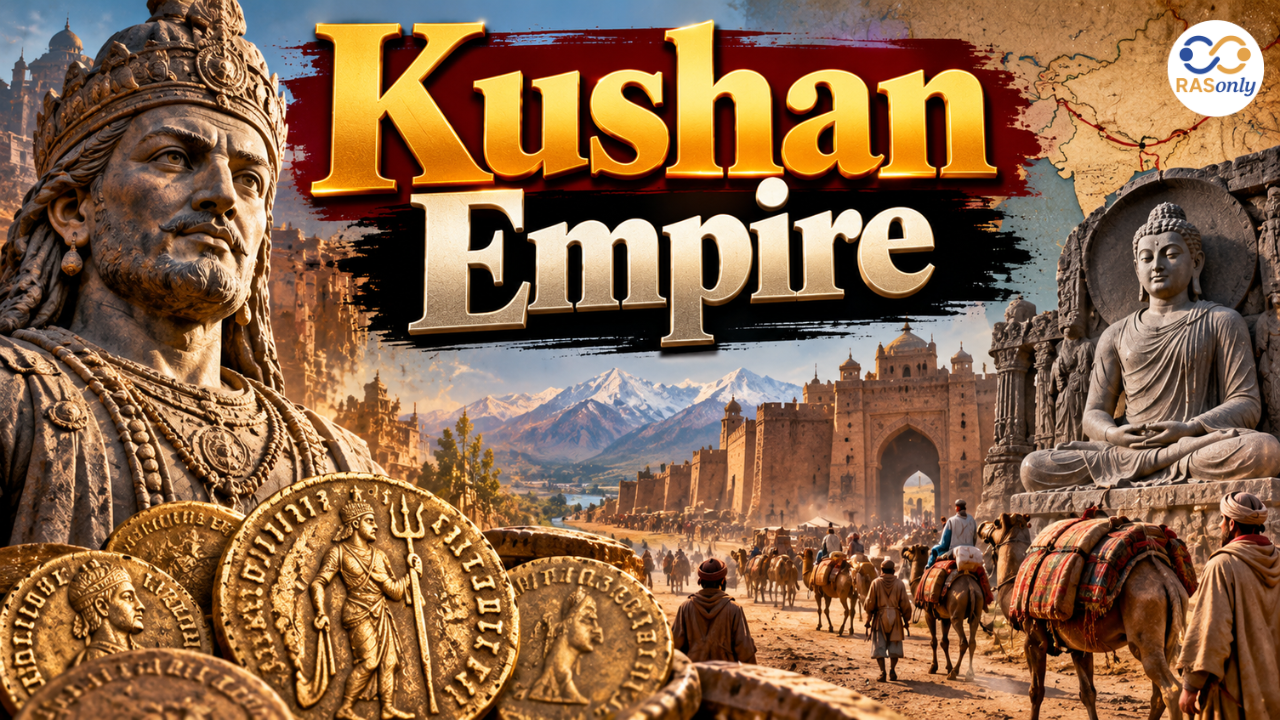
Kushan Empire: History, Rulers, Administration, Economy, Art, Decline
Indian Pressure Belts & Winds Strategy for RAS 2026 (Complete Climatology Concepts, Winds, Monsoon, Maps, MCQs & Revision Plan)

Get in Touch with RASonly!

Learn the complete Pressure Belts & Winds Strategy for RAS 2026 including climatology concepts, Trade Winds, Westerlies, Polar Easterlies, Indian Monsoon, Jet Streams, maps, MCQs, and revision techniques. This detailed guide helps aspirants improve conceptual clarity, map practice, and Geography preparation for RAS Prelims 2026.

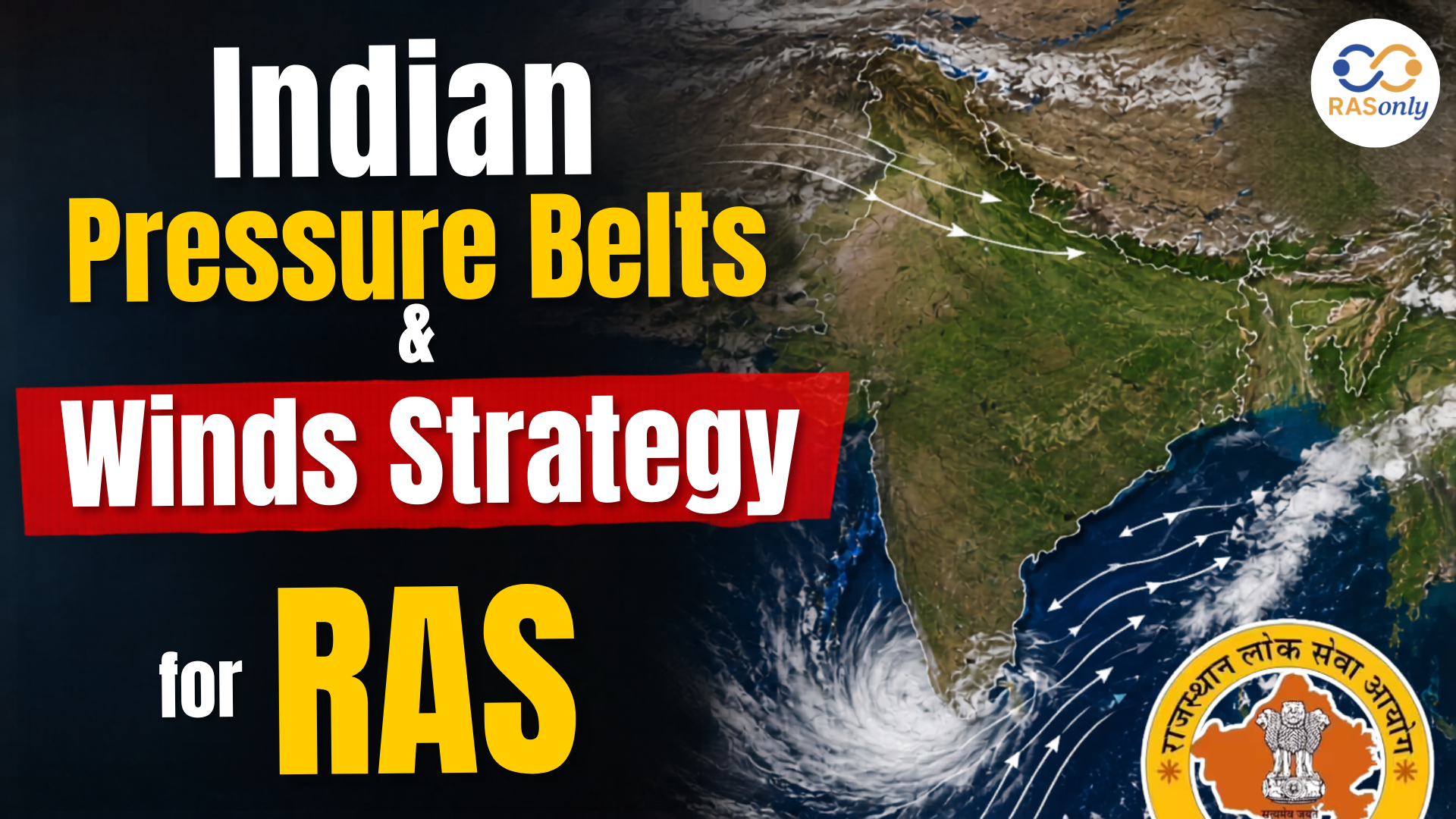
Indian Pressure Belts and Winds is one of the most important topics of Climatology under Geography for the RAS Prelims 2026 Exam as questions are frequently asked from concepts related to atmospheric pressure, pressure belts, planetary winds, monsoon mechanism, jet streams, local winds, and climatic systems. Climate Science is very conceptual and interrelated to many topics like pressure gradient, trade winds, westerlies, ITCZ, monsoon circulation, Coriolis force etc. which is difficult for many aspirants. But, if you follow the correct approach with the help of diagrams, Pressure Belts and Winds is one of the highest scoring parts in Geography.
Physical Geography, Indian Climate, atmospheric circulation, monsoon systems, environment geography and climatic regions are still a major focus point of the latest RAS syllabus in the General Studies section. Questions are generally conceptual, statement based, map based, and related to Indian monsoon, distribution of precipitation, jet streams, climate change and global atmospheric circulation. Instead of rote memorization, the strategy for the smart Indian Pressure Belts & Winds for RAS 2026 should emphasize conceptual clarity, diagrams, maps, MCQ practice, and repeated revision.
Why Pressure Belts & Winds are Important for RAS 2026
Pressure Belts and Winds are the backbone of climatology; most of the climatic conditions, ocean currents, cyclones, rainfall distribution and weather systems of the world are dependent on pressure and movement of air in the atmosphere. Conceptual and application based questions on winds, pressure systems and Indian monsoon are asked frequently by RAS.
Benefits of Strong Climatology Preparation
- Improves Physical Geography preparation
- Helps in Indian Monsoon topics
- Useful for Environment & Climate Change
- Strengthens map-based Geography understanding
- Improves conceptual clarity in climatology
- Helpful in both Prelims and Mains
What are Pressure Belts?
Pressure Belts are the belts of high & low pressure that occur at various latitudes of the Earth because of differential heating and rotation of the Earth. These belts regulate the world wind circulation, rainfall and climatic conditions.
Main Factors Responsible for Pressure Belts
- Unequal heating of Earth
- Rotation of Earth
- Temperature differences
- Air density variations
- Rising and sinking air movement
Understanding pressure belts conceptually is extremely important because all planetary winds originate from these pressure systems.
Major Pressure Belts of the Earth for RAS 2026
The pressure belts are one of the most significant concepts in Climatology as they have direct impact on the system of winds in the world, ocean currents, desert, rainfall, and monsoon circulation. Each aspirant should concentrate on formation, location, characteristics and climatic importance of each pressure belt.
Important Pressure Belts Table
| Pressure Belt | Location | Main Feature |
|---|---|---|
| Equatorial Low Pressure Belt | 0°–10° | Rising hot air & heavy rainfall |
| Subtropical High Pressure Belt | 25°–35° | Descending dry air |
| Subpolar Low Pressure Belt | 60°–65° | Cyclonic activity |
| Polar High Pressure Belt | 90° | Cold dense sinking air |
Comparative revision through tables and diagrams makes climatology much easier to remember for RAS Geography preparation.
Equatorial Low Pressure Belt Strategy
The Equatorial Low Pressure Belt forms as a result of strong heating near the Equator. The warm air rises continually, leaving behind a low pressure area called the Doldrums or ITCZ (Inter Tropical Convergence Zone).
Important Features
- Located near the Equator
- Intense convectional rainfall
- Rising warm air
- Calm surface winds
- High humidity throughout the year
Important Terms
- Doldrums
- ITCZ
- Convectional rainfall
Smart Preparation Tips
- Learn ITCZ movement carefully
- Link with Indian monsoon
- Revise rainfall mechanism visually
- Practice conceptual MCQs
Subtropical High Pressure Belt Strategy
The Subtropical High Pressure Belts are produced by the descending cold air from the upper atmosphere at about 30° latitude in both hemispheres. These belts are also known as Horse Latitudes.
Important Features
- Descending dry air
- Stable atmospheric conditions
- Desert formation regions
- Calm winds
Important Examples
- Sahara Desert
- Arabian Desert
- Australian Desert
Smart Strategy
- Link deserts with pressure belts
- Understand descending air conceptually
- Revise horse latitudes repeatedly
Subpolar Low Pressure Belt Strategy
The Subpolar Low Pressure Belts are positioned around 60° latitudes and are formed due to the interaction between warm westerlies and cold polar easterlies, resulting in cyclonic activity and weather instability.
Important Features
- Cyclonic storms common
- Meeting zone of warm & cold winds
- Frequent rainfall
- Dynamic origin
Preparation Tips
- Focus on cyclonic activity
- Understand frontal systems
- Practice climate-related MCQs
Polar High Pressure Belt Strategy
Polar High Pressure Belts form at the poles when the very cold air becomes thick and dense and sinks down, forming high pressure.
Important Features
- Extremely cold climate
- Dry conditions
- Descending dense air
- Polar easterlies originate here
Smart Strategy
- Link with polar winds
- Revise cold air subsidence concept
- Practice pressure belt comparison questions
Planetary Winds Strategy for RAS 2026
The Trade Winds flow from the subtropical high pressure belts to the Equatorial Low pressure belt. Because of the "Coriolis effect" they turn into the "Northeasterly Trade Winds" in the Northern hemisphere and the "Southeasterly Trade Winds" in the Southern hemisphere.
Major Planetary Winds Table
| Wind Type | Direction | Origin |
|---|---|---|
| Trade Winds | East to West | Subtropical High to Equatorial Low |
| Westerlies | West to East | Subtropical High to Subpolar Low |
| Polar Easterlies | East to West | Polar High to Subpolar Low |
Trade Winds Strategy
Trade Winds are generated by Sub Tropical high pressure belts and blow towards Equatorial low pressure belt. Due to the Coriolis force they become Northeasterly Trade Winds in the Northern hemisphere and Southeasterly Trade Winds in the Southern hemisphere.
Important Features
- Permanent planetary winds
- Blow toward Equator
- Moisture-bearing over oceans
- Important for monsoon mechanism
Smart Preparation Tips
- Revise Coriolis effect carefully
- Link trade winds with monsoon
- Practice wind-direction diagrams
Westerlies Strategy
Important planetary winds are the westerlies which flow from the subtropical high pressure belts to the subpolar low pressure belts at the middle latitudes. These winds have a great influence on temperate climate, cyclonic activity and Western Disturbances and hence are very important for the preparation of RAS Geography and climatology.
Important Features
- Blow from west to east
- Stronger in the Southern Hemisphere
- Bring cyclonic rainfall
- Important for temperate climatic regions
- Influence Western Disturbances in India
Smart Strategy
- Link Westerlies with Western Disturbances
- Focus on temperate climate regions through maps
- Understand wind direction conceptually
- Practice map-based climatology MCQs regularly
Polar Easterlies Strategy
The Polar Easterlies are cold and dry winds blowing from the Polar High Pressure Belts towards the Subpolar Low pressure Belts. These winds primarily control the climatic conditions and global system of atmospheric circulation in the polar regions.
Important Features
- Cold and dry planetary winds
- Blow from east to west
- Originate from polar regions
- Influence polar climatic conditions
- Meet Westerlies near subpolar regions
Smart Strategy
- Compare Polar Easterlies with Trade Winds and Westerlies
- Revise global wind circulation diagrams repeatedly
- Focus on pressure belt linkage carefully
- Practice conceptual MCQs regularly
Indian Monsoon & Pressure Belt Linkage Strategy
Indian Monsoon is a major branch of Climatology for RAS as it has direct linkages with pressure belts, movements of ITCZ, trade winds, jet streams and seasonal land-sea breezes. Conceptual understanding of the monsoon circulation is extremely important when it comes to solving Geography and Environment questions.
Important Topics
- ITCZ shift
- Southwest Monsoon
- Northeast Monsoon
- Tibetan Plateau
- Mascarene High
- Jet Streams
Smart Strategy
- Understand monsoon mechanism visually through diagrams
- Revise seasonal pressure shifts carefully
- Link monsoon circulation with trade winds
- Practice map-based and statement-based MCQs
- Focus on Indian rainfall distribution patterns
Jet Streams Strategy for RAS 2026
Jet Streams are fast-moving upper atmospheric winds that play a major role in Indian weather systems, monsoon circulation, cyclonic activity, and seasonal climate changes. Questions from Jet Streams are usually conceptual and linked with Indian Monsoon in RAS Geography.
Important Jet Streams Table
| Jet Stream | Importance |
|---|---|
| Subtropical Westerly Jet | Winter weather & Western Disturbances |
| Tropical Easterly Jet | Southwest Monsoon |
| Somali Jet | Monsoon intensification |
Smart Preparation Tips
- Learn seasonal shift of Jet Streams carefully
- Link Jet Streams with Indian Monsoon mechanism
- Practice map-based climatology questions
- Revise winter vs summer atmospheric circulation
- Focus on monsoon-related PYQs
Local Winds Strategy for RAS 2026
Local winds are temporary regional winds due to temperature and pressure differences over smaller geographical areas. Important local wind system (hot and cold) questions are often asked in competitive exams.
Important Local Winds Table
| Wind | Region |
|---|---|
| Loo | Northern India |
| Chinook | Rocky Mountains |
| Foehn | Alps Mountains |
| Mistral | France |
| Bora | Adriatic Region |
| Sirocco | Sahara to Mediterranean |
Smart Strategy
- Revise hot vs cold winds comparatively
- Practice map-based wind locations regularly
- Focus more on Indian local winds
- Learn regional climatic effects of local winds
- Use comparison tables for quick revision
Map Practice Strategy for Pressure Belts & Winds
In Climatology, map practice is of great importance as many RAS Geography questions are directly related to pressure belts, global wind circulation, monsoon directions and climatic regions of the world. Visual learning helps to retain information and clarify concepts.
Important Areas to Practice
- Pressure belt locations
- Trade wind zones
- Westerlies regions
- Monsoon wind directions
- Jet Stream paths
Smart Map Practice Tips
- Practice blank world maps regularly
- Draw wind direction diagrams repeatedly
- Revise pressure belt shifts visually
- Link maps with Indian Monsoon concepts
- Practice climate-region mapping questions
Best Note-Making Strategy for Pressure Belts & Winds
Pressure Belts and Winds have many interconnected ideas, diagrams and atmospheric circulation systems, which makes it very important to have proper short notes to be revised before the exam.
Smart Notes Strategy
- Prepare flowcharts and atmospheric diagrams
- Make wind comparison tables
- Draw pressure belt sketches regularly
- Write one-line factual notes
- Revise notes every week
Best Notes Format
| Notes Type | Purpose |
|---|---|
| Diagrams | Better visual understanding |
| Flowcharts | Fast conceptual revision |
| Comparison Tables | Avoid confusion between winds |
| One-Line Notes | Quick final revision |
Pressure Belts & Winds MCQ Practice Strategy
Most of the Climatology questions are conceptual, diagram oriented and statement oriented type questions and need to be practiced regularly to achieve accuracy and build confidence for RAS Prelims.
Best MCQ Practice Method
- Solve topic-wise MCQs daily
- Practice PYQs regularly
- Analyze wrong answers carefully
- Revise weak concepts repeatedly
- Practice map-based Geography questions
Important Focus Areas
- Pressure belt locations
- Wind directions
- Coriolis Force
- ITCZ movement
- Monsoon mechanism
Most Important Pressure Belts & Winds Topics for RAS 2026
There are some topics in climatology, which are repeatedly asked in RAS Prelims as they are the backbone of the whole topics related to the Indian Monsoon, world climate systems and atmospheric circulation. The aspirants should practice these high weightage topics on a regular basis in the form of diagrams and MCQs.
High-Weightage Topics
- Pressure Belts
- Trade Winds
- Westerlies
- ITCZ
- Indian Monsoon
- Jet Streams
- Local Winds
- Coriolis Force
Topic Priority Table
| Topic | Importance Level |
|---|---|
| Indian Monsoon | Very High |
| Pressure Belts | Very High |
| Trade Winds | High |
| Jet Streams | High |
| Local Winds | Moderate to High |
Common Mistakes Students Make in Climatology Preparation
Many aspirants find climatology difficult because they try to memorize the definitions without getting their mind conceptualized about the atmospheric circulation, wind flow and pressure systems. It causes confusion in answering the questions of statement and diagram.
Mistakes to Avoid
- Memorizing without diagrams
- Ignoring map practice
- Confusing wind directions
- Skipping monsoon concepts
- Avoiding MCQ practice
- Ignoring repeated revision
Smart Improvement Strategy
- Use visual learning methods
- Practice atmospheric diagrams regularly
- Compare different winds side-by-side
- Revise climatology concepts repeatedly
- Focus on conceptual understanding first
Revision Strategy for Pressure Belts & Winds
Revision is very critical in Climatology since concepts such as winds, pressure belts, monsoon circulation and atmospheric systems are interwoven and tend to be confused in the examination.
Smart Revision Tips
- Revise diagrams weekly
- Practice wind-direction maps regularly
- Use short comparison tables
- Focus on repeated PYQ concepts
- Revise monsoon mechanism visually
Best Revision Cycle
| Revision Stage | Focus Area |
|---|---|
| First Revision | Concept understanding |
| Second Revision | Maps & diagrams |
| Final Revision | MCQs & quick notes |
How Toppers Prepare Climatology for RAS
Pressure Belts & winds is a chapter that most toppers do not mug up but prepare using conceptual understanding, diagrams, maps, and by practicing numerous MCQs. Their preparation strategy primarily emphasizes visualization, consistency in revision and clever linking of concepts.
Toppers’ Strategy
- Practice diagrams consistently
- Revise maps repeatedly
- Focus on conceptual understanding
- Solve PYQs regularly
- Prepare short revision notes
What Makes Toppers Different?
- Better conceptual clarity
- Strong visual memory
- Consistent revision habits
- Smart MCQ analysis
- Better map practice
Conclusion
Pressure Belts and Winds are among the most important climatology topics for RAS Prelims 2026 because they form the foundation of atmospheric circulation, Indian Monsoon, rainfall distribution, cyclones, climate systems, and environmental geography. Questions from these topics are usually conceptual, map-based, and statement-oriented, so aspirants should focus more on understanding atmospheric mechanisms instead of memorizing isolated facts.
A smart Pressure Belts & Winds preparation strategy for RAS 2026 should include diagrams, map practice, conceptual comparison, MCQ-solving, and repeated revision. Aspirants who regularly revise pressure systems, planetary winds, monsoon circulation, and Jet Streams through visual learning methods generally perform much better in Geography and Environment sections during the exam.
FAQs
Pressure Belts are zones of high and low atmospheric pressure formed due to unequal heating of Earth and atmospheric circulation.
Trade Winds, Westerlies, Polar Easterlies, Local Winds, and Jet Streams are the most important winds for RAS Geography preparation.
Indian Monsoon is important because many Geography and Environment questions are directly linked with rainfall, pressure systems, ITCZ movement, and Jet Streams.
Focus on conceptual clarity, diagrams, map practice, MCQs, atmospheric circulation, and repeated revision instead of rote memorization.
Yes, map practice is extremely important because many RAS Geography questions are map-based and linked with wind directions, monsoon flow, and climatic regions.

BEST SELLER
🏆 PRELIMS
RAS Pass
Prelims focused Hindi & English
₹399
✓
Prelims Topic-Wise Tests
✓
Subject-Wise Tests
✓
Full-Length Prelims Tests
✓
Daily Current Affairs Tests
✓
Prelims PYQs Tests
✓
Detailed Solutions & Analysis
✓
All Rajasthan Ranking
✓
Unlimited Reattempts
✓
Mains Tests
✓
Hindi & English Tests
✓
All Rajasthan Ranking
Trusted by 5,000+ Students
Post Category
- RAS Salary
- Result
- RAS Admit Card
- RAS Job
- RAS Cutoff
- Preparation Tips
- RAS Answer Key
- RAS Exam Analysis
- RAS Syllabus
- RAS Previous Year Papers
- RPSC RAS Exam Pattern
- RAS Interview
- RAS Exam Date
- RAS Vacancy
- RAS Test Series
- RAS Best Books
- RAS Preparation Resources
- RAS Coaching Centre
- History
- Polity
- Geography
- Economics
- Science
- Art and Culture
- RPSC RAS Application Form
- RPSC RAS Notification
- RAS Eligibility Criteria
- UPSC Exam
- RPSC RAS Mains
Visit Our RASonly Offline Center
Our Expert Faculty

Bhunesh Sir
Current Affairs · 13+ Yrs

Aamir Khan Sir
RAS-2017 · IIM Ahm.

Akash Sir
Polity · 8+ Yrs
Free Resources
Official Mobile App

RASOnly App
by OTSAdda · Free
Full Video Lectures
Mock Tests & PYQs
Daily Current Affairs
AI Mock Interview
Free Download · No subscription needed to install
RAS 2024 Toppers — RASonly
Rank 2
Virendra Charan
Rank 9
Bhoopinder Singh
Rank 26
Aanchal Nagpal
Rank 33
Lokendra Singh
Rank 45
Amar Rathore
Rank 46
Manasvini Verma

Join RASonly WhatsApp Community
Get daily current affairs, exam alerts, free study material and tips from expert faculty — right on WhatsApp.
Join for Free →RASonly Interview Guidance Program

Mr. Ashok Jain
Ex-Chief Secretary Govt of Rajasthan
- IAS officer of the 1981 batch, Rajasthan cadre.
- Passionate about mentoring the next generation of RAS officers with real-world insights.
- Got retired in Dec 2017 from the post of Chief Secretary of the state of Rajasthan.

Mr. Guru Charan Rai
Ex-ASP / SP in Jaisalmer
- Guru Charan Rai, IPS (Retd), retired as Inspector General of Police (Security), Rajasthan, Jaipur in 2017.
- Served as ASP and SP in Jaisalmer, Nagaur, Sri Ganganagar, Sawai Madhopur, Dausa, Sikar, and Karauli.
- He also held key positions as DIGP and IGP in the Law and Order division.

Mr. Rakesh Verma
Ex-IAS Officer, B.Tech, MBA, and M.A. (Economics)
- IAS officer of the 1981 batch and retired in Chief Secretary Rank.
- Civil servant of high repute and vast experience.
- Has been teaching UPSC CSE subjects for the last six years.


Daily Current Affairs for RAS Exam Preparation 2026

India Wins Gold in 10m Air Pistol
September 26, 2026
India’s Rank in Travel And Tourism Development Index 2026
September 26, 2026
India Wins Bronze Medal in Men’s Double Sculls
September 25, 2026