Gupta Empire, Founder, Time Period, Rulers, Map, Capital City
Empowered Panchayats, Prosperous Rural Rajasthan

Get in Touch with RASonly!

Rajasthan’s rural transformation focuses on empowered Panchayati Raj Institutions, women-led self-help groups, sustainable livelihoods, digital governance and climate-resilient infrastructure. Through inclusive planning, financial inclusion and water security initiatives, the state aims to build self-reliant Gram Panchayats and resilient communities, ensuring equitable growth and prosperity across all 44,000+ villages by 2047.

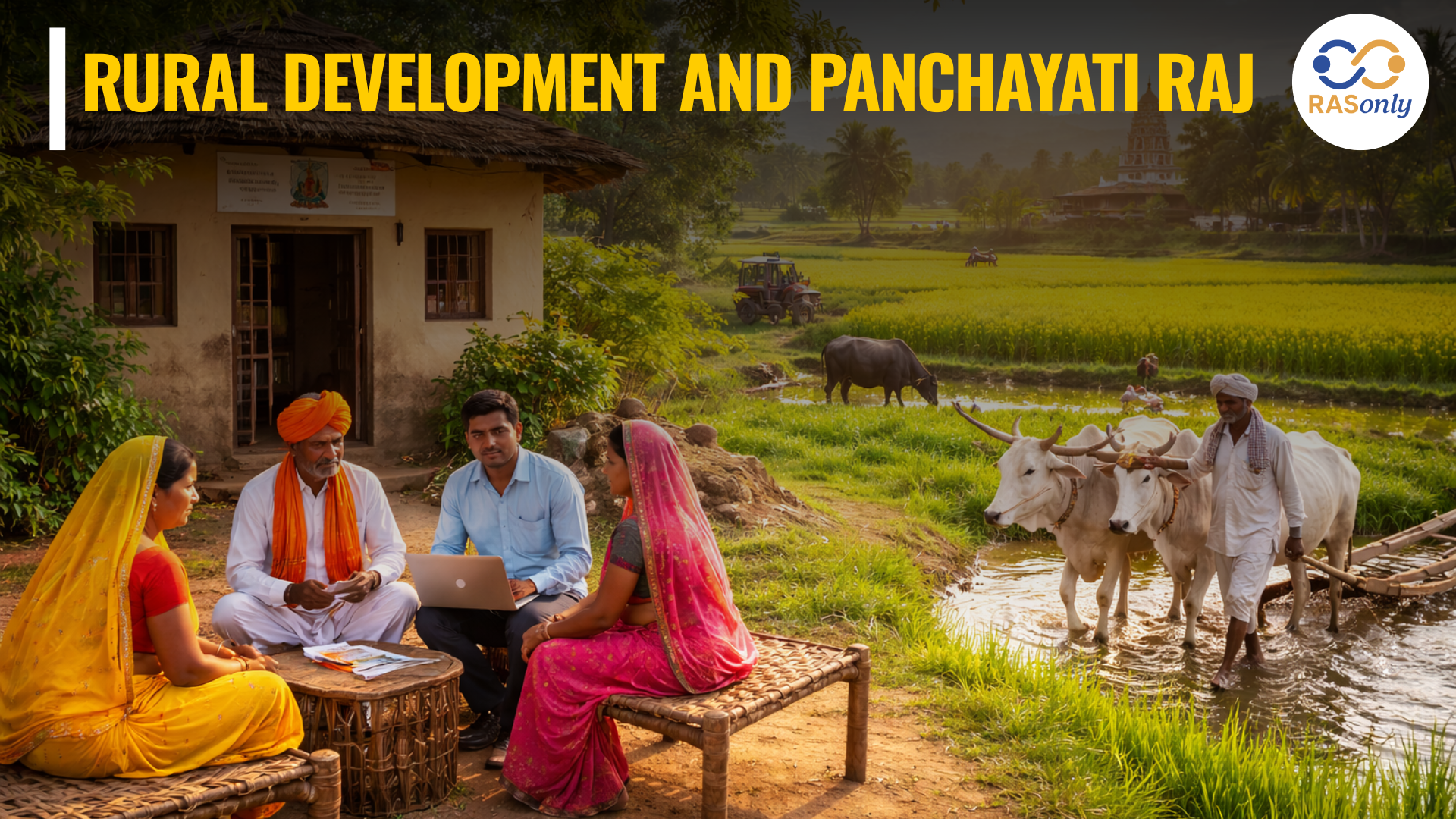
Rajasthan's soul lies in its 44,000+ villages, where agriculture and allied sectors contribute 26.92% to the state's economy. The Rural Development and Panchayati Raj Department plays a pivotal role in driving inclusive growth through a robust three-tier system of 11,329 Gram Panchayats, 355 Panchayat Samitis and 33 Zila Parishads.
Achieving the 'Viksit Rajasthan@2047' vision hinges on rural empowerment, preserving the state's cultural and ecological identity and accelerating development. Leveraging its extensive Panchayati Raj Institutions and the social capital of Self-Help Groups, the department is well-positioned to enable sustainable, transformative and inclusive rural progress across all development dimensions.
Enhance digital access by expanding rural broadband, promoting digital literacy and integrating AI tools to bridge urban-rural governance gaps.
Improve rural road networks to 100% connectivity at Gram Panchayat level, enhancing mobility, service delivery and economic linkages.
Promote renewable energy adoption, water conservation and rainwater harvesting; over 1,35,000 water works implemented.
Ensure women's active role in planning and monitoring; 51% women representatives in PRIs must be empowered beyond token participation.
Strengthen PRI-SHG convergence; over 50.25 lakh SHG women mobilised under RAJEEVIKA to drive last-mile services and community-led development.
Implementation of various initiatives to increase the number of women beneficiaries under schemes like Namo Drone Didi, Solar Didi, Lakhpati Didi, Bank Sakhi, Krishi Sakhi and Pashu Sakhi.
VISION 2047
By 2047, decentralised governance institutions have the desired capacities to function as vibrant and democratic system of governance to drive rural transformation through functional collaboration focusing on empowerment of rural communities, building inclusive and accessible infrastructure, livelihood security and income enhancement, water safety and security, environmental hygiene and sanitation for realisation of the overarching vision of gram swaraj.
Thrust Areas
Inclusive & Accessible Rural Infrastructure
Regional boards (Daang, Magra, Mewat) were created to address backwardness; improved roads, housing (PMAY), electrification (Saubhagya), LPG (Ujjwala) ensured integrated infrastructure reach to last mile gram panchayat.
Efficient System of Decentralised Governance
Over 2.59 lakh works under 15th Finance Commission and 2.38 lakh under 6th State Finance Commission have strengthened PRIs' role in decentralised planning, monitoring and delivery of rural services.
Livelihood Security & Income Augmentation
Rajasthan generated 3,166.14 lakh person-days under MGNREGS (2024-2025) and 50.25+ lakh women benefited from SHGs, enhancing non-agriculture enterprises, women owned alternative livelihood opportunities to reduce economic vulnerabilities.
Empowering Rural Communities
Strengthen rural infrastructure to promote self-employment for women and skill development for youth through region specific approach.
Safely Managed & Climate Resilient Water & Sanitation Services
Under SBM Phase-II, 8.77 lakh individual and 25,920 community toilets constructed, 42,780 villages declared ODF Plus; 1.35 lakh plus water conservation works completed under Jal Sanchay Yojana.
Partnerships for Rural Transformation
Panchayat Resource Centres and Program Units were established; convergence with Survey of India (Swamitva), SHGs and departments enabled coordinated planning, capacity building and SDG-aligned governance.
Rural Development
Decline in Multi-Dimensional Poverty
Between 2015-16 and 2019-21, Rajasthan's MPI headcount dropped from 28.86% to 15.31%, & between 2013-14 to 2022-23 with 1.87 crore people overcoming poverty through improved nutrition, sanitation, schooling and fuel access.
Women in Panchayati Raj Institutions
51% women representation in PRIs (2020) under 50% reservation; however, male proxy leadership (Sarpanch Pratinidhi) still restricts women's autonomy in exercising constitutional governance powers.
Financial Inclusion via SHGs
More than 50.25 lakh women in 4.21 lakh SHGs accessed INR 1,209 crore savings, INR 9,883.57 crore bank credit and INR 2,083.75 crore investment via SHGs, driving economic empowerment and service delivery.
MGNREGS & Rural Distress Relief
Rajasthan created 3,166.14 lakh person-days under MGNREGA 2024-25, second highest in India, with INR 10,012.96 crore during the year 2024-25 spent; online attendance via NMMS enhanced transparency and accountability in wage employment delivery.
Rural Housing & Scheme Convergence
State achieved 98.42% PMAY target (2016-22), integrating toilets (SBM), LPG (Ujjwala), water (Jal Jeevan) and electricity for comprehensive rural housing and livelihood support. 4,94,754 (99.2%) houses sanctioned against 4,98,468 target allotted by MoRD for the Year 2024-25.
Regional Development Boards
Since 2014-15, Daang, Magra and Mewat boards completed 91%, 91% and 89% respectively of 18,580 works worth INR 929 crore to uplift backward rural regions through infrastructure.
Thematic SDG Alignment
LSDG indicator framework enables monitoring of inclusive, sustainable and climate-resilient rural development.
Rashtriya Gram Swaraj Abhiyan (RGSA)
RGSA (2022-26) ensures capacity-building for PRIs via Program Management Units, SPRCs, DPRCs and BPRCs; funding split 60:40 between Centre and State to localise SDGs effectively.
Gram Panchayat Development Plan (GPDP)
GPDPs integrate LSDGs and departmental schemes from 2nd October to 31st March; resource pooling includes Finance Commission grants, sectoral funds and panchayat revenue for grassroots implementation.
Swamitva Yojana
Launched in 2020, Swamitva uses drones for digital land mapping and ownership issuance through Panchayati Raj, Revenue Department and Survey of India coordination, promoting land security.
Swachh Bharat Mission (Rural)
SBM Phase-II (2020-25) enabled construction of 8.77 lakh individual and 25,920 community toilets; 42,404 villages were declared ODF Plus Model under Rajasthan Rajya SBM (Rural) Jaipur society.
Watershed & Soil Conservation
Under PMKSY 1.0, 46 lakh hectares of land were treated; 7.5 lakh hectares of land were targeted in PMKSY 2.0.
GP-Level Resource Mobilisation
Over 2.59 lakh works completed under 15th CFC using INR 15,332.97 crore; 2.38 lakh works executed via INR 17,750 crore from 6th SFC, boosting infrastructure and decentralisation at gram panchayat level.
Rajasthan Grameen Aajeevika Vikas Parishad (RGAVP)
Launched in 2010, RGAVP supports more than 50.25 lakh women via 4.21 lakh SHGs, 31,626 Village Organisations and 1061 Cluster Federations, enhancing sustainable livelihood and women-led development.
Goals
Rural Development
| INDICATORS | TARGET (2030) | TARGET (2035) | TARGET (2040) | TARGET (2047) |
|---|---|---|---|---|
| Infrastructure | • Anganwadi, CHC/PHC, Rural connectivity etc. • Functional Panchayat Bhawans in all GPs • Increase in renewable energy access (solar) • 100% access to healthcare, education & sanitation • Land development: soil conservation & levelling • 100% achievement of the goal "housing for all" till 2028-29 |
• 15000 Anganwadi building works in convergence with ICDS (MGNREGA) • 4.0 lakh ha. pasture and waste land & fodder farm development (MGNREGA) • Developing of Solar Didi cadre aimed at promoting renewable energy solutions in rural Rajasthan |
• Developing playgrounds and sports infrastructure • Creating rural markets and shops to support more than 80% local economies |
• Develop rural storage and warehousing to reduce post-harvest losses • MGNREGA can support 100% GPs for sustainable agriculture practices |
| Women Empowerment & Financial Inclusion | Setting up 2-3 digital literacy centers for women at each block level | To ensure the sustainability of digital literacy, these centres will be strengthened through regular and close monitoring by BPMU and DPMU staff. Saksham Centres will also function as digital and financial empowerment hubs, promoting digital transactions and enhancing financial literacy among SHG women and rural communities | Setting up 2-3 hostels and shelters for women at each block level | Developing block-level community centres for women's interaction, healthcare, education & skill development |
Goals
| INDICATORS | TARGET (2030) | TARGET (2035) | TARGET (2040) | TARGET (2047) |
|---|---|---|---|---|
| Diversified Economy | Contribution of non-farm sector to rural GDP, growth in rural services and tourism | • Establish 5,000 new MSMEs in sectors like textiles, handicrafts, food processing, agro-based industries, leather goods and construction materials under Start-Up Village Entrepreneurship Programme, One Stop Facility, Micro Enterprise Development & Incubator • Formalise 80% of traditional artisans with access to UDYAM registration, marketing support, and credit |
Develop and promote rural tourism initiatives, such as homestays & farm stays at each GP | 100% rural SMEs established with employment generation, promote agro-processing, value addition & food industries |
| Livelihood | Strengthening value chains to boost local product competitiveness and market reach | Developing producer enterprises in the leather sector and food service cluster, convert existing mature producer groups into producer companies with full legal, governance and business capability | Creating market linkages for 70% rural products to ensure better prices and opportunities | Supporting livelihoods through afforestation, horticulture, animal husbandry & ensure market linkages for all products |
| Social Inclusion | Community Engagement, Awareness and Outreach, Awareness Generation | Enhance institutional mechanisms for social inclusion by building capacities, mainstreaming inclusive practices, and scaling successful community-led models | Promoting participatory planning, transparent monitoring and evaluation | Promoting social and cultural integration, improving governance |
Panchayati Raj
| INDICATORS | TARGET (2030) | TARGET (2035) | TARGET (2040) | TARGET (2047) |
|---|---|---|---|---|
| Governance | • Dedicated manpower for waste management, water conservation and e-governance at GP • Real time live display of Gram Sabha meetings (virtual Gram Sabha) • Active and visible inclusion of ward, Block, ZP level members and directors |
• Functional digital interface for Gram Sabhas with public grievance redressal • Block-level dashboards for program tracking • Partial deployment of financial advisors at GPs |
• Deployment of financial experts at GP level • Ward sabhas with virtual inclusion • Linking all GPs with digital process monitoring framework |
Smart & AI driven governance for transparent and timely process in all GPs |
| Digital Governance | 100% Digitalisation of all records | • Real-time updating of digitised records • 50% GPs integrating with GIS • Initial phase of cross-platform integration |
• Real-time dashboard • 100% GPs using GIS |
Cross-platform real-time integration |
| Service Delivery | 100% services online | • 75% of services accessible via single digital portal • Integration with state and national digital service systems |
100% services online | Smart villages, managed locally |
| Financial Stability | • 100% fund utilisation • 10% Own source of revenue (OSR) of total fund devolution to PRIs |
• 100% fund utilisation sustained • 17.5% OSR of total fund devolution to PRIs |
25% Own source of revenue (OSR) of total fund devolution to PRIs | 50% Own source of revenue (OSR) of total fund devolution to PRIs |
| Social Inclusion | • 100% saturation of marginal sections (women, SC, ST, OBC, Special abled person etc) for beneficiary schemes • Assuring minimum proportional representation of marginal section |
• Representation of marginalised groups in planning bodies • Functional referral system for specialised needs |
Dedicated homes for specialised marginal groups in each block | Dedicated homes for specialised marginal groups at cluster of GPs |
| Sanitation | 100% Solid & Liquid waste management | • FSM infrastructure rollout in GPs with >5,000 population • 50% waste reprocessing facilities operational |
• 100% FSM & sewerage networking in GPs with more than 5000 population • 100% waste processing with re-use |
• Zero liquid discharge • Revenue generation from waste processing |
Mid-Term Action Plan
- Redesign MGNREGS to include semi-skilled jobs in water, sanitation and infrastructure maintenance to create sustainable employment for rural youth and improve community-level service delivery systems.
- Leverage MGNREGS for disaster responsiveness by front loading benefits to vulnerable households during shocks, enhancing resilience and ensuring livelihood continuity during natural calamities and pandemics.
- To empower women in rural areas and generate new employment opportunities for underserved communities, activities related to the rural care economy such as creches, elderly care and disability services will be developed.
- Engage SHGs in rural asset management, including roads and water systems, strengthening community ownership, decentralised governance and sustained employment for women-led collectives.
- Create SHG-run incubation cum resource centres in every district to promote rural entrepreneurship, facilitate innovation and foster local employment generation through skilling and mentoring support.
- Convert underutilised panchayat assets into business incubation hubs to support rural startups, improve productive asset utilisation, stimulate grassroots economic activity and enterprise development.
- Self-Reliant Gram Panchayats
Develop new sources of income to build self-reliant Gram Panchayats through initiatives like rural tourism, promotion of cottage and small industries, installation of solar plants, establishment of fruit-vegetable markets, milk collection centers, and livestock haat bazaars.
- Link all farmers with Primary Agriculture Credit Societies to improve access to institutional credit, input financing and crop insurance schemes across Rajasthan's rural blocks.
- Ensure functional Har Ghar Jal connections for 100% rural households and service delivery institutions to achieve state-wide safe drinking water certification.
- Achieve 100% access to functional sanitation through safe, water-efficient and resilient toilets; introduce dry, bio and composting toilets in water-stressed or remote areas.
- Sustainable Use of Natural Resources
Promote responsible and efficient management of natural resources for long-term ecological balance and rural prosperity.
- Implement underground sewerage systems and waste segregation protocols in all gram panchayats with over 10,000 population to ensure public hygiene and sustainable waste management.
- Activate 100% Village Water & Sanitation Committees for asset maintenance, water budgeting and revival of traditional sources through community-led water management and MGNREGS linkage.
- Saturate rainwater harvesting structures and integrate water budgeting into GPDPs; adopt efficient irrigation techniques and promote crop choices suited for local water availability.
- Link 1 woman per MPI-poor household with SHGs; extend banking, smartphone and registry access to empower digital inclusion and financial literacy in remote areas.
- Integrate SHGs in GPDP formulation by enabling local planning roles, incorporating risk reduction and poverty reduction plans and institutionalising women's voices in governance.
- Revisit Eleventh Schedule devolution mandates and ensure functional funds, functionaries and infrastructure (mini secretariats) to PRIs with ICT-enabled and accountable rural administration systems.
- Ensure each GP has own revenue source empower gram panchayats to mobilise local revenues for sustainable development and reduce grant dependency.
- Institutionalise annual women and child audits, gender budgeting in GPDPs and strengthen Bal Panchayats, Mahila Sabhas and child grievance redressal systems at the local level.
- Promote inclusive rural infrastructure, including ramps, handwashing facilities, functional toilets, open gyms, solar lights, libraries and accessible public spaces for elderly and specially abled person.
- Create RD&PR-led Rural Partnerships Forum with CSR Authority, UN, CSOs, academia and experts to co-develop and fund pilots, infrastructure, innovations and capacity-building under Vision 2047.
- Villages near cities will be developed as satellite towns to reduce urban migration and boost local development.
Long-Term Action Plan
- Ensure 100% household coverage with wage/self-employment; integrate social protection measures for disaster response to enhance long-term livelihood and income security in rural areas.
- Every Gram Panchayat will have a dynamic website, showcasing local governance, services, SHG products and enabling e-governance, digital marketing and entrepreneurship across villages.
- Link every village entrepreneur to market chains, product quality benchmarks and forward linkages for sustained income, rural branding and global product competitiveness.
- Promote Circular Economy in rural Rajasthan, enabling SHGs and GPs to lead micro-enterprises focused on recycling, zero-waste production and sustainable livelihoods.
- Achieve 100% farmer coverage under PMFBY, establish agri-mandis in all blocks with e-NAM integration and ensuring up to 15% of the total government outlay on agriculture.
- Install tamper-proof water meters in 100% households, regulate wastage and implement differentiated tariffs ensuring 80% recovery for financially viable rural water management systems.
- Establish Rajasthan State Water Grid, utilising inter-basin transfers and AI-based monitoring, ensuring year-round, equitable and climate-resilient water access for all villages.
- Ensure zero-waste villages by installing modular wet waste machines, underground sewer systems and biodegradable toilets in all 44,000+ revenue villages of Rajasthan.
- Institutionalise women's role in WASH governance, enabling O&M decisions, tariff collection, surveillance and community-led monitoring through SHG federations and VWSCs in every GP.
- Transition from Village Poverty Plans to Prosperity Plans, aligning SHGs, GPDPs, MGNREGS and RF/CIF to promote self-reliant, inclusive development at GP level.
- Ensure one OGOP per SHG, with credit, logistics, e-commerce and brand visibility support through partnerships with retail chains, aggregators and corporations.
- Foster adolescent girls' empowerment through digital, technical and entrepreneurial training under SHG ecosystems to drive intergenerational leadership and innovation in rural communities.
- Achieve 100% digitisation of GP services, paperless workflows, Ease of Living Index and geospatial participatory planning via Panchayat Portals and mobile-first governance tools.
- Ensure at least 30% of GP budget from OSR, incentivise revenue generation, credit linkages and panchayat-level market borrowing for infrastructure and social programs.
- Achieve universal secondary education, zero dropout, 100% literacy and rural internships linked to higher education through SDMCs and local entrepreneurship exposure.
- Zero stunting, anaemia and malnutrition in children; increase life expectancy by integrating digital health records, Ayushman Bharat, nutrition campaigns and rural wellness centers.
- 100% rural habitation saturation with piped water, toilets, roads and drainage; use sensors and AI to monitor and maintain rural roads in real time.
- Establish public libraries and digital parks in each GP, build EV charging networks and transform rural nodes into green, smart and inclusive growth hubs.
- Ensure gender and child budgeting in 100% GPs, strengthen Mahila and Bal Panchayats and integrate their voices in planning, grievance redressal and fund allocation.
- Institutionalise CSR, Unnat Bharat Abhiyan and GP-SHG convergence to co-create sustainable development projects under a decentralised, "whole-of-society" rural development ecosystem.
Empowered Panchayats, Resilient Communities - Building Inclusive, Green and Prosperous Rural Rajasthan by 2047.
BEST SELLER
🏆 PRELIMS
RAS Pass
Prelims focused Hindi & English
₹399
✓
Prelims Topic-Wise Tests
✓
Subject-Wise Tests
✓
Full-Length Prelims Tests
✓
Daily Current Affairs Tests
✓
Prelims PYQs Tests
✓
Detailed Solutions & Analysis
✓
All Rajasthan Ranking
✓
Unlimited Reattempts
✓
Mains Tests
✓
Hindi & English Tests
✓
All Rajasthan Ranking
Trusted by 5,000+ Students
Post Category
- RAS Salary
- Result
- RAS Admit Card
- RAS Job
- RAS Cutoff
- Preparation Tips
- RAS Answer Key
- RAS Exam Analysis
- RAS Syllabus
- RAS Previous Year Papers
- RPSC RAS Exam Pattern
- RAS Interview
- RAS Exam Date
- RAS Vacancy
- RAS Test Series
- RAS Best Books
- RAS Preparation Resources
- RAS Coaching Centre
- History
- Polity
- Geography
- Economics
- Science
- Art and Culture
- RPSC RAS Application Form
- RPSC RAS Notification
- RAS Eligibility Criteria
- UPSC Exam
- RPSC RAS Mains
Visit Our RASonly Offline Center
Our Expert Faculty

Bhunesh Sir
Current Affairs · 13+ Yrs

Aamir Khan Sir
RAS-2017 · IIM Ahm.
Akash Sir
Polity · 8+ Yrs
Free Resources
Official Mobile App

RASOnly App
by OTSAdda · Free
Full Video Lectures
Mock Tests & PYQs
Daily Current Affairs
AI Mock Interview
Free Download · No subscription needed to install
RAS 2024 Toppers — RASonly
Rank 2
Virendra Charan
Rank 9
Bhoopinder Singh
Rank 26
Aanchal Nagpal
Rank 33
Lokendra Singh
Rank 45
Amar Rathore
Rank 46
Manasvini Verma

Join RASonly WhatsApp Community
Get daily current affairs, exam alerts, free study material and tips from expert faculty — right on WhatsApp.
Join for Free →RASonly Interview Guidance Program

Mr. Ashok Jain
Ex-Chief Secretary Govt of Rajasthan
- IAS officer of the 1981 batch, Rajasthan cadre.
- Passionate about mentoring the next generation of RAS officers with real-world insights.
- Got retired in Dec 2017 from the post of Chief Secretary of the state of Rajasthan.

Mr. Guru Charan Rai
Ex-ASP / SP in Jaisalmer
- Guru Charan Rai, IPS (Retd), retired as Inspector General of Police (Security), Rajasthan, Jaipur in 2017.
- Served as ASP and SP in Jaisalmer, Nagaur, Sri Ganganagar, Sawai Madhopur, Dausa, Sikar, and Karauli.
- He also held key positions as DIGP and IGP in the Law and Order division.

Mr. Rakesh Verma
Ex-IAS Officer, B.Tech, MBA, and M.A. (Economics)
- IAS officer of the 1981 batch and retired in Chief Secretary Rank.
- Civil servant of high repute and vast experience.
- Has been teaching UPSC CSE subjects for the last six years.
Related Post




Daily Current Affairs for RAS Exam Preparation 2026

Khelo Rajasthan Campaign
October 09, 2026
Apache Helicopters 30 mm Chain Gun Tested for Aerial...
October 09, 2026
CM Bhajan Lal Sharma Launches Rajasthan Portals
October 08, 2026