Chalukya Dynasty: Origin, Rulers, Three Branches and Architecture
Rajasthan Water Security Vision 2047

Get in Touch with RASonly!

Rajasthan’s Vision 2047 focuses on achieving water security through improved governance, advanced technology, groundwater recharge, irrigation expansion and community participation. The roadmap promotes sustainable water management, equitable distribution and climate resilience to ensure long-term water availability for agriculture, households and industries.

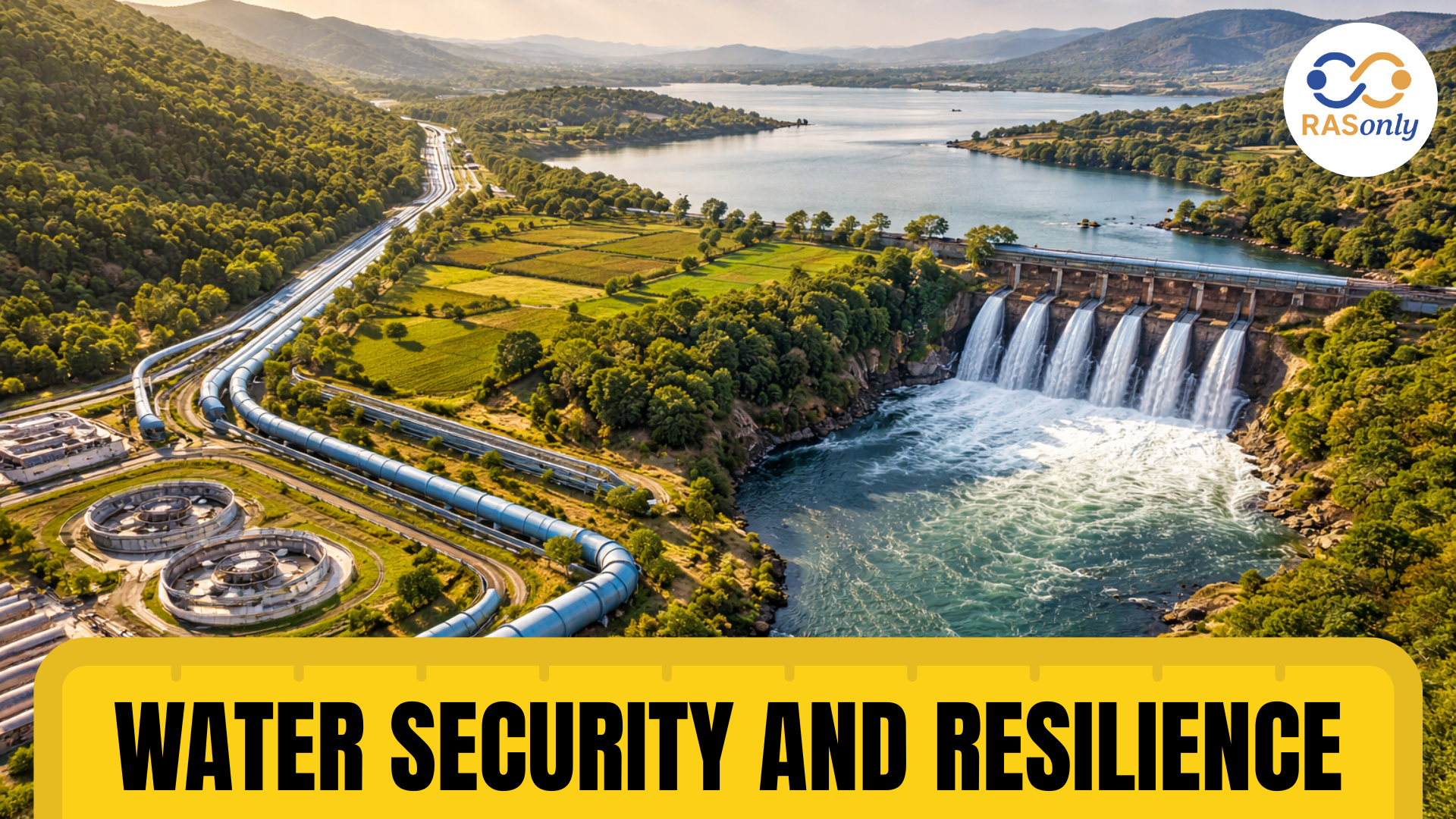
Rajasthan, India's largest state, faces severe water scarcity, with per capita availability projected to drop to 450 cubic meters by 2050. Despite covering 10.41% of India's area, it has only 1.16% of the country's surface water.
The state is implementing Jal Shakti Abhiyan and MJSA 2.0 to ensure sustainable water management and source sustainability for drinking, agriculture and industrial use.
Rajasthan's surface water availability
25.38 BCM
Inter-State agreements allocate an additional
17.88 BCM of water
Thar Desert
covers two-third of the state, worsening water scarcity
Severe famine conditions occur due to
erratic monsoon patterns
Only two river basins,
Mahi and Chambal,
have excess water
Average annual rainfall
531 mm, nearly half of India's average
Non-agricultural water demand projected to rise to
8.07 BCM by 2045
Jal Jeevan Mission targets
100% household tap water coverage by 2028
Mukhyamantri Jal Swavlamban Abhiyan (MJSA) 2.0
focuses on groundwater recharge
Rajasthan supports
18.70%
of India's livestock with limited water
VISION 2047
By 2047, Rajasthan will achieve water security through robust governance, sustainable conservation and equitable utilisation.
Ensuring availability, quality and resilience, the state will empower agriculture, communities and ecosystems, fostering long-term sustainability and prosperity while adapting to climate challenges for a water-secure and thriving Rajasthan.
Thrust Areas
Rana Pratap Sagar Dam, Rawatbhata
MANAGEMENT OF WATER RESOURCES (Center)
- INFORMATION AND TECHNOLOGY
- WATER QUALITY MONITORING AND SURVEILLANCE
- MANAGEMENT OF WATER SOURCES
- RECHARGE TECHNIQUE DEMONSTRATION
- WATER GOVERNANCE THROUGH REGULATORY REFORMS
- UNIVERSAL ACCESS TO 100% HOUSEHOLD IN JJM
- GREY WATER MANAGEMENT
Water secure Rajasthan through improved water management
MJSA 2.0 Expansion
The INR 11,200 crore budget under MJSA 2.0 aims to build 5 lakh water harvesting structures in 20,000 villages by 2030 to enhance water conservation.
Modified Parbati-Kalisindh-Chambal Project (Ram Jal Setu Link Project)
Modified PKC, now part of India’s River Linking Projects, will cost more than INR 80,000 crore and improve water availability for 17 districts, benefiting irrigation and industrial needs.
Severe Water Scarcity
50% of drinking water relies on groundwater but demand surge, surface water depletion and encroachment intensify Rajasthan’s water crisis.
Groundwater Over-Extraction
In 2024, Rajasthan extracted 17.05 BCM groundwater while only 11.37 BCM was recharged, reducing safe groundwater blocks from 203 (1984) to 37 (2024).
Declining Surface Water Availability
Catchment area encroachments, untreated sewage discharge and anicuts have reduced Rajasthan's surface water sources, worsening shortages for the growing population.
Groundwater Contamination
As of April 2024, 4.23 lakh households (24.52 lakh people) face water contamination from salinity, fluoride and nitrate due to excessive groundwater use.
Climate Change Impact
Frequent heat waves, erratic monsoons and geological limitations disrupt groundwater recharge, worsening water scarcity and increasing drought vulnerability.
Monsoon Dependency
Rajasthan’s rainfall variability directly impacts agriculture, groundwater recharge and drinking water supply, making the state prone to droughts and seasonal water shortages.
Revitalisation of Traditional Rainwater Harvesting
Rajasthan’s historic rainwater systems (Johads, Kunds, Baoris, Talabs, etc.) require urgent rejuvenation to enhance rainwater storage and climate resilience.
Need for Stronger Community Participation
Lack of public engagement in water management hinders sustainable solutions, enhanced community participation is crucial for effective water conservation.
RAJASTHAN STATE DEPTH TO WATER LEVEL MAY 2024
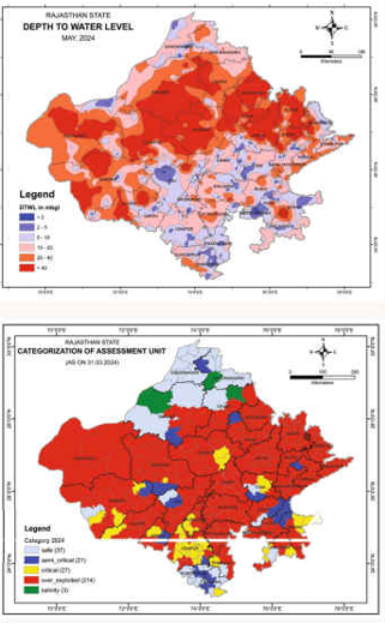
RAJASTHAN STATE CATEGORIZATION OF ASSESSMENT UNIT (AS ON 31.03.2023)
| INDICATOR | HOUSEHOLDS | POPULATION |
|---|---|---|
| SALINITY | 3,48,141 | 20,11,800 |
| FLUORIDE | 10,053 | 58,264 |
| NITRATE | 64,285 | 3,79,063 |
| IRON | 623 | 3,455 |
| TOTAL | 4,23,102 | 24,52,582 |
Population and households affected by chemical contaminated groundwater in Rajasthan as on 01.04.2025
Water Management
Expansion of Irrigation Projects
Rajasthan’s irrigation potential has increased from 4 lakh ha (pre-Independence) to 39.20 lakh ha with 108 Major and Medium projects and over 4,000 minor projects; yet, demand continues to outpace supply.
Modified Parbati-Kalisindh-Chambal Project (Ram Jal Setu Link Project)
More than INR 80,000 crore Modified PKC will transfer surplus monsoon water to 17 districts, providing drinking and industrial water and 2.82 lakh ha irrigation coverage.
Declining Per Capita Water Availability
Water availability dropped from 500 cubic meters per person and is projected to reach 450 cubic meters by 2050, far below the 1,000 cubic meter global standard.
Water Supply Uncertainty
Rainfall is highly variable and Rajasthan depends on inter-state water-sharing agreements, while only Mahi and Chambal basins have surplus water.
Inequity in Water Access
Rural-urban disparities, sectoral allocation imbalances and geographical inequalities lead to uneven drinking, agriculture and industrial water access.
Groundwater Depletion & Over-extraction
80% of Rajasthan’s area faces groundwater depletion; 50% of drinking water and 60% of irrigation rely on rapidly declining aquifers.
Deteriorating Groundwater Quality
Over-extraction leads to high salinity, fluoride and nitrate contamination, causing serious health risks in many regions.
Inefficient Water Management
Significant losses in drinking and irrigation sectors due to low operational efficiency, aging infrastructure and poor maintenance.
High Service Costs & Low Recovery
Water rates do not reflect scarcity, causing poor revenue collection, limited budget for repairs and outdated reservoir maintenance.
Lack of Stakeholder Participation
Weak ownership among Water User Associations (WUAs) results in poor irrigation project maintenance, canal mismanagement and revenue collection challenges.
Water Management
| INDICATORS | CURRENT STATUS | TARGET (2030) | TARGET (2035) | TARGET (2040) | TARGET (2047) |
|---|---|---|---|---|---|
| Universal access to safe water for all (%) | 56 | 95 | 95 | 100 | 100 |
| Universal access to safe water for all government institutions (%) | 65 | 95 | 95 | 100 | 100 |
| Groundwater extraction / Freshwater withdrawal (%) | 149.86 | <125 | <122 | <120 | <100 |
| Non-revenue Water loss (%) | 40 | <25 | <23 | <20 | <15 |
| Drinking Water supply frequency in all Urban Towns (256 towns) | > 96 hrs - 13 Towns | 0 Town | 0 Town | 0 Town | 0 Town |
| > 48 < 96 hrs - 33 Towns | 22 Towns | 0 Town | 0 Town | 0 Town | |
| > 24 < 48 hrs - 86 Towns | 80 Towns | 62 Towns | 32 Towns | 0 Town | |
| < 24 hrs - 114 Towns | 154 Towns | 194 Towns | 224 Towns | 100% Towns | |
| Water Storage from Rainwater & River Diversion (BCM) | 14.55 | 19.68 | 20.28 | 20.88 | 20.88 |
| Total Command Area (Lakh ha.) | 39.51 | 45.00 | 47.50 | 50.00 | 50.00 |
| Micro Irrigation System, under the command area (Lakh ha.) | 6.17 | 10.00 | 12.50 | 15.00 | 20.00 |
| Water Use Efficiency (%) | 35-40 | 50 | 55 | 60 | 60 |
| Formation of Water User Association (WUA) | 5,074 | All irrigation projects | All irrigation projects | All irrigation projects | All irrigation projects |
| Automation of Dams and Canals | Automation of gates at Mahi, Jawai, Narmada Canal, Chhapi, Gudha, Jawahar, Sagar, Rana Pratap Sagar, Kalisindh and Rajgarh has been completed | All major irrigation projects | All medium irrigation projects | All medium irrigation projects | All medium irrigation projects |
Mid-Term Action Plan
Har Ghar Jal Certification
Achieve 100% rural household tap water coverage, ensuring safe drinking water, sanitation and hygiene facilities in all schools, anganwadis and healthcare institutions.
Strengthened Water Governance
Establish institutional frameworks for bulk water transmission, village distribution management and promote Public-Private Partnerships (PPPs) for sustainable water infrastructure development.
Advanced Technology Integration
Implement AI, IoT sensors and Decision Support Systems (DSS) to optimise water demand, monitor groundwater extraction and enhance data-driven governance.
Real-Time Water Quality Monitoring
Deploy sensor-based monitoring and dashboard integration to detect water impurities and ensure safe drinking water for 4.20 lakh affected households by 2027.
Digital Water Metering
Introduce prepaid water meters in urban areas first, later expanding to rural regions for efficient monitoring and cost recovery.
Non-Revenue Water (NRW) Reduction
Establish NRW Cells at state and district levels, ensuring minimal water loss through smart metering, leak detection and volumetric water usage control.
Smart Water Dispensing Systems
Install smart-card-operated water kiosks in areas where piped networks are not feasible, ensuring safe drinking water access.
Grey Water Management & Recycling
Encourage wastewater reuse in agriculture and industry, ensuring Zero Liquid Discharge (ZLD) compliance in Pali, Bhilwara, Balotra, Udaipur and Kota.
Circular Economy in Water
Promote wastewater treatment for irrigation, industry and horticulture, with quality standards developed by IIT Jodhpur & ICAR.
Rainwater Harvesting & Storage
Adopt the lapodia model and construct 5 lakh water harvesting structures under MJSA 2.0, including storm water collection along roads and rooftop rainwater harvesting.
Groundwater Recharge & Control
Implement scientific deep exploration, aquifer testing, hydro-fracturing and Telemetry Digital Water Level Recorders (TDWLR) at gram panchayat levels.
Water Conservation Awareness
Establish Water Harvesting Theme Parks and launch rainwater harvesting awareness programs in schools, colleges and rural communities.
Inter-Basin Water Transfer Projects
Prioritise Sabarmati-Jawai floodwater diversion, Dewas III & IV projects and Chambal-Banas transfers to address district-level water deficits.
Climate Resilience & River Health
Implement downstream water release mandates, strengthen environmental protection and study Ghaggar floodwater harvesting for groundwater augmentation.
Smart Water Resource Management
Develop the Rajasthan State Water Informatics Center (RSWIC) to provide real-time hydrological forecasts and decision support systems for efficient water governance.
Automation in Water Infrastructure
Automate canals and dams using Supervisory Control and Data Acquisition (SCADA) to enhance water distribution efficiency.
Efficient Irrigation & Agriculture Water Use
Expand drip, sprinkler and pressurised irrigation. Integrate solar-powered micro-irrigation and promote low-water-consuming, high-value crops.
Equitable Water Distribution System
Implement water-sharing policies among sectors and regions, prioritising critical shortage areas for balanced distribution.
Micro-Watershed-Based Project Planning
Develop Upper High-Level Canal Project (42,000 ha. Irrigation), Parwan Project (2.01 lakh ha. irrigation + drinking water) and Dholpur Lift Project (39,980 ha. Irrigation).
Community Participation & Water User Associations
Strengthen Participatory Irrigation Management (PIM), train Water User Organisations and return 50% of collected water charges for irrigation system maintenance.
Long-Term Action Plan
Sustaining Har Ghar Jal Status
100% rural households will continue to have regular and safe drinking water, along with functional tap connections, sanitation and hygiene facilities in all institutions.
Strengthening Water Governance
A State Planning Organisation will oversee water resources, demand assessment, inter-sectoral allocation, overall water budgeting and State Water Policy implementation with scientific and GIS-based studies.
Advanced AI & IoT-Based Water Monitoring
AI-driven leak detection, satellite-based geospatial analysis and IoT sensors will optimise water management, minimize losses and improve water distribution efficiency.
Groundwater Recharge & Management
GIS-based aquifer mapping, Hydro Geo-Morphological (HGM) modelling and artificial recharge will restore over-exploited groundwater resources.
Reduction in Non-Revenue Water (NRW)
Every urban water supply zone will reduce NRW by 15% through smart metering, automated leak detection and AI-powered water loss prevention systems.
Universal Prepaid Water Meters
100% water supply metering in urban and rural areas will improve cost recovery, conservation and equitable distribution.
Treated Wastewater Recycling
100% wastewater treatment, with recycling for agriculture, industries and urban usage, as emphasised in the PM's 2023 Chief Secretaries Conference.
Decentralised Wastewater Management
City Water Balance Plans (CWBP) and City Sanitation Plans (CSP) will promote local reuse of treated water and wastewater-to-resource recovery transformation.
Paleo Drainage Network Rejuvenation
Revival of defunct Saraswati and other paleo channels to strategically store groundwater for climate resilience and emergency water supply.
Interlinking of Canals & River Basins
Diversion of Chambal, Mahi and Brahmani basin surplus water to deficit regions, ensuring year-round water supply and agricultural stability.
Floating Solar Panels on Dams & Canals
Reservoir-based floating solar farms and solar-covered irrigation canals will reduce evaporation losses and generate renewable energy.
Expansion of Alternative Water Sources
Rainwater harvesting, aquifer recharge and storm water collection will be mandatory in urban and rural areas to ensure uninterrupted water supply.
Farmer Training & Efficient Irrigation
Drip, sprinkler and precision irrigation techniques will improve agricultural water efficiency, reducing dependency on groundwater extraction.
Data-Driven Irrigation Planning
SCADA-based irrigation monitoring, mobile apps and crop-specific water norms will ensure demand-based water supply.
Expansion of Storage Infrastructure
New reservoirs, canal upgrades and increased dam heights will enhance water security and supply reliability.
Sustainable River Basin Management
Periodic river cross-section analysis, rainfall-runoff models and discharge rating updates will improve long-term water resource planning.
Automation of Canals & Dams
SCADA automation for all major irrigation projects will enable efficient water release and reduce manual inefficiencies.
Formation of Water User Regulatory Authority
A Water User Authority will set tariffs covering operation & maintenance (O&M) costs, ensuring financial sustainability of water infrastructure.
Strengthening Community Participation
Water User Associations (WUAs) in all irrigation projects will be empowered for decision-making, fee collection and maintenance.
Exploring Abandoned Mine-Pit Storage
Feasibility studies on storing water in abandoned mines will create new groundwater reserves for future climate resilience.
This strategic roadmap will make Rajasthan to lead with innovation, sustainability, resilience and technology for a greener future.
BEST SELLER
🏆 PRELIMS
RAS Pass
Prelims focused Hindi & English
₹399
✓
Prelims Topic-Wise Tests
✓
Subject-Wise Tests
✓
Full-Length Prelims Tests
✓
Daily Current Affairs Tests
✓
Prelims PYQs Tests
✓
Detailed Solutions & Analysis
✓
All Rajasthan Ranking
✓
Unlimited Reattempts
✓
Mains Tests
✓
Hindi & English Tests
✓
All Rajasthan Ranking
Trusted by 5,000+ Students
Post Category
- RAS Salary
- Result
- RAS Admit Card
- RAS Job
- RAS Cutoff
- Preparation Tips
- RAS Answer Key
- RAS Exam Analysis
- RAS Syllabus
- RAS Previous Year Papers
- RPSC RAS Exam Pattern
- RAS Interview
- RAS Exam Date
- RAS Vacancy
- RAS Test Series
- RAS Best Books
- RAS Preparation Resources
- RAS Coaching Centre
- History
- Polity
- Geography
- Economics
- Science
- Art and Culture
- RPSC RAS Application Form
- RPSC RAS Notification
- RAS Eligibility Criteria
- UPSC Exam
- RPSC RAS Mains
Visit Our RASonly Offline Center
Our Expert Faculty

Bhunesh Sir
Current Affairs · 13+ Yrs

Aamir Khan Sir
RAS-2017 · IIM Ahm.

Akash Sir
Polity · 8+ Yrs
Free Resources
Official Mobile App

RASOnly App
by OTSAdda · Free
Full Video Lectures
Mock Tests & PYQs
Daily Current Affairs
AI Mock Interview
Free Download · No subscription needed to install
RAS 2024 Toppers — RASonly
Rank 2
Virendra Charan
Rank 9
Bhoopinder Singh
Rank 26
Aanchal Nagpal
Rank 33
Lokendra Singh
Rank 45
Amar Rathore
Rank 46
Manasvini Verma

Join RASonly WhatsApp Community
Get daily current affairs, exam alerts, free study material and tips from expert faculty — right on WhatsApp.
Join for Free →RASonly Interview Guidance Program

Mr. Ashok Jain
Ex-Chief Secretary Govt of Rajasthan
- IAS officer of the 1981 batch, Rajasthan cadre.
- Passionate about mentoring the next generation of RAS officers with real-world insights.
- Got retired in Dec 2017 from the post of Chief Secretary of the state of Rajasthan.

Mr. Guru Charan Rai
Ex-ASP / SP in Jaisalmer
- Guru Charan Rai, IPS (Retd), retired as Inspector General of Police (Security), Rajasthan, Jaipur in 2017.
- Served as ASP and SP in Jaisalmer, Nagaur, Sri Ganganagar, Sawai Madhopur, Dausa, Sikar, and Karauli.
- He also held key positions as DIGP and IGP in the Law and Order division.

Mr. Rakesh Verma
Ex-IAS Officer, B.Tech, MBA, and M.A. (Economics)
- IAS officer of the 1981 batch and retired in Chief Secretary Rank.
- Civil servant of high repute and vast experience.
- Has been teaching UPSC CSE subjects for the last six years.
Related Post




Daily Current Affairs for RAS Exam Preparation 2026
Rajasthan Initiative to Build India’s First UNESCO Global Geopark
October 07, 2026
Indigenous Tejas Mk-1 Inducted into IAF
October 07, 2026
Vedanta to Increase Oil Production in Rajasthan
October 06, 2026