Jainism: Founder, Symbol, Teachings, Beliefs, History & Principles
Ethical Governance in Rajasthan 2026: Meaning, Principles, Initiatives, Challenges & Importance (RAS)

Get in Touch with RASonly!

Ethical governance in Rajasthan ensures transparency, accountability, and citizen-centric administration through strong legal frameworks and digital initiatives. It reduces corruption, improves service delivery, and builds public trust in governance systems. This topic is highly important for RPSC RAS 2026 as it connects ethics with real administrative practices.

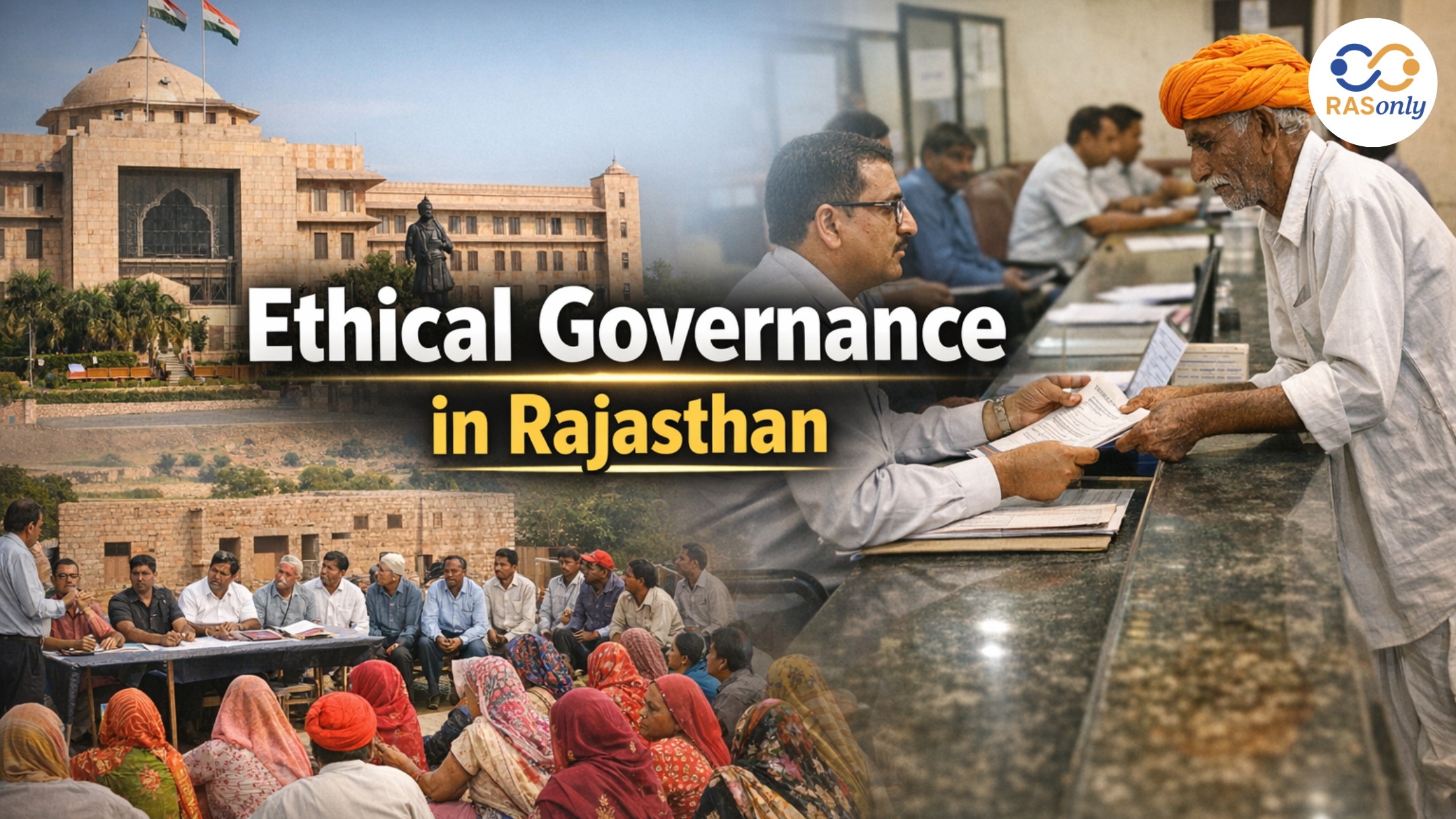
The Ethical Governance in Rajasthan refers to a system of administration based on integrity, transparency, accountability, rule of law, and citizen-centric governance, where public officials perform their duties with honesty, fairness, and responsibility. It ensures that governance is not only efficient but also ethical, inclusive, and people-oriented, focusing on delivering public services without bias, corruption, or delay.
Ethical governance is an extremely critical subject in the context of RPSC RAS 2026, Rajasthan GK, Ethics, Public Administration, and Governance, since it relates administrative ethics to the actual governance practices. Rajasthan has enhanced ethical governance by providing legal frameworks, e-governance programs, anti-corruption programs, and welfare programs that enhance transparency, service provision, trust, and accountability of the citizens and have made governance more effective and friendly to the citizens.
Meaning and Concept of Ethical Governance
Ethical governance merely implies that the administration will be managed fairly, with honesty and responsibility, whereby the decisions made will be in the best interest of the people and not to serve their own. It holds that the activities of the government are transparent, accountable, and moral.
In Rajasthan, ethical governance focuses on clean administration, trust-building, and citizen-centric service delivery. It connects governance with ethics, ensuring that power is used responsibly and people get fair access to services without corruption or bias.
Objectives of Ethical Governance in Rajasthan
As the primary objective of ethical governance, the administration should be efficient, transparent, and people-oriented, in which services are offered in terms of fairness and timeliness. It will help to diminish corruption and increase the level of confidence among citizens and the government.
In Rajasthan, the goal is to enhance service delivery, hold officials accountable, and to establish a corruption-free government system, which later results in the achievement of better governance results and citizen satisfaction.
Key Objectives
- Transparency in decision-making
- Accountability of public officials
- Ethical conduct in administration
- Citizen-centric governance
- Reduction in corruption
- Better service delivery
Principles of Ethical Governance
Ethical governance works on certain basic principles that guide how administration should function. These principles ensure that governance remains fair, transparent, and responsive to public needs.
They help in building a system where citizens are treated equally, and officials act responsibly while delivering services.
Core Principles
- Transparency → Open processes and clear information
- Accountability → Officials are answerable for their actions
- Integrity → Honest behavior in administration
- Rule of Law → Equal laws for everyone
- Inclusiveness → No discrimination
- Responsiveness → Timely services
- Participation → Citizen involvement
Legal and Institutional Framework
Rajasthan has powerful laws and organizations that aid in maintaining an ethical governing process, transparency, accountability, and the safeguarding of the rights of the citizens.
These legal provisions make sure that services are delivered on time, complaints are heard, and corruption is controlled through proper systems.
Key Laws & Institutions
- Rajasthan Public Service Guarantee Act, 2011 → Time-bound services
- Rajasthan Right to Hearing Act, 2012 → Complaint resolution
- RTI Act, 2005 → Access to information
- Lokayukta Rajasthan → Anti-corruption body
- Vigilance Department → Monitoring and investigation
E-Governance and Ethical Administration
The digital platforms have enhanced ethical governance in Rajasthan by minimizing human interventions and enhancing transparency. Technology also contributes to ensuring that services are quicker and more convenient.
E-governance helps in tracking services, reducing corruption, and improving efficiency, making administration more reliable for citizens.
Key Digital Initiatives
- e-Mitra → Online service delivery
- Jan Aadhaar → Citizen database
- SSO Portal → Single login system
- Online grievance systems
- Digital land records
Anti-Corruption Measures and Administrative Integrity
The state of Rajasthan has stringent anti-corruption policies and an administrative integrity system to make administration transparent, accountable, and corruption-free. The focus is on reducing misuse of power, improving monitoring systems, and strengthening public trust in administration.
The government focuses on good governance, ethical administration, and accountability of those in office, and hence, human resources are used judiciously and services are delivered without favouritism or delay.
Key Measures
- Strong Lokayukta system
- Regular audits and inspections
- Transparent procurement process
- Action against corrupt officials
- Monitoring of government schemes
Citizen-Centric Governance and Welfare
Ethical governance in Rajasthan is based on citizen-centric governance and inclusive development, whereby the government schemes directly benefit the people. It is all about equity, access, and openness in the provision of government services.
Special emphasis is given to weaker sections, rural populations, and marginalized groups, making governance more inclusive and equitable through efficient service delivery systems.
Key Focus Areas
- Direct Benefit Transfer (DBT)
- Welfare schemes (pension, housing, etc.)
- Public Distribution System (PDS)
- Rural and village-level service delivery
- Social security programs
Ethical Leadership and Capacity Building
The quality of leadership and administrative training is very critical in ethical governance as it keeps the officials in the government to be honest, responsible and professional in discharging their duties. Rajasthan is concerned with the development of ethical values in administrators.
Training programs help officials develop ethical decision-making skills, accountability, and public service values, which improve governance quality and efficiency.
Focus Areas
- Ethics training for civil servants
- Leadership and decision-making skills
- Value-based administration
- Administrative reforms and capacity building
Importance of Ethical Governance in Rajasthan
Ethical governance is key to designing a system where citizens place their trust on the government and have access to services efficiently and fairly. It ensures that governance is transparent, accountable, and focused on public welfare.
It also enhances the overall administrative system by minimizing corruption, enhancing service delivery, and inclusive development, which is key to long term growth.
Key Importance
- Builds public trust
- Reduces corruption
- Improves service delivery
- Strengthens democracy
- Promotes inclusive growth
Challenges in Ethical Governance
Despite improvements, ethical governance in Rajasthan faces several challenges that affect its implementation at the ground level. These issues limit the effectiveness of policies and service delivery.
Addressing these challenges requires better awareness, strong monitoring, administrative reforms, and digital inclusion, especially in rural areas.
Key Challenges
- Lack of awareness among citizens
- Low participation in governance
- Administrative delays and inefficiency
- Digital divide in rural areas
- Political interference and bias
Ethical Governance and Good Governance
Ethical governance forms the foundation of good governance, as it ensures that administration works in a fair, transparent, and accountable manner. It aligns governance practices with ethical values and public interest.
It makes governance more people-oriented, responsive, and effective, ensuring better decision-making and improved public service delivery.
Future of Ethical Governance (2026 Perspective)
Ethical governance in Rajasthan is headed in the direction of digital governance, data-driven decision-making and smart administration systems. Technology is also contributing to transparency and efficiency.
With the adoption of modern tools, governance is becoming more accessible, real-time, and citizen-friendly, ensuring better monitoring and reduced corruption.
Future Trends
- AI-based governance systems
- Digital transparency platforms
- Real-time monitoring
- Smart service delivery
- Data protection and ethical technology use
Importance for RPSC RAS 2026
Ethical governance is a high-weightage topic for RPSC RAS 2026, especially in Ethics, Governance, and Public Administration. It helps in understanding how ethical values are applied in real governance.
This topic is important for both conceptual clarity and answer writing, especially in case studies and governance-related questions.
Exam Focus
- Prelims
- Acts and governance concepts
- Institutions and principles
Mains
- Ethics in governance
- Transparency and accountability
- Case studies
Interview
- Ethical decision-making
- Real-life governance situations
Conclusion
Ethical governance in Rajasthan is essential in the creation of an accountable, transparent and citizen-focused administration system. The state is achieving fair, efficient and welfare-oriented governance through the incorporation of legal frameworks, e-governance programs, anti-corruption systems and welfare provisions. It enhances confidence between citizens and the administration, and enhances service delivery and minimisation of corruption.
For RPSC RAS 2026, ethical governance is not just a theoretical concept but a practical framework that connects administrative ethics with real governance practices. Understanding this topic helps aspirants develop analytical answers on good governance, accountability, and ethical decision-making, making it highly important for both Prelims and Mains.
FAQ
Ethical governance in Rajasthan refers to administration based on integrity, transparency, accountability, and citizen-centric service delivery without corruption or bias.
Major laws include the Rajasthan Public Service Guarantee Act, 2011, Right to Hearing Act, 2012, and RTI Act, 2005.
E-governance reduces human interference, increases transparency, enables service tracking, and minimizes corruption through digital platforms.
Major challenges include corruption, lack of awareness, administrative delays, digital divide, and political interference.
It is important because it connects governance with ethics, helping in answering questions related to transparency, accountability, and administrative reforms.
BEST SELLER
🏆 PRELIMS
RAS Pass
Prelims focused Hindi & English
₹399
✓
Prelims Topic-Wise Tests
✓
Subject-Wise Tests
✓
Full-Length Prelims Tests
✓
Daily Current Affairs Tests
✓
Prelims PYQs Tests
✓
Detailed Solutions & Analysis
✓
All Rajasthan Ranking
✓
Unlimited Reattempts
✓
Mains Tests
✓
Hindi & English Tests
✓
All Rajasthan Ranking
Trusted by 5,000+ Students
Post Category
- RAS Salary
- Result
- RAS Admit Card
- RAS Job
- RAS Cutoff
- Preparation Tips
- RAS Answer Key
- RAS Exam Analysis
- RAS Syllabus
- RAS Previous Year Papers
- RPSC RAS Exam Pattern
- RAS Interview
- RAS Exam Date
- RAS Vacancy
- RAS Test Series
- RAS Best Books
- RAS Preparation Resources
- RAS Coaching Centre
- History
- Polity
- Geography
- Economics
- Science
- Art and Culture
- RPSC RAS Application Form
- RPSC RAS Notification
- RAS Eligibility Criteria
- UPSC Exam
- RPSC RAS Mains
Visit Our RASonly Offline Center
Our Expert Faculty

Bhunesh Sir
Current Affairs · 13+ Yrs

Aamir Khan Sir
RAS-2017 · IIM Ahm.

Akash Sir
Polity · 8+ Yrs
Free Resources
Official Mobile App

RASOnly App
by OTSAdda · Free
Full Video Lectures
Mock Tests & PYQs
Daily Current Affairs
AI Mock Interview
Free Download · No subscription needed to install
RAS 2024 Toppers — RASonly
Rank 2
Virendra Charan
Rank 9
Bhoopinder Singh
Rank 26
Aanchal Nagpal
Rank 33
Lokendra Singh
Rank 45
Amar Rathore
Rank 46
Manasvini Verma

Join RASonly WhatsApp Community
Get daily current affairs, exam alerts, free study material and tips from expert faculty — right on WhatsApp.
Join for Free →RASonly Interview Guidance Program

Mr. Ashok Jain
Ex-Chief Secretary Govt of Rajasthan
- IAS officer of the 1981 batch, Rajasthan cadre.
- Passionate about mentoring the next generation of RAS officers with real-world insights.
- Got retired in Dec 2017 from the post of Chief Secretary of the state of Rajasthan.

Mr. Guru Charan Rai
Ex-ASP / SP in Jaisalmer
- Guru Charan Rai, IPS (Retd), retired as Inspector General of Police (Security), Rajasthan, Jaipur in 2017.
- Served as ASP and SP in Jaisalmer, Nagaur, Sri Ganganagar, Sawai Madhopur, Dausa, Sikar, and Karauli.
- He also held key positions as DIGP and IGP in the Law and Order division.

Mr. Rakesh Verma
Ex-IAS Officer, B.Tech, MBA, and M.A. (Economics)
- IAS officer of the 1981 batch and retired in Chief Secretary Rank.
- Civil servant of high repute and vast experience.
- Has been teaching UPSC CSE subjects for the last six years.


Daily Current Affairs for RAS Exam Preparation 2026
25th SCO Foreign Trade Ministers' Meeting
September 19, 2026
India’s flag bearer at the opening ceremony of the...
September 19, 2026
PM-YASASVI Scheme Update 2026
September 18, 2026