Central Information Commission (CIC), Power, RAS Notes
Governor of Rajasthan: Powers, Functions, Role in State Politics & Complete List (RAS 2026)

Get in Touch with RASonly!

The Governor of Rajasthan is the constitutional head of the state, responsible for ensuring governance as per the Indian Constitution. The Governor exercises executive, legislative, financial, and discretionary powers and plays an important role in state politics. This topic is highly important for RPSC RAS 2026, Rajasthan GK, and Indian Polity preparation.

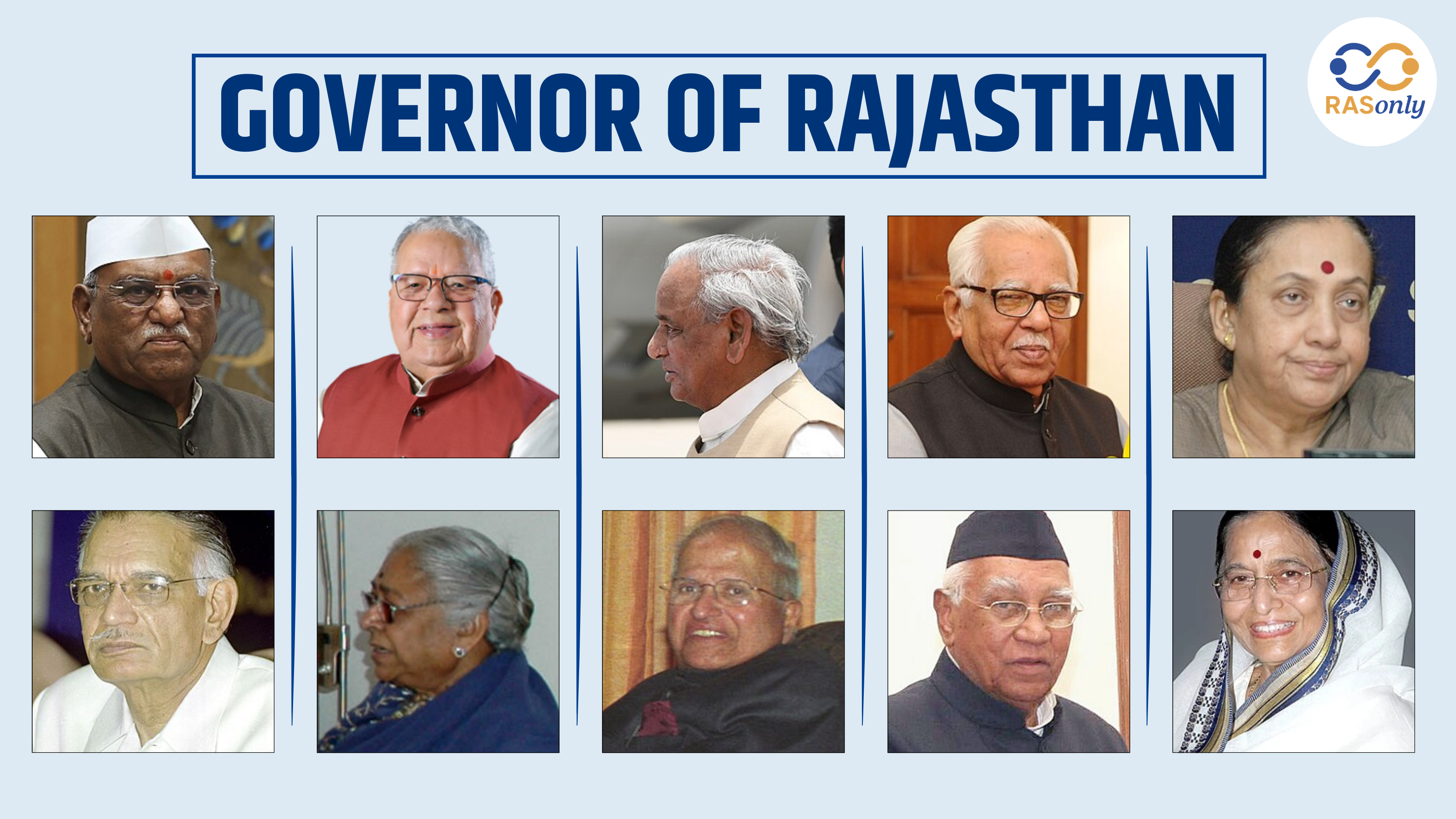
The Governor of Rajasthan is the constitutional head of the state and a key component of the Indian federal system and state governance structure. Appointed by the President of India, the Governor represents the Union government at the state level and ensures that all administrative, legislative, and financial functions are carried out according to the Constitution of India. While the real executive authority lies with the Chief Minister and Council of Ministers, the Governor plays an important role in maintaining constitutional balance, legal governance, and political stability in Rajasthan.
The subject Governor of Rajasthan: powers, functions, appointment, and role in state politics is very crucial to those candidates who are preparing to take the exams of RPSC RAS 2026, Rajasthan GK, and Indian Polity. During both prelims and mains, there are often questions on powers of the Governor, his discretionary position, provisions of the constitution, and the list of Governors of Rajasthan. A clear knowledge of this subject enables aspiring candidates to reinforce their ideas about state administration, governance, and the constitutional system.
Who is the Governor of Rajasthan?
The Governor of Rajasthan is the constitutional and nominal executive head of the state, appointed by the President of India under the Indian Constitution. While the real executive powers are exercised by the Chief Minister and Council of Ministers, the Governor ensures that the state government functions in accordance with constitutional provisions, legal framework, and democratic principles. The role of the Governor is essential in maintaining constitutional governance and administrative balance in Rajasthan.
As of 2026, Haribhau Kisanrao Bagade is serving as the 22nd Governor of Rajasthan, having taken office on 31 July 2024. The role of the Governor is extremely pertinent to the state-level politics of Rajasthan, and to the RPSC RAS examination, including major crises and events like the creation of the government, the stalemate of the assembly, the constitutional crisis, and the suggestion of the President’s Rule.
Constitutional Provisions Related to the Governor
The Constitutional Provisions related to the Governor of Rajasthan are defined under the Indian Constitution, mainly from Articles 153 to 161. These articles explain the appointment, powers, functions, and role of the Governor in state governance.
These are the provisions that need to be understood according to RPSC RAS 2026, Indian Polity, and Rajasthan GK, since the questions are often asked based on the articles of the constitution concerning the Governor.
Key Articles Table
| Article | Provision |
|---|---|
| Article 153 | Governor of each state |
| Article 154 | Executive power of the state |
| Article 155 | Appointment by the President |
| Article 156 | Term of office |
| Article 157 | Qualifications |
| Article 161 | Pardoning powers |
These constitutional articles form the foundation of the powers and functions of the Governor of Rajasthan. A clear understanding of these provisions helps aspirants strengthen their concepts of state administration, constitutional authority, and governance, which is important for both prelims and mains exams.
Historical Evolution: Rajpramukh to Governor
The historical development of the Governor of Rajasthan indicates the change from the princely regime to a modern constitutional regime after independence. In the process of integrating the princely states, before gaining the system of a Governor, Rajasthan had various administrative heads.
Understanding the evolution from Rajpramukh to Governor in Rajasthan is important for RPSC RAS 2026, Rajasthan History, and Polity, as it explains how the present governance structure was established.
Evolution Table
| Period | Position | Details |
|---|---|---|
| 1948–1956 | Rajpramukh | Head after the integration of princely states |
| 1949–1955 | Maharajpramukh | Senior constitutional authority |
| 1956–Present | Governor | Constitutional head under the Indian Constitution |
After the States Reorganisation Act, 1956, the modern post of Governor was formally established in Rajasthan, replacing earlier systems and aligning the state with the constitutional framework of India.
List of Governors of Rajasthan (1956–Present)
The List of Governors of Rajasthan is an important part of Rajasthan GK and RPSC RAS 2026 preparation, especially for factual and direct questions. Aspirants should focus on the first governor, recent governors, and tenure-related questions.
Understanding the list also helps in analyzing the political and administrative evolution of Rajasthan under different Governors.
Major Governors Table
| Governor | Tenure |
|---|---|
| Gurmukh Nihal Singh | 1956–1962 |
| Sampurnanand | 1962–1967 |
| Sardar Hukam Singh | 1967–1972 |
| Jogendra Singh | 1972–1977 |
| Raghukul Tilak | 1977–1981 |
| O. P. Mehra | 1982–1985 |
| Vasantdada Patil | 1985–1987 |
| Sukhdev Prasad | 1988–1990 |
| Debi Prasad Chattopadhyaya | 1990–1991 |
| Chenna Reddy | 1992–1993 |
| Bali Ram Bhagat | 1993–1998 |
| Anshuman Singh | 1999–2003 |
| Madan Lal Khurana | 2004 |
| Pratibha Patil | 2004–2007 |
| Shilendra Kumar Singh | 2007–2009 |
| Margaret Alva | 2012–2014 |
| Kalyan Singh | 2014–2019 |
| Kalraj Mishra | 2019–2024 |
| Haribhau Bagade | 2024–Present |
Exam Tip: Focus on Gurmukh Nihal Singh (First Governor) and recent governors (Kalyan Singh, Kalraj Mishra, Haribhau Bagade).
Appointment, Tenure, and Qualifications
The appointment, tenure, and qualifications of the Governor of Rajasthan are defined under the Indian Constitution and are frequently asked in RAS Polity questions. These provisions ensure that the office remains constitutional and non-partisan.
A clear understanding of these aspects helps aspirants answer questions related to the Governor’s appointment, eligibility, and removal process.
Key Details Table
| Feature | Details |
|---|---|
| Appointment | By the President of India |
| Term | 5 years |
| Qualification | Citizen of India, 35+ years |
| Removal | By President |
| Oath | By Chief Justice of Rajasthan High Court |
The Governor holds office at the pleasure of the President, meaning the tenure can be extended or terminated earlier depending on circumstances.
Powers of the Governor of Rajasthan
The powers of the Governor of Rajasthan are an important topic in Indian Polity for RPSC RAS 2026. These powers are divided into different categories based on constitutional functions. Understanding these powers helps aspirants analyze the role of the Governor in governance, legislation, and political situations.
Types of Powers
| Type | Description |
|---|---|
| Executive | Administrative powers |
| Legislative | Law-making role |
| Financial | Budget-related powers |
| Judicial | Pardoning powers |
| Discretionary | Independent powers |
Executive Powers
The executive powers of the Governor of Rajasthan include appointing the Chief Minister, Council of Ministers, and other key officials. All executive actions are taken in the name of the Governor.
This makes the Governor a central figure in the administrative functioning and constitutional governance of the state.
Legislative Powers
The legislative powers of the Governor include summoning, proroguing, and dissolving the Legislative Assembly. The Governor also gives assent to bills passed by the Assembly.
Without the Governor’s approval, no bill can become law, highlighting his importance in the law-making process of Rajasthan.
Financial Powers
The financial powers of the Governor of Rajasthan ensure control over state finances and budget procedures. The budget is presented in the name of the Governor.
No money bill can be introduced without the Governor’s recommendation, making this role crucial in financial governance.
Judicial Powers
The Governor has the power to grant pardon, reprieve, remission, or commutation of punishment under state laws.
This reflects the constitutional and humanitarian role of the Governor in the justice system.
Discretionary Powers
The discretionary powers of the Governor are exercised in special situations where independent decision-making is required.
These include:
- Hung assembly
- Government formation
- Recommendation of the President’s Rule
These powers make the Governor an important authority in state politics and constitutional crises.
Functions of the Governor of Rajasthan
The functions of the Governor of Rajasthan include constitutional, administrative, and legislative responsibilities. The Governor ensures that governance is carried out smoothly and according to the Constitution.
These functions are important for understanding the overall role of the Governor in Rajasthan administration and governance.
Functions Table
| Function | Role |
|---|---|
| Constitutional Head | Represents the state |
| Link with Centre | Coordinates with Union |
| Legislative Role | Approves laws |
| Administrative Role | Supervises governance |
| Crisis Role | Handles emergencies |
The Governor acts as a link between the state and the central government, ensuring coordination and constitutional compliance.
Role of Governor in Rajasthan State Politics
The role of the Governor in Rajasthan state politics becomes highly significant during periods of political instability, hung assembly, or constitutional crisis. Although the Governor is generally a ceremonial head, in certain situations, he exercises important powers to ensure that the government functions according to the Constitution of India.
In the context of RPSC RAS 2026, Rajasthan GK, and Indian Polity, understanding the political role and discretionary powers of the Governor of Rajasthan is essential, as questions are often asked on government formation and constitutional responsibilities.
Key Roles of the Governor in State Politics
- Formation of Government: Invites the majority party or coalition to form the government in case of elections or a hung assembly.
- Floor Test Decision: Orders a floor test in the Legislative Assembly to check the majority of the government.
- President’s Rule Recommendation: Recommends Article 356 (President’s Rule) if constitutional machinery fails in the state.
- Ensuring Constitutional Governance: Ensures that the state government works within the constitutional framework and law.
The Governor of Rajasthan thus acts as a constitutional guardian, neutral authority, and stabilizing force in state politics, especially during uncertain political situations.
Importance for RPSC RAS 2026
The topic of the Governor of Rajasthan is highly important for RPSC RAS 2026, Rajasthan GK, and Indian Polity preparation, as it covers key concepts related to state governance, constitutional provisions, and political administration. Questions from this topic are frequently asked in both RAS Prelims and Mains examinations, making it essential for aspirants to prepare thoroughly.
A clear understanding of the powers, functions, appointment, and role of the Governor in Rajasthan state politics helps candidates build strong conceptual clarity and improve their performance in the exam.
Important Areas for Exam
- RAS Prelims: Direct questions on Governor’s powers, articles, and facts
- RAS Mains: Analytical questions on the role in governance and the constitutional system
- Rajasthan GK: Questions on the current Governor and the list of Governors
Frequently Asked Topics:
- Powers of the Governor
- Appointment and tenure
- Role in state politics
- Constitutional provisions (Articles 153–161)
A strong command over this topic helps aspirants score better in both objective (MCQs) and descriptive answers, especially in Indian Polity and Rajasthan Administration sections.
Conclusion
The Governor of Rajasthan is a key figure in the state as the constitutional head of government, in order to see the state's governance in conformity with the Indian Constitution. In spite of the fact that the actual executive power is concentrated in the Chief Minister and Council of Ministers, the Governor has significant legislative, financial, and emergency powers.
Understanding the powers, functions, constitutional provisions, and role of the Governor in the state politics of Rajasthan is necessary in the preparation of RPSC RAS 2026, Rajasthan GK, and Indian Polity. Good mastery of this subject is useful to aspirants to answer both analytical and factual questions well in competitive exams.
Frequently Asked Questions (FAQs)
Haribhau Kisanrao Bagade is the current Governor of Rajasthan since 31 July 2024.
The President of India appoints the Governor under Article 155 of the Constitution.
The Governor has executive, legislative, financial, judicial, and discretionary powers under the Constitution.
The Governor serves for 5 years, but holds office at the pleasure of the President.
The Governor plays a key role in government formation, floor tests, constitutional crises, and maintaining political stability.
BEST SELLER
🏆 PRELIMS
RAS Pass
Prelims focused Hindi & English
₹399
✓
Prelims Topic-Wise Tests
✓
Subject-Wise Tests
✓
Full-Length Prelims Tests
✓
Daily Current Affairs Tests
✓
Prelims PYQs Tests
✓
Detailed Solutions & Analysis
✓
All Rajasthan Ranking
✓
Unlimited Reattempts
✓
Mains Tests
✓
Hindi & English Tests
✓
All Rajasthan Ranking
Trusted by 5,000+ Students
Post Category
- RAS Salary
- Result
- RAS Admit Card
- RAS Job
- RAS Cutoff
- Preparation Tips
- RAS Answer Key
- RAS Exam Analysis
- RAS Syllabus
- RAS Previous Year Papers
- RPSC RAS Exam Pattern
- RAS Interview
- RAS Exam Date
- RAS Vacancy
- RAS Test Series
- RAS Best Books
- RAS Preparation Resources
- RAS Coaching Centre
- History
- Polity
- Geography
- Economics
- Science
- Art and Culture
- RPSC RAS Application Form
- RPSC RAS Notification
- RAS Eligibility Criteria
- UPSC Exam
- RPSC RAS Mains
Visit Our RASonly Offline Center
Our Expert Faculty

Bhunesh Sir
Current Affairs · 13+ Yrs

Aamir Khan Sir
RAS-2017 · IIM Ahm.
Akash Sir
Polity · 8+ Yrs
Free Resources
Official Mobile App

RASOnly App
by OTSAdda · Free
Full Video Lectures
Mock Tests & PYQs
Daily Current Affairs
AI Mock Interview
Free Download · No subscription needed to install
RAS 2024 Toppers — RASonly
Rank 2
Virendra Charan
Rank 9
Bhoopinder Singh
Rank 26
Aanchal Nagpal
Rank 33
Lokendra Singh
Rank 45
Amar Rathore
Rank 46
Manasvini Verma

Join RASonly WhatsApp Community
Get daily current affairs, exam alerts, free study material and tips from expert faculty — right on WhatsApp.
Join for Free →RASonly Interview Guidance Program

Mr. Ashok Jain
Ex-Chief Secretary Govt of Rajasthan
- IAS officer of the 1981 batch, Rajasthan cadre.
- Passionate about mentoring the next generation of RAS officers with real-world insights.
- Got retired in Dec 2017 from the post of Chief Secretary of the state of Rajasthan.

Mr. Guru Charan Rai
Ex-ASP / SP in Jaisalmer
- Guru Charan Rai, IPS (Retd), retired as Inspector General of Police (Security), Rajasthan, Jaipur in 2017.
- Served as ASP and SP in Jaisalmer, Nagaur, Sri Ganganagar, Sawai Madhopur, Dausa, Sikar, and Karauli.
- He also held key positions as DIGP and IGP in the Law and Order division.

Mr. Rakesh Verma
Ex-IAS Officer, B.Tech, MBA, and M.A. (Economics)
- IAS officer of the 1981 batch and retired in Chief Secretary Rank.
- Civil servant of high repute and vast experience.
- Has been teaching UPSC CSE subjects for the last six years.



Daily Current Affairs for RAS Exam Preparation 2026
Swami Vivekananda Government Model Schools Rajasthan
September 15, 2026
Krantikari Charu Chandra Bose Yojana
September 15, 2026
Shyam Sunder Swami Wins Bronze at World Archery Para...
September 14, 2026