Chola Dynasty: Capital, Founder, Kings, Time Period and History
How to Revise the Entire Syllabus Before the RAS Exam: A Complete Guide

Get in Touch with RASonly!

Revising the vast RAS syllabus becomes easier with a structured plan. This guide explains smart prioritization, effective notes, MCQs, mock tests, and focused revision techniques to boost your final exam performance.

Preparing for the RAS exam is a long journey, and the real challenge often comes during the revision stage. With such a vast syllabus, candidates frequently feel overwhelmed when the exam is near. The key to performing well lies not just in studying but in knowing how to revise the entire RAS syllabus effectively. A proper revision plan helps you stay organized, retain what you’ve learned, and identify weak areas before the final test. This guide explains exactly how to revise the entire syllabus before the RAS exam, along with practical tips, revision strategies, and focused techniques that truly work.
Understand the Weightage and Prioritize Smartly
It should be noted before you start revision that not everything is equal in the subject matter. It is common to find many of the aspirants spending time on editing topics that have a lower priority but leaving the areas where they have chances to score to waste. What is even smarter is to study the syllabus, review some past-year papers and determine the important sections.
What to do:
- Review the official syllabus carefully.
- Mark high-weightage subjects like Rajasthan History, Geography, Polity, and Economy.
- Identify areas where you are already strong and where you need more revision.
By prioritizing the important topics first, you gain more confidence and reduce your workload significantly.
Create a Realistic and Structured Revision Timetable
A revision timetable helps bring discipline and direction to your preparation. Many aspirants fail not because they lack knowledge, but because they lack proper time management. A well-structured timetable distributes your workload evenly and prevents last-minute panic.
Tips to create an effective timetable:
- Set daily and weekly revision goals.
- Rotate subjects to avoid boredom.
- Include dedicated time for mock tests and question practice.
- Keep a small time slot for daily quick revisions (mind maps, flashcards).
- A good balance is to divide your time into major subjects, weak subjects, and final revision sessions. When your timetable is realistic, you are more likely to follow it consistently.
Start with NCERTs and Core Books for Strong Fundamentals
Revision should begin with the basics, not advanced books. NCERTs lay a strong conceptual foundation, which is essential for remembering facts and linking topics across subjects. Once the basics are clear, standard books become much easier to revise.
How to revise core books effectively:
- Highlight key facts while reading.
- Simplify tough concepts into your own words.
- Connect related topics across subjects—for example, link economy chapters with budget or government schemes.
A strong foundation speeds up your revision and reduces confusion, especially in subjects like Geography, Polity, and Economics.
Use Short Notes, Mind Maps, and Summary Charts
Short notes are the backbone of fast revision. They save time and help you revise large topics within minutes. Instead of reading entire chapters again, your short notes give you instant clarity.
Your notes should include:
- Key definitions
- Important dates and places
- Flowcharts, tables and diagrams.
- One-line sentences and brief points.
- Mind maps of topics such as Rajasthan Geography and History.
Such visual aids will assist you to remember the information longer and go through your end revision without any hassles and under stress.
Practice MCQs Alongside Revision
Practicing questions is not completed without revision. The MCQs provide you with immediate feedback about what you have learned and enable you to verify how much you have really learned. They also enhance consistency, speed and accustomedness with the exam patterns.
The practice of MCQs should involve:
- Pre-RAS past year question papers.
- MCQs of the topics based on credible books.
- Rajasthan-specific MCQs
- Mock exams and online quizzes.
Revise by attempting at least 50-70 MCQs per day. This will make you think in a critical manner and require a more critical revision.
Take Full-Length Mock Tests and Analyze Them Carefully
Mock tests are essential in the revision of the RAS exam. They provide a simulated real-exam environment and make you realize how well you can perform with the knowledge when you are under pressure. Nevertheless, it is not sufficient to take tests and analyze your performance.
During analysis, focus on:
- Questions you got wrong
- Things you spent too much time responding to.
- Repeated mistakes
- Reliability and faster performance.
Revision: Plan to do 10-12 Prelims mock tests. Each time you take a test, you learn a new style of doing the exam more intelligently.
Give Extra Attention to Rajasthan-Specific Topics
RAS is an exam for Rajasthan Administrative Services, so knowledge about Rajasthan holds major importance. Many students concentrate more on general subjects and underestimate Rajasthan-specific content, which can be scored if revised properly.
Ensure thorough revision of:
- Rajasthan History and Dynasties
- Geography: rivers, minerals, climate zones
- Administration and governance
- Art, culture, fairs, festivals
- Economy and state schemes
Making tables and charts for these topics helps you memorize details faster and with better clarity.
Strengthen Current Affairs with Monthly Compilations
Current affairs greatly influence both Prelims and Mains. Instead of trying to revise everything at once, follow a structured approach using monthly magazines and curated notes.
Focus your current affairs revision on:
- Rajasthan government schemes and announcements
- National-level policies and economic updates
- Committees, reports, and important indexes
- Budget and Economic Survey
- Social issues and welfare programs
Try to link current affairs with the General Studies syllabus to improve understanding.
Use a Strategic 3-Phase Revision Plan
A proper revision schedule would save a lot of confusion and you can cover the whole syllabus without being stressed. Toppers use one of the most effective
techniques, which is the 3-phase model.
Phase 1: First Revision (Broad)
Revise everything in a short time so as to refresh ideas.
Phase 2: Second Revision (Focused)
Revise key subjects and MCQs and update notes.
Phase 3: Phase 3 Final Revision (Quick Polishing)
Recall Last-minute recall Use mind maps, short notes, and tabular and summary forms.
This way, you will be guaranteed that key information does not get lost in your mind.
Avoid New Topics in the Final Week
In the final week before the exam, do not start to pick up new topics and new books. This just causes confusion and brings stress. The final week should not be any heavier but it should be lighter.
Focus on:
- High-yield chapters
- Notes and summaries
- Mistakes from mock tests
- Speed improvement
- Memory retention
Maintain Mental Calmness and Physical Well-Being
When your mind and body are balanced then revision works. Having stress, studying much, and not having enough sleep makes you less productive.
To stay healthy:
- Sleep at least 6–7 hours
- Consume less and healthy food.
- Stay hydrated
- Take short breaks
- Avoid excessive screen time
- Meditate or do deep breathing.
Conclusion
It might be difficult to revamp the entire RAS syllabus before the exam, but it will be thoroughly manageable with a systematic approach. Being aware of the weightage of the syllabus, having a realistic schedule, having short notes and training MCQs are some of the ways in which you can perform better. Mock tests will assist you in perfecting your strategy, whereas the Rajasthan-specific subjects and current affairs will provide you with an advantage. The RAS exam can be handled with complete confidence and clarity with constant revision and the right attitude. The secrets of success lie in smart planning and strict execution.
BEST SELLER
🏆 PRELIMS
RAS Pass
Prelims focused Hindi & English
₹399
✓
Prelims Topic-Wise Tests
✓
Subject-Wise Tests
✓
Full-Length Prelims Tests
✓
Daily Current Affairs Tests
✓
Prelims PYQs Tests
✓
Detailed Solutions & Analysis
✓
All Rajasthan Ranking
✓
Unlimited Reattempts
✓
Mains Tests
✓
Hindi & English Tests
✓
All Rajasthan Ranking
Trusted by 5,000+ Students
Post Category
- RAS Salary
- Result
- RAS Admit Card
- RAS Job
- RAS Cutoff
- Preparation Tips
- RAS Answer Key
- RAS Exam Analysis
- RAS Syllabus
- RAS Previous Year Papers
- RPSC RAS Exam Pattern
- RAS Interview
- RAS Exam Date
- RAS Vacancy
- RAS Test Series
- RAS Best Books
- RAS Preparation Resources
- RAS Coaching Centre
- History
- Polity
- Geography
- Economics
- Science
- Art and Culture
- RPSC RAS Application Form
- RPSC RAS Notification
- RAS Eligibility Criteria
- UPSC Exam
- RPSC RAS Mains
Visit Our RASonly Offline Center
Our Expert Faculty

Bhunesh Sir
Current Affairs · 13+ Yrs

Aamir Khan Sir
RAS-2017 · IIM Ahm.

Akash Sir
Polity · 8+ Yrs
Free Resources
Official Mobile App

RASOnly App
by OTSAdda · Free
Full Video Lectures
Mock Tests & PYQs
Daily Current Affairs
AI Mock Interview
Free Download · No subscription needed to install
RAS 2024 Toppers — RASonly
Rank 2
Virendra Charan
Rank 9
Bhoopinder Singh
Rank 26
Aanchal Nagpal
Rank 33
Lokendra Singh
Rank 45
Amar Rathore
Rank 46
Manasvini Verma

Join RASonly WhatsApp Community
Get daily current affairs, exam alerts, free study material and tips from expert faculty — right on WhatsApp.
Join for Free →RASonly Interview Guidance Program

Mr. Ashok Jain
Ex-Chief Secretary Govt of Rajasthan
- IAS officer of the 1981 batch, Rajasthan cadre.
- Passionate about mentoring the next generation of RAS officers with real-world insights.
- Got retired in Dec 2017 from the post of Chief Secretary of the state of Rajasthan.

Mr. Guru Charan Rai
Ex-ASP / SP in Jaisalmer
- Guru Charan Rai, IPS (Retd), retired as Inspector General of Police (Security), Rajasthan, Jaipur in 2017.
- Served as ASP and SP in Jaisalmer, Nagaur, Sri Ganganagar, Sawai Madhopur, Dausa, Sikar, and Karauli.
- He also held key positions as DIGP and IGP in the Law and Order division.

Mr. Rakesh Verma
Ex-IAS Officer, B.Tech, MBA, and M.A. (Economics)
- IAS officer of the 1981 batch and retired in Chief Secretary Rank.
- Civil servant of high repute and vast experience.
- Has been teaching UPSC CSE subjects for the last six years.
Related Post




Daily Current Affairs for RAS Exam Preparation 2026

Inauguration of 100 New Kalika Patrolling Units in Rajasthan
October 21, 2026
Jaipur International Film Festival 2027
October 21, 2026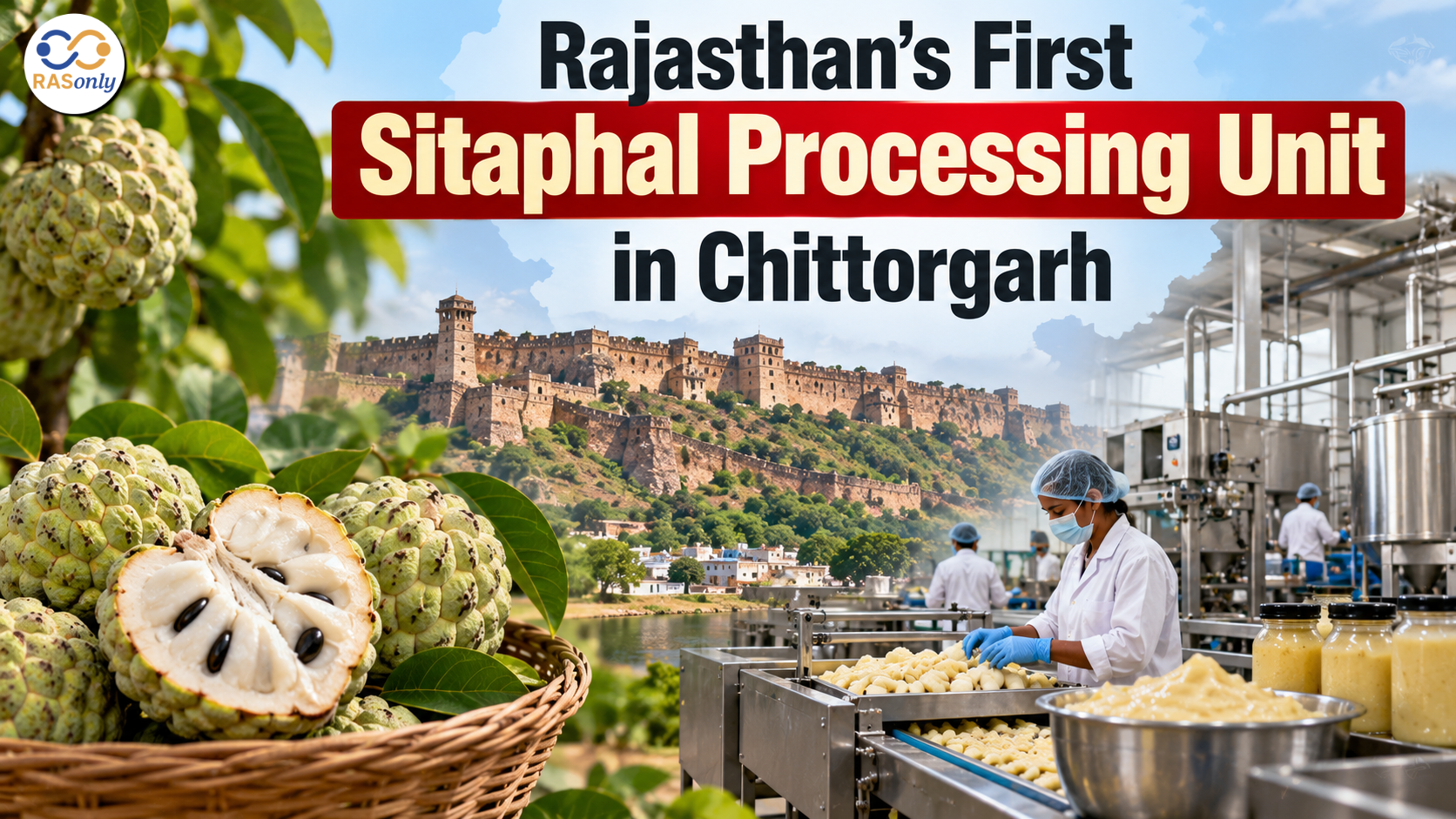
Rajasthan’s First Sitaphal Processing Unit in Chittorgarh
October 19, 2026