Gupta Empire, Founder, Time Period, Rulers, Map, Capital City
Urban Development in Rajasthan: Housing, Smart Cities, Water & Vision 2047

Get in Touch with RASonly!

Urban development in Rajasthan prioritises housing and slum rehabilitation amid rising migration and economic disparity. Government schemes like PMAY (3.06 lakh sanctioned; 2.13 lakh completed- February 2025) and Jan Awas Yojana support affordable housing. Online Building Permission System (OBPS) ensures ease of building permissions in AMRUT towns. Rapid urbanisation has stressed sanitation systems despite state-led infrastructure improvements.

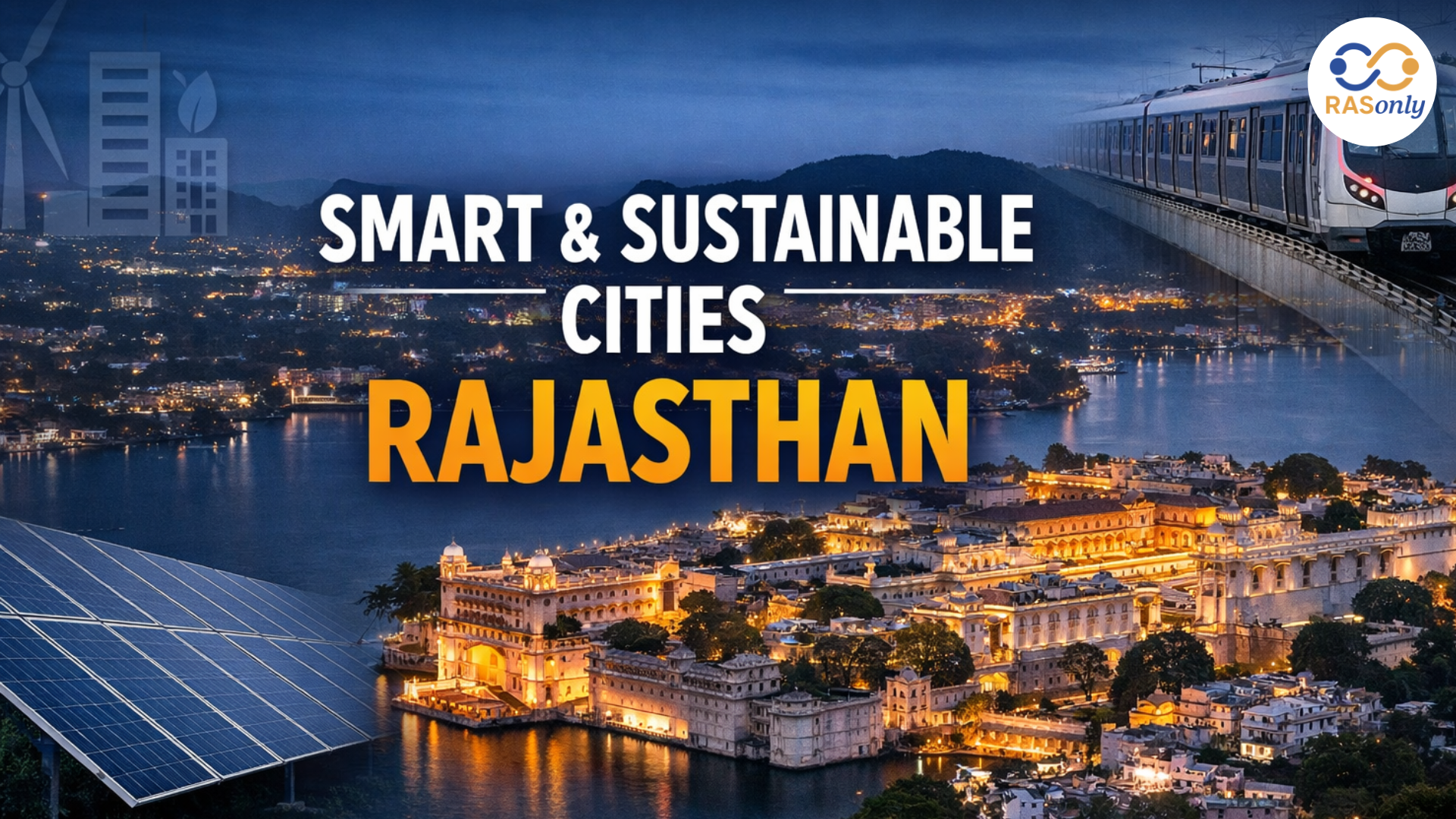
LSG, with 312 ULBs, oversees urban governance through RUIDP and RUDSICO. These bodies drive public utility, housing and infrastructure projects. While infrastructure boosts economic and social well-being, Rajasthan's climate vulnerability, limited water resources and growing noise pollution underscore the need for sustainable, climate-resilient urban planning and natural resource conservation.
- OBPS implementation in all AMRUT towns streamlines approvals, reducing delays in urban construction permits
- RUIDP functions as an SPV supported by ADB and GoI for infrastructure transformation
- Rajasthan has only 1% of India’s water resources, demanding urgent water conservation strategies
- Climate extremes like heatwaves and droughts increasingly threaten urban liveability and socio-economic stability in Rajasthan
- Vehicle-induced noise pollution is a growing urban challenge requiring enforcement and sustainable mobility solutions
VISION 2047
By 2047, Rajasthan envisions vibrant, inclusive and sustainable urban centers marked by affordable housing, smart townships and transformed informal settlements with essential amenities. The state will lead in urban cleanliness through the 5R approach—Reduce, Reuse, Recycle, Recover and Remove—leveraging advanced technologies. Rajasthan will protect its rich cultural heritage through robust conservation strategies and strengthen decentralised urban governance for participatory and accountable service delivery. With a focus on renewable energy, resilient infrastructure and green public spaces, Rajasthan aims to balance urban growth with ecological preservation, ensuring enhanced quality of life and climate resilience for present and future generations.
Jaipur International Airport
Thrust Areas
- Smart GIS, drones and AI tools are adopted for urban planning, land management, infrastructure monitoring and governance transparency.
- Urban biodiversity, noise and air quality improvement are pursued through green-blue infrastructure, sustainable transport and eco-friendly construction guidelines.
- Ward-level AI-enabled governance and single-window systems promote citizen engagement, streamline services and reduce corruption in urban local bodies.
- Green public spaces and sociable streets are being prioritised to enhance liveability, promote health and support vibrant urban ecosystems.
- 132 STPs treat 1118.92 MLD of sewage, improving urban sanitation under AMRUT and Swachh Bharat Mission in Rajasthan's cities.
- Slum rehabilitation programs like ARHCs target 12.13% urban slum population to build inclusive, formalised and serviced urban settlements.
- Rainwater harvesting is mandatory in all public parks and buildings, addressing Rajasthan’s severe water scarcity with only 1% national water resources.
- Street vendor zones and beggar rehabilitation centers offer safety, skill development and dignity to vulnerable urban informal populations.
- Rajasthan leads in solar capacity, exceeding 8,000 MW; Bhadla Solar Park drives shift to clean energy infrastructure in cities.
Urban Development
- Urban population in Rajasthan projected to rise to 27.74% by 2031, with districts like Kota (60.31%) and Jaipur (52.4%) driving housing demand and infrastructure expansion.
- Urban Development Authorities exist in seven major cities. (Jaipur, Jodhpur, Ajmer, Udaipur, Kota, Bikaner and Bharatpur)
- 3.06 lakh houses sanctioned under PMAY, with 2.13 lakh completed by February 2025, facilitating affordable housing for low and middle-income urban groups across Rajasthan.
- UITs established in 10 cities, including Alwar, Bhilwara and Sri Ganganagar, with plans for enhanced staffing and planning capabilities for structured urban development.
- RERA and Development Authorities regulate urban housing markets, promoting private investments and supporting multi-income housing schemes across rapidly growing urban centers in the state.
- Climate-responsive drainage upgrades are underway in flood-prone areas to prevent waterlogging, integrate rainwater channels and modernise city-level drainage systems for resilience.
- 12.13% of Rajasthan's urban population lives in slums, addressed through AHP and ARHC schemes for housing, skills and dignified livelihoods.
- Rajasthan generates 1,649.95 MLD sewage, with 1118.92 MLD treated via 132 STPs under AMRUT and SBM; decentralised solutions are now gaining importance for wider coverage.
- Smart City Initiatives and infrastructure upgrades improve sustainability in cities with eco-friendly practices like solar rooftops, green buildings and water conservation measures.
- SBM and SBM 2.0 guide solid waste management, including mobile collection units, WTE systems and recycling infrastructure in both dense and underserved urban areas.
- Urban planning targets sustainability, resilience and zero encroachment through master plans, optimised land use and disaster-risk-sensitive zoning across growing towns and peri-urban regions.
- Multilevel parking facilities are being constructed in high-traffic areas to manage congestion, support tourism and ensure efficient use of urban land resources.
- UNESCO World Heritage Sites like Jaipur Walled City highlight Rajasthan's cultural richness; dedicated urban heritage conservation plans ensure preservation of forts, havelis and traditional neighbourhoods.
- Public transport boosted with city buses, MRT systems and last-mile connectivity improvements to reduce reliance on private vehicles and ease congestion.
- Single window clearance systems and grievance redressal portals promote transparent, citizen-centric urban governance and reduce delays in service delivery and building permissions.
- Rajasthan leads India in solar capacity, crossing 8,000 MW, with Bhadla Solar Park and Renewable Energy Policy 2023 driving urban clean energy transition.
- The Mukhyamantri Svanidhi Yojana has been launched in urban areas of Rajasthan to support unorganised sector workers with loans. The scheme aims to uplift underprivileged urban families.
- Urban water bodies like lakes and wetlands are being revived to mitigate water scarcity, recharge groundwater and provide sustainable ecological and cultural benefits.
- Rajasthan promotes electric vehicles through EV charging stations and fiscal incentives, reducing dependence on fossil fuels and combating urban air pollution.
- Climate-resilient planning prioritises heatwave and flood mitigation, integrating DRR in infrastructure design and enhancing urban adaptive capacities through community-based strategies.
Goals
Waste Free and Hygienic Cities
|
INDICATORS |
CURRENT STATUS |
TARGET (2030) |
TARGET (2035) |
TARGET (2040) |
TARGET (2047) |
|
Proportion of waste recycled vs. waste generated (Only hazardous waste) |
0.83 (2021-22) |
1 |
1 |
1 |
Saturation |
|
Waste processed (%) |
69 (2023-24) |
80 |
85 |
90 |
100 |
|
Proportion of sewerage treatment capacity out of total generation (%) |
88.61 |
100 |
100 |
100 |
100 |
Housing for All
|
INDICATORS |
CURRENT STATUS |
TARGET (2030) |
TARGET (2035) |
TARGET (2040) |
TARGET (2047) |
|
Rehabilitation / relocation of unorganised settlements |
Unorganised |
Unorganised settlements on government land will be relocated and rehabilitated to proper housing areas |
Unorganised settlements will be rehabilitated with access to basic infrastructure |
All unorganised settlements will receive essential services, tenure security and urban governance inclusion to prevent unchecked growth |
Well-planned cities |
|
Urban population living in slums, informal settlements or inadequate housing (%) |
12.13 |
10 |
7 |
5 |
Slum free cities |
|
Urban habitations fully covered with drinking water supply (%) |
92.50 (2022-23) |
100 |
100% homes get water |
100% homes get water; 50% buildings harvest rainwater |
Ensure 100% houses have potable water & rainwater harvesting |
|
Use of recycled water in sanitary systems out of total water consumption by households (%) |
- |
10 |
20 |
30 |
50 |
Strengthening Local Governance
|
INDICATORS |
CURRENT STATUS |
TARGET (2030) |
TARGET (2035) |
TARGET (2040) |
TARGET (2047) |
|
Cities with master plans (%) |
64.24 (2024) |
80 |
85 |
90 |
100 |
|
Number of GIS based master plans (%) |
43 |
66 |
80 |
85 |
100 |
|
Number of cities covered/ Investment in Atal Mission for Rejuvenation and Urban Transformation |
City covered 29 |
Coverage of all ULBs, which were in existence till October 2021 |
Coverage of 80% of newly created ULBs (post-2021) |
All newly created ULBs (post 2021) to be fully covered |
Remaining ULBs to be covered |
|
Number of government services provided online |
14 + |
Enhance digital footprints in all public services |
50% of government services to be available online through unified digital platforms |
80% govt services fully online with integrated ID, payment, grievance & feedback systems |
Fully digital platform for public service delivery |
Sustainable Urban Infrastructure
|
INDICATORS |
TARGET (2030) |
TARGET (2035) |
TARGET (2040) |
TARGET (2047) |
|
Renewable energy share in the total installed electricity generation |
90 GW, including 65 GW from solar, 15 GW from wind and wind-solar hybrids and 10 GW from hydropower, pumped storage and battery energy storage |
40-50% electricity from renewables with storage and grid modernisation |
60%+ electricity from renewables with storage and grid modernisation |
Using renewable sources of energy as the major source of energy |
|
Safe and adequate water within premises through piped water supply |
100% Piped water supply to every household & potable tap water at every major public place |
Ensure reliable piped water supply to all households with 60-70% coverage of automated metering through smart systems |
Smart systems in major cities, 24x7 piped supply, real-time quality & leakage monitoring |
Incorporation of drinking AI technologies to transform the water supply in urban areas |
|
Health Institutions |
Adequate number of hospitals. (CHC/PHC) |
Strengthen urban health infrastructure |
Urban health hubs with digital records for seamless healthcare delivery |
Developing robust infrastructure for advanced health information systems |
|
Primary/ Secondary/ Senior Secondary School and Colleges |
Ensuring adequate number of education institutions |
Strengthen education infrastructure |
Smart classrooms in all educational institutions |
Advancement of existing infrastructure for integrated technology-based education systems |
Urban Transportation
|
INDICATORS |
CURRENT STATUS |
TARGET (2030) |
TARGET (2035) |
TARGET (2040) |
TARGET (2047) |
|
Metro Connectivity |
Phase 1A- Mansarovar to Chandpole, 9.6Km Phase 1B - Chandpole to Badi Chaupar, 2.4Km |
Completing the North-South Corridor for Jaipur Metro Rail Project from Ambabari to Sitapura with a total length of 42.95 Kms |
Achieve full operationalisation of the North-South Corridor and initiate metro network extensions within Jaipur |
The planned expansion of the metro network in Jaipur, with potential extensions to other cities within a 45-50 km radius of the state capital |
• MRTS for all the towns with population >2 million or more • Introduce metro systems in cities such as Udaipur and Jodhpur, kota to improve urban mobility |
|
Public Transport System coverage per 1,00,000 Population (100 buses per 1 Lakh population) |
All major cities like divisional head quarters and district head quarters don't have organised bus system or public transport |
• Integrated multi- modal transport corridors planned in Rajasthan with EV bus introduction • Organised city bus services in all towns with population over 1 lakh |
Initiate integration of public transport modes (bus, metro, IPT) in Tier-1 and Tier-2 cities with operational common mobility cards |
• Minimum 100 buses per 1 lakh population in all ULBs with 50% electric fleet • Integrated transport systems in major cities for seamless connectivity across bus, metro and IPT modes |
• 100% electric or hydrogen-powered public bus fleet • Integrated Land Use and Transportation facilities, to foster sustainable development and efficient mobility |
|
Urban Infra Road |
Most cities face inadequate road width, weak intersections and limited infrastructure as well as lack footpath for pedestrians and cycle lanes |
Designing road networks and public transportation systems to ensure last-mile connectivity through multi-modal transit |
30% of major urban roads in Municipal Corporations retrofitted to be NMT friendly (Non-Motorised Transport) with dedicated pedestrian and cycling infrastructure |
• 50% major urban roads in Municipal Corporations made NMT-friendly with pedestrian and cycle lanes • ITS deployed in all tier-1 and tier-2 cities for traffic management and real-time mobility integration |
• 100% Non-Motorised Transport friendly road lanes in all Municipal Corporations • Integrated Intelligent Transport system in all public transport and traffic infrastructure |
Solid Waste Management
|
INDICATORS |
CURRENT STATUS |
TARGET (2030) |
TARGET (2035) |
TARGET (2040) |
TARGET (2047) |
|
Solid Waste Management |
• Percentage of wards with 100% door to door waste collection = 98.42 • Total Collected Municipal Solid Waste per Capita per Year 80% |
• Maximise recovery out of recyclable/ non-recyclable fractions of waste • Waste to Energy Plant for the treatment of Legacy waste |
Achieving 80% recovery of recyclable and non-recyclable waste through decentralized processing and partial automation of sorting in major cities |
• 100% source segregation and MRFs in all Class-I towns; major cities to use semi-automated • Complete legacy waste remediation in metros; 50% reclaimed land redeveloped as green/ public spaces |
• Garbage free cities • Automated sorting technologies and robotics for efficient waste segregation • Reclamation and Land Redevelopment : Restore treated sites for productive use such as green zones or public spaces for legacy waste |
Sanitation and Waste Water Treatment
|
INDICATORS |
CURRENT STATUS |
TARGET (2030) |
TARGET (2035) |
TARGET (2040) |
TARGET (2047) |
|
Sanitation and Waste water Treatment |
• 100% city population with access to sanitary toilet facilities • 80.98% waste water treatment capacity created relative to total generation |
• Access to safe sanitation with 100% toilet coverage and containment • Treat 90% of urban wastewater and faecal sludge |
Maintain 100% access to sanitary toilet facilities and expand wastewater treatment capacity to cover 90-95% of total wastewater generation |
Strengthening of infrastructure for waste water treatment |
At least 75% urban wastewater treated via central and decentralised systems; smart monitoring in major cities ensures efficiency, quality and reuse |
Legacy Waste Management
|
INDICATORS |
CURRENT STATUS |
TARGET (2030) |
TARGET (2035) |
TARGET (2040) |
TARGET (2047) |
|
Legacy Waste Management |
Only select pilot projects underway in cities like Jaipur and Udaipur using biomining techniques |
100% scientific remediation of all legacy waste dumpsites in cities with more than 1 lakh population |
Complete scientific remediation of legacy waste in all cities with over 50,000 population |
• Remediate legacy waste in urban areas using sustainable, scientific methods • Repurpose reclaimed land into green/ public spaces with ongoing monitoring |
All urban local bodies achieve 100% legacy waste clearance with reclaimed land put to public or ecological use |
Mid-Term Action Plan
- PMAY-2.0 and private participation aim to construct affordable green housing for EWS/LIG, targeting 50% adoption of sustainable, energy-efficient building technologies.
- Slum rehabilitation in class I and II towns, using GIS-based mapping and conurbation planning, targets upgradation of kachhi bastis into serviced, authorised townships.
- Mandatory rainwater harvesting in houses above 225 sq.m to reduce groundwater dependence in Rajasthan's arid urban zones.
- Sewerage and drainage master plans In cities with a population of >1 lakh target waterlogging-free infrastructure and climate-resilient sanitation systems.
- 50% of sewerage networks to use robotic cleaning, replacing manual scavenging and ensuring safe, mechanised maintenance practices.
- Effluent treatment plants to ensure zero discharge, preventing industrial waste dumping into Rajasthan's landfills and water bodies.
- Bio-medical waste facility at each divisional HQ under SBM 2.0 to manage hospital and clinical waste scientifically.
- 'Waste to Wealth' and plastic recycling plants to eliminate open landfills and improve circular waste economy in urban centers.
- All women's toilets upgraded to Bio/Pink Complexes, supporting hygiene, dignity and gender-sensitive sanitation planning.
- IoT, GPS-based smart waste tracking system implemented in major towns to improve collection efficiency and coverage.
- ECBC compliance mandated for new constructions, enforcing energy-efficient design in public buildings and town planning across Rajasthan.
- Regional, zonal and smart city plans for 10 new cities under Smart City Mission to guide future urban development.
- Jaipur Metro North-South Corridor (23.1 km) completion to boost clean, mass transit in Rajasthan's capital.
- City bus services for towns with >1 lakh population and MRTS for cities with >10 lakh population.
- 15% cities to be signal-free zones, smart traffic management with nano satellites and real-time regulation systems.
- 2-meter-wide cycling infrastructure and smart parking, coupled with solar-lit, sensor-enabled urban road infrastructure in Class I and II cities.
- 100% installation of smart electricity meters, retrofitting of all government buildings with renewable energy and water-saving technologies.
- Desilting and rejuvenation of urban water bodies through PPP models to improve storage and recharge in water-stressed areas.
- Vertical gardens, green roofs and urban forests to counter urban heat islands and improve Rajasthan's low green cover.
- Disaster-resilient smart housing, early warning systems for dust storms and floods and integration of climate resilience in building bylaws.
Long-Term Action Plan
- All households to have disaster-resilient, energy-efficient homes, using green construction and reducing carbon footprints through sustainable materials and design practices.
- 100% urban housing to incorporate renewable energy systems and green building norms, reducing emissions and optimising natural resource usage.
- Slum-free urban Rajasthan with legal tenure, access to basic services and planned urban layouts ensuring inclusive, dignified living.
- Universal adoption of rainwater harvesting and water reuse systems, boosting household-level self-sufficiency in water-scarce regions of Rajasthan.
- Complete sewerage and drainage network coverage in all urban cities, ensuring zero waterlogging and hygienic urban conditions.
- Establish state-run biomedical waste facilities in all districts, managing healthcare waste safely under WHO and CPCB norms.
- Solid waste converted into renewable energy, scaling bio-methanation and WTE systems aligned with the Waste-to-Wealth Mission.
- 100% litter-free public spaces, with tech-based monitoring and strict enforcement under Swachh Bharat Mission and smart city regulations.
- Satellite towns to be fully developed, emerging as industrial and residential growth hubs for economic expansion.
- 100% digital governance and automated surveillance systems, ensuring efficient, accessible and transparent service delivery in all urban bodies.
- Citizen-friendly, AI-enabled ward offices operational in all cities, streamlining local service access, redressal and feedback systems.
- Metro systems extended to all class I and II cities, offering clean, high-capacity public transit options.
- Speed control sensors and ITS systems integrated across cities to manage urban mobility, safety and congestion using real-time data.
- Signal-free urban zones in 15% of cities, easing bottlenecks and boosting clean transport infrastructure.
- Main roads to include mechanised parking, footpaths, green buffers, ensuring universal accessibility and service integration.
- All municipal corporations to have NMT-friendly lanes, promoting cycling, walking and sustainable, inclusive transport.
- IoT-enabled energy monitoring systems and automated audits, ensuring smart, real-time control of urban electricity usage and leakages.
- AI-driven water monitoring and rainwater harvesting, optimising usage and improving drought resilience in water-scarce cities.
- Urban forests and ecosystem restoration practices implemented to improve biodiversity, mitigate urban heat and manage invasive species.
- Integrated Water Resources Management (IWRM) and climate-aligned flood and drought interventions at the river basin and city level.
Smart, Green, Inclusive Cities: Empowering Citizens, Restoring Nature and Building Resilient Urban Futures by 2047.
Conclusion
Rajasthan’s urban development strategy is moving beyond basic infrastructure to focus on inclusive growth, climate resilience and long-term sustainability. Affordable housing schemes such as PMAY, slum rehabilitation programs and regulated urban planning are helping provide secure housing and essential services to vulnerable populations while supporting expanding cities.
At the same time, the state is addressing critical challenges like water scarcity, heatwaves, rapid migration and pollution through rainwater harvesting mandates, sewage treatment expansion, renewable energy adoption and green infrastructure planning. Digital governance systems and smart city initiatives are improving transparency, efficiency and citizen engagement across urban local bodies.
With Vision 2047, Rajasthan aims to build slum-free, waste-free and climate-resilient cities powered by renewable energy and supported by strong local governance. If implementation remains consistent and participatory, the state can emerge as a national model for sustainable and future-ready urban development.
BEST SELLER
🏆 PRELIMS
RAS Pass
Prelims focused Hindi & English
₹399
✓
Prelims Topic-Wise Tests
✓
Subject-Wise Tests
✓
Full-Length Prelims Tests
✓
Daily Current Affairs Tests
✓
Prelims PYQs Tests
✓
Detailed Solutions & Analysis
✓
All Rajasthan Ranking
✓
Unlimited Reattempts
✓
Mains Tests
✓
Hindi & English Tests
✓
All Rajasthan Ranking
Trusted by 5,000+ Students
Post Category
- RAS Salary
- Result
- RAS Admit Card
- RAS Job
- RAS Cutoff
- Preparation Tips
- RAS Answer Key
- RAS Exam Analysis
- RAS Syllabus
- RAS Previous Year Papers
- RPSC RAS Exam Pattern
- RAS Interview
- RAS Exam Date
- RAS Vacancy
- RAS Test Series
- RAS Best Books
- RAS Preparation Resources
- RAS Coaching Centre
- History
- Polity
- Geography
- Economics
- Science
- Art and Culture
- RPSC RAS Application Form
- RPSC RAS Notification
- RAS Eligibility Criteria
- UPSC Exam
- RPSC RAS Mains
Visit Our RASonly Offline Center
Our Expert Faculty

Bhunesh Sir
Current Affairs · 13+ Yrs

Aamir Khan Sir
RAS-2017 · IIM Ahm.
Akash Sir
Polity · 8+ Yrs
Free Resources
Official Mobile App

RASOnly App
by OTSAdda · Free
Full Video Lectures
Mock Tests & PYQs
Daily Current Affairs
AI Mock Interview
Free Download · No subscription needed to install
RAS 2024 Toppers — RASonly
Rank 2
Virendra Charan
Rank 9
Bhoopinder Singh
Rank 26
Aanchal Nagpal
Rank 33
Lokendra Singh
Rank 45
Amar Rathore
Rank 46
Manasvini Verma

Join RASonly WhatsApp Community
Get daily current affairs, exam alerts, free study material and tips from expert faculty — right on WhatsApp.
Join for Free →RASonly Interview Guidance Program

Mr. Ashok Jain
Ex-Chief Secretary Govt of Rajasthan
- IAS officer of the 1981 batch, Rajasthan cadre.
- Passionate about mentoring the next generation of RAS officers with real-world insights.
- Got retired in Dec 2017 from the post of Chief Secretary of the state of Rajasthan.

Mr. Guru Charan Rai
Ex-ASP / SP in Jaisalmer
- Guru Charan Rai, IPS (Retd), retired as Inspector General of Police (Security), Rajasthan, Jaipur in 2017.
- Served as ASP and SP in Jaisalmer, Nagaur, Sri Ganganagar, Sawai Madhopur, Dausa, Sikar, and Karauli.
- He also held key positions as DIGP and IGP in the Law and Order division.

Mr. Rakesh Verma
Ex-IAS Officer, B.Tech, MBA, and M.A. (Economics)
- IAS officer of the 1981 batch and retired in Chief Secretary Rank.
- Civil servant of high repute and vast experience.
- Has been teaching UPSC CSE subjects for the last six years.
Related Post




Daily Current Affairs for RAS Exam Preparation 2026

Khelo Rajasthan Campaign
October 09, 2026
Apache Helicopters 30 mm Chain Gun Tested for Aerial...
October 09, 2026
CM Bhajan Lal Sharma Launches Rajasthan Portals
October 08, 2026