Kushan Empire: History, Rulers, Administration, Economy, Art, Decline
Indian Judiciary Preparation Strategy for RAS 2026 (Complete Judiciary Notes, Constitution, Courts, PYQs, MCQs & Revision Plan)

Get in Touch with RASonly!

Learn the complete Indian Judiciary Preparation Strategy for RAS 2026 including Supreme Court, High Courts, Writs, Judicial Review, PIL, Constitutional Articles, MCQs, PYQs, and revision techniques. This detailed guide helps aspirants improve conceptual clarity and strengthen Indian Polity preparation for RAS Prelims 2026.

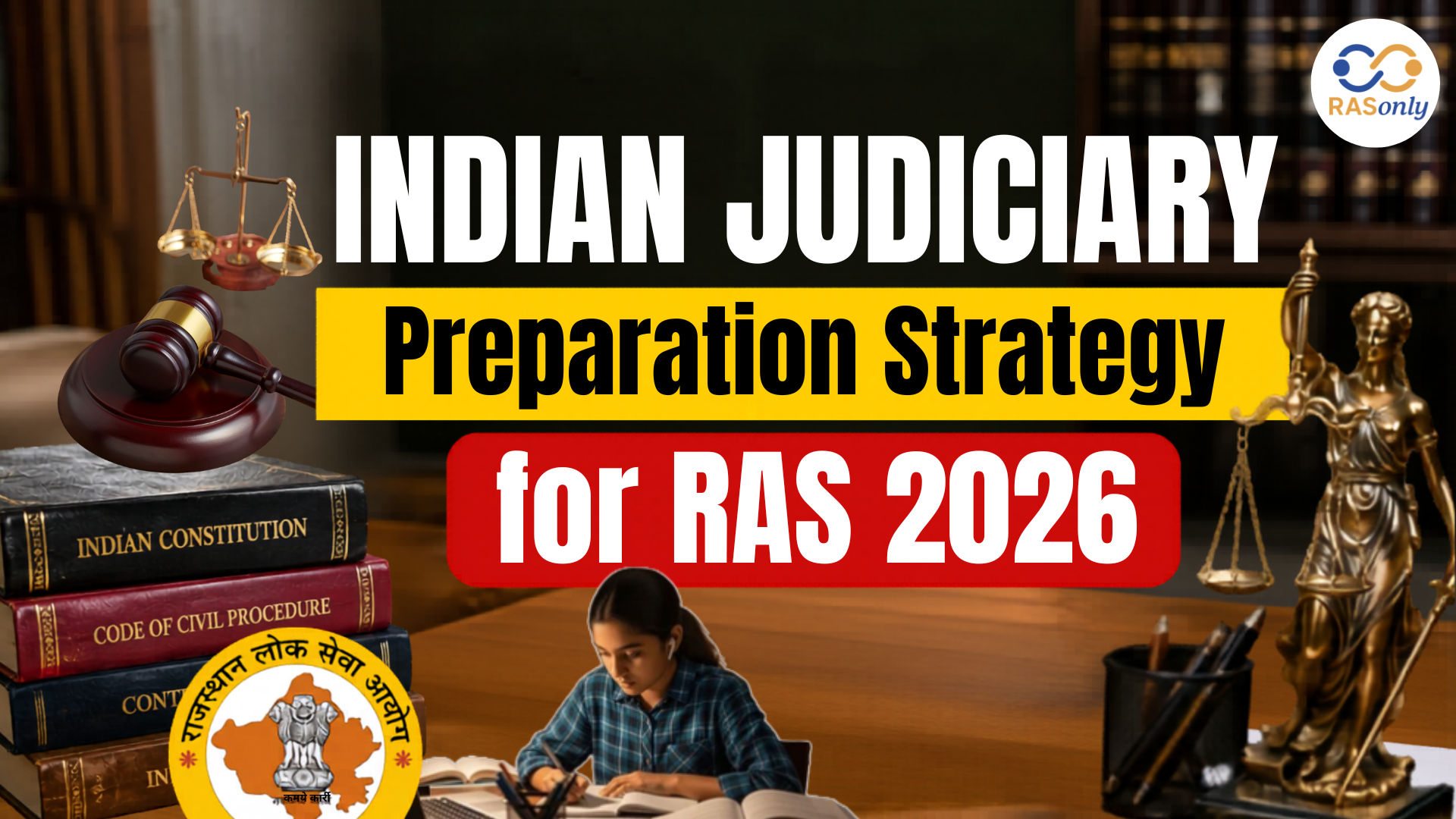
Indian Judiciary is one of the most important topics in Indian Polity for RAS Prelims 2026 because questions are regularly asked from the Supreme Court, High Courts, judicial review, PIL, writs, judicial appointments, constitutional provisions, and important judiciary-related concepts. Many aspirants find the judiciary difficult because of multiple Articles, legal terminology, constitutional concepts, and overlapping powers of courts. However, with the right preparation strategy and conceptual understanding, the Indian Judiciary becomes one of the most scoring sections in Polity.
The latest RAS syllabus continues to emphasize the Indian Constitution, constitutional bodies, governance, judiciary, fundamental rights, and democratic institutions within General Studies. Questions are usually conceptual, statement-based, constitutional, and current-affairs-linked. A smart Indian Judiciary preparation strategy for RAS 2026 should focus on constitutional concepts, Articles, comparison tables, PYQs, MCQ practice, and repeated revision instead of rote memorization.
Why Indian Judiciary is Important for RAS 2026
Indian Judiciary is one of the core areas of Indian Polity because it protects the Constitution, safeguards Fundamental Rights, interprets laws, and maintains the balance between the Legislature and Executive. RAS frequently asks direct and conceptual questions about constitutional provisions, courts, writs, judicial review, and important judicial principles.
Benefits of Strong Judiciary Preparation
- Improves Indian Polity preparation
- Helps in Constitution-related topics
- Useful for Fundamental Rights questions
- Important for governance and current affairs
- Helpful in both Prelims and Mains
- Scoring with conceptual clarity and revision
Indian Judiciary Syllabus for RAS 2026
Indian Judiciary is mainly covered under Indian Constitution, Political System, Governance, and Constitutional Bodies in the RAS syllabus. Questions are generally asked from the structure, powers, functions, and constitutional role of the judiciary.
Important Judiciary Topics for RAS 2026
- Supreme Court of India
- High Courts
- Subordinate Courts
- Judicial Review
- Judicial Activism
- Public Interest Litigation (PIL)
- Writs
- Judicial Appointments
- Independence of Judiciary
- Judicial Review & Judicial Overreach
- Constitutional Articles related to Judiciary
- Tribunals
- Important Constitutional Amendments
Topic-Wise Importance Table
| Topic | Preparation Focus |
|---|---|
| Supreme Court | Powers, jurisdiction, judges |
| High Courts | Structure and powers |
| Writs | Types and applications |
| Judicial Review | Constitutional interpretation |
| PIL | Rights and activism |
| Independence of Judiciary | Constitutional safeguards |
Judiciary preparation becomes much easier when studied through constitutional concepts, Articles, and comparison-based revision.
Best Indian Judiciary Preparation Strategy for RAS 2026
Judiciary should never be prepared through random memorization because constitutional concepts are interconnected and application-based. A structured preparation strategy helps aspirants improve conceptual clarity and retention.
Smart Preparation Approach
- Start with constitutional basics first
- Learn the court hierarchy systematically
- Focus on Articles related to Judiciary
- Prepare comparison tables regularly
- Link current affairs with Judiciary topics
- Practice MCQs after every topic
- Revise constitutional concepts repeatedly
Smart Judiciary Preparation Flow
| Step | Focus Area |
|---|---|
| Step 1 | Constitutional basics |
| Step 2 | Supreme Court & High Courts |
| Step 3 | Writs & judicial review |
| Step 4 | Current affairs linkage |
| Step 5 | MCQs & PYQs |
Supreme Court Strategy for RAS 2026
The Supreme Court is the highest judicial authority in India and one of the most important topics in the judiciary for RAS Prelims. Questions are frequently asked about constitutional provisions, powers, jurisdiction, judges, and landmark constitutional concepts.
Important Topics
- Article 124
- Composition of Supreme Court
- Appointment of judges
- Removal of judges
- Original jurisdiction
- Appellate jurisdiction
- Advisory jurisdiction
- Judicial review
- Court of Record
Important Features
- Highest court in India
- Guardian of Constitution
- Protector of Fundamental Rights
- Final interpreter of law
Smart Strategy
- Learn jurisdiction types comparatively
- Revise the constitutional Articles repeatedly
- Practice statement-based MCQs
- Focus on the powers of the Supreme Court carefully
High Court Strategy for RAS 2026
High Courts are the highest judicial authorities at the state level and are highly important for Indian Polity preparation.
Important Topics
- Article 214
- Composition of High Courts
- Appointment of judges
- Writ jurisdiction
- Powers of High Courts
- Court of Record
Important Features
- The highest court at the state level
- Supervises subordinate courts
- Can issue writs under Article 226
Smart Strategy
- Compare Supreme Court and High Court powers
- Learn Articles carefully
- Focus on writ jurisdiction
- Practice conceptual MCQs
Writs Strategy for RAS 2026
Writs are one of the most important and repeatedly asked Judiciary topics in RAS Prelims. Questions are generally direct, conceptual, and statement-based.
Important Writs Table
| Writ | Purpose |
|---|---|
| Habeas Corpus | Produce arrested person before court |
| Mandamus | Order to perform duty |
| Prohibition | Stop lower court proceedings |
| Certiorari | Transfer or quash lower court order |
| Quo Warranto | Question legality of office |
Smart Preparation Tips
- Learn writ meanings conceptually
- Practice writ-based MCQs regularly
- Use comparison tables for revision
- Focus on Articles 32 and 226
Judicial Review Strategy
Judicial Review is the power of courts to examine the constitutional validity of laws and government actions. It is one of the core features of the Indian Constitution.
Important Areas
- Constitutional interpretation
- Protection of Fundamental Rights
- Review of unconstitutional laws
- Basic Structure Doctrine
Smart Strategy
- Understand judicial review conceptually
- Link with Fundamental Rights
- Focus on constitutional supremacy
- Practice statement-based questions
Judicial Activism & PIL Strategy
Judicial Activism and Public Interest Litigation (PIL) are highly important because they are frequently linked with governance, rights, and constitutional issues.
Important Topics
- Public Interest Litigation
- Judicial Activism
- Judicial Overreach
- Social justice
- Constitutional remedies
Smart Strategy
- Compare Judicial Activism vs Judicial Overreach
- Focus on rights-based judgments
- Link current affairs with Judiciary topics
- Practice governance-related MCQs
Independence of Judiciary Strategy
Independence of Judiciary is one of the most important constitutional principles in India because it ensures fair justice and protects democracy.
Constitutional Safeguards
- Security of tenure
- Fixed salaries
- Removal procedure
- Separation of Judiciary from Executive
- Independent functioning
Smart Strategy
- Learn safeguards systematically
- Link with democratic principles
- Practice constitutional MCQs
Judicial Appointments Strategy for RAS 2026
Questions are frequently asked about judicial appointments, the collegium system, and constitutional provisions related to judges.
Important Topics
- Appointment of Supreme Court judges
- Appointment of High Court judges
- Collegium system
- Removal of judges
- Judicial independence
Smart Strategy
- Revise appointment process repeatedly
- Learn constitutional Articles carefully
- Practice comparison-based MCQs
Tribunals Strategy for RAS 2026
Tribunals are quasi-judicial bodies created for the speedy resolution of disputes and are increasingly important in competitive exams.
Important Topics
- Administrative Tribunals
- NGT (National Green Tribunal)
- CAT (Central Administrative Tribunal)
- Constitutional basis of Tribunals
Smart Strategy
- Learn tribunal functions carefully
- Focus on environment-related tribunals
- Practice current-affairs-linked MCQs
Important Articles Related to Judiciary
Constitutional Articles related to the Judiciary are extremely important for RAS Prelims because many Polity questions are directly asked from Articles, court powers, writ jurisdiction, and constitutional provisions. Aspirants should revise important Articles regularly through comparison tables and short notes to improve retention and accuracy during the exam.
Important Articles Table
| Article | Related Topic |
|---|---|
| Article 124 | Supreme Court |
| Article 214 | High Courts |
| Article 32 | Constitutional Remedies |
| Article 226 | Writ jurisdiction of High Courts |
| Article 50 | Separation of Judiciary from Executive |
Article-based revision and repeated MCQ practice help strengthen Indian Polity preparation for RAS 2026.
Current Affairs Linkage Strategy for Judiciary
Modern Judiciary questions are increasingly linked with constitutional debates, Supreme Court judgments, governance issues, and judicial developments. Current affairs linkage is extremely important because many statement-based questions are framed from recent constitutional and legal issues.
Important Areas
- Judicial appointments
- Important Supreme Court judgments
- Constitutional issues
- PIL-related developments
- Governance and rights issues
Smart Strategy
- Follow major constitutional developments regularly
- Revise important judgments briefly
- Link current affairs with Polity concepts
- Practice statement-based Judiciary MCQs
- Focus on rights and governance-related issues
Best Note-Making Strategy for Indian Judiciary
Indian Judiciary contains many constitutional Articles, legal concepts, court powers, and judicial principles, so short and organized notes become extremely important for quick revision before the exam. Proper note-making improves retention and reduces confusion during revision.
Smart Notes Strategy
- Prepare Article-wise short notes
- Make comparison tables for courts and writs
- Use flowcharts and constitutional diagrams
- Write one-line constitutional facts
- Revise notes every week
Best Notes Format
| Notes Type | Purpose |
|---|---|
| Article Notes | Quick constitutional revision |
| Comparison Tables | Avoid confusion between concepts |
| Flowcharts | Fast conceptual revision |
| One-Line Notes | Final quick revision |
Judiciary MCQ Practice Strategy for RAS 2026
MCQ practice is extremely important in Judiciary because most RAS Polity questions are conceptual, Article-based, and statement-oriented. Regular practice improves both constitutional understanding and question-solving accuracy.
Best MCQ Practice Method
- Solve topic-wise MCQs daily
- Practice PYQs regularly
- Analyze wrong answers carefully
- Revise weak areas repeatedly
- Practice statement-based Judiciary questions
Important Focus Areas
- Writs
- Constitutional Articles
- Jurisdiction of courts
- Judicial Review
- PIL & Judicial Activism
Most Important Judiciary Topics for RAS 2026
Some Judiciary topics are repeatedly asked in RAS Prelims because they form the foundation of Indian Polity and constitutional governance. Aspirants should focus more on these high-weightage topics and revise them regularly through Articles, MCQs, and comparison tables.
High-Weightage Topics
- Supreme Court
- High Courts
- Writs
- Judicial Review
- PIL
- Independence of Judiciary
- Constitutional Articles
Topic Priority Table
| Topic | Importance Level |
|---|---|
| Supreme Court | Very High |
| Writs | Very High |
| Judicial Review | High |
| High Courts | High |
| PIL | Moderate to High |
Common Mistakes Students Make in Judiciary Preparation
Many aspirants find Judiciary difficult because they try to memorize the constitutional Articles without understanding the concepts behind them. This creates confusion during statement-based and application-oriented questions in the exam.
Mistakes to Avoid
- Memorizing Articles without conceptual clarity
- Ignoring comparison tables
- Skipping MCQ practice
- Not revising constitutional provisions regularly
- Ignoring current affairs linkage
- Studying too many sources
Smart Improvement Strategy
- Focus on conceptual understanding first
- Use Article-wise revision methods
- Practice statement-based MCQs regularly
- Revise comparison tables repeatedly
- Link constitutional concepts with current affairs
Revision Strategy for Indian Judiciary
Revision is extremely important in Judiciary because constitutional Articles, court powers, writs, and judicial concepts are easy to confuse during the exam. Repeated revision through comparison tables and MCQs improves retention significantly.
Smart Revision Tips
- Revise constitutional Articles weekly
- Practice MCQs regularly
- Use comparison tables for quick revision
- Focus on repeated PYQ concepts
- Revise writs repeatedly through short notes
Best Revision Cycle
| Revision Stage | Focus Area |
|---|---|
| First Revision | Constitutional concepts |
| Second Revision | Articles & comparison tables |
| Final Revision | MCQs & quick notes |
How Toppers Prepare Indian Judiciary for RAS
Most toppers prepare Indian Judiciary through conceptual clarity, constitutional Articles, comparison tables, and repeated MCQ practice instead of rote memorization. Their preparation approach mainly focuses on understanding constitutional logic and consistent revision.
Toppers’ Strategy
- Revise constitutional Articles repeatedly
- Practice statement-based MCQs regularly
- Focus on conceptual understanding first
- Solve PYQs consistently
- Prepare short revision notes
What Makes Toppers Different?
- Better constitutional clarity
- Strong Article retention
- Consistent revision habits
- Smart MCQ analysis
- Better comparison-based learning
Conclusion
Indian Judiciary is one of the most important sections of Indian Polity for RAS Prelims 2026 because it forms the foundation of constitutional governance, Fundamental Rights protection, judicial review, and democratic balance in India. Questions from Judiciary are generally conceptual, Article-based, and statement-oriented, so aspirants should focus more on understanding constitutional principles rather than memorizing facts only.
A smart Indian Judiciary preparation strategy for RAS 2026 should include constitutional Articles, comparison tables, MCQ practice, PYQs, current affairs linkage, and repeated revision. Aspirants who regularly revise court powers, writs, judicial review, PIL, and constitutional provisions through conceptual learning methods generally perform much better in Polity sections during the exam.
FAQ
Indian Judiciary is important because many Polity questions are directly asked from Supreme Court, High Courts, writs, judicial review, PIL, and constitutional Articles.
Supreme Court, High Courts, Writs, Judicial Review, PIL, Judicial Activism, and Constitutional Articles are the most important Judiciary topics for RAS preparation.
Focus on conceptual clarity, constitutional Articles, comparison tables, MCQ practice, PYQs, and repeated revision instead of rote memorization.
Most Judiciary questions in RAS are conceptual, statement-based, and Article-oriented with some current affairs linkage.
Yes, current affairs are extremely important because many Judiciary questions are linked with constitutional debates, Supreme Court judgments, governance issues, and judicial developments.
BEST SELLER
🏆 PRELIMS
RAS Pass
Prelims focused Hindi & English
₹399
✓
Prelims Topic-Wise Tests
✓
Subject-Wise Tests
✓
Full-Length Prelims Tests
✓
Daily Current Affairs Tests
✓
Prelims PYQs Tests
✓
Detailed Solutions & Analysis
✓
All Rajasthan Ranking
✓
Unlimited Reattempts
✓
Mains Tests
✓
Hindi & English Tests
✓
All Rajasthan Ranking
Trusted by 5,000+ Students
Post Category
- RAS Salary
- Result
- RAS Admit Card
- RAS Job
- RAS Cutoff
- Preparation Tips
- RAS Answer Key
- RAS Exam Analysis
- RAS Syllabus
- RAS Previous Year Papers
- RPSC RAS Exam Pattern
- RAS Interview
- RAS Exam Date
- RAS Vacancy
- RAS Test Series
- RAS Best Books
- RAS Preparation Resources
- RAS Coaching Centre
- History
- Polity
- Geography
- Economics
- Science
- Art and Culture
- RPSC RAS Application Form
- RPSC RAS Notification
- RAS Eligibility Criteria
- UPSC Exam
- RPSC RAS Mains
Visit Our RASonly Offline Center
Our Expert Faculty

Bhunesh Sir
Current Affairs · 13+ Yrs

Aamir Khan Sir
RAS-2017 · IIM Ahm.

Akash Sir
Polity · 8+ Yrs
Free Resources
Official Mobile App

RASOnly App
by OTSAdda · Free
Full Video Lectures
Mock Tests & PYQs
Daily Current Affairs
AI Mock Interview
Free Download · No subscription needed to install
RAS 2024 Toppers — RASonly
Rank 2
Virendra Charan
Rank 9
Bhoopinder Singh
Rank 26
Aanchal Nagpal
Rank 33
Lokendra Singh
Rank 45
Amar Rathore
Rank 46
Manasvini Verma

Join RASonly WhatsApp Community
Get daily current affairs, exam alerts, free study material and tips from expert faculty — right on WhatsApp.
Join for Free →RASonly Interview Guidance Program

Mr. Ashok Jain
Ex-Chief Secretary Govt of Rajasthan
- IAS officer of the 1981 batch, Rajasthan cadre.
- Passionate about mentoring the next generation of RAS officers with real-world insights.
- Got retired in Dec 2017 from the post of Chief Secretary of the state of Rajasthan.

Mr. Guru Charan Rai
Ex-ASP / SP in Jaisalmer
- Guru Charan Rai, IPS (Retd), retired as Inspector General of Police (Security), Rajasthan, Jaipur in 2017.
- Served as ASP and SP in Jaisalmer, Nagaur, Sri Ganganagar, Sawai Madhopur, Dausa, Sikar, and Karauli.
- He also held key positions as DIGP and IGP in the Law and Order division.

Mr. Rakesh Verma
Ex-IAS Officer, B.Tech, MBA, and M.A. (Economics)
- IAS officer of the 1981 batch and retired in Chief Secretary Rank.
- Civil servant of high repute and vast experience.
- Has been teaching UPSC CSE subjects for the last six years.


Daily Current Affairs for RAS Exam Preparation 2026

India Wins Gold in 10m Air Pistol
September 26, 2026
India’s Rank in Travel And Tourism Development Index 2026
September 26, 2026
India Wins Bronze Medal in Men’s Double Sculls
September 25, 2026