Kushan Empire: History, Rulers, Administration, Economy, Art, Decline
Livestock Economy of Rajasthan 2026: Structure, Census, Breeds, Distribution, Challenges & Economic Role (RAS)

Get in Touch with RASonly!

The livestock economy of Rajasthan plays a crucial role in supporting rural livelihoods, especially in arid regions where agriculture is uncertain. It provides income, employment, and stability through dairy, wool, and animal husbandry activities. With growing focus on modernization, sustainability, and government support, the sector is becoming a strong driver of economic growth in the state.

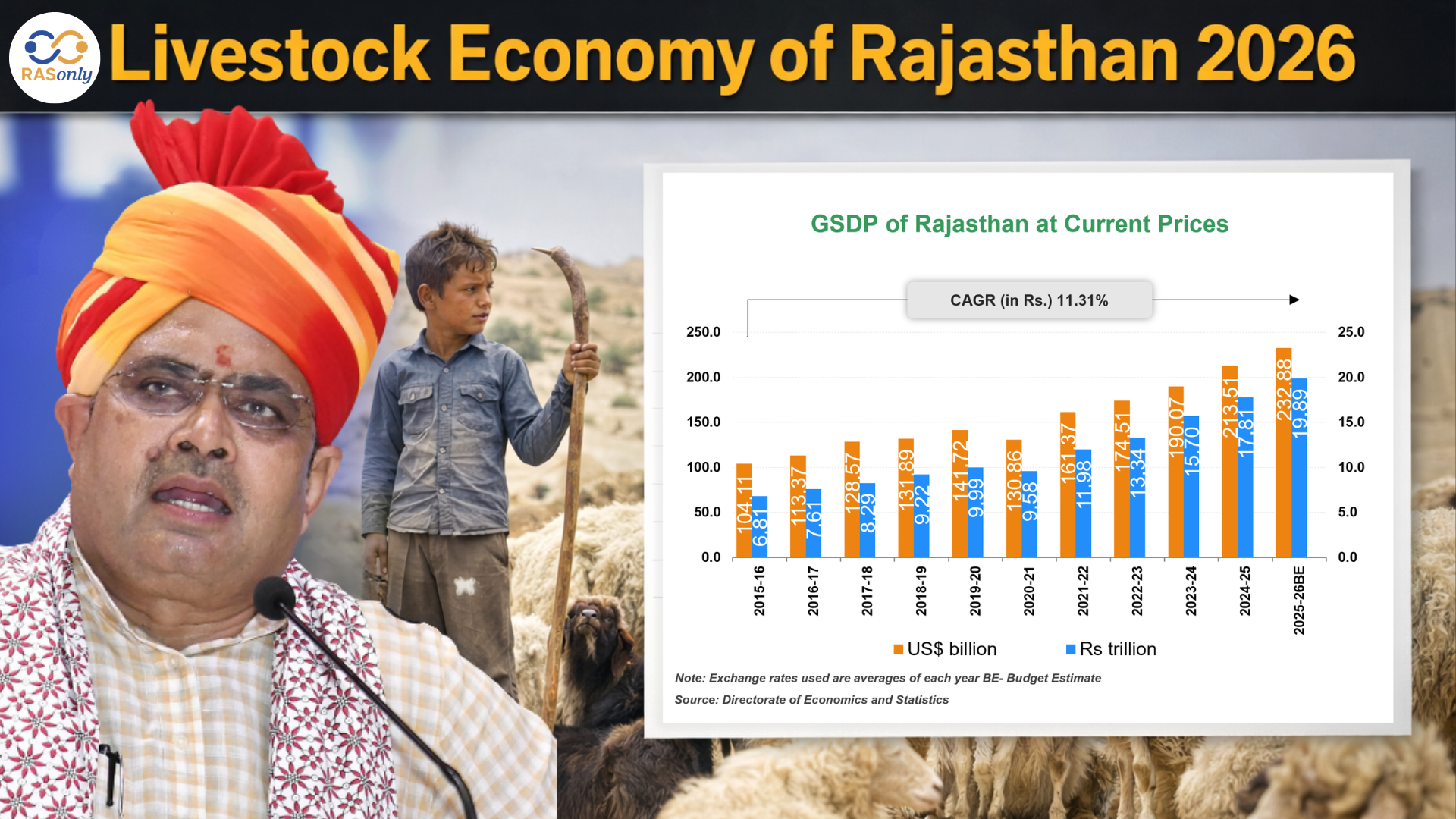
Rajasthan's livestock economy is the backbone of the state's rural and agrarian economy, especially in the dry and semi-arid zones where agriculture is largely reliant on erratic rainfall. Livestock practices provide a consistent and viable source of livelihood, employment and source of income for millions of people. It provides vital needs for milk, meat, wool and transportation, and is integral to rural life.
Rajasthan holds a prominent position in India’s livestock sector, with a large population of goats, sheep, cattle, and the highest number of camels in the country. The state is also the leading producer of wool and a major contributor to milk production. The livestock sector significantly contributes to the Gross State Value Added (GSVA) and plays a crucial role in reducing poverty, supporting pastoral communities, and strengthening the overall rural economy.
Major Observations of Rajasthan’s Livestock Sector
Livestock in Rajasthan is not only a subsidiary but a prominent industry. It plays an important role in the state and national livestock sector, particularly in the case of wool and camel.
Key Observations
- Rajasthan has about 10.60% of India’s livestock
- Highest share in camel population (~80%+)
- Major contributor in:
- Goat (~14%)
- Sheep (~10%)
- Production:
- Milk → ~14%
- Wool → ~45–50% (highest in India)
Livestock Census in Rajasthan
Livestock census helps in tracking the animal population and to form policies. This is done every five years and the data is used for planning.
Census Overview
| Parameter | Details |
|---|---|
| First Census | 1919–20 |
| Latest Census | 2019 |
| Population | ~567.75 lakh |
| Growth | Slight decline |
Livestock Composition
The livestock composition of Rajasthan reflects adaptation to its climatic conditions and economic priorities, with goats and cattle forming the majority.
Composition Table
| Animal | Share (%) |
|---|---|
| Goat | 36.7% |
| Cow | 24.5% |
| Buffalo | 24.1% |
| Sheep | 13.9% |
Regional Distribution of Livestock
Rajasthan's livestock distribution is affected by climatic, water and vegetation conditions. Camels and goats thrive in the desert, while dairy animals are found in the east.
Regional Pattern
| Region | Dominant Livestock |
|---|---|
| Western Rajasthan | Camel, Sheep, Goat |
| Eastern Rajasthan | Buffalo, Cattle |
| Southern Rajasthan | Mixed livestock |
Livestock Density
Livestock density indicates the dependence of people on animal husbandry. Higher density areas usually have better rainfall and pasture availability.
Key Data
👉 166 animals per sq. km
Variation
| Maximum | Minimum |
|---|---|
| Dungarpur | Jaisalmer |
| Banswara | Bikaner |
Growth and Decline Trends
Livestock trends in Rajasthan show a shift from traditional animals to dairy-based livestock, reflecting changing economic demands.
Growth
| Animal | Growth |
|---|---|
| Buffalo | +5.53% |
| Cattle | +4.41% |
Decline
| Animal | Decline |
|---|---|
| Donkey | -71% |
| Camel | -34% |
👉 Shift towards milk economy
Goat Breeds in Rajasthan
Goats are the most important livestock in Rajasthan due to their ability to survive in harsh desert conditions. They require less water and feed, making them ideal for rural households.
Goat Breeds
| Breed | Region | Features |
|---|---|---|
| Marwari | Jodhpur | Meat |
| Sirohi | Udaipur | Meat |
| Jhakhrana | Alwar | High milk |
| Barbari | East Rajasthan | Dual |
Cow Breeds in Rajasthan
Cows are important for both milk production and agricultural activities. Indigenous breeds are well adapted to local climatic conditions.
Cow Breeds
| Breed | Region | Features |
|---|---|---|
| Rathi | Bikaner | High milk |
| Tharparkar | Jaisalmer | Dual |
| Gir | Ajmer | Dairy |
Buffalo Breeds
Buffaloes are a major source of milk production in Rajasthan, especially in eastern regions where water availability is relatively better.
Buffalo Breeds
| Breed | Region | Features |
|---|---|---|
| Murrah | East Rajasthan | High milk |
| Mehsana | SW Rajasthan | Cross |
Sheep Breeds
Sheep are important for wool production, and Rajasthan is the leading wool-producing state in India.
Sheep Breeds
| Breed | Region | Features |
|---|---|---|
| Chokla | Bikaner | Fine wool |
| Nali | Ganganagar | Hardy |
| Marwari | West Rajasthan | Large population |
Camel Breeds
Camels are highly adapted to desert conditions and are an important part of Rajasthan’s economy and culture.
Camel Breeds
| Breed | Region | Features |
|---|---|---|
| Bikaneri | Bikaner | Load |
| Nachna | Jaisalmer | Fast |
Horse Breeds
Horses have historical and cultural importance in Rajasthan, especially in warfare and royal traditions.
Horse Breeds
| Breed | Region | Features |
|---|---|---|
| Marwari | West Rajasthan | War horse |
| Malani | Barmer | Strong |
Livestock Fairs
Livestock fairs are important for trade, culture, and rural economy. They also attract tourism and support local businesses.
Major Fairs
| Fair | Location |
|---|---|
| Pushkar | Ajmer |
| Nagaur | Nagaur |
Research & Development
Research centers help in improving breeds, productivity, and disease control, making livestock farming more efficient and sustainable.
Centers
| Center | Location |
|---|---|
| Camel Research | Bikaner |
| Sheep Research | Avikanagar |
Government Schemes
Government schemes support livestock farmers by improving breeds, providing healthcare, and ensuring income security.
Schemes
| Scheme | Purpose |
|---|---|
| Gopal | Breed improvement |
| Kamdhenu | Dairy |
Economic Importance
Livestock is a key component of Rajasthan’s economy, especially in rural areas. It provides employment, supports industries, and ensures income during drought.
Importance
- Employment
- Dairy production
- Wool industry
- Rural income
Challenges in Livestock Economy of Rajasthan
Rajasthan's livestock industry is confronted by a series of structural and environmental barriers that impact on productivity, livelihood and sustainability. The state's dry environment, water scarcity and reliance on traditional methods of livestock production can lead to regional disparities in production.
Moreover, problems such as disease outbreaks, inadequate modern infrastructure, and reduction of traditional livestock (such as camels) pose longer-term challenges for livelihoods and the environment. To tackle these issues, policy, technology and livestock-owner awareness must all improve.
Major Issues
| Problem | Impact |
|---|---|
| Water scarcity | Low productivity and poor animal health |
| Disease outbreaks | Economic loss and mortality |
| Decline in camel population | Cultural and economic loss |
| Overgrazing | Land degradation and reduced pasture |
| Lack of modernization | Low efficiency and income |
Future Trends in Livestock Sector (2026 Perspective)
The livestock sector in Rajasthan is transitioning towards a modern, sustainable and market-driven approach. The demand for milk and other animal products is on the rise, and the industry is seeing an increase in dairy farming, advanced breeding methods and veterinary care.
The government is also investing in digital technologies, climate-smart livestock and scientific livestock management systems to increase productivity and sustainability. These developments will be crucial in the livestock sector becoming more structured and profitable.
Key Future Trends
- Expansion of dairy sector and milk production
- Scientific breed improvement and genetic development
- Use of digital livestock tracking and management systems
- Adoption of climate-resilient and sustainable practices
- Growth of value-added livestock products and exports
Conclusion
Rajasthan's livestock economy is a crucial support to rural development, particularly in the dry and drought-prone zones where agriculture is insufficient for livelihood. It offers jobs, income security and contributes to dairy, wool and handicraft businesses.
Despite challenges such as water restrictions, animal and poultry diseases, and the decline of traditional livestock, the livestock sector is transforming with modernisation, new breeds, and state support. Emphasising sustainability, dairy development and technology, livestock is poised to become even more important to Rajasthan's economy and rural development.
FAQ
Livestock is important because it provides income, employment, and food security in drought-prone areas where agriculture is unreliable.
Goat has the highest share in the livestock population, followed by cattle and buffalo.
Rajasthan has the highest camel population in India due to its desert climate, where camels are well adapted.
Livestock supports dairy production, wool industry, transport, and acts as a financial backup during crop failure.
Key challenges include water scarcity, diseases, overgrazing, lack of modernization, and declining camel population.
BEST SELLER
🏆 PRELIMS
RAS Pass
Prelims focused Hindi & English
₹399
✓
Prelims Topic-Wise Tests
✓
Subject-Wise Tests
✓
Full-Length Prelims Tests
✓
Daily Current Affairs Tests
✓
Prelims PYQs Tests
✓
Detailed Solutions & Analysis
✓
All Rajasthan Ranking
✓
Unlimited Reattempts
✓
Mains Tests
✓
Hindi & English Tests
✓
All Rajasthan Ranking
Trusted by 5,000+ Students
Post Category
- RAS Salary
- Result
- RAS Admit Card
- RAS Job
- RAS Cutoff
- Preparation Tips
- RAS Answer Key
- RAS Exam Analysis
- RAS Syllabus
- RAS Previous Year Papers
- RPSC RAS Exam Pattern
- RAS Interview
- RAS Exam Date
- RAS Vacancy
- RAS Test Series
- RAS Best Books
- RAS Preparation Resources
- RAS Coaching Centre
- History
- Polity
- Geography
- Economics
- Science
- Art and Culture
- RPSC RAS Application Form
- RPSC RAS Notification
- RAS Eligibility Criteria
- UPSC Exam
- RPSC RAS Mains
Visit Our RASonly Offline Center
Our Expert Faculty

Bhunesh Sir
Current Affairs · 13+ Yrs

Aamir Khan Sir
RAS-2017 · IIM Ahm.

Akash Sir
Polity · 8+ Yrs
Free Resources
Official Mobile App

RASOnly App
by OTSAdda · Free
Full Video Lectures
Mock Tests & PYQs
Daily Current Affairs
AI Mock Interview
Free Download · No subscription needed to install
RAS 2024 Toppers — RASonly
Rank 2
Virendra Charan
Rank 9
Bhoopinder Singh
Rank 26
Aanchal Nagpal
Rank 33
Lokendra Singh
Rank 45
Amar Rathore
Rank 46
Manasvini Verma

Join RASonly WhatsApp Community
Get daily current affairs, exam alerts, free study material and tips from expert faculty — right on WhatsApp.
Join for Free →RASonly Interview Guidance Program

Mr. Ashok Jain
Ex-Chief Secretary Govt of Rajasthan
- IAS officer of the 1981 batch, Rajasthan cadre.
- Passionate about mentoring the next generation of RAS officers with real-world insights.
- Got retired in Dec 2017 from the post of Chief Secretary of the state of Rajasthan.

Mr. Guru Charan Rai
Ex-ASP / SP in Jaisalmer
- Guru Charan Rai, IPS (Retd), retired as Inspector General of Police (Security), Rajasthan, Jaipur in 2017.
- Served as ASP and SP in Jaisalmer, Nagaur, Sri Ganganagar, Sawai Madhopur, Dausa, Sikar, and Karauli.
- He also held key positions as DIGP and IGP in the Law and Order division.

Mr. Rakesh Verma
Ex-IAS Officer, B.Tech, MBA, and M.A. (Economics)
- IAS officer of the 1981 batch and retired in Chief Secretary Rank.
- Civil servant of high repute and vast experience.
- Has been teaching UPSC CSE subjects for the last six years.

Daily Current Affairs for RAS Exam Preparation 2026
Rajasthan State Election Commission Wins Gold SKOCH Award
September 28, 2026
Tarang Shakti 2026
September 28, 2026
India Wins Gold in 10m Air Pistol
September 26, 2026