Free Rajasthan GK One-Liner Notes for RAS
Modern History of Rajasthan (1700–1956): British Rule, Freedom Movement and Integration

Get in Touch with RASonly!

The Modern History of Rajasthan explains how the region transformed from princely states of Rajputana into a unified democratic state after independence. Major events such as the rise of Maratha power, British treaties, the Revolt of 1857, Praja Mandal movements, and the integration of Rajasthan shaped the political development of the state. This topic is very important for Rajasthan GK and RPSC RAS Exam preparation.

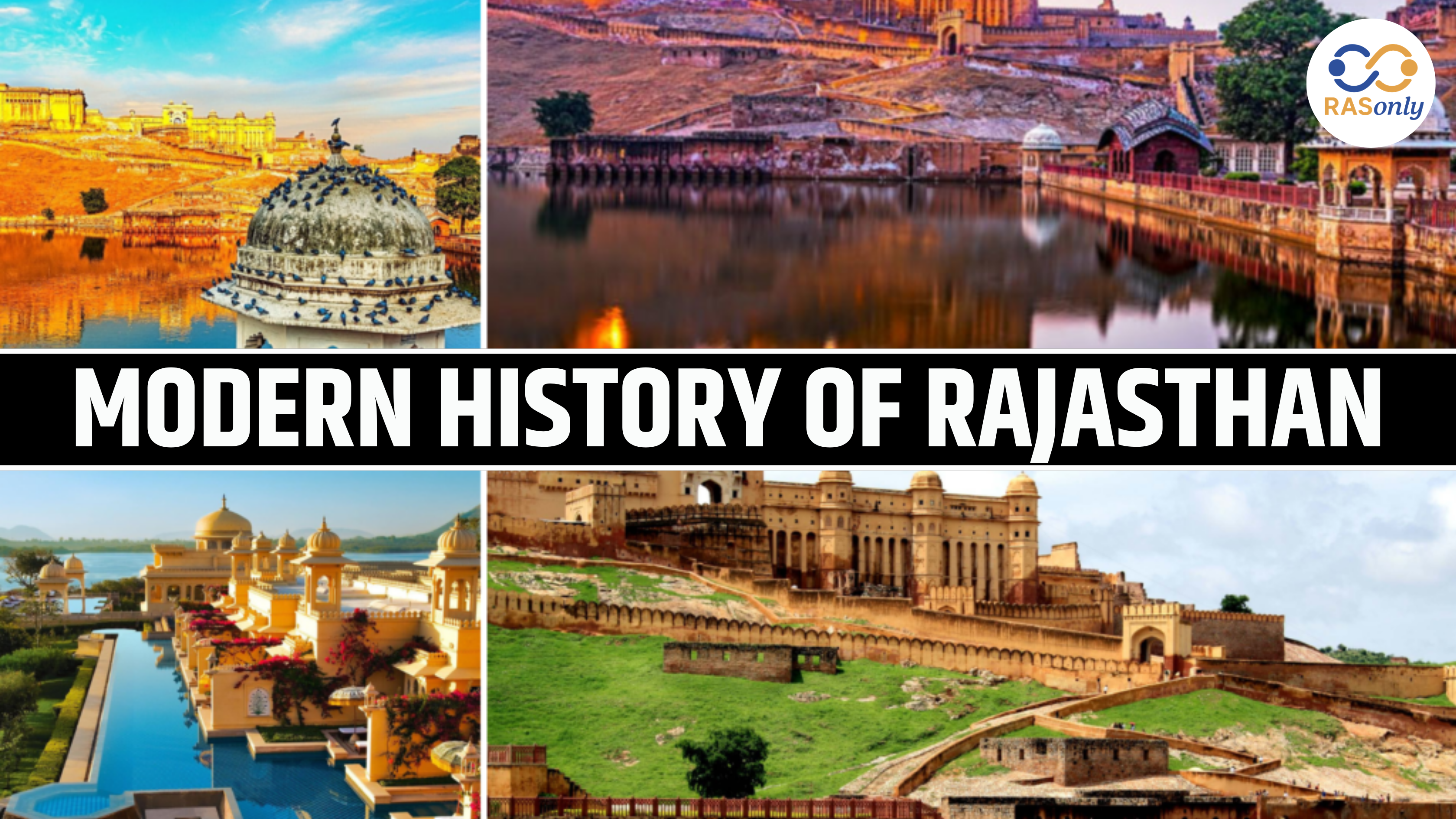
The Modern History of Rajasthan covers the period from the decline of Mughal power in the 18th century to the formation of the modern state of Rajasthan in 1956. During this period, Rajasthan witnessed major political changes including the rise of Maratha influence, treaties with the British East India Company, the Revolt of 1857, the Praja Mandal movements, and finally the integration of princely states into a unified Rajasthan.
Before independence, Rajasthan was known as Rajputana, which consisted of several princely states ruled by Rajput rulers. The states were then incorporated into British political control via subsidiary alliances and treaties. The area was also a hub of the Indian freedom movement which was active and demanded responsible governance and democratic rights.
Understanding the modern history of Rajasthan, Rajputana states, freedom movement in Rajasthan, and the integration of Rajasthan is quite significant to RPSC RAS Exam 2026, Rajasthan GK, and Indian modern history studies.
Overview of Modern History of Rajasthan
The Modern History of Rajasthan deals with the time between the beginning of the 18th century and the establishment of the current state of Rajasthan in 1956. This was the time of significant political shifts such as the fall of Mughal authority, emergence of Maratha influence, British rule over Rajputana, freedom movements and integration of princely states into new Rajasthan.
The history of modern Rajasthan is divided into various key periods such as the fall of the Mughal rule, the rise of the Maratha, the rise of the British, the freedom struggle, and the integration of the state following independence.
| Period | Major Developments |
|---|---|
| 1700–1818 | Decline of Mughal power and rise of Maratha influence |
| 1818–1857 | British treaties with Rajput states |
| 1857 | Revolt of 1857 in Rajputana |
| 1900–1947 | Freedom movement and Praja Mandal movements |
| 1947–1956 | Integration of princely states and formation of Rajasthan |
These phases together shaped the political, social, and administrative structure of modern Rajasthan.
Decline of Mughal Power in Rajasthan
The decline of the Mughal Empire in the early 18th century significantly affected the political situation in Rajasthan. As Mughal authority weakened, Rajput rulers gained greater independence and started strengthening their regional kingdoms.
The decline of the Mughal Empire in the early 18th century created a political vacuum across northern India. Rajput states such as Jaipur, Jodhpur, Udaipur, Bikaner, and Jaisalmer regained greater autonomy as Mughal authority weakened.
During this period:
- Rajput rulers attempted to strengthen their kingdoms.
- Several regional conflicts occurred between Rajput states.
- The weakening of central authority allowed new powers like the Marathas to expand into Rajasthan.
The decline of Mughal rule marked the beginning of the modern political history of Rajasthan.
Rise of Maratha Influence in Rajasthan
The Marathas emerged as a major political force in the 18th century in Rajasthan and northern India. Their political and economic policies had a serious effect on the political and economic state of the Rajput states because of their military campaigns and taxation.
During the 18th century, the Marathas took over the political scene in most of India including Rajasthan. Holkars and Scindias (Maratha leaders) would collect taxes and tribute on a number of the Rajput states.
Impact of Maratha influence:
- Rajput states had to pay chauth and tribute.
- Frequent Maratha invasions weakened local kingdoms.
- Internal conflicts among Rajput rulers increased.
Due to Maratha pressure, many Rajput states later sought protection from the British East India Company.
British Treaties with Rajput States (1817–1823)
The British East India Company politically occupied Rajputana in the first half of the 19th century by treaty with Rajput leaders. These treaties made the states of the princes under the protection of the British although rulers retained internal rule.
During the early 19th century, the British East India Company established political control over Rajputana through a series of treaties with Rajput rulers.
These treaties were signed mainly between 1817 and 1823.
Major Features of British Treaties
-
British provided protection against Maratha attacks.
-
Rajput rulers accepted British political supremacy.
-
British Residents were appointed in princely states.
-
Internal administration remained with the local rulers.
This system placed Rajasthan under indirect British rule, while the princely states continued to exist.
Revolt of 1857 in Rajasthan
The Revolt of 1857, also known as the First War of Independence, had a significant impact on Rajasthan. Although many princely rulers supported the British, several regions witnessed rebellion against colonial authority.
The Revolt of 1857 also affected the region of Rajputana. Although some rulers supported the British, several places witnessed rebellion against colonial authority.
Major Centers of Revolt in Rajasthan
|
Location |
Event |
|---|---|
|
Nasirabad |
Sepoy revolt occurred in May 1857 |
|
Neemuch |
Soldiers revolted against British officers |
|
Kota |
Major uprising against British rule |
|
Erinpura |
Military rebellion occurred |
In Kota, rebels killed the British Political Agent Major Burton, making it one of the most significant uprisings in Rajasthan during the revolt.
The revolt marked an important stage in the freedom struggle in Rajasthan.
Freedom Movement in Rajasthan
Rajasthan became a vibrant center of Indian freedom movement in the 20th century. A number of leaders and groups tried to establish political awareness and insist on democratic changes in the princely states.
During the 20th century, Rajasthan became an important part of the Indian freedom movement. Various political organizations and leaders started movements demanding democratic reforms and responsible government in princely states.
Many people in Rajputana opposed feudal rule and demanded political rights.
Major Leaders of Freedom Movement in Rajasthan
- Arjun Lal Sethi
- Jamnalal Bajaj
- Manikya Lal Verma
- Vijay Singh Pathik
- Haribhau Upadhyay
These leaders worked to promote nationalism, social reform, and political awareness among the people.
Praja Mandal Movements in Rajasthan
The Praja Mandal movements were political organizations formed in various princely states of Rajasthan to demand democratic rights and responsible governance. These movements played a major role in mobilizing the people against feudal oppression.
The Praja Mandal movements were political organizations formed in various princely states of Rajasthan during the freedom struggle.
The main aim of these movements was to demand:
- Responsible government
- Civil rights
- End of feudal oppression
- Democratic reforms
Important Praja Mandal Organizations
| State | Praja Mandal |
|---|---|
| Jaipur | Jaipur Praja Mandal |
| Mewar | Mewar Praja Mandal |
| Marwar | Marwar Praja Mandal |
| Bikaner | Bikaner Praja Mandal |
These organizations played a major role in spreading political awareness and nationalism in Rajasthan.
Integration of Rajasthan after Independence
After India gained independence in 1947, the princely states of Rajputana were gradually integrated into the Indian Union. This process took place in several stages between 1948 and 1956, resulting in the formation of the modern state of Rajasthan.
After India gained independence in 1947, the princely states of Rajputana had to be integrated into the Indian Union. The process of Rajasthan integration was completed in several stages between 1948 and 1956.
Stages of Rajasthan Integration
| Stage | Date | Development |
|---|---|---|
| Stage 1 | March 1948 | Formation of Matsya Union |
| Stage 2 | April 1948 | United State of Rajasthan formed |
| Stage 3 | March 30, 1949 | Greater Rajasthan formed |
| Stage 4 | May 1949 | Integration of additional princely states |
| Stage 5 | January 1950 | Rajasthan became Part B state |
| Stage 6 | 1952 | Democratic government established |
| Stage 7 | November 1, 1956 | Final reorganization under States Reorganisation Act |
30 March 1949 is celebrated as Rajasthan Day because major princely states like Jaipur, Jodhpur, Bikaner, and Jaisalmer joined to form Greater Rajasthan.
Role of Mohan Lal Sukhadia in Modern Rajasthan
Mohan Lal Sukhadia played a crucial role in the political and economic development of Rajasthan after independence. His leadership helped modernize the state and strengthen democratic governance.
One of the greatest leaders who contributed to the development of Rajasthan in the post-independent period was Mohan Lal Sukhadia. He was the Chief Minister of Rajasthan between 1954 and 1971 and brought about numerous reforms.
Major Contributions
- Expansion of education
- Agricultural reforms
- Development of irrigation projects
- Strengthening of democratic governance
Because of his contributions, he is often called the architect of modern Rajasthan.
Significance of Modern History of Rajasthan
The modern history of Rajasthan highlights the transformation of the region from feudal princely states to a democratic and unified state within India. The political movements and integration process played a key role in shaping modern Rajasthan.
The modern history of Rajasthan is important because it shows how the region transitioned from feudal princely states to a democratic state within India.
Key Outcomes
- End of princely rule
- Establishment of democratic governance
- Political integration of Rajasthan
- Economic and social development
The events of this period shaped the political identity and administrative structure of present-day Rajasthan.
Conclusion
Modern History of Rajasthan is one of the significant changes in the political and administrative setup in the region. Since the fall of the Mughal rule and the emergence of the power of the Marathas until the time of the formation of the British rule over Rajputana, the 18th and 19th centuries were marked by major political transformations in Rajasthan.
The freedom movement of Rajasthan, Praja Mandal movements and the works of the leaders like Arjun Lal Sethi, Jamnalal Bajaj and Manikaya Lal Verma contributed significantly to the democratic reforming. Lastly, in 1948-1956 the state of Rajasthan was formed because of the integration of princely states. Knowledge about the contemporary history of Rajasthan, Rajputana states and integration of Rajasthan is imperative to students involved in RPSC RAS Exam 2026 and Rajasthan GK.
FAQ
The modern history of Rajasthan generally covers the period from the decline of Mughal power in the early 18th century to the final integration of Rajasthan in 1956.
Before independence, Rajasthan was known as Rajputana, which consisted of several princely states ruled by Rajput rulers under British political supervision.
The Praja Mandal movements were political organizations that demanded responsible government, civil rights, and democratic reforms in the princely states of Rajasthan during the freedom movement.
The process of integration began in 1948, and the modern state of Rajasthan was finally formed on 1 November 1956 under the States Reorganisation Act.
30 March 1949 is celebrated as Rajasthan Day because major princely states like Jaipur, Jodhpur, Bikaner, and Jaisalmer joined to form Greater Rajasthan on that date.

BEST SELLER
🏆 PRELIMS
RAS Pass
Prelims focused Hindi & English
₹399
✓
Prelims Topic-Wise Tests
✓
Subject-Wise Tests
✓
Full-Length Prelims Tests
✓
Daily Current Affairs Tests
✓
Prelims PYQs Tests
✓
Detailed Solutions & Analysis
✓
All Rajasthan Ranking
✓
Unlimited Reattempts
✓
Mains Tests
✓
Hindi & English Tests
✓
All Rajasthan Ranking
Trusted by 5,000+ Students
Post Category
- RAS Salary
- Result
- RAS Admit Card
- RAS Job
- RAS Cutoff
- Preparation Tips
- RAS Answer Key
- RAS Exam Analysis
- RAS Syllabus
- RAS Previous Year Papers
- RPSC RAS Exam Pattern
- RAS Interview
- RAS Exam Date
- RAS Vacancy
- RAS Test Series
- RAS Best Books
- RAS Preparation Resources
- RAS Coaching Centre
- History
- Polity
- Geography
- Economics
- Science
- Art and Culture
- RPSC RAS Application Form
- RPSC RAS Notification
- RAS Eligibility Criteria
- UPSC Exam
- RPSC RAS Mains
Visit Our RASonly Offline Center
Our Expert Faculty

Bhunesh Sir
Current Affairs · 13+ Yrs

Aamir Khan Sir
RAS-2017 · IIM Ahm.
Akash Sir
Polity · 8+ Yrs
Free Resources
Official Mobile App

RASOnly App
by OTSAdda · Free
Full Video Lectures
Mock Tests & PYQs
Daily Current Affairs
AI Mock Interview
Free Download · No subscription needed to install
RAS 2024 Toppers — RASonly
Rank 2
Virendra Charan
Rank 9
Bhoopinder Singh
Rank 26
Aanchal Nagpal
Rank 33
Lokendra Singh
Rank 45
Amar Rathore
Rank 46
Manasvini Verma

Join RASonly WhatsApp Community
Get daily current affairs, exam alerts, free study material and tips from expert faculty — right on WhatsApp.
Join for Free →RASonly Interview Guidance Program

Mr. Ashok Jain
Ex-Chief Secretary Govt of Rajasthan
- IAS officer of the 1981 batch, Rajasthan cadre.
- Passionate about mentoring the next generation of RAS officers with real-world insights.
- Got retired in Dec 2017 from the post of Chief Secretary of the state of Rajasthan.

Mr. Guru Charan Rai
Ex-ASP / SP in Jaisalmer
- Guru Charan Rai, IPS (Retd), retired as Inspector General of Police (Security), Rajasthan, Jaipur in 2017.
- Served as ASP and SP in Jaisalmer, Nagaur, Sri Ganganagar, Sawai Madhopur, Dausa, Sikar, and Karauli.
- He also held key positions as DIGP and IGP in the Law and Order division.

Mr. Rakesh Verma
Ex-IAS Officer, B.Tech, MBA, and M.A. (Economics)
- IAS officer of the 1981 batch and retired in Chief Secretary Rank.
- Civil servant of high repute and vast experience.
- Has been teaching UPSC CSE subjects for the last six years.


Daily Current Affairs for RAS Exam Preparation 2026
Rajasthan Universities in the QS World University Rankings 2027
September 12, 2026
Rajasthan to Host Miss Ocean World 2026
September 12, 2026
PM-SETU Scheme Bhiwadi ITI Cluster Gets Approval
September 11, 2026
