Satavahana Dynasty: History, Rulers, Administration, Art and Culture
Satavahana Dynasty: History, Rulers, Administration, Art and Culture

Get in Touch with RASonly!

The Satavahana Dynasty was a powerful Indian dynasty that ruled the Deccan and central India after the Mauryan decline. Founded by Simuka, it flourished under Gautamiputra Satakarni and Yajna Sri Satakarni. The Satavahanas promoted Roman trade, Buddhist art and Prakrit literature before weak successors and regional powers ended their rule.

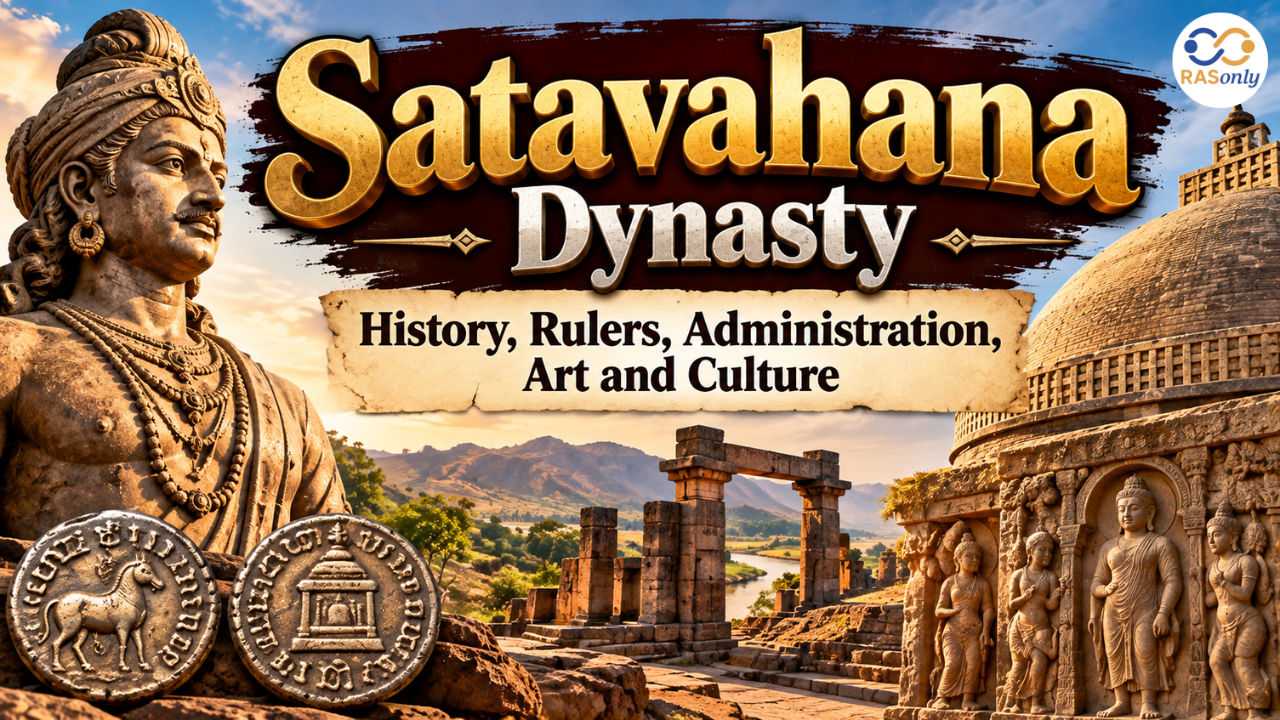
The Satavahana Dynasty was one of the great ancient Indian dynasties that was important in the political and cultural life of the Deccan and central India. After the demise of the Mauryan Empire, the kingdom of the Satavahanas came into being at various times in parts of present-day Maharashtra, Telangana, Andhra Pradesh, Karnataka and Madhya Pradesh and was powerful. They were even more important to the development of trade, Buddhism, Prakrit literature, art, architecture and administrative matters of the Deccan. The expansion and consolidation of the dynasty had been done by important rulers, like Simuka, Satakarni I, Gautamiputra Satakarni and Yajna Sri Satakarni.
Origin and Rise of the Satavahana Dynasty
Satavahana dynasty is connected with the Deccan region. They came to political prominence when the power of the Mauryas over the Deccan waned.
The true order and early history of the dynasty is sometimes disputed since the dates are established from inscriptions, coins, references in the Puranas, and archaeology.
Founder of the Satavahana Dynasty
- Simuka was a founder or an early founder of the Satavahana dynasty.
- Satavahana rule came to the Deccan after the waning political importance of the Mauryas.
- The dynasty gradually gained control of key territories and trade routes.
Early Satavahana Expansion
The early Satavahana kings consolidated Satavahana power in the Deccan was followed by its spread into western and central India.
Geographically, their location was very significant, as the Deccan was connected with:
- The north of India and the southern peninsula.
- River towns and towns on the west coast.
- Established agricultural areas containing main commercial centres.
- Trade relations with outside markets in India.
Satavahana Dynasty: Important Rulers
Several rulers contributed to the expansion and development of the Satavahana kingdom.
Simuka
- Traditionally, Simuka is regarded as the founder of the Satavahana dynasty.
- During his reign, the Satavahanas gained political sway in the Deccan. Subsequent kings added to the land mass granted in the early centuries.
Satakarni I
Satakarni I was an important early Satavahana ruler.
It is during his reign that there is known territory expansion, and important Vedic rituals were performed and enacted.
He is especially noted for his:
- Increase in Satavahana power.
- Performance of the Ashvamedha sacrifices
- The worship of Brahmanical traditions
- The rise of the power of kings.Increased monarchical authority.
Naganika is important to Satavahana history as his wife. The Naneghat inscription relating to Naganika sheds light on the status of the royal family, the sacrifices and the political status during that time.
Gautamiputra Satakarni
Gautamiputra Satakarni is generally regarded as one of the most powerful Satavahana rulers.
His name is known primarily from his inscriptions, especially the Nasik inscription, which was erected by his mother, Gautami Balashri.
His achievements included:
- Union of the Satavahana region.
- Conflict with the Western Kshatrapas
- Satavahana political power was restored.
- Increase in royal power
- Patronage of Brahmanical practices
Gautamiputra Satakarni is significant because his reign marks a major step toward the revival of Satavahana political power.
Vashishthiputra Pulumavi
- Vashishthiputra Pulumavi was the successor of Gautamiputra Satakarni.
- He ruled large tracts of the Deccan and continued to trade with the significant business centres.
- There were also continued developments of Buddhist establishments and trade during his time.
Yajna Sri Satakarni
- One of the later powerful Satavahana rulers was Yajna Sri Satakarni.
- He is especially linked to the Satavahana resurgence in a few western regions.
- His coins of his are an historical fact. Several of his coins show ships and sea trade in the Satavahana era.
Satavahana Administration
Kingship was unified with local administration in the Satavahana administration.
The king was the central authority, with local officials, feudatories and regional administrative units having important roles to play.
Role of the King
The ruler was responsible for:
- The office of a king.The office of a ruler or prince.
- Military organization
- Protection of territory
- Revenue collection
- Support of religious institutions
- Political connections were maintained.
Lineage, military success and religious legitimacy are significant as shown by the use of royal titles and inscriptions.
Administrative Divisions
- Satavahana kingdom was divided into administrative units.
- Inscriptions contain the term Ahara and names linked to territorial or administrative division.
- The local authorities assisted in the administration, collecting taxes and handling regional affairs for the central authority.
Feudatories and Local Chiefs
Satavahana kings used to leave royal agents known as chieftains along with their sub-lawyers for village and state supervision.
Other inscriptions mentioned important groups and officials, including:
- Maharathis
- Mahabhojas
- Additional elites and officials
While acknowledging Satavahana authority, they had considerable powers in their locality.
Satavahana Economy
Satavahana economy was agricultural, craft production, trade and long-distance trade.
The Deccan, the centre of important trade routes, both land and sea, became important for the dynasty.
Agriculture
- Agriculture was a significant source of income.
- Farmers grew crops in fertile areas, and irrigation and water enabled agricultural production.
- Land revenue was a component of the economy.
Trade and Commerce
There was much trading during the Satavahana period.
Key industries involved were:
- Textile production
- Metalworking
- Pottery
- Bead-making
- Agricultural products
- A collection of semi-precious and precious stones.
- Other manufactured goods
The physical geography of the kingdom enabled the traders to transport the goods from the north, west, and South of India.
Roman Trade
- During the Satavahana era, important trade relations between the Romans and India.
- The archaeological findings and Roman coins confirm long-distance trade to the western coast and Deccan.
- The Deccan economy was linked to the rest of the world through important trade centres further inland.
Satavahana Coins
- Coins are a valuable source for the study of the Satavahanas' political and economic history.
- The Satavahana kings struck their own coins of varying sizes and on various metals.
- Examples of Satavahana coins are as follows:
Satavahana coins can have a reverse inscribed with either of the following.
- Ships
- Animals
- Trees
- Chaitya symbols
- Ujjain symbol
- Portrait-like royal representations
- Legends written in Prakrit
It is fitting that on some coins of Yajna Sri Satakarni, it is the ship motif that finds special mention in the course of discussion of maritime trade.
Satavahana Society
Satavahana society was a product of the process of interaction between social, religious and economic groups.
Inscriptions offer details on:
- Kings and royal families
- Merchants
- Artisans
- Monks
- Religious donors
- Local elites
- Women donors
Position of Women
- The Satavahana inscriptions also refer to women from both noble and non-noble families as donors and as members of significant families.
- Two special women, significant to Satavahana history, are Naganika and Gautami Balashri.
- There is also much information provided by Gautami Balashri's inscription at Nasik regarding the achievements of her son Gautamiputra Satakarni.
Religion During Satavahana Period
During Satavahana rule, both Brahmanism and Buddhism were in coexistence. The rulers and members of royal families patronised various religious centres.
Brahmanical Traditions
The Satavahana rulers conducted significant Vedic ceremonies such as:
- Ashvamedha
- Rajasuya
- Other sacrificial ceremonies
These activities signify the relevance of the Brahmanical traditions in the royal ideology.
Buddhism
Satavahana kings also witnessed the growth of Buddhist sculpture.
Donations were made to Buddhist monasteries and stupas from:
- Kings
- Queens
- Merchants
- Guilds
- Local elites
- Ordinary devotees
The patronage helped to blossom Buddhist art and architecture in the Deccan.
Satavahana Art and Architecture
It is during the Satavahana period that Buddhist architecture and sculpture in the Deccan developed especially.
Stupas, monasteries and cave complexes gave birth to major artistic centres.
Amaravati Stupa
The Amaravati Stupa evolved into one of the most prominent Buddhist art centres of the entire cultural area of the Satavahana period.
It is a sculptural tradition renowned for:
Detailed reliefs
Scenes that relate to Buddha's life and teachings.
Jataka narratives
Patterns that are inspired by flowers and decoration.
Dynamic human figures
Subsequently, the Amaravati art style spread to Buddhist art of the Deccan and beyond.
Sanchi
- There were also links between Satavahana rulers and elites and Buddhist agencies at Sanchi.
- There are also significant architectural and sculptural relics here that document the ongoing evolution of Buddhist art at this time.
Nasik Caves
- The Nasik Caves provide valuable material to study the religion, architecture and patronage of the Satavahana period.
- Inscriptions found at the site provide information about rulers, donors and religious establishments.
Karla Caves
- The Karla caves are well known for their huge Buddhist Chaitya hall.
- The caves illustrate the evolution of the rock-cut buildings and also the role of the merchant classes as supporters of Buddhist institutions.
Religion and Society under the Satavahanas
During the Satavahana period, the co-existence of Brahmanical traditions, Vaishnavism and Buddhism. There was no monopoly of religious patronage by one set of beliefs.
- Satavahana rulers are generally associated with Brahmanical traditions.
- Certain rulers performed important Vedic rituals such as Ashvamedha and Vajapeya.
- The Naneghat inscription names Naganika as Satakarni; several Vedic sacrifices were performed by the royal family of Satakarni.
- The Satavahanas also worshipped Vaishnava deities like Krishna and Vasudeva.
- Buddhism was also well patronised during the period.
- Buddhist buildings and monks were given land and other gifts.
- The religious and economic activity of the Satavahanas is reflected in the Buddhist statues and inscriptions in the Deccan.
- The time reflects religious pluralism, not the hegemonic dominance of any one single religious tradition, but rather religious pluralism.
Society
Satavahana society was one with a multistate structure, based on the varna tradition, groups of occupation, trade and urbanisation.
Social Structure
- The traditional varna system continued to influence social organisation.
- inscriptional sources, there are references to the four Varna, namely Brahmans, Kshatriyas, Vaishyas and Shudras.
- But the reality of society was more complicated than the four-varna ideology.
- Trade increased in importance, leading to the rise in prominence of merchants, traders, artisans and guilds (shrenis).
- Valued trade centres emerged in western coastal and Deccan trading areas.
- For instance, merchants could sometimes refer to the town or region that they belonged to, as a sort of association.
Position of Women
- Furthermore, women had a role in visible activities like royal, religious and economic ones.
- Satavahana rulers or the royal family are known to be associated with matronymics, meaning names that refer to the mother.
- They were Gautamiputra Satakarni, Vashishthiputra Pulumavi, etc.
- Gautami Balashri (mother of Gautamiputra Satakarni) is a particularly important person owing to the inscription at Nasik.
- But the use of matronymics is not sufficient evidence of total matrilineal society of the Satavahanas. Another term that would be more appropriate to use for an aspect of royalty and descent would be important.
Agriculture and Settlements
- Expansion of agriculture contributed to the growth of permanent settlements.
- Agricultural development was encouraged along fertile river valleys.
- Both towns and trade networks and political centres were sustained by growing agricultural production.
- The spread of trade facilitated the link between the Deccan and the coastal ports of the West and wider Indian Ocean trade networks.
Decline of the Satavahana Dynasty
Satavahana dynasty did not collapse in one stroke of the pen it was a progressive process that took place. Eventually, Satavahana rule came to an end due to political fragmentation, loss of central power, and the growth of regional powers.
1. Weak Successors
- Generally, Yajna Sri Satakarni was regarded as the last and most important ruler of the Satavahana dynasty.
- Following his reign, there were relatively weak rulers of the dynasty.
- This reduced the dynasty's ability to maintain control over its large territories.
- This also encompasses the weakness of Central Authority.
- The Satavahana Empire was large one, and its political and administrative control was needed.
2. Political Fragmentation
- Following the later Satavahana rulers, their lands were more and more influenced by the adjacent regions.
- The fall was, therefore, a bit gradual and not abrupt.
- The successor power systems of the different regions of the Deccan were different.
3. Emergence of the regional dynasties
- The weakening of Satavahana kingship allowed the piecemeal rise of powerful regional states.
- A successor power was the Ikshvakus in the eastern Deccan, especially in Krishna-Guntur.
- In other regions, the Satavahana power was also increased by the other powers of the local areas.
4. Loss of territorial control.
- Competitive forces arose in various parts of the Deccan from among the Satavahanas.
- Some other significant geographical areas and trade routes under their control were lost, contributing to their diminished political power.
Also Read
| Kushan Empire | Maurya Empire |
| Jainism | Buddhism |
| Cultural Foundations of India | Vedic Age in India |
FAQs on Satavahana Dynasty
The Satavahana Dynasty is generally associated with Simuka as its founder. He established Satavahana power in the Deccan around the late 1st century BCE.
Gautamiputra Satakarni is widely regarded as one of the most powerful Satavahana rulers. His achievements are described in the Nasik inscription of his mother, Gautami Balashri.
Yajna Sri Satakarni is generally considered the last major powerful Satavahana ruler. He is also associated with the revival of Satavahana power in parts of the Deccan.
The Satavahanas ruled large parts of the Deccan and central India, with their power extending across regions of present-day Maharashtra, Telangana, Andhra Pradesh, Madhya Pradesh and Karnataka at different times.
Pratishthana (modern Paithan) was an important Satavahana capital. Amaravati was also an important political, cultural and Buddhist centre during the period.

BEST SELLER
🏆 PRELIMS
RAS Pass
Prelims focused Hindi & English
₹399
✓
Prelims Topic-Wise Tests
✓
Subject-Wise Tests
✓
Full-Length Prelims Tests
✓
Daily Current Affairs Tests
✓
Prelims PYQs Tests
✓
Detailed Solutions & Analysis
✓
All Rajasthan Ranking
✓
Unlimited Reattempts
✓
Mains Tests
✓
Hindi & English Tests
✓
All Rajasthan Ranking
Trusted by 5,000+ Students
Post Category
- RAS Salary
- Result
- RAS Admit Card
- RAS Job
- RAS Cutoff
- Preparation Tips
- RAS Answer Key
- RAS Exam Analysis
- RAS Syllabus
- RAS Previous Year Papers
- RPSC RAS Exam Pattern
- RAS Interview
- RAS Exam Date
- RAS Vacancy
- RAS Test Series
- RAS Best Books
- RAS Preparation Resources
- RAS Coaching Centre
- History
- Polity
- Geography
- Economics
- Science
- Art and Culture
- RPSC RAS Application Form
- RPSC RAS Notification
- RAS Eligibility Criteria
- UPSC Exam
- RPSC RAS Mains
Visit Our RASonly Offline Center
Our Expert Faculty

Bhunesh Sir
Current Affairs · 13+ Yrs

Aamir Khan Sir
RAS-2017 · IIM Ahm.

Akash Sir
Polity · 8+ Yrs
Free Resources
Official Mobile App

RASOnly App
by OTSAdda · Free
Full Video Lectures
Mock Tests & PYQs
Daily Current Affairs
AI Mock Interview
Free Download · No subscription needed to install
RAS 2024 Toppers — RASonly
Rank 2
Virendra Charan
Rank 9
Bhoopinder Singh
Rank 26
Aanchal Nagpal
Rank 33
Lokendra Singh
Rank 45
Amar Rathore
Rank 46
Manasvini Verma

Join RASonly WhatsApp Community
Get daily current affairs, exam alerts, free study material and tips from expert faculty — right on WhatsApp.
Join for Free →RASonly Interview Guidance Program

Mr. Ashok Jain
Ex-Chief Secretary Govt of Rajasthan
- IAS officer of the 1981 batch, Rajasthan cadre.
- Passionate about mentoring the next generation of RAS officers with real-world insights.
- Got retired in Dec 2017 from the post of Chief Secretary of the state of Rajasthan.

Mr. Guru Charan Rai
Ex-ASP / SP in Jaisalmer
- Guru Charan Rai, IPS (Retd), retired as Inspector General of Police (Security), Rajasthan, Jaipur in 2017.
- Served as ASP and SP in Jaisalmer, Nagaur, Sri Ganganagar, Sawai Madhopur, Dausa, Sikar, and Karauli.
- He also held key positions as DIGP and IGP in the Law and Order division.

Mr. Rakesh Verma
Ex-IAS Officer, B.Tech, MBA, and M.A. (Economics)
- IAS officer of the 1981 batch and retired in Chief Secretary Rank.
- Civil servant of high repute and vast experience.
- Has been teaching UPSC CSE subjects for the last six years.
Related Post

Daily Current Affairs for RAS Exam Preparation 2026
Financial Approval Granted for the Development of Religious Sites
October 05, 2026
IIT Madras Signs MoU for Joint Educational Programmes
October 05, 2026
Niharika Rathore Wins MIS Global India Title
October 03, 2026