Chola Dynasty: Capital, Founder, Kings, Time Period and History
Panchayati Raj System in Rajasthan for RAS Prelims 2026

Get in Touch with RASonly!

The Panchayati Raj System in Rajasthan is an important topic in the RPSC RAS Prelims syllabus under Rajasthan Polity. It explains the three tier rural governance structure consisting of Gram Panchayat, Panchayat Samiti, and Zila Parishad. Understanding the functions, powers, and constitutional provisions of Panchayati Raj institutions helps candidates prepare effectively for the RAS Prelims examination.

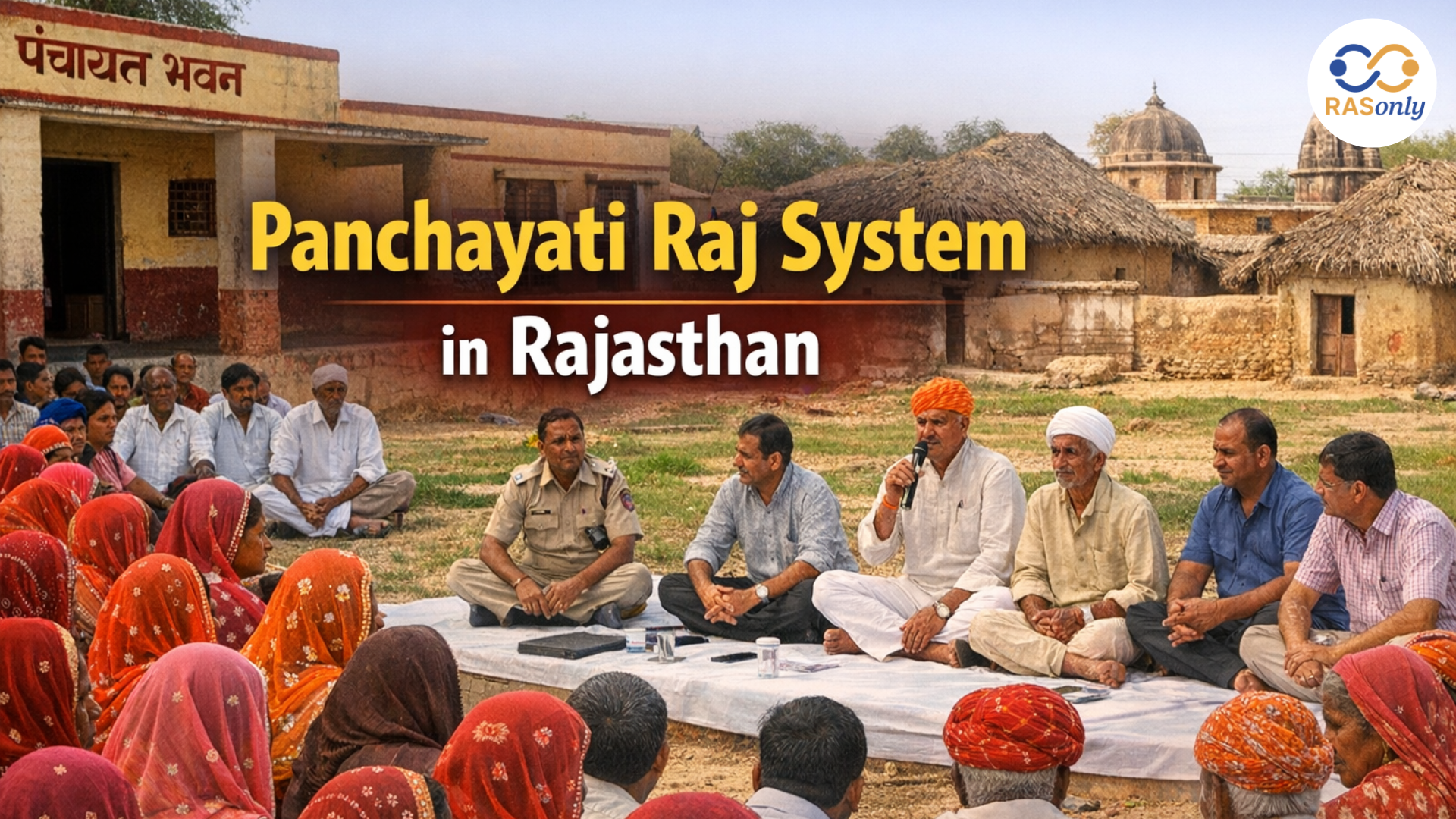
The Panchayati Raj System in Rajasthan is an important topic in the RPSC RAS Prelims syllabus under Indian Polity and Rajasthan Polity. The Panchayati Raj system represents the structure of local self government in rural areas, which promotes democratic decentralization, rural development, and grassroots governance in Rajasthan.
The Rajasthan Panchayati Raj system allows the rural citizens to take an active part in the local administration, decision making, and planning of the development at the level of the village. The government makes sure that the rural communities receive development programs, welfare programs and public services through the Panchayati Raj institutions.
For candidates preparing for the RPSC RAS exam, understanding the Panchayati Raj institutions in Rajasthan, their structure, functions, powers, and constitutional provisions is extremely important. Questions related to Rajasthan Panchayati Raj system, rural governance, decentralization, and local self government are frequently asked in the RAS Prelims examination and Rajasthan GK section.
Historical Development of Panchayati Raj in Rajasthan
The history of local self government in India has an important role to play in the Panchayati Raj system of Rajasthan. The Panchayati Raj system was introduced in Rajasthan, the first state in India to do so according to the proposals of the Balwant Rai Mehta Committee (1957).
The committee suggested that democratic governance should be strengthened through decentralized administration at village, block, and district levels.
The Panchayati Raj system was officially inaugurated by the prime minister, Jawaharlal Nehru on 2 October 1959 in Nagaur district of Rajasthan. This incident brought the onset of the grass-root democracy and decentralized rule to rural India.
Later, the 73rd Constitutional Amendment Act of 1992 gave constitutional status to Panchayati Raj institutions across India, which further strengthened the Panchayati Raj system in Rajasthan and other states.
Objectives of Panchayati Raj System in Rajasthan
The Panchayati Raj System of Rajasthan was unveiled to enhance the local self government, rural governance as well as democratic decentralization at the village level. It tries to make people more active in decision making, enhance administration of the rural areas, and provide proper implementation of the development programs and government welfare schemes in the rural areas.
Major Objectives
- Strengthening local self government in rural areas
- Promoting democratic decentralization in governance
- Encouraging public participation in local governance
- Implementing rural development programs effectively
- Improving social and economic development of villages
These objectives help strengthen grassroots democracy, rural governance, and Panchayati Raj institutions in Rajasthan.
Three-Tier Structure of the Panchayati Raj System in Rajasthan
Rajasthan has a three tier system of rural local governance in the form of the Panchayati Raj System since this system provides effective administration and development at the village, block, and district levels. This de-centralized design assists in the implementation of the rural development initiatives, government schemes and local governance policies effectively throughout the rural Rajasthan.
Three Tier Panchayati Raj Structure
| Level | Institution | Area of Governance |
|---|---|---|
| Village Level | Gram Panchayat | Village administration |
| Block Level | Panchayat Samiti | Block development |
| District Level | Zila Parishad | District planning and coordination |
This three tier Panchayati Raj structure ensures that governance, planning, and development programs reach the grassroots level in rural Rajasthan.
Gram Sabha in Panchayati Raj System
The basis of the Panchayati Raj System in Rajasthan is the Gram Sabha which is the direct involvement of villagers in local government and decision-making. It is a democratic arena whereby villagers deliberate on development matters, ratify the village plans, and also check on how the Gram Panchayat is operating.
Features of Gram Sabha
| Feature | Description |
|---|---|
| Members | All adult residents of the village |
| Meetings | Conducted periodically |
| Role | Approves development plans |
| Importance | Ensures transparency and public participation |
The Gram Sabha supervises the work of the Gram Panchayat and ensures accountability and transparency in rural administration.
Gram Panchayat in Rajasthan
The Gram Panchayat is the lowest level of the Panchayati Raj system in Rajasthan and functions as the primary unit of village administration and rural governance. It is responsible for implementing government schemes, rural development programs, and basic public services in the village.
Structure of Gram Panchayat
| Position | Role |
|---|---|
| Sarpanch | Head of Gram Panchayat |
| Panch | Elected ward members |
| Secretary | Administrative officer |
Major Functions of Gram Panchayat
- Implementation of government welfare schemes in villages
- Maintenance of roads, sanitation, drinking water, and street lighting
- Promotion of agriculture and rural development activities
- Registration of births and deaths in the village
The Gram Panchayat plays a vital role in local governance, village administration, and rural development in Rajasthan.
Panchayat Samiti in Rajasthan
The Panchayat Samiti operates at the block level in the Panchayati Raj system in Rajasthan and acts as an intermediary body between Gram Panchayat and Zila Parishad. It coordinates development programs and supervises the functioning of Gram Panchayats within the block.
Structure of Panchayat Samiti
| Position | Role |
|---|---|
| Pradhan | Head of Panchayat Samiti |
| Members | Elected representatives |
| Development Officer | Administrative officer |
Functions of Panchayat Samiti
- Coordination of development activities at the block level
- Supervision of Gram Panchayats
- Implementation of agriculture, education, and health programs
- Promotion of rural employment and infrastructure development
The Panchayat Samiti plays an important role in regional planning and rural administration in Rajasthan.
Zila Parishad in Rajasthan
The Zila Parishad is the highest level of the Panchayati Raj system in Rajasthan and functions at the district level. It also helps in the planning and coordination of the district level development programs and rural governance programs.
Structure of Zila Parishad
| Position | Role |
|---|---|
| Zila Pramukh | Head of Zila Parishad |
| Members | Elected representatives |
| District Officials | Administrative support |
Functions of Zila Parishad
- Preparation of district development plans
- Supervision of Panchayat Samitis and Gram Panchayats
- Allocation of funds for rural development programs
- Implementation of education, health, and infrastructure schemes
The Zila Parishad ensures effective district level planning, coordination, and implementation of rural development programs in Rajasthan.
Constitutional Provisions for Panchayati Raj
Constitutional recognition of the Panchayati Raj system in India was given by the 73rd Constitutional Amendment Act 1992 and increased the local self government and decentralized governance in the state of Rajasthan.
Important Constitutional Provisions
| Provision | Details |
|---|---|
| Article 243 | Panchayati Raj institutions |
| Five Year Term | Regular elections every 5 years |
| Reservation | SC, ST, and women representation |
| State Election Commission | Conducts Panchayat elections |
| State Finance Commission | Financial distribution |
These constitutional provisions strengthened local democracy, decentralized governance, and rural administration in Rajasthan.
Powers and Responsibilities of Panchayati Raj Institutions
The Panchayati Raj institutions in Rajasthan perform several important functions related to rural governance, development planning, and implementation of government schemes.
Key Responsibilities
- Implementation of rural development schemes
- Maintenance of village infrastructure and public facilities
- Promotion of agriculture and irrigation projects
- Implementation of poverty alleviation programs
- Encouraging public participation in local governance
These responsibilities help improve socio economic development and rural administration in Rajasthan.
Importance of Panchayati Raj System in Rajasthan
The Panchayati Raj system in Rajasthan is significant in reinforcing the grassroots democracy, local government and rural development. It makes sure that individuals at the village level are involved in the decision making process, development planning and governance.
Key Importance
- Promotes democratic decentralization
- Strengthens local self government institutions
- Encourages citizen participation in governance
- Improves implementation of government welfare schemes
- Supports economic and social development in rural areas
When a candidate is taking the RPSC RAS exam, it is important that s/he is aware of the system of Panchayati Raj in Rajasthan, their structure, institutions, workings, and provisions in the constitution since questions involving Rajasthan polity and rural governance are always common in RAS prelim examination.
Conclusion
The Panchayati Raj System in Rajasthan is critical towards enhancing local self government and democratic decentralization, as well as rural development in the state. The system facilitates proper involvement of citizens in the running of government and execution of development projects at the grassroots level through the institutions like Gram Sabha, Gram Panchayat, Panchayat Samiti and Zila Parishad. To help candidates who are going to take the RPSC RAS Prelims test, it is vital to know the structure, functions, and the sections in the Constitution of Panchayati Raj institutions in Rajasthan since they are the frequent subject of questions in the RAS Policies and Rajasthan GK section.
FAQ
The Panchayati Raj System in Rajasthan is a decentralized system of local self government in rural areas that allows people to participate in decision making and rural development through institutions like Gram Panchayat, Panchayat Samiti, and Zila Parishad.
The Panchayati Raj system in Rajasthan was officially introduced on 2 October 1959 in Nagaur district by Prime Minister Jawaharlal Nehru.
The three tier Panchayati Raj structure in Rajasthan includes Gram Panchayat at the village level, Panchayat Samiti at the block level, and Zila Parishad at the district level.
The 73rd Constitutional Amendment Act 1992 gave constitutional status to Panchayati Raj institutions in India, strengthening local governance and rural democracy.
The Panchayati Raj System in Rajasthan is an important topic in RPSC RAS Polity and Rajasthan GK, and questions related to its structure, functions, and constitutional provisions are frequently asked in the RAS Prelims examination.

BEST SELLER
🏆 PRELIMS
RAS Pass
Prelims focused Hindi & English
₹399
✓
Prelims Topic-Wise Tests
✓
Subject-Wise Tests
✓
Full-Length Prelims Tests
✓
Daily Current Affairs Tests
✓
Prelims PYQs Tests
✓
Detailed Solutions & Analysis
✓
All Rajasthan Ranking
✓
Unlimited Reattempts
✓
Mains Tests
✓
Hindi & English Tests
✓
All Rajasthan Ranking
Trusted by 5,000+ Students

Post Category
- RAS Salary
- Result
- RAS Admit Card
- RAS Job
- RAS Cutoff
- Preparation Tips
- RAS Answer Key
- RAS Exam Analysis
- RAS Syllabus
- RAS Previous Year Papers
- RPSC RAS Exam Pattern
- RAS Interview
- RAS Exam Date
- RAS Vacancy
- RAS Test Series
- RAS Best Books
- RAS Preparation Resources
- RAS Coaching Centre
- History
- Polity
- Geography
- Economics
- Science
- Art and Culture
- RPSC RAS Application Form
- RPSC RAS Notification
- RAS Eligibility Criteria
- UPSC Exam
- RPSC RAS Mains
Visit Our RASonly Offline Center
Our Expert Faculty

Bhunesh Sir
Current Affairs · 13+ Yrs

Aamir Khan Sir
RAS-2017 · IIM Ahm.

Akash Sir
Polity · 8+ Yrs
Free Resources
Official Mobile App

RASOnly App
by OTSAdda · Free
Full Video Lectures
Mock Tests & PYQs
Daily Current Affairs
AI Mock Interview
Free Download · No subscription needed to install
RAS 2024 Toppers — RASonly
Rank 2
Virendra Charan
Rank 9
Bhoopinder Singh
Rank 26
Aanchal Nagpal
Rank 33
Lokendra Singh
Rank 45
Amar Rathore
Rank 46
Manasvini Verma

Join RASonly WhatsApp Community
Get daily current affairs, exam alerts, free study material and tips from expert faculty — right on WhatsApp.
Join for Free →RASonly Interview Guidance Program

Mr. Ashok Jain
Ex-Chief Secretary Govt of Rajasthan
- IAS officer of the 1981 batch, Rajasthan cadre.
- Passionate about mentoring the next generation of RAS officers with real-world insights.
- Got retired in Dec 2017 from the post of Chief Secretary of the state of Rajasthan.

Mr. Guru Charan Rai
Ex-ASP / SP in Jaisalmer
- Guru Charan Rai, IPS (Retd), retired as Inspector General of Police (Security), Rajasthan, Jaipur in 2017.
- Served as ASP and SP in Jaisalmer, Nagaur, Sri Ganganagar, Sawai Madhopur, Dausa, Sikar, and Karauli.
- He also held key positions as DIGP and IGP in the Law and Order division.

Mr. Rakesh Verma
Ex-IAS Officer, B.Tech, MBA, and M.A. (Economics)
- IAS officer of the 1981 batch and retired in Chief Secretary Rank.
- Civil servant of high repute and vast experience.
- Has been teaching UPSC CSE subjects for the last six years.
Related Post



Daily Current Affairs for RAS Exam Preparation 2026

Ustad Bismillah Khan Yuva Puraskar
October 24, 2026
Marwar Festival 2026
October 24, 2026
Kundan Art Display in Hong Kong
October 23, 2026