Satavahana Dynasty: History, Rulers, Administration, Art and Culture
Rare Earth Minerals & Strategic Resources Preparation Strategy for RAS 2026

Get in Touch with RASonly!

Rare Earth Minerals and Strategic Resources have become highly important for RAS 2026 because they are directly linked with clean energy, semiconductors, defence technology, electric vehicles, and strategic resource security. This topic connects Geography, Environment, Science & Technology, Economy, and Current Affairs together. Proper preparation through maps, conceptual clarity, and current affairs integration can make it one of the most scoring emerging topics for RAS Prelims 2026.

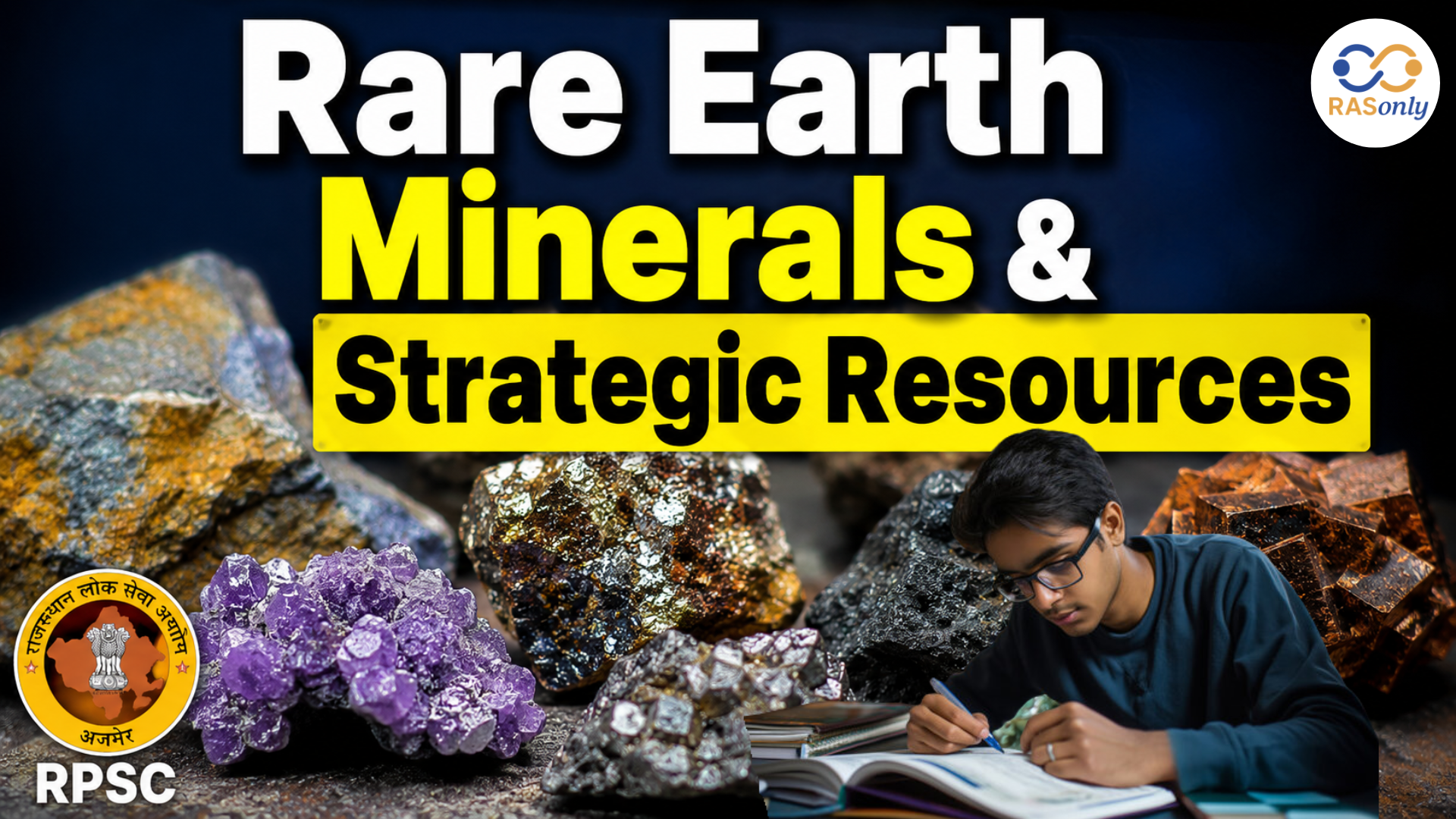
Rare Earth Minerals and Strategic Resources is one of the most critical emerging topics for RAS Prelims 2026, as questions have become relevant to critical minerals, renewables, clean energy transition, electric vehicles, semiconductor manufacturing, defence technology, and strategic resource security of India. In recent years, the topics of Environment, Geography, Science & Technology, Economy, and Current Affairs have been mixed up in the competitive exam syllabus, and critical minerals are a very high-potential topic for serious RAS aspirants.
The Government of India has been giving a significant push towards critical minerals with the establishment of the National Critical Mineral Mission, Rare Earth Corridors, expansion of semiconductor manufacturing, clean energy goals, and strategic mineral exploration programs. Budget 2026-27 also mentioned the Rare Earth Corridors in Odisha, Kerala, Andhra Pradesh, and Tamil Nadu to enhance the mining, processing, research, and manufacturing landscape for the rare earth resources in India.
Why Rare Earth Minerals are Important for RAS 2026
Rare Earth Minerals are strategically important for use in electric vehicles, wind turbines, solar panels, semiconductors, missiles, smartphones, batteries, aerospace systems, AI systems, defence systems, etc. The questions could be pertaining to the mineral resources, strategic importance, current affairs, linkage between clean energy and resource security policies in India etc.
Benefits of Strong Preparation
- Improves Geography & Environment preparation
- Helps in Science & Technology topics
- Useful for Economy & Industrial Policy linkage
- Important for current affairs integration
- Helpful in both Prelims and Mains
- Scoring through conceptual understanding and revision
What are Rare Earth Minerals?
Rare Earth Elements (REEs) are a set of 17 elements, which are chemically similar and have significant applications in modern technology, advanced industries, defence and renewable energy. Many of these minerals are present in nature, but the economic extraction and processing of many minerals is difficult, despite its name being rare.
Countries around the world consider Rare Earth Minerals to be of great strategic importance to their supply chains for national security and industrial development, and therefore, Rare Earth Minerals are included in the category “Critical Minerals”.
Important Rare Earth Elements
- Neodymium
- Dysprosium
- Lanthanum
- Cerium
- Europium
- Praseodymium
- Yttrium
Strategic Importance of Rare Earth Minerals
Rare Earth Minerals are of great significance as they are essential to modern economies, 'green' technologies, and defence systems. Stable supply chains of strategic minerals are being sought after by countries around the world.
Major Uses of Rare Earth Minerals
| Sector | Importance |
|---|---|
| Electric Vehicles | Permanent magnets |
| Wind Energy | Turbine magnets |
| Defence | Missiles, radar, sensors |
| Electronics | Smartphones, chips |
| Space Technology | Satellites & aerospace |
| AI & Robotics | Advanced electronics |
| Renewable Energy | Green technology systems |
Rare Earth Permanent Magnets are especially important for EVs, renewable energy systems, and advanced defence equipment.
Critical Minerals vs Rare Earth Minerals
Many aspirants confuse Critical Minerals and Rare Earth Minerals
Comparison Table
| Feature | Critical Minerals | Rare Earth Minerals |
|---|---|---|
| Meaning | Strategically important minerals | Group of 17 elements |
| Importance | Economic & security needs | Technology applications |
| Examples | Lithium, Cobalt, Nickel | Neodymium, Cerium |
| Usage | Batteries, semiconductors | Magnets & electronics |
| Strategic Role | Industrial security | High-tech manufacturing |
India’s Rare Earth Mineral Strategy for RAS 2026
India is on a strategic drive to enhance its strategic mineral ecosystem with a view to becoming less dependent on imports and promoting self-reliance in advanced manufacturing sectors.
The National Critical Mineral Mission started in 2025 to enhance exploration, mining, processing, stockpiling, recycling, and manufacturing of strategic minerals.
Important Government Initiatives
- National Critical Mineral Mission (NCMM)
- Rare Earth Corridors
- PLI Scheme for Rare Earth Magnets
- Critical Mineral Exploration Projects
- Strategic Stockpiling Policy
- Recycling & Circular Economy Initiatives
Rare Earth Corridors Strategy for RAS 2026
Rare Earth Corridors have gained significant importance following the dedicated corridors for rare earth material mining, research, processing, and manufacturing announced in the Union Budget 2026–27.
Important States
- Odisha
- Kerala
- Andhra Pradesh
- Tamil Nadu
Importance of Rare Earth Corridors
- Domestic mineral processing
- Magnet manufacturing
- EV ecosystem support
- Renewable energy expansion
- Strategic resource security
- Defence manufacturing support
Smart Strategy
- Revise corridor states carefully
- Link with the clean energy transition
- Focus on the Budget 2026 current affairs
- Practice map-based MCQs regularly
India’s Rare Earth Mineral Distribution
The reserves of rare earths in India are mainly in the geologic belts where the minerals are found, and coastal sands where monazite is found. Mineral distribution is an important Geography and current affairs question for RAS 2026, as the minerals are playing an important role in the production of clean energy and other sectors such as defence, semiconductors, and advanced industrial technologies.
Important Rare Earth Regions in India
| Region | Important Mineral Areas |
|---|---|
| Kerala | Coastal monazite sands |
| Odisha | Beach sand deposits |
| Tamil Nadu | Rare earth coastal belts |
| Andhra Pradesh | Mineral-rich coast |
| Gujarat | Strategic mineral deposits |
| Rajasthan | Critical mineral potential |
India has large monazite reserves containing rare earth oxides that are highly important for strategic industries, renewable energy systems, and advanced manufacturing sectors.
Rare Earth Minerals & Defence Linkage
The Rare Earth Minerals are very critical for the modern defence systems as they are the basis for the manufacturing of high-performance magnets and strategic alloys, which are essential for advanced missiles, fighter aircraft, radars, satellites, and precision weapons. Self-reliance in defence, strategic security, and indigenous manufacturing are some of the umbrella themes around the questions.
Important Defence Uses
- Missile guidance systems
- Radar technology
- Fighter aircraft systems
- Precision weapons
- Satellites & aerospace systems
- Naval defence electronics
Smart Strategy
- Link minerals with defence technology
- Focus on strategic security concepts
- Revise current affairs repeatedly
- Practice statement-based MCQs
Rare Earth Minerals & Clean Energy Linkage
The Rare Earth Minerals have become much more important as strategic minerals are essential in the efficient generation, storage, and transmission of energy in modern clean energy technologies. The global shift to renewable energy and electric mobility has vastly accelerated, and the demand for key minerals around the world has increased accordingly.
Important Clean Energy Uses
- EV batteries & motors
- Wind turbines
- Solar technology
- Green hydrogen infrastructure
- Energy storage systems
The global clean energy transition has increased geopolitical competition for strategic mineral resources and secure supply chains.
China & Global Rare Earth Dominance Strategy
China currently dominates the global rare earth supply chain, especially in mineral refining and processing industries. This has made strategic mineral security an important geopolitical issue globally, and many countries, including India, are now focusing on reducing import dependence and strengthening domestic mineral ecosystems.
Important Concepts
- Supply chain vulnerability
- Strategic mineral security
- Import dependence
- Resource nationalism
- Mineral diplomacy
Smart Strategy
- Link minerals with geopolitics
- Focus on India-China comparison
- Revise strategic dependency concepts
- Practice current-affairs-based MCQs
Rare Earth Minerals & Rajasthan Linkage
Rajasthan holds significance in terms of mining economy, industrial mineral development, expansion of renewable energy, and exploration of strategic resources. Questions can be related to mineral geography, industrial growth, critical resources, and the contribution of Rajasthan to strategic minerals in India.
Important Rajasthan Linkages
- Strategic mineral exploration
- Mining economy
- Industrial minerals
- Renewable energy linkage
- Defence corridor support
Environmental Concerns Related to Rare Earth Mining
Rare Earth mining creates major environmental challenges because extraction and processing activities can generate toxic waste, ecological degradation, and pollution. Questions are increasingly linked with sustainable mining, environmental governance, climate sustainability, and resource management concepts.
Important Environmental Issues
- Soil degradation
- Water pollution
- Radioactive waste
- Coastal ecosystem damage
- Deforestation
- Mining waste management
Smart Strategy
- Link mining with the environment
- Focus on sustainable mining concepts
- Practice environment-based MCQs
- Revise the climate sustainability linkage
Important Organizations & Institutions
There are various organisations and institutions engaged in mineral exploration, strategic resource management and rare earth processing in India. Aspirants can better relate mineral policy, industrial development, and strategic resource governance with the understanding of their role.
| Organization | Role |
|---|---|
| Ministry of Mines | Mineral policy |
| GSI | Geological exploration |
| IREL India Limited | Rare earth processing |
| NMDC | Mineral exploration |
| Atomic Minerals Directorate | Strategic minerals |
For current-affairs-based preparation, this topic has been made more significant with the cooperation between NMDC & GMDC for the exploration of rare earth and the development of strategic minerals.
Map Practice Strategy for Rare Earth Minerals
Map practice is very important as there is a growing trend towards map-based, location-based Geography and Environment questions. Repeated map practice should be undertaken to update strategic mineral regions, coastal deposits and critical mineral corridors visually.
Important Areas to Practice
- Rare Earth Corridor states
- Coastal mineral regions
- Monazite deposits
- Critical mineral zones
- Rajasthan mining regions
Smart Map Practice Tips
- Practice blank India maps regularly
- Mark coastal mineral belts repeatedly
- Revise strategic mineral regions visually
- Link minerals with industries
Rare Earth Minerals MCQ Practice Strategy
MCQ practice becomes very significant as questions asked from strategic minerals are mostly conceptual, statement-type, current affairs-based and application-based. Solving regular MCQs makes the concepts very clear, enhances retention and will help you a lot in the exams.
Important Focus Areas
- Rare Earth Elements
- Critical Minerals
- Rare Earth Corridors
- National Critical Mineral Mission
- Strategic minerals & defence
- Clean energy linkage
Smart MCQ Strategy
- Solve topic-wise MCQs daily
- Practice current-affairs-based questions
- Analyze wrong answers carefully
- Revise the mineral-location linkage repeatedly
Most Important Rare Earth & Strategic Resource Topics for RAS 2026
Rare Earth Minerals and Strategic Resources are high-priority topics as they have a linkage with Geography, Environment, Economy, Science & Technology, Defence and Current Affairs. It is advisable to repeatedly go over these topics using maps, current affairs or conceptual comparison tables.
High-Weightage Topics
- Rare Earth Minerals
- Critical Minerals
- National Critical Mineral Mission
- Rare Earth Corridors
- Strategic Mineral Security
- EV & Clean Energy Minerals
- India-China Mineral Dependency
- Rare Earth Magnet Manufacturing
Topic Priority Table
| Topic | Importance Level |
|---|---|
| Critical Minerals | Very High |
| Rare Earth Corridors | Very High |
| Rare Earth Elements | High |
| Strategic Resources | High |
| Clean Energy Minerals | High |
Revision Strategy for Rare Earth Minerals
Revision is very important as the names of the minerals, their locations, government schemes, concept of strategies, and current affairs are very confusing during the exam. Map, comparison tables, and MCQs help to retain the information in long-term memory effectively if repeated multiple times.
Smart Revision Tips
- Revise mineral maps weekly
- Use comparison tables regularly
- Practice current affairs MCQs
- Revise strategic concepts visually
- Focus on repeated PYQ themes
Best Revision Cycle
| Revision Stage | Focus Area |
|---|---|
| First Revision | Concepts & minerals |
| Second Revision | Maps & current affairs |
| Final Revision | MCQs & quick notes |
How Toppers Prepare Strategic Mineral Topics for RAS
Most toppers prepare strategic mineral topics with Current Affairs Integration, Maps, Conceptual Understanding and with repeated MCQ practice rather than simply memorising. They prepare them in three major aspects: strategic importance, global linkage, and application-based learning.
Toppers’ Strategy
- Practice mineral mapping consistently
- Revise current affairs repeatedly
- Focus on conceptual clarity
- Solve statement-based MCQs
- Prepare short revision notes
What Makes Toppers Different?
- Better map retention
- Strong current affairs linkage
- Smart MCQ analysis
- Better conceptual understanding
- Consistent revision habits
This is an important topic for RAS 2026 preparation due to India's increasing emphasis on Rare Earth Minerals, strategic resource security, semiconductor manufacturing, defence self-reliance, and the clean energy transition. The aspirants are suggested to prepare this topic with Concept Clearing, Maps, Current Affairs, Comparative Tables and practice many MCQs so as to score maximum marks in Geography, Environment, Economy and Science & Technology.
Conclusion
One of the most important interdisciplinary subjects for RAS 2026 is Rare Earth Minerals and Strategic Resources, which is related to Geography, Environment, Science & Technology, Economy, Defence and Current Affairs. In the context of India's aggressive stance on clean energy transition, semiconductor manufacturing, strategic mineral security, electric vehicles and defence self-reliance, the critical mineral and rare earth ecosystem are expected to be part of upcoming exams.
The aspirants should study the topic by conceptual clarity, mapping the location of minerals, linking with current affairs, comparative tables and repeated MCQ practice rather than rote memorization. Strategic mineral corridors, government initiatives, clean energy linkage, and India's mineral policies can be a fruitful area in RAS 2026, for both Prelims and Mains.
FAQ
Rare Earth Minerals are a group of 17 strategically important metallic elements used in modern technologies such as electric vehicles, semiconductors, renewable energy systems, defence equipment, and electronics.
Rare Earth Minerals are important because they are linked with Geography, Environment, Economy, Science & Technology, clean energy transition, defence security, and current affairs, making them a high-weightage topic for RAS 2026.
Kerala, Odisha, Tamil Nadu, Andhra Pradesh, Gujarat, and Rajasthan are important from the perspective of rare earth mineral reserves and strategic resource development.
Critical Minerals are strategically important minerals required for industrial and national security needs, while Rare Earth Minerals are a specific group of 17 elements mainly used in advanced technologies and magnet manufacturing.
Aspirants should focus on conceptual understanding, mineral distribution maps, current affairs linkage, government initiatives, strategic importance, and repeated MCQ practice for effective preparation.

BEST SELLER
🏆 PRELIMS
RAS Pass
Prelims focused Hindi & English
₹399
✓
Prelims Topic-Wise Tests
✓
Subject-Wise Tests
✓
Full-Length Prelims Tests
✓
Daily Current Affairs Tests
✓
Prelims PYQs Tests
✓
Detailed Solutions & Analysis
✓
All Rajasthan Ranking
✓
Unlimited Reattempts
✓
Mains Tests
✓
Hindi & English Tests
✓
All Rajasthan Ranking
Trusted by 5,000+ Students
Post Category
- RAS Salary
- Result
- RAS Admit Card
- RAS Job
- RAS Cutoff
- Preparation Tips
- RAS Answer Key
- RAS Exam Analysis
- RAS Syllabus
- RAS Previous Year Papers
- RPSC RAS Exam Pattern
- RAS Interview
- RAS Exam Date
- RAS Vacancy
- RAS Test Series
- RAS Best Books
- RAS Preparation Resources
- RAS Coaching Centre
- History
- Polity
- Geography
- Economics
- Science
- Art and Culture
- RPSC RAS Application Form
- RPSC RAS Notification
- RAS Eligibility Criteria
- UPSC Exam
- RPSC RAS Mains
Visit Our RASonly Offline Center
Our Expert Faculty

Bhunesh Sir
Current Affairs · 13+ Yrs

Aamir Khan Sir
RAS-2017 · IIM Ahm.

Akash Sir
Polity · 8+ Yrs
Free Resources
Official Mobile App

RASOnly App
by OTSAdda · Free
Full Video Lectures
Mock Tests & PYQs
Daily Current Affairs
AI Mock Interview
Free Download · No subscription needed to install
RAS 2024 Toppers — RASonly
Rank 2
Virendra Charan
Rank 9
Bhoopinder Singh
Rank 26
Aanchal Nagpal
Rank 33
Lokendra Singh
Rank 45
Amar Rathore
Rank 46
Manasvini Verma

Join RASonly WhatsApp Community
Get daily current affairs, exam alerts, free study material and tips from expert faculty — right on WhatsApp.
Join for Free →RASonly Interview Guidance Program

Mr. Ashok Jain
Ex-Chief Secretary Govt of Rajasthan
- IAS officer of the 1981 batch, Rajasthan cadre.
- Passionate about mentoring the next generation of RAS officers with real-world insights.
- Got retired in Dec 2017 from the post of Chief Secretary of the state of Rajasthan.

Mr. Guru Charan Rai
Ex-ASP / SP in Jaisalmer
- Guru Charan Rai, IPS (Retd), retired as Inspector General of Police (Security), Rajasthan, Jaipur in 2017.
- Served as ASP and SP in Jaisalmer, Nagaur, Sri Ganganagar, Sawai Madhopur, Dausa, Sikar, and Karauli.
- He also held key positions as DIGP and IGP in the Law and Order division.

Mr. Rakesh Verma
Ex-IAS Officer, B.Tech, MBA, and M.A. (Economics)
- IAS officer of the 1981 batch and retired in Chief Secretary Rank.
- Civil servant of high repute and vast experience.
- Has been teaching UPSC CSE subjects for the last six years.
Related Post



Daily Current Affairs for RAS Exam Preparation 2026

Financial Approval Granted for the Development of Religious Sites
October 05, 2026
IIT Madras Signs MoU for Joint Educational Programmes
October 05, 2026
Niharika Rathore Wins MIS Global India Title
October 03, 2026