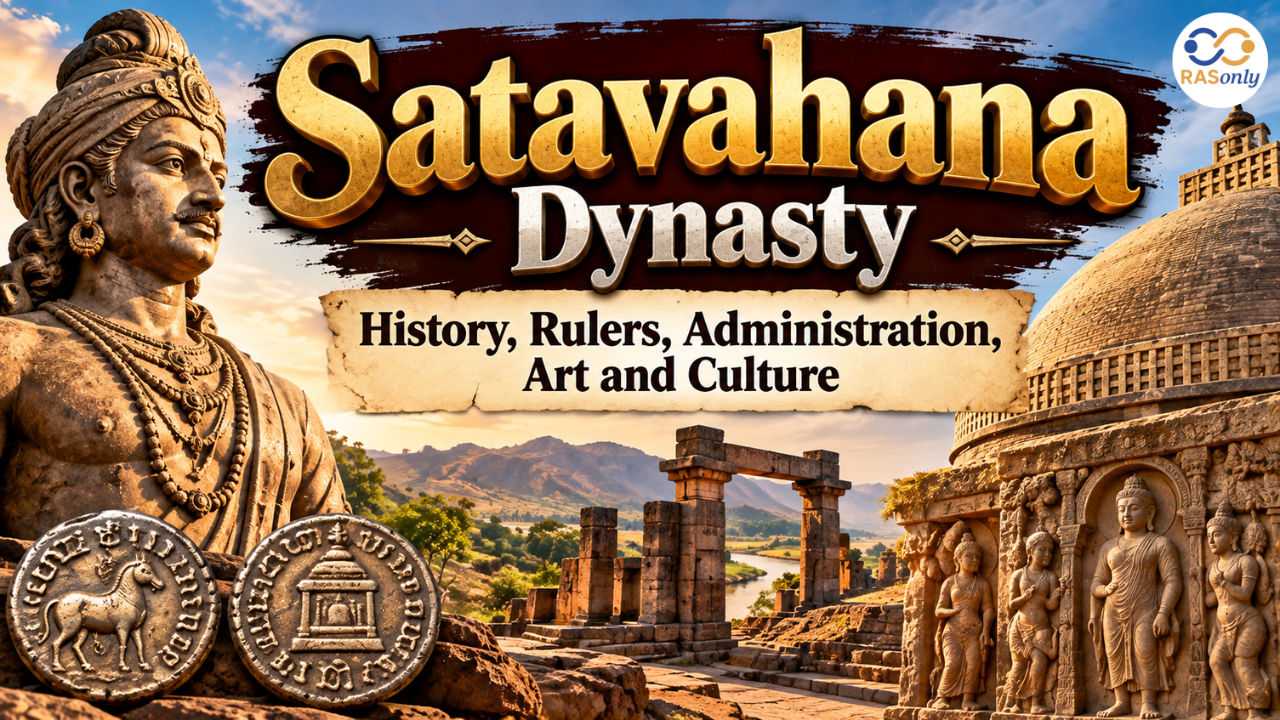
Satavahana Dynasty: History, Rulers, Administration, Art and Culture
RAS Mains 2027: Rajasthan Examples for High-Scoring Answers

Get in Touch with RASonly!

Learn how to integrate relevant Rajasthan examples into RAS Mains 2027 answers. Explore examples for history, governance, economy, ethics, and practical answer-writing strategies to improve relevance, analysis, presentation, and overall scoring potential.

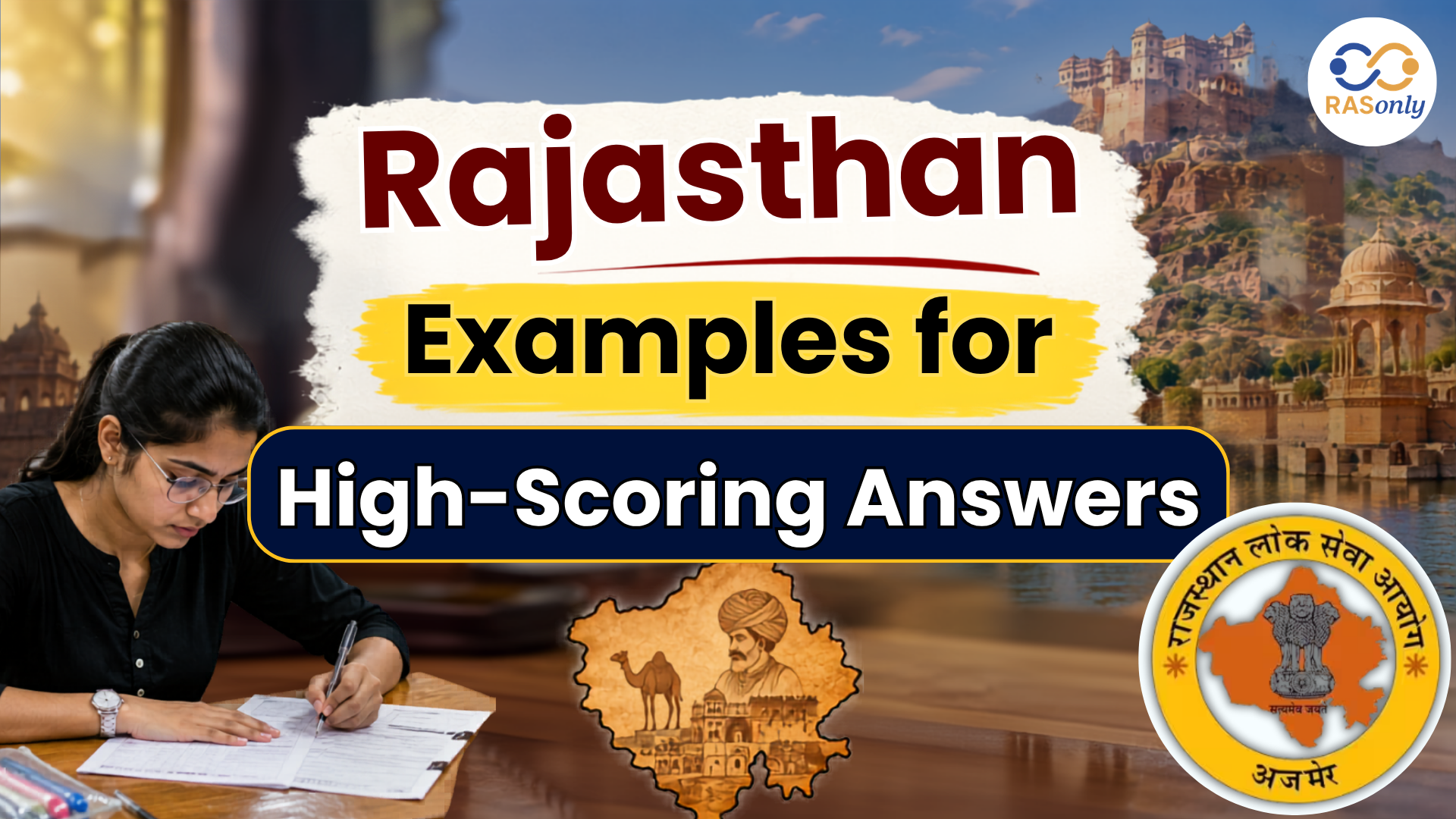
As RAS Mains 2027 preparation is in a critical stage, one difference between a good answer and a high-scoring answer is the proper use of Rajasthan examples in RAS Mains. RPSC answer writers are always rewarded for answers that are based on real development happening in the state, by applying concepts from textbooks and connecting them to real schemes, administrative reforms, cultural heritage, etc. Whether you are attempting General Studies Paper I, II, or III, weaving in accurate, well-timed Rajasthan-specific illustrations demonstrates depth of understanding and awareness—exactly what the Rajasthan Public Service Commission looks for in a future administrator.
This blog explains RPSC RAS Mains 2027 practically from an answer-writing point of view. You will get the latest structure of RAS Mains, a collection of examples of Rajasthan from history, governance, economy, and ethics, and you will also get a step-by-step strategy for RAS Mains answer writing that you can practice in your daily routine. The aim is straightforward – make the information you learn static information dynamic and answerable with examples, which will return a steady score in the RPSC evaluation process.
Understanding the RAS Mains 2027 Exam Pattern
It would be wise to understand the exam structure itself and only develop strategies that support this structure, as the marking scheme and paper design must be supported by any strategy. When compared to UPSC, the RPSC RAS Mains exam is a purely descriptive paper – there are no optional subjects in RPSC compared to the UPSC exam, which makes it important for every aspirant to prepare for Rajasthan-specific topics rather than optional subjects. In recent cycles, the commission has also tweaked the pattern of questions, giving more emphasis to questions that require analysis and those that are admin-related, instead of just the recall-type questions.
| Paper | Subject Focus | Marks | Duration |
|---|---|---|---|
| Paper I | History, Art, Culture, Heritage of Rajasthan and India | 200 | 3 Hours |
| Paper II | Ethics, Science & Technology, Geography | 200 | 3 Hours |
| Paper III | Polity, Governance, Public Administration, Economy | 200 | 3 Hours |
| Paper IV | General Hindi & General English | 200 | 3 Hours |
- All 4 papers are compulsory, and marks in Mains and interview are combined to draw the final merit.
- Questions are of short, medium, and long answer type with a clear trend to higher-mark analytical questions in the revised scheme.
- Regional examples are not only used in Paper 1 but are also used throughout your preparation in the papers.
Why Rajasthan Examples Matter in RAS Mains Answers
A state-generic answer prepared for any state civil service question does not get good marks in RPSC marking, as they are specifically trained to mark for state-level administrative awareness. The Rajasthan example indicates that the candidate is not just referring to notes on coaching but is, in fact, pursuing the story of government, culture and development in the state. This one practice can make a candidate stand out from the pack and go from an average score to the high-score bracket.
- Relevance to context: As RPSC is hiring officers for Rajasthan, the answers that are relevant to the context are far more convincing.
- Differentiation: If thousands of candidates can write the same points in theory, a few points of a local example can make your answer stick in the mind of your examiner.
- With an administrative outlook, the reference to schemes, policies, or institutions demonstrates that you think like an administrator, not only a student.
- Answer enrichment: Examples are added in between what is written in books and what is happening on the ground.
Rajasthan Examples for History, Art, and Culture (Paper I)
Paper I is one of the most example-based papers in the entire Mains paper, as it tests the candidates' knowledge of the history, art, culture, literature and heritage of Rajasthan as well as broader Indian and world history. Excellent responses include factual accuracy and use of archaeological sites, dynastic administration, folk traditions and heritage conservation current in the present day.
| Theme | Rajasthan Example to Use |
|---|---|
| Ancient sources of history | Archaeological sites, archival and numismatic evidence from Rajasthan |
| Administrative systems of rulers | Revenue and administrative systems of major Rajput dynasties |
| Freedom movement | Peasant and tribal movements, political awakening of the 19th–20th century |
| Heritage conservation | Institutional efforts such as the Rajasthan Heritage Conservation and Promotion Authority |
| Folk culture | Rajasthani dialects, folk music, fairs, festivals, and religious traditions |
Transform descriptions into analyses by using examples: for example, explain how a revenue system led to a later administrative system in a state rather than just name the dynasties.
Rajasthan Examples for Governance and Public Administration (Paper III)
Governance and public administration is the core of Paper III, and the state-specific content really comes to the fore here as you can show abstract theories in action at the State level. RPSC increasingly expects candidates to connect governance concepts with real initiatives, recent budget announcements, and monitoring mechanisms used by the state government.
- Monitoring of flagship schemes under direct monitoring of the Chief Minister's office: Rajasthan has introduced a set of central and state schemes under their direct monitoring for which departments submit monthly progress reports, a good example of accountability and administrative reforms.
- Rural employment guarantee: The state has a rural employment system with a higher number of work days per year, and it has adopted geo-tagging, satellite imagery, and digital social audits as part of the process, which are beneficial for e-governance and rural development.
- Financial inclusion and welfare administration: Direct benefit transfer schemes for financial support of farmers demonstrate farmer welfare support.
- Water security projects: These are large-scale water projects and inter-basin water-sharing arrangements that show cooperative federalism and water resource management in a water-scarce state.
When citing schemes, always mention the underlying administrative principle (transparency, accountability, decentralisation) rather than only naming the scheme — this shows conceptual clarity to the examiner.
Rajasthan Examples for Economy and Current Affairs
Economy-related questions in RAS Mains reward candidates who can connect macro-level Questions revolving around the economy can be seen in the RAS Mains exam, which can fetch marks if the candidate can relate macro concepts with the development happening in Rajasthan regarding that sector. With the recent state budgets, it is agriculture, water conservation, renewable energy, and youth employment, providing plentiful examples of what's going on right now that are verifiable.
- Agriculture and irrigation: State-level top-ups to central farmer income support schemes, along with subsidies on drip irrigation and solar pumps, are strong examples for questions on agricultural reform.
- Employment generation policy: Concessional loan schemes for youth-based businesses and recruitment drives for youth in large numbers are examples of employment generation policies.
- Renewable energy: Rajasthan's growing solar energy capacity is a commonly asked question for sustainable development and energy security solutions.
- Healthcare investment: Strong arguments for spending on social services, particularly on health, benefit from a large portion of the annual State budget spent on health care and health infrastructure.
Have a current affairs notebook for Rajasthan showing only developments in the state, with a monthly update, so that your examples do not become outdated.
Rajasthan Examples for Ethics and Administrative Case Studies (Paper II)
Ethics is usually taught as a theoretical subject, but RPSC is looking for solutions to real administrative dilemmas that are based on ethical principles. A dedicated ethics unit tests values, integrity, and case-based decision-making, so candidates should prepare short, verifiable local case references in advance.
- Public accountability mechanisms: Welfare schemes with compulsory social auditing and with digital evidence requirements provide good examples of answers on transparency and integrity in public service.
- Field-level dilemmas: issues of resource allocation under water scarcity/drought relief are suitable for the illustration of ethical decision-making under constraints.
- Institutional checks: References to grievance redressal portals and citizen service platforms demonstrate responsiveness and ethical governance.
Write two or three short, generic, administrative case studies based on the development context of Rajasthan to quickly adapt to the ethics question that comes in the paper.
RAS Mains Answer Writing: A Practical Strategy for 2027
Making good content is not enough; organisation and presentation of content within a strict word and time limit is equally important to achieve a high score. The new exam pattern has scrapped very low-mark questions and given more weight to five-mark and ten-mark questions, so candidates should now develop more precise and analytical answer-writing skills than in the past.
- Begin with a clear introduction: give a definition of the term or concept in a single or two sentences before you enter the main body.
- Use the body for structured analysis: Break the answer into sub-headings or bullet points, and place a relevant Rajasthan example within the first half of the answer, not as an afterthought at the end.
- Balance theory and example: In a ten-mark question, try to spend about 60% of the time explaining the theory in concept and about 40% illustrating and analysing with examples.
- Close with a forward-looking conclusion: End with a brief note on policy implications, way forward, or administrative significance rather than simply repeating the introduction.
- Complete the papers under timed conditions: With each paper containing a variety of short, medium, and long questions, timed conditions have a direct impact on the number of high-value questions that can be answered in a competent manner.
Common Mistakes Aspirants Should Avoid
Even when prepared well, candidates miss out on marks because of unnecessary mistakes and inaccuracies in the presentation of information from Rajasthan, so you should be mindful of the following issues when answering your practice questions.
- Overloading an answer with too many examples instead of one or two well-explained ones.
- The use of old or obsolete schemes and figures rather than the most recent reliable information.
- Providing illustrative examples that do not tie in with the specific question(s) being answered.
- Not reading diagrams, flowcharts, or simple tables that may depict administrative structures more clearly.
- Not spending equal time on the papers and not practicing all four papers equally seriously.
Also Read
| How to Prepare for RAS Mains | RAS Mains exam pattern |
| RAS Mains Syllabus | Rajasthan current affairs |
| RAS previous year papers | RAS Prelims Exam Date 2026 |
Conclusion
The key to success in RAS Mains 2027 is to thoroughly understand the syllabus and maintain consistent practice of incorporating relevant, up-to-date, and well-integrated examples from the state of Rajasthan into all your answers. Whether you're from a heritage background, History Paper I, or governance, economy, and ethics, Papers II and III, the state's own development story has enough content to make your responses robust — if you can keep your notes up to date and your examples verifiable. Combine this example-driven teaching with a steady schedule of timed answer-writing drills, and you'll put yourself in a position to have a real advantage in such a competitive selection process. Work on your example bank for the exam, which is specific to the state of Rajasthan now, and update it every month with the help of official RPSC notifications, and ensure that each answer you write encapsulates the awareness and maturity in administration that the commission is searching for.
FAQs
Answers that are related to the state-level administrative context are more likely to be relevant than generic answers, which can be supported by generic examples that are applicable to the whole country. More relevant answers can be provided to the state-level administrative context by providing examples specific to the state rather than generic examples, which can be applicable throughout the country.
This is not limited to Paper I, but could be used throughout Mains. They are especially helpful for answers to questions about governance, economy, ethics, history, and art and culture.
Archaeological evidence, archival evidence, numismatic evidence, the Rajput administrative systems, the peasant or tribal movements, the efforts to conserve heritage, the folk music, the fairs, festivals and traditions.
Implement state schemes, monitoring mechanisms, rural employment initiatives, digital social audits, financial inclusion measures and water security projects, and link with concepts of accountability, transparency and decentralisation.
Concepts of Agriculture, Irrigation, Employment, Renewable energy, Healthcare investment, etc. can be linked to the development of Rajasthan with suitable examples.
BEST SELLER
🏆 PRELIMS
RAS Pass
Prelims focused Hindi & English
₹399
✓
Prelims Topic-Wise Tests
✓
Subject-Wise Tests
✓
Full-Length Prelims Tests
✓
Daily Current Affairs Tests
✓
Prelims PYQs Tests
✓
Detailed Solutions & Analysis
✓
All Rajasthan Ranking
✓
Unlimited Reattempts
✓
Mains Tests
✓
Hindi & English Tests
✓
All Rajasthan Ranking
Trusted by 5,000+ Students
Post Category
- RAS Salary
- Result
- RAS Admit Card
- RAS Job
- RAS Cutoff
- Preparation Tips
- RAS Answer Key
- RAS Exam Analysis
- RAS Syllabus
- RAS Previous Year Papers
- RPSC RAS Exam Pattern
- RAS Interview
- RAS Exam Date
- RAS Vacancy
- RAS Test Series
- RAS Best Books
- RAS Preparation Resources
- RAS Coaching Centre
- History
- Polity
- Geography
- Economics
- Science
- Art and Culture
- RPSC RAS Application Form
- RPSC RAS Notification
- RAS Eligibility Criteria
- UPSC Exam
- RPSC RAS Mains
Visit Our RASonly Offline Center
Our Expert Faculty

Bhunesh Sir
Current Affairs · 13+ Yrs

Aamir Khan Sir
RAS-2017 · IIM Ahm.

Akash Sir
Polity · 8+ Yrs
Free Resources
Official Mobile App

RASOnly App
by OTSAdda · Free
Full Video Lectures
Mock Tests & PYQs
Daily Current Affairs
AI Mock Interview
Free Download · No subscription needed to install
RAS 2024 Toppers — RASonly
Rank 2
Virendra Charan
Rank 9
Bhoopinder Singh
Rank 26
Aanchal Nagpal
Rank 33
Lokendra Singh
Rank 45
Amar Rathore
Rank 46
Manasvini Verma

Join RASonly WhatsApp Community
Get daily current affairs, exam alerts, free study material and tips from expert faculty — right on WhatsApp.
Join for Free →RASonly Interview Guidance Program

Mr. Ashok Jain
Ex-Chief Secretary Govt of Rajasthan
- IAS officer of the 1981 batch, Rajasthan cadre.
- Passionate about mentoring the next generation of RAS officers with real-world insights.
- Got retired in Dec 2017 from the post of Chief Secretary of the state of Rajasthan.

Mr. Guru Charan Rai
Ex-ASP / SP in Jaisalmer
- Guru Charan Rai, IPS (Retd), retired as Inspector General of Police (Security), Rajasthan, Jaipur in 2017.
- Served as ASP and SP in Jaisalmer, Nagaur, Sri Ganganagar, Sawai Madhopur, Dausa, Sikar, and Karauli.
- He also held key positions as DIGP and IGP in the Law and Order division.

Mr. Rakesh Verma
Ex-IAS Officer, B.Tech, MBA, and M.A. (Economics)
- IAS officer of the 1981 batch and retired in Chief Secretary Rank.
- Civil servant of high repute and vast experience.
- Has been teaching UPSC CSE subjects for the last six years.
Related Post

Daily Current Affairs for RAS Exam Preparation 2026

Financial Approval Granted for the Development of Religious Sites
October 05, 2026
IIT Madras Signs MoU for Joint Educational Programmes
October 05, 2026
Niharika Rathore Wins MIS Global India Title
October 03, 2026