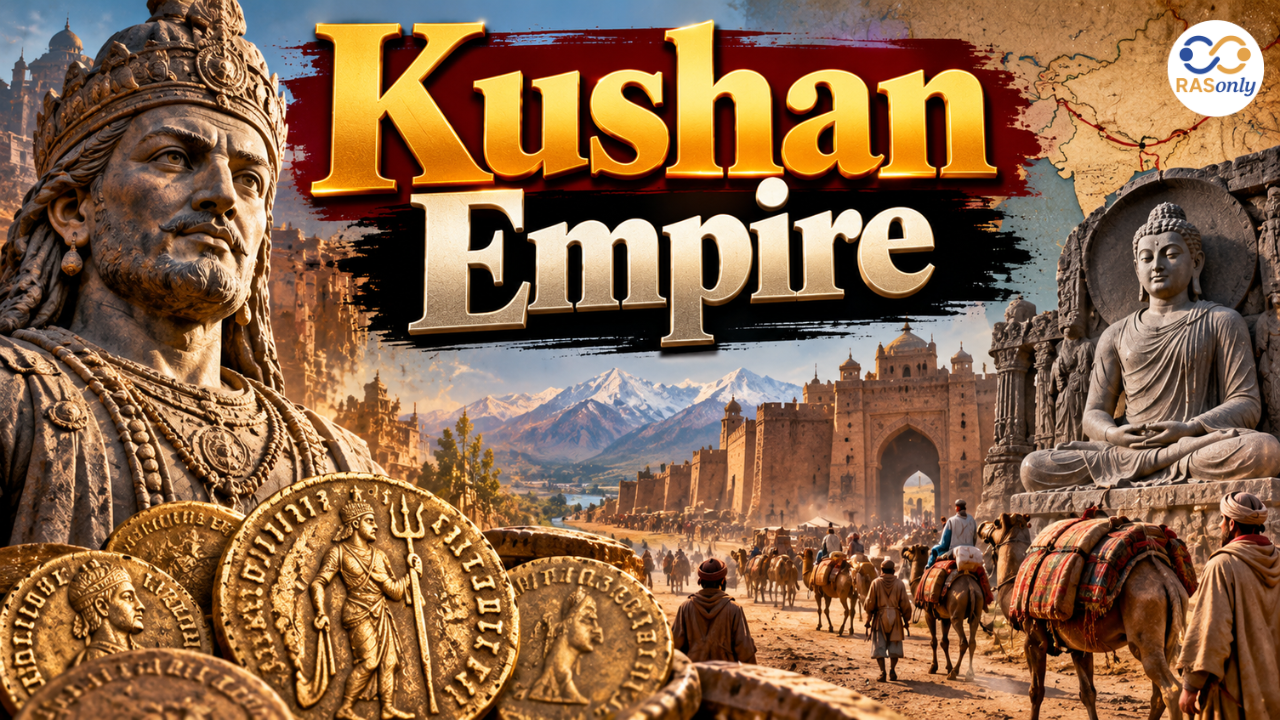
Kushan Empire: History, Rulers, Administration, Economy, Art, Decline
Historical Background of Indian Constitution, Acts, Reforms and Constitutional Development

Get in Touch with RASonly!

The historical background of the Indian Constitution traces constitutional developments from the Regulating Act of 1773 to the Indian Independence Act of 1947. These Acts and reforms gradually shaped India's administrative system, legislative institutions, federal structure, and parliamentary democracy.

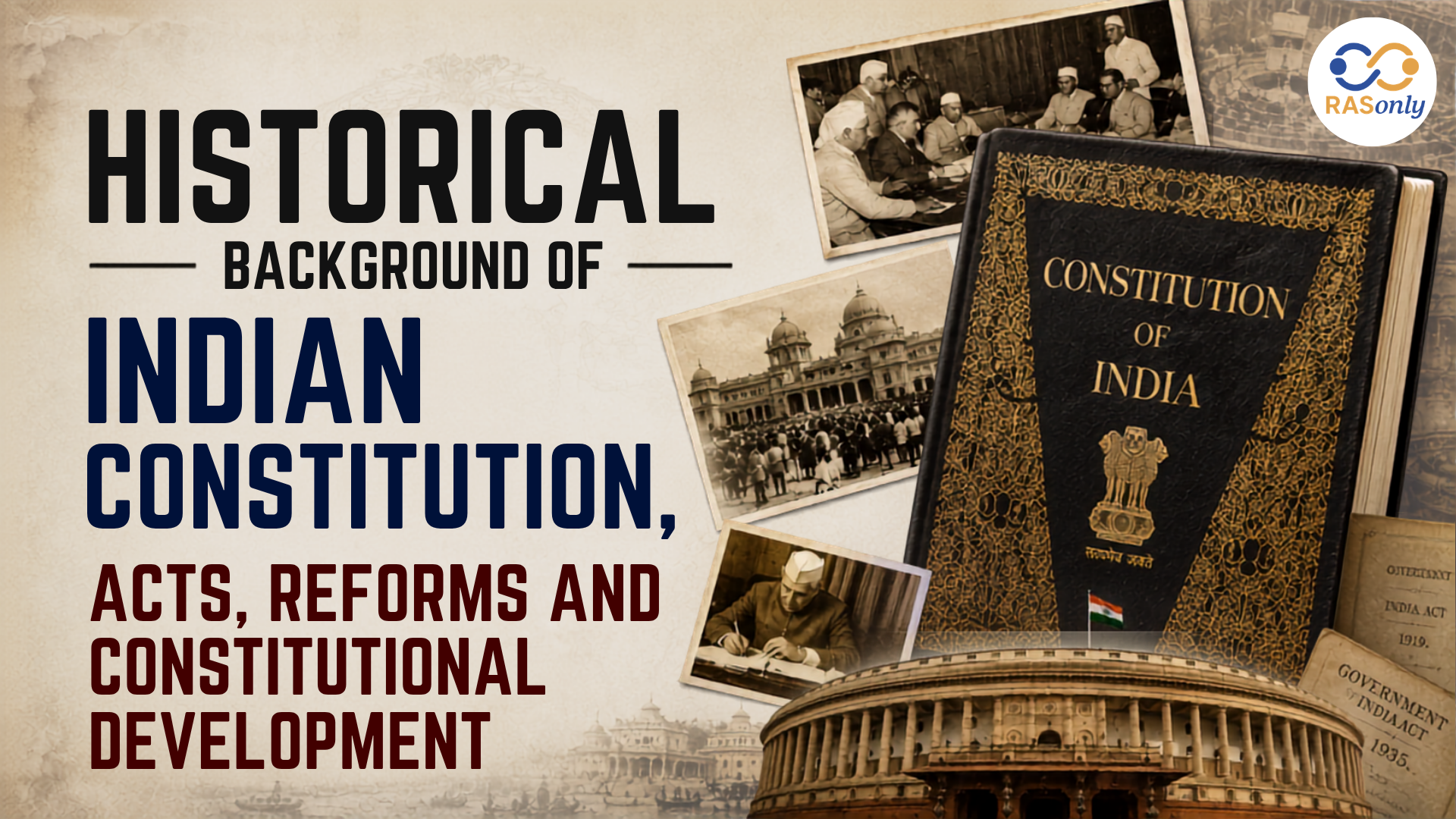
India has a parliamentary democracy with an executive responsible to the Parliament. Parliament consists of two Houses, the Lok Sabha and Rajya Sabha. India, like the US, is a Federal state with powers and responsibilities divided between the Union (Central) and State governments. Also, of Panchayats and Municipalities for the local self-government system. All these institutions have evolved from the administrative and constitutional changes made during British rule. The various Acts and reforms during the British period laid the foundation of the Indian political and administrative system gradually. Now let us know about the historical Background of the constitution's rise and development through the ages.
Historical Background of the Indian Constitution
The history of the Indian Constitution can be traced through various constitutional and administrative reforms introduced by way of which the British rule. These reforms delinked the nature of governance in India, civility and imposed an increased Indian role in administration. It began with the Regulating Act of 1773 and continued with more crucial laws like the Pitt's India Act of 1784, Charter Acts, Government of India Acts and Indian Councils Acts. Some of the provisions of the Constitution of India are most significantly influenced by the Government of India Act, 1935. Lastly, the Indian Independence Act, 1947 abolished British rule and legally formed India.
Regulating Act, 1773
- This was the first major intervention by the British Parliament in the affairs of the East India Company.
- Introduced the office of Governor-General of Bengal.
- The very first Governor-General of Bengal was Warren Hastings.
- An Executive Council of four members was created to aid the Governor-General.
- Facilitated the establishment of the Supreme Court at Calcutta, which started functioning from 1774
- Greatly strengthened parliamentary oversight over the Company's role.
- Signalled an era of increased control by the British Government over the Company's business.
Pitt’s India Act, 1784
- Introduced a dual control system over the Indian territories of the Company.
- Created the Board of Control to supervise Political and administrative affairs
- The management of the commercial affairs of the Company was still in the hands of a court of directors.
- Identified the political and commercial roles of the Company.
- Caused the British Government's power of administration over India to become stronger,
- The mechanism through which both the British Govt. and East India Company played a role in the matters concerning Indian affairs
Charter Act, 1813
- Ended the East India Company's monopoly on trade in India (but not its tea trade).
- Christian missionaries were now allowed to enter India.
- To be used for education in India ₹1 lakh a year
- Represented a key moment in British government engagement with education.
- Reduced the business profits of the East India Organisation in India.
Charter Act, 1833
- Transformed the Governor-General of Bengal into the Governor-General of India.
- Lord William Bentinck was the first Governor-General of India.
- Abolished the last commercial trading of the East India Company.
- Made the Company function almost as an administrative unit.
- Governor-General in Council denotes centralised legislative power.
- Administrative and legislative centralisation gains strength in British India.
Charter Act, 1853
- This distinguished the legislative and executive roles of the Governor-General's Council.
- Expanded the legislative council.
- Introduced the element of open competitive selection for civil service recruitment.
- No fixed period for the state of the Company's charter renewal.
- It was the last Charter Act for the East India Company.
- Expanded on the legislative framework of British India.
Government of India Act, 1858
- Ended the East India Company Rule.
- Transferred the administration of India to the British Crown.
- Established the office of Secretary of State for India.
- Created the Council of India to help the Secretary of State.
- The Governor-General was also the Viceroy of India
- Canning was the first Viceroy of India.
- Initiated the era of Crown administration in India.
Indian Councils Act, 1861
- Began process Indians with the legislative work.
- Enabled Indians to be nominated to provincial legislative councils.
- Reinstated legislative powers to Bombay and Madras Presidencies.
- Introduced the portfolio system.
- To enable the Viceroy to make an ordinance in some cases of emergency.
- It represented a significant phase in India's legislative institutions.
Indian Councils Act, 1892
- Increased the size of the legislative councils.
- It is also the epicentre where councils little by little gained an indirect element of election.
- Enabled member discussion of the budget.
- Permitted members to ask questions to the executive, subject to limitations.
- Greater Indian engagement with the legislative institutions.
- Expanded the representative character of legislative councils.
Indian Councils Act, 1909
Also known as Morley-Minto Reforms
- Increased the scope of legislative councils both at the Centre and in provinces.
- Introduced separate electorates for Muslims.
- Increased Indian role in legislative councils.
- Enabled an Indian to get representation in the Viceroy's Executive Council.
- S.P. Sinha became the first indian takes over the Viceroy's Executive Council
Government of India Act, 1919
Also known as the Montagu-Chelmsford Reforms.
- Introduced dyarchy in the provinces.
- Separation of subjects in provincial jurisdiction into Reserved and Transferred matters.
- Introduced bicameralism at the Centre.
- Expanded the legislative councils.
- Enhanced the communal representation system.
- More Indian involvement in the provincial administration.
- It provided a more defined separation of administrative functions at the provincial level.
Government of India Act, 1935
- Proposed an All India Federation including British Indian provinces and princely states.
- Introduced provincial autonomy.
- Abolished dyarchy in the provinces.
- Proposed dyarchy at the Centre.
- Distribution of legislative powers between the Centre and provinces by means of a Federal, Provincial and Concurrent Lists.
- Provided for the establishment of a Federal Court.
- Expanded the electorate.
- Made available for public service commissions on the provincial level and a Federal Public Service Commission.
- An important constitutional reference point for many provisions subsequently incorporated into the Constitution of India.
Indian Independence Act, 1947
- Ended British rule in India.
- The British created two dominions in the Indian subcontinent -- India and Pakistan.
- Came into force on 15 August 1947.
- Demise of British paramountcy over princely states.
- Abolishing the post of Secretary of State for India.
- Assigned legislative power to the Constituent Assemblies of their dominions.
- Until the Constitution could come into effect, the Constituent Assembly of India persisted as India's sovereign legislative body.
- Formulated Indian independence and the partition of British India.
Important Facts About the Constitutional Development of India
- Regulations and Acts: The laws promulgated before the Charter Act of 1833 by the Governor-General in Council were generally called Regulations. After the year 1833, laws promulgated by this legislative body started to be known as Acts.
- District Collector: The office of the District Collector was first introduced by Warren Hastings in 1772, primarily to consolidate revenue administration. With the reorganisation of these functions and their separation, in response to Lord Cornwallis's policy directives, the Collector had a limited role as a judge.
- Portfolio System: Though the portfolio system was established by Lord Canning in 1859, it received statutory recognition under the Indian Councils Act, 1861. Under this system, individual departments were allotted to different members on the Executive Council of the Viceroy.
- Local self-Government: Lord Ripon's Resolution of 1882 gave a great impetus to local Self-government in India. Lord Ripon is called the Father of Local Self-Government in India because of his role in local institutions.
- Railway Budget: The Railway Budget was delinked from the General Budget in 1924 on the recommendation of the Acworth Committee (Report submitted 1921). The independent Railway Budget lasted until it was combined with the Union Budget in 2017.
- Charter Act of 1833: The Charter Act of 1833 was a significant landmark in constitutional history, as it consolidated legislative power in the hands of the Government and established the Governor-General of Bengal as the Governor-General of India.
- The Government of India Act, 1935: It proposed an All-India Federation along with dyarchy at the Centre; however, these provisions were never implemented. Its provisions related to provincial autonomy were, however, implemented in 1937.
- Government of India Act, 1919: The Act introduced the system of dyarchy in the provinces and a bicameral central legislature with the Council of State and Legislative Assembly. These institutions were an important step in the liberalisation of representative government over time in India.
- Responsible Government(Democracy): British reforms in the constitution opened avenues for greater participation of Indians. But only a Constitution of India and parliamentary government post-independence would be a responsible legislature in the modern sense.
Also Read
| Parliament of India | President of India |
| Prime Minister and Council of Ministers | Legislature and Judiciary in India |
| Supreme Court and Judicial Review | Panchayati Raj System in Rajasthan |
FAQs on Historical Background of the Indian Constitution
The historical background refers to the constitutional and administrative developments under British rule that gradually shaped India's system of governance before the Constitution came into force.
The Regulating Act of 1773 was the first major intervention by the British Parliament to regulate the administration of the East India Company.
The Pitt’s India Act of 1784 introduced dual control through the Board of Control and the Court of Directors.
The Charter Act of 1833 created the office of the Governor-General of India, and Lord William Bentinck became the first holder of the office.
The Government of India Act, 1858 ended the Company's rule and transferred the administration of India to the British Crown.

BEST SELLER
🏆 PRELIMS
RAS Pass
Prelims focused Hindi & English
₹399
✓
Prelims Topic-Wise Tests
✓
Subject-Wise Tests
✓
Full-Length Prelims Tests
✓
Daily Current Affairs Tests
✓
Prelims PYQs Tests
✓
Detailed Solutions & Analysis
✓
All Rajasthan Ranking
✓
Unlimited Reattempts
✓
Mains Tests
✓
Hindi & English Tests
✓
All Rajasthan Ranking
Trusted by 5,000+ Students
Post Category
- RAS Salary
- Result
- RAS Admit Card
- RAS Job
- RAS Cutoff
- Preparation Tips
- RAS Answer Key
- RAS Exam Analysis
- RAS Syllabus
- RAS Previous Year Papers
- RPSC RAS Exam Pattern
- RAS Interview
- RAS Exam Date
- RAS Vacancy
- RAS Test Series
- RAS Best Books
- RAS Preparation Resources
- RAS Coaching Centre
- History
- Polity
- Geography
- Economics
- Science
- Art and Culture
- RPSC RAS Application Form
- RPSC RAS Notification
- RAS Eligibility Criteria
- UPSC Exam
- RPSC RAS Mains
Visit Our RASonly Offline Center
Our Expert Faculty

Bhunesh Sir
Current Affairs · 13+ Yrs

Aamir Khan Sir
RAS-2017 · IIM Ahm.

Akash Sir
Polity · 8+ Yrs
Free Resources
Official Mobile App

RASOnly App
by OTSAdda · Free
Full Video Lectures
Mock Tests & PYQs
Daily Current Affairs
AI Mock Interview
Free Download · No subscription needed to install
RAS 2024 Toppers — RASonly
Rank 2
Virendra Charan
Rank 9
Bhoopinder Singh
Rank 26
Aanchal Nagpal
Rank 33
Lokendra Singh
Rank 45
Amar Rathore
Rank 46
Manasvini Verma

Join RASonly WhatsApp Community
Get daily current affairs, exam alerts, free study material and tips from expert faculty — right on WhatsApp.
Join for Free →RASonly Interview Guidance Program

Mr. Ashok Jain
Ex-Chief Secretary Govt of Rajasthan
- IAS officer of the 1981 batch, Rajasthan cadre.
- Passionate about mentoring the next generation of RAS officers with real-world insights.
- Got retired in Dec 2017 from the post of Chief Secretary of the state of Rajasthan.

Mr. Guru Charan Rai
Ex-ASP / SP in Jaisalmer
- Guru Charan Rai, IPS (Retd), retired as Inspector General of Police (Security), Rajasthan, Jaipur in 2017.
- Served as ASP and SP in Jaisalmer, Nagaur, Sri Ganganagar, Sawai Madhopur, Dausa, Sikar, and Karauli.
- He also held key positions as DIGP and IGP in the Law and Order division.

Mr. Rakesh Verma
Ex-IAS Officer, B.Tech, MBA, and M.A. (Economics)
- IAS officer of the 1981 batch and retired in Chief Secretary Rank.
- Civil servant of high repute and vast experience.
- Has been teaching UPSC CSE subjects for the last six years.

Daily Current Affairs for RAS Exam Preparation 2026

Niharika Rathore Wins MIS Global India Title
October 03, 2026
Rajasthan Achieves 90.19 Lakh Farmer ID Target
October 03, 2026
Chandra Shekhar Sain Receives Lalit Kala Akademi National Award
October 01, 2026