Satavahana Dynasty: History, Rulers, Administration, Art and Culture
Preamble of the Indian Constitution, Complete Notes, Features & Important Facts

Get in Touch with RASonly!

The Preamble of the Indian Constitution explains its philosophy, objectives and core values. It declares India a Sovereign, Socialist, Secular, Democratic Republic and promises Justice, Liberty, Equality and Fraternity, while emphasizing individual dignity, national unity and constitutional governance.

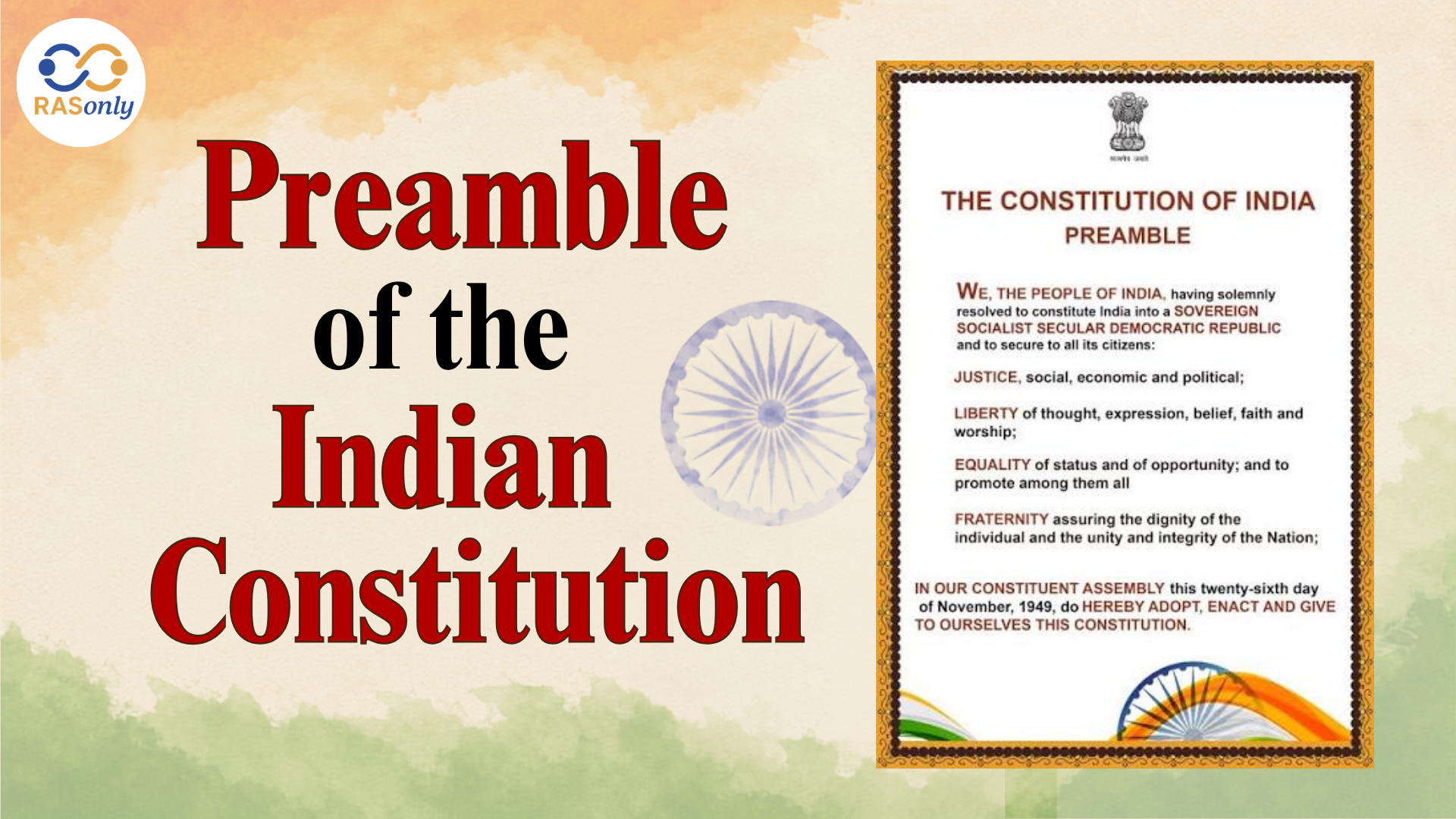
The Preamble of the Constitution of India is a brief introductory statement that states the philosophy, objectives and fundamental values of the Constitution in Indian polity. It starts with “We, the People of India”, signifying that the power of the Constitution originates from us, the people of India. The Preamble announces India as a Sovereign, Socialist, Secular and Democratic Republic and promises Justice, Liberty, Equality and Fraternity for all Indians. It again shows the devotion to the dignity of an individual, unity and integrity of the nation. The Preamble is based on the one that was adopted by the Constituent Assembly together with the Constitution on 26 November 1949, when it became law on 26 January 1950. It was grounded on the principles laid down in the Objectives Resolution, put forward by Jawaharlal Nehru on 13 December 1946 and adopted by the Constituent Assembly on 22 January 1947.
What Is the Preamble of the Indian Constitution?
The Preamble is the statement at the beginning of the Constitution that expresses its basic principles and aspirations. It does not provide a precise outline of government and it does not separately provide personal rights. It does not try to account for all that was going on in the world at that time but seeks to articulate what the framers had in mind with these constitutional provisions.
The Preamble broadly tells us:
- The constitutional power: The people of India
- The nature of the Indian state: Sovereign, Socialist, Secular, Democratic and Republic
- The objectives of the Constitution: Justice, Liberty, Equality and Fraternity
The Historical Journey Behind the Preamble
The Preamble did not emerge in isolation. Its development was closely associated with the constitution-making process in the Constituent Assembly.
The Objectives Resolution of 1946
- Jawaharlal Nehru presented the Objectives Resolution in the Constituent Assembly on 13 December 1946.
- Making India an independent sovereign republic
- Coming into power based on popular mandate
- Providing justice, equality and freedom
- Protecting minorities and disadvantaged groups
- Maintaining the integrity of the country
- Peace and well-being of mankind
Meaning of Sovereign, Socialist, Secular, Democratic and Republic
The five terms that describe the character of the Indian state have a constitutional meaning.
Sovereign
- India is independent and possesses unlimited power over its internal affairs as well as freedom in relations with the rest of the world.
- The Indian state has constitutional control over its territory.
- Legally, India is not a vassal of another nation and is free to handle its foreign relations.
- So, sovereignty means India is independent and free to make decisions.
Socialist
- The expression Socialist was incorporated into the Preamble by the 42nd Constitutional Amendment Act, 1976.
- If only you ask yourself, the socialism of India can be partly that general form based on the constitutional commitment to social and economic justice and the removal of all inequalities.
- The principle is embodied, in particular, in the Directive Principles of State Policy which seek to enhance the welfare of people and bring about a more just distribution of material resources.
- That does not mean that Indian constitutional socialism is about the complete abolition of private property or private economic activity.\
Secular
- The word “Secular” was inserted by the 42nd Constitutional Amendment Act, 1976.
- India does not have a state religion. The Constitution guarantees freedom of conscience and freedom of religion, subject to constitutional restrictions.
- The provisions relating to religious freedom are found in articles 25 to 28.
- Indian secularism is the right to freedom of religion and equality and non-discrimination within the Constitution.
Democratic
The term 'Democratic' represents the principle that the government derives its power from the consent of those governed and their active participation.
India has a representative democratic system where citizens elect their representatives.
The democratic character of India is reflected through:
- Universal adult suffrage
- Regular elections
- Representative government
- Parliamentary democracy
- Rule of law
- Constitutional accountability
Republic
- The word “Republic” implies that India has an elected head of state instead of a hereditary monarch.
- Indirectly, according to the constitutional procedure, the Union President of India is the constitutional head.
- Hence, the republican character of India sets it apart from a monarchy based on hereditary succession.
Aspirations of the People
The Preamble expresses the fundamental objectives and principles that are expected to be guaranteed by the Constitution to each citizen. These aspirations give shape to the functioning of the State and rights & duties of people.
- Justice: The Preamble assures social, economic and political justice to all the citizens. The Fundamental Rights are primarily the foundation of political justice, and the Directive Principles of State Policy, social and economic justice.
- Liberty: It protects the freedom of thought, expression, belief, faith and access to worship. Fundamental Rights broadly safeguard these rights.
- Equality: The Preamble guarantees equality in status and opportunity. While Article 14 and other constitutional provisions lay the ground for equality before law and for equal opportunity, they also permit special measures (special legislation) to uplift certain weaker sections of society.
- Fraternity: It unites the people of India by creating a brotherhood. Fraternity also protects the honour of an individual and the unity and integrity of a nation.
Is the Preamble a Part of the Constitution?
The Supreme Court has elaborated the constitutionality of the Preamble through significant judgments. This ultimately developed from dismissing it as something that lay outside of the Constitution to embracing it as something integral to the constitutional framework.
Berubari Union Case, 1960
- The Preamble was not a Part of the Constitution, as held by the Supreme Court in the Berubari Union case (1960).
- It was said to have been a preambular phrase indicating the intentions of the Constitution-makers.
- It further held that the Court cannot regard the Preamble as a source of substantive powers.
Kesavananda Bharati Case, 1973
- The Supreme Court changed this position in Kesavananda Bharati v. State of Kerala (1973).
- The court ruled that the Preamble is a part of the Constitution.
- It is to be your guide for what the ideals, aims, and philosophy of the Constitution must be.
- This judgment also established the Basic Structure Doctrine.
- Through the Basic Structure Doctrine, Parliament may amend the Constitution as long as the change does not alter or destroy its basic structure in accordance with Article 368.
LIC of India Case, 1995
- The Preamble is also a key instrument to give effect to the values sought to be achieved under the Constitution, as noted in LIC of India v. Consumer Education & Research Centre 1995.
- Yet the Preamble does not by itself generate enforceable rights.
- It can aid in the interpretation of constitutional provisions by courts, but its declarations do not generally carry independent enforceable rights.
Significance of the Preamble
The significance of the Preamble lies in its role in understanding the philosophy, objectives, and Constitutional identity of a country.
- Authority of Source: The words We, the People of India show that the people are the source from which this Constitution derives its authority.
- Defines the Nature of the State: It declares India to be a Sovereign, Socialist, Secular, Democratic Republic.
- Expresses Goals of Constitution: It declares Justice, Liberty, Equality and Fraternity as the Fundamental aims of the Constitution.
- Promotes Social Justice: The focus on social, economic and political justice is a tool for creating an inclusive society.
- Protects Individual Dignity: The dignity of the individual is associated with fraternity; therefore, respect for individuals should be a matter of constitutional concern.
- Reinforces National Integration: The expression “unity and integrity of the Nation” reinforces national integration.
- Constitution as part: The Supreme Court in the Kesavananda Bharati case (1973) held that Preamble is a part of the Constitution.
- Can Be Amended: The Preamble can be amended by Article 368, but the Amendment cannot touch the Basic Structure of the Constitution.
- Key Facts: The Preamble has been amended only a few times, i.e. once by the 42nd Constitutional Amendment Act, 1976 (added "Socialist" and "Secular"; changed "unity of the Nation" to "Unity and integrity of the Nation").
Also Read
| Supreme Court and Judicial Review | Article 42 in the Constitution of India |
| 86th Constitutional Amendment Act | President of India |
| Parliament of India | Indian Polity Notes for RAS |
FAQs
The Preamble is the introductory statement of the Constitution that explains its philosophy, objectives and fundamental values.
The Preamble was adopted by the Constituent Assembly on 26 November 1949.
The Constitution came into force on 26 January 1950.
Jawaharlal Nehru moved the Objectives Resolution on 13 December 1946.
The main objectives are Justice, Liberty, Equality and Fraternity.
BEST SELLER
🏆 PRELIMS
RAS Pass
Prelims focused Hindi & English
₹399
✓
Prelims Topic-Wise Tests
✓
Subject-Wise Tests
✓
Full-Length Prelims Tests
✓
Daily Current Affairs Tests
✓
Prelims PYQs Tests
✓
Detailed Solutions & Analysis
✓
All Rajasthan Ranking
✓
Unlimited Reattempts
✓
Mains Tests
✓
Hindi & English Tests
✓
All Rajasthan Ranking
Trusted by 5,000+ Students
Post Category
- RAS Salary
- Result
- RAS Admit Card
- RAS Job
- RAS Cutoff
- Preparation Tips
- RAS Answer Key
- RAS Exam Analysis
- RAS Syllabus
- RAS Previous Year Papers
- RPSC RAS Exam Pattern
- RAS Interview
- RAS Exam Date
- RAS Vacancy
- RAS Test Series
- RAS Best Books
- RAS Preparation Resources
- RAS Coaching Centre
- History
- Polity
- Geography
- Economics
- Science
- Art and Culture
- RPSC RAS Application Form
- RPSC RAS Notification
- RAS Eligibility Criteria
- UPSC Exam
- RPSC RAS Mains
Visit Our RASonly Offline Center
Our Expert Faculty

Bhunesh Sir
Current Affairs · 13+ Yrs

Aamir Khan Sir
RAS-2017 · IIM Ahm.

Akash Sir
Polity · 8+ Yrs
Free Resources
Official Mobile App

RASOnly App
by OTSAdda · Free
Full Video Lectures
Mock Tests & PYQs
Daily Current Affairs
AI Mock Interview
Free Download · No subscription needed to install
RAS 2024 Toppers — RASonly
Rank 2
Virendra Charan
Rank 9
Bhoopinder Singh
Rank 26
Aanchal Nagpal
Rank 33
Lokendra Singh
Rank 45
Amar Rathore
Rank 46
Manasvini Verma

Join RASonly WhatsApp Community
Get daily current affairs, exam alerts, free study material and tips from expert faculty — right on WhatsApp.
Join for Free →RASonly Interview Guidance Program

Mr. Ashok Jain
Ex-Chief Secretary Govt of Rajasthan
- IAS officer of the 1981 batch, Rajasthan cadre.
- Passionate about mentoring the next generation of RAS officers with real-world insights.
- Got retired in Dec 2017 from the post of Chief Secretary of the state of Rajasthan.

Mr. Guru Charan Rai
Ex-ASP / SP in Jaisalmer
- Guru Charan Rai, IPS (Retd), retired as Inspector General of Police (Security), Rajasthan, Jaipur in 2017.
- Served as ASP and SP in Jaisalmer, Nagaur, Sri Ganganagar, Sawai Madhopur, Dausa, Sikar, and Karauli.
- He also held key positions as DIGP and IGP in the Law and Order division.

Mr. Rakesh Verma
Ex-IAS Officer, B.Tech, MBA, and M.A. (Economics)
- IAS officer of the 1981 batch and retired in Chief Secretary Rank.
- Civil servant of high repute and vast experience.
- Has been teaching UPSC CSE subjects for the last six years.
Related Post



Daily Current Affairs for RAS Exam Preparation 2026

Financial Approval Granted for the Development of Religious Sites
October 05, 2026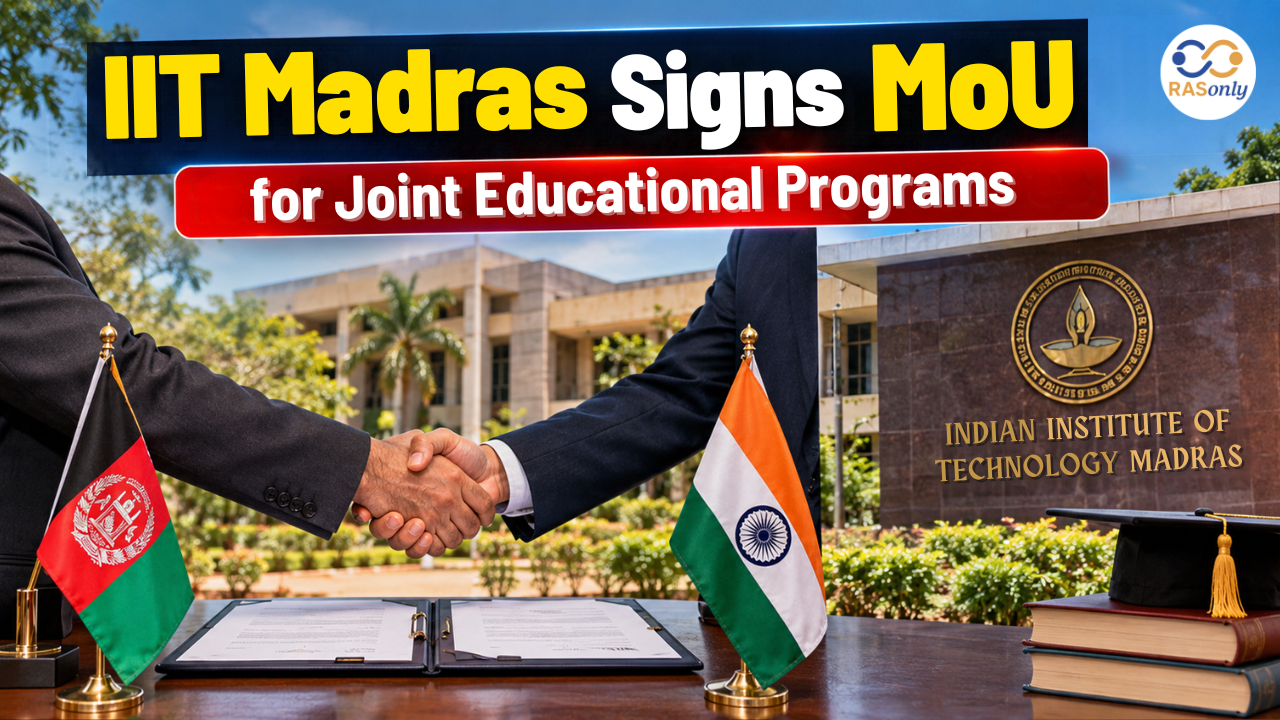
IIT Madras Signs MoU for Joint Educational Programmes
October 05, 2026
Niharika Rathore Wins MIS Global India Title
October 03, 2026